
TITLE: ABOVE & BEYOND
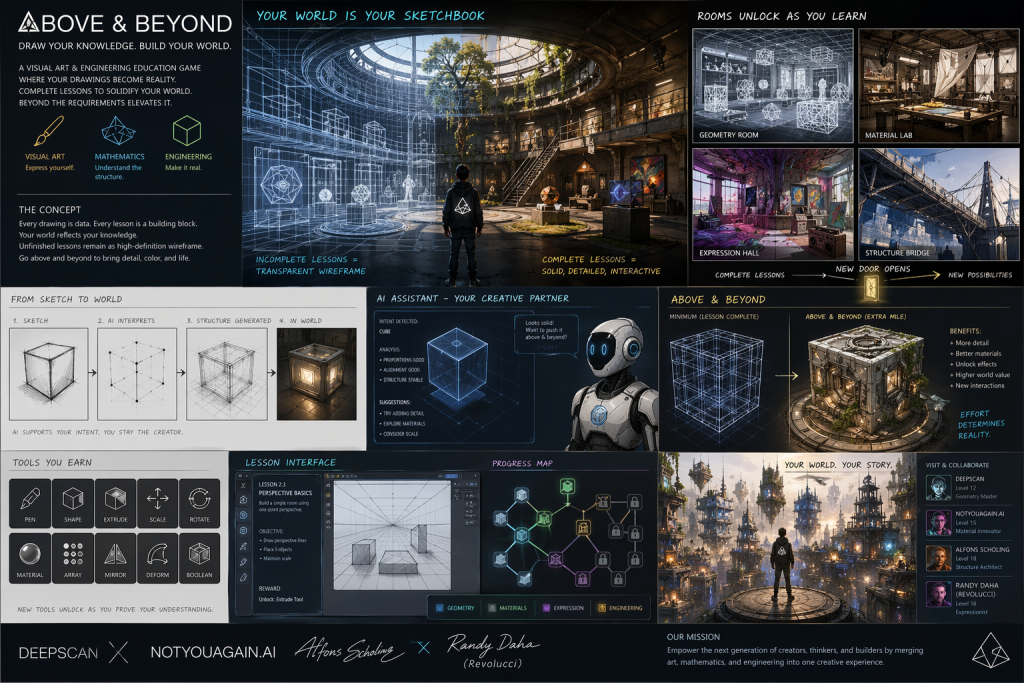
FRANCHISE BIBLE
(Working Title: Deepscan Learning World System)
1. CORE PREMISE
Above & Beyond is a hybrid educational game engine, AI art system, and spatial learning environment where players construct explorable 3D worlds through their own drawings.
Every drawing is not content—it is world-building logic.
- Learn → Draw → Interpret → Build → Explore
- Knowledge becomes architecture
- Skill becomes spatial complexity
- Incomplete understanding becomes visible geometry (wireframe states)
The system is continuously interpreted by an AI engine that transforms student output into evolving 3D environments.
2. CORE DESIGN PHILOSOPHY
2.1 “Learning = Construction”
Knowledge is not represented—it is physically instantiated in a world space.
2.2 “Fidelity reflects mastery”
- High mastery → fully rendered geometry
- Partial mastery → semi-textured or unstable forms
- Missing knowledge → wireframe / ghost structures
2.3 “Player authorship is absolute”
The AI never replaces creation; it only translates it.
3. CORE SYSTEM ARCHITECTURE
3.1 Input Layer (Human)
- Hand drawings (2D)
- Sketches (digital or scanned)
- Geometry construction tasks
- Problem-solving outputs
3.2 AI Interpretation Layer
Built under the framework vision of NotYouAgain.ai
Functions:
- Shape recognition → vectorization → mesh generation
- Intent classification (art / math / engineering)
- Structural feasibility analysis
- Style preservation (user identity consistency)
3.3 Transformation Engine
- Converts learning outputs into:
- 3D geometry
- Physics rules
- Material properties
- Interactive objects
4. EDUCATIONAL FRAMEWORK
The system is structured into three parallel learning tracks:
4.1 Visual & Artistic Intelligence
Influenced by experimental visual systems such as Randy Daha
Focus:
- Form abstraction
- Perspective logic
- Composition systems
- Visual language development
4.2 Mathematical Structure Layer
Core computational literacy:
- Geometry (2D → 3D transformation)
- Vectors and coordinate systems
- Symmetry and pattern logic
- Transform matrices (rotation, scale, projection)
Mathematics is not taught as symbols, but as world behavior rules.
4.3 Engineering & Material Logic
Inspired by applied systems thinking associated with institutions like TU Delft
Focus:
- Structural stability
- Material simulation (weight, stress, tension)
- Constructive logic
- Spatial feasibility
5. CORE GAMEPLAY LOOP
- Receive lesson task (visual / math / engineering)
- User creates drawing or structure
- AI interprets intent + geometry
- World object is generated
- Player explores resulting environment
- System evaluates completeness
- New tools + rooms unlock
6. WORLD SYSTEM
6.1 Spatial Core: “Origin Room”
Starting environment:
- Empty coordinate grid
- Visible axes
- Minimal geometry scaffolding
6.2 Room Generation System
Rooms are unlocked through learning clusters:
- Geometry Room
- Material Physics Lab
- Abstract Visualization Hall
- Structural Engineering Space
- Hybrid Cognitive Chambers
Each room is a compiled state of knowledge.
6.3 “Door Logic”
Doors are not static objects—they are:
- Aggregated student outputs
- Composite geometry gates
- Knowledge thresholds
7. VISUAL SYSTEM
7.1 Dual-State Rendering
Completed Knowledge
- Fully textured
- Physically lit
- Interactive
Incomplete Knowledge
- Transparent wireframe
- Grid-visible
- Floating structural hints
- “Unresolved geometry”
This defines the signature aesthetic:
Reality is a function of understanding
7.2 “Above & Beyond Mode”
Special state when mastery exceeds expectations:
- Enhanced polygon density
- Animated physical behavior
- Procedural material refinement
- Environmental reaction systems
8. AI TOOL SYSTEM
8.1 Drawing Interpreter
- Converts sketches → 3D meshes
- Preserves user style
- Detects structural intent
8.2 Feedback Engine
Non-invasive educational system:
- “This structure lacks support at X axis”
- “Perspective inconsistency detected”
- “Mass distribution unstable”
8.3 Tool Unlock System
Tools are earned:
- Deformation brush
- Grid snap system
- Physics preview mode
- Material simulator
- Procedural generator
9. PROGRESSION SYSTEM
Player progression is not XP—it is spatial intelligence expansion.
Metrics:
- Structural accuracy
- Complexity of constructs
- Mathematical precision
- Creative deviation
Unlocking:
- New tools
- New spatial dimensions
- New rooms
- AI assistance levels
10. MULTIPLAYER / SHARED WORLDS (OPTIONAL LAYER)
- Collaborative architecture building
- Shared knowledge rooms
- Comparative world evolution
- “Learning city” environments
Players can observe:
how other minds construct reality
11. EXPANSION MEDIA STRATEGY
11.1 Game Platform
Core interactive learning engine
11.2 Educational Licensing
- Schools
- Universities
- Engineering academies
11.3 Creative Studio Ecosystem
Under frameworks like NotYouAgain.ai
Extensions:
- VR experience layer
- AR sketch overlays
- Physical modeling kits (hybrid learning)
12. ART DIRECTION
- Minimalist technical aesthetic
- Low-poly + wireframe hybrid
- Blueprint-inspired UI language
- Animated geometry overlays
- Real-time construction visualization
Tone:
Clinical clarity + creative freedom tension
13. TECHNOLOGICAL STACK (CONCEPTUAL)
- AI vision model (sketch interpretation)
- 3D engine (procedural geometry generation)
- Physics simulation layer
- Real-time mesh compiler
- Educational rule engine
14. BRAND IDENTITY
Core idea:
“You don’t learn inside the system. You build the system through learning.”
Keywords:
- Spatial intelligence
- Constructive education
- AI-mediated creativity
- Living architecture of knowledge
15. LONG-TERM VISION
The franchise evolves into:
- A global visual literacy standard
- A new form of STEM education interface
- A creative engine where learning permanently becomes world-building
Ultimate goal:
Replace static education models with explorable cognitive environments
If you want, the next step would be to convert this into a pitch deck (10–12 slides) or a vertical slice prototype design (first playable room + 3 lessons + AI loop specification) so it becomes production-usable instead of conceptual.