
FRANCHISE BIBLE — FULL PRODUCTION OUTLINE // Title: The Cool Neighbor
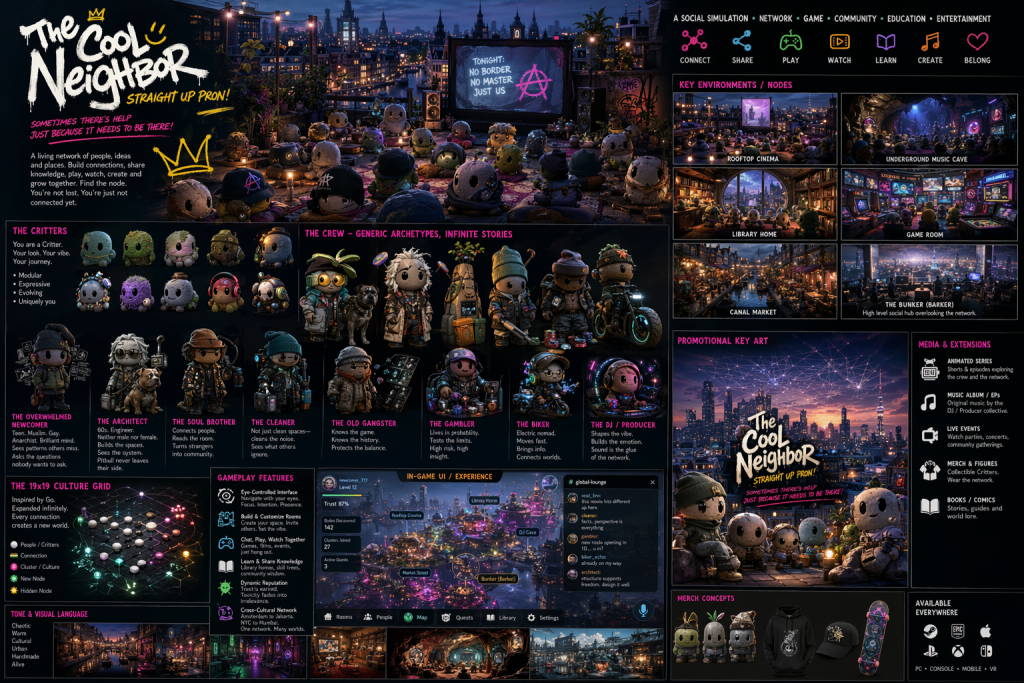
Subtitle: Straight Up Pron!
Alt Title: Sometimes There’s Help Just Because It Needs to Be There
1. CORE DEFINITION
A network-based social simulation franchise where players inhabit a living, expanding system of interconnected spaces.
It operates as:
- A game
- A social network
- A narrative engine
- An educational environment
The experience is chaotic, humorous, and human, but structurally precise.
2. CORE MECHANIC: THE CULTURE GRID
2.1 Structure
- Base: 19×19 grid (inspired by Go)
- Expansion: infinite through user interaction
- Each node = a room
2.2 Node Types
- Library Rooms (knowledge exchange)
- Game Rooms (interactive play)
- Cinema Nodes (shared viewing)
- Social Nodes (free interaction)
- Hidden Nodes (unlocked through behavior)
2.3 Growth Logic
- Nodes expand when:
- Trust increases
- Useful interaction occurs
- Diverse archetypes engage
- Nodes decay when:
- Repetition dominates
- Toxicity increases
- No new input is added
3. PLAYER FORM: CRITTER SYSTEM
3.1 Design
- Chibi, stone-like entities
- Modular attachments = traits, behaviors, learned skills
3.2 Function
- Critters are not identities—they are interfaces
- They evolve based on:
- Interaction style
- Contribution quality
- Network influence
4. INPUT SYSTEM
4.1 Eye-Control Interface
- Navigation via gaze
- Selection via focus duration
- Reduces impulsive behavior
- Encourages intentional interaction
4.2 Passive Intelligence Layer
System tracks:
- Behavioral patterns
- Contribution value
- Trust relationships
Adjusts:
- Visibility
- Reach
- Node influence
No visible ranking—only systemic response.
5. CHARACTER SYSTEM (INTEGRATED ARCHETYPES)
All archetypes exist simultaneously across:
- Game interactions
- Narrative media
- Environmental design
5.1 The Overwhelmed Newcomer
- Teenage, Muslim, gay, anarchist
- Highly intelligent, critical thinker
System Function:
- Detects inconsistencies
- Reveals hidden connections
- Unlocks complex nodes early
Narrative Role:
- Entry perspective
- Moves between clusters rapidly
5.2 The Architect
- 60s, engineer, androgynous
- Accompanied by a pitbull
System Function:
- Builds and stabilizes nodes
- Alters environmental structure
Presence:
- Rare, high-impact appearances
- Leaves permanent changes
5.3 The Soul Brother
Function:
- Social cohesion
- Emotional calibration
Effect:
- Increases trust density
- Activates dormant nodes
5.4 The Cleaner
Function:
- Maintenance and optimization
Effect:
- Repairs broken nodes
- Removes informational noise
5.5 The Old Gangster
Function:
- Power awareness
Effect:
- Identifies manipulation
- Breaks false authority loops
5.6 The Gambler
Function:
- Risk modeling
Effect:
- Tests system limits
- Reveals hidden mechanics
5.7 The Biker (Electric Nomad)
Function:
- Mobility across the network
Effect:
- Connects distant clusters
- Transfers knowledge between zones
5.8 The DJ / Producer
Function:
- Emotional environment design
Effect:
- Changes interaction tone
- Influences engagement levels
6. ENVIRONMENTAL SYSTEM
6.1 World Composition
Hybrid of:
- Amsterdam canals
- New York rooftops
- Asian megacity alleys
- Jungle edges
- Abstract caves
6.2 Spatial Evolution
Spaces evolve based on:
- Who uses them
- How they’re used
- What is exchanged
6.3 Key Locations
Library Homes
- Personal and shared knowledge hubs
- Modular interiors
Game Rooms
- Cooperative mini-games
- Skill-building environments
Cinema Nodes
- Scheduled shared viewing
- Synchronized audience presence
The Bunker (“Barker”)
- High-trust, high-density network space
- Represents accumulated social capital
7. SOCIAL DYNAMICS
7.1 Cool Spots
- High interaction diversity
- Balanced archetype presence
- Continuous evolution
7.2 Dead Zones
- Repetitive interaction
- Single-archetype dominance
- Low trust
7.3 Network Behavior
- Players form webs (connections)
- Webs create clusters
- Clusters become cultures
8. SAFETY & INTELLIGENCE SYSTEM
8.1 Anti-Toxic Mechanisms
- Reduced visibility for harmful patterns
- Context-based filtering
- Collective correction through interaction
8.2 Misinformation Control
- Cross-node verification
- Pattern inconsistency detection
- Emergent correction, not top-down moderation
9. NARRATIVE ENGINE
9.1 Structure
- Non-linear
- Emergent storytelling
9.2 Story Drivers
- Player interaction
- Archetype collisions
- Environmental changes
9.3 Tone
- Chaotic
- Humorous
- Insightful
- Occasionally confrontational
10. MEDIA EXTENSIONS
10.1 Core Game
- Persistent online platform
- Continuous expansion
10.2 Animated Shorts
- Character-driven
- Episodic chaos
10.3 Live Network Events
- Cinema node screenings
- Interactive sessions
10.4 Social Media Integration
- Real-time extensions of nodes
- Community-driven storytelling
11. CULTURAL SCALABILITY
System adapts to:
- Amsterdam
- New York
- India
- Indonesia
- East Asia
Through:
- Behavioral patterns
- Interaction styles
- Spatial reinterpretation
12. MONETIZATION
- Cosmetic Critter upgrades
- Environment customization
- Patronage system
No:
- Pay-to-win
- Status gating
13. CORE STATEMENT
This franchise builds:
A living network where people who lack structure can find it—
not through authority, but through connection.
14. TAGLINES
- “Find the node.”
- “Somewhere, someone knows.”
- “You’re not lost. You’re just not connected yet.”
CONCEPT ART & PROMOTIONAL VISUAL DIRECTION
The Cool Neighbor
1. VISUAL IDENTITY CORE
Art Philosophy
- “Soft chaos with structural intelligence”
- Everything feels:
- Slightly improvised
- Socially alive
- Systemically intentional
Style Blend
- Chibi abstraction (approachable, universal)
- Material realism (stone, moss, ceramic textures)
- Urban hybridity (global city layering)
- UI as environment (interfaces exist in-world)
2. CRITTER DESIGN SYSTEM (KEY ART DRIVER)
Base Form
- Rounded, stackable, slightly asymmetrical
- Size variance = influence, not power
- No sharp edges → psychological safety
Material Variants
Each critter looks like it’s “grown” from a culture:
- Polished marble (structured thinkers)
- Moss-covered stone (connectors, social types)
- Cracked ceramic (experimental / risk-takers)
- Metallic sheen (system builders)
- Glowing seams (high network activity)
Modular Add-ons
Used heavily in promotional visuals:
- Floating symbols (ideas, beliefs)
- Small environmental fragments (books, cables, speakers)
- Light halos or distortions (influence fields)
Expression System
- Minimal faces (dots, slits, subtle shifts)
- Emotion expressed via:
- tilt
- spacing
- glow intensity
3. ENVIRONMENT ART DIRECTION
Core Principle
Every space = social behavior visualized
Primary Environments for Promotion
A. Rooftop Cinema Node
- Amsterdam canal rooftops + NYC skyline hybrid
- Floating projection screens
- Critters sitting in clusters, not rows
- Ambient lighting reacting to conversation
Promo Use:
- Posters, key art, trailers
B. Underground Music Cave
- Organic carved chamber
- Subwoofers embedded in stone
- Light pulses synced to DJ activity
Promo Use:
- Music tie-ins, social media clips
C. Library Homes
- Cozy interiors floating in void/grid
- Books = glowing data fragments
- Personal + communal overlap
Promo Use:
- Educational positioning, calmer marketing beats
D. The Bunker (“Barker”)
- Brutalist, high-altitude or underground hybrid
- Overlooks entire glowing network grid
- Sparse, powerful, almost sacred
Promo Use:
- Prestige visuals, endgame content
E. Transit Flow (Biker Routes)
- Electric trails across floating nodes
- Neon lines connecting cultures
- Motion blur, speed emphasis
Promo Use:
- Trailers, kinetic ads
4. CHARACTER KEY ART (HERO SHOTS)
Each archetype gets cinematic framing + system context:
The Overwhelmed Newcomer
- Standing slightly apart from clusters
- Grid lines visible beneath their feet
- Seeing connections others don’t (highlighted lines)
The Architect
- Mid-construction of a node
- Pitbull calmly seated
- Geometry forming in air
The Soul Brother
- Surrounded by multiple critters
- Subtle light linking everyone
- Warm tones, fluid composition
The Cleaner
- Quiet corner of a node
- Removing visual “noise” (floating fragments dissolving)
- Precision lighting, minimalism
The Old Gangster
- In shadow, observing
- Overlapping conversations visualized as layers
- Calm dominance without aggression
The Gambler
- Multiple outcomes branching visually
- Dice-like fragments, probability lines
- Slight instability in composition
The Biker
- Motion streak cutting across nodes
- Electric arcs connecting environments
The DJ / Producer
- Center of rhythmic distortion
- Sound visualized as spatial waves
5. PROMOTIONAL ASSET SYSTEM
5.1 Master Key Art (Franchise Poster)
Composition:
- Central grid expanding outward
- Multiple environments embedded
- Archetypes placed in motion, not posing
Tone:
- Controlled chaos
- Warm + neon contrast
5.2 Modular Campaign Visuals
Each focuses on one concept:
- “Find the Node” → isolated critter discovering connection
- “You’re Not Alone” → cluster formation
- “Systems Shape Behavior” → Architect scene
- “Vibe Changes Everything” → DJ scene
5.3 Social Media Visual Language
- Short looping animations:
- Nodes forming
- Critters reacting
- Connections lighting up
- Format:
- Vertical-first (mobile-native)
- High contrast, readable instantly
5.4 Motion Graphics Direction
- Smooth, organic transitions
- No hard cuts—everything flows
- UI elements emerge from environment
5.5 Typography
- Clean, geometric sans-serif
- Slightly rounded edges (matches critters)
- Occasional glitch/distortion for chaos tone
6. UI / UX VISUAL INTEGRATION
UI is not separate—it is:
- Floating
- Embedded
- Reactive
Examples:
- Node connections appear as light threads
- Menus emerge from critter interaction
- Data visualizations feel tactile
7. COLOR SYSTEM
Base Palette
- Warm neutrals (stone, sand, clay)
- Deep urban tones (charcoal, asphalt)
Accent Colors
- Electric blue (connection)
- Neon green (growth)
- Magenta (social intensity)
- Amber (knowledge)
Behavioral Color Logic
- Trust = warmer tones
- Chaos = high contrast
- Dead zones = desaturated
8. TRAILER VISUAL STRUCTURE
Sequence Flow
- Empty grid
- Single critter appears
- First connection forms
- Rapid expansion
- Archetypes introduced
- Chaos montage
- Calm moment (library or rooftop)
- Final wide shot: living network
9. MERCHANDISING VISUAL STRATEGY
- Physical critter figures (modular)
- Posters with evolving grid patterns
- Apparel with subtle node connections (not loud branding)
10. BRAND CONSISTENCY RULES
- No static posing → everything implies interaction
- No isolated characters → always contextualized
- No clean perfection → slight imperfection = humanity
- Always show connection or potential for connection
11. PRODUCTION PIPELINE (ART TEAM READY)
- Concept sketches (fast, volume-driven)
- Material exploration (texture-first approach)
- Environment blockouts
- Lighting studies
- Key art polish
- Motion adaptation
- Marketing asset breakdown
12. CORE VISUAL STATEMENT
This world is not designed to look perfect.
It is designed to look alive, evolving, and connected.
If you want the next step, I can generate:
- Specific shot lists for trailers
- Exact MidJourney / generative prompts for concept art production
- UI wireframes mapped to this visual system
That’s where this turns from direction into actual asset generation.