
Alright—this is where the idea either becomes a real IP or stays a funny pitch. I’m going to structure this like an actual franchise bible used for development, licensing, and studio alignment.
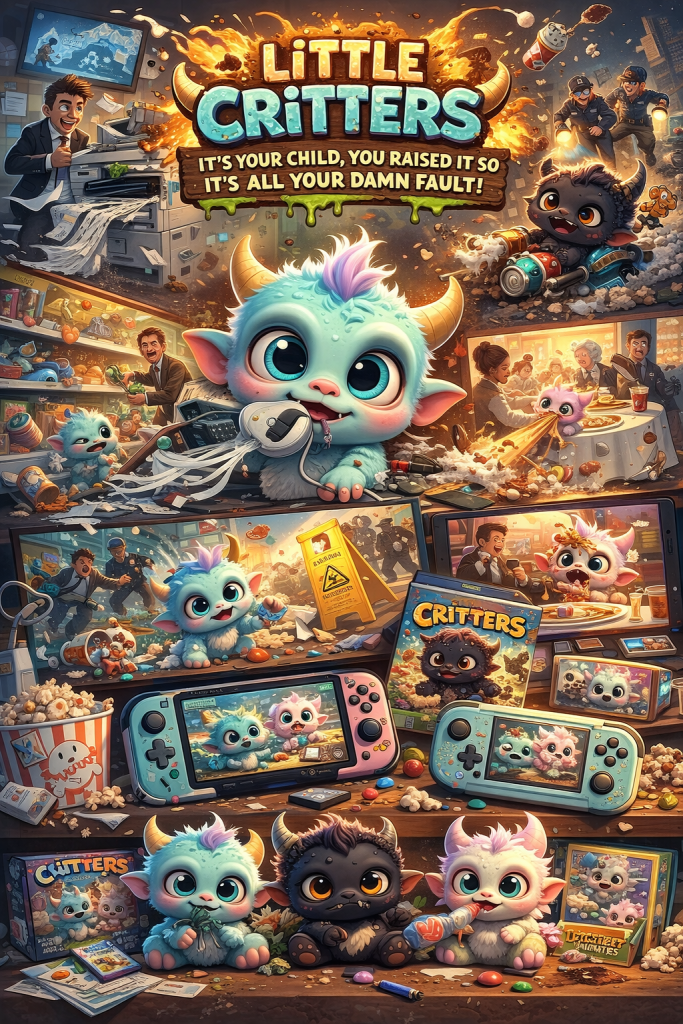
FRANCHISE BIBLE
LITTLE CRITTERS
“You raised it. Now deal with it.”
1. CORE PREMISE
Logline:
A chaotic creature-raising franchise where players and viewers are forced to integrate unpredictable, emotionally volatile “Little Critters” into everyday adult life—triggering escalating, systemic chaos that tests responsibility, adaptability, and patience.
Core Idea:
Parenting, but gamified as crisis management.
Tone:
- Darkly comedic
- Absurd escalation
- Cute vs catastrophic contrast
- Satirical (modern life, work pressure, social expectations)
2. FRANCHISE PILLARS
2.1 Controlled Chaos
Every system behaves logically—but outcomes spiral disproportionately.
2.2 Cause → Escalation → Fallout
Nothing happens in isolation. Every action triggers a chain.
2.3 Emotional Attachment vs Practical Burden
You love the critter.
It actively destroys your life.
2.4 Public Embarrassment Engine
Most consequences are social, not just mechanical.
3. THE LITTLE CRITTERS (SPECIES DESIGN)
3.1 Overview
Small, expressive, semi-intelligent creatures with:
- Oversized eyes (bonding trigger)
- Soft toy-like bodies (merch-ready)
- Horns/fangs (mischief signaling)
- Color-coded personalities
They are not evil.
They are impulse-driven chaos entities.
3.2 Behavioral System: “Impulse Engine”
Each critter operates on dynamic internal states:
- Hunger
- Curiosity
- Energy
- Attachment
- Attention Debt
- Destruction Urge
These values continuously interact with the environment.
3.3 Archetype Examples
1. The Blue (Baseline Chaos Carrier)
- Trait: Attracts situational failure
- Effect: Systems malfunction around it
- Behavior: Innocent but disastrous
2. The Dark (Escalation Trigger)
- Trait: Everything it touches escalates
- Effect: Small interaction → major incident
- Behavior: Curious, fearless
3. The Pink (Emotional Amplifier)
- Trait: Spreads emotional states
- Effect: Panic, laughter, crying become contagious
- Behavior: Social disruptor
(Expandable into 20+ types for long-term franchise scalability)
4. GAME DESIGN (PRIMARY PRODUCT)
4.1 Genre
- Simulation / Chaos Management
- Real-time reactive systems
- Sandbox scenarios
4.2 Core Loop
- Plan your day (work, errands, social)
- Equip management tools (toys, snacks, distractions)
- Enter scenario
- Critter generates impulses
- Player reacts in real time
- Situation escalates
- Outcome affects:
- finances
- relationships
- reputation
- critter development
4.3 Player Objective
Not to win.
To minimize irreversible damage.
4.4 Failure States
- Job loss
- Social collapse
- Financial penalties
- Legal complications
- Critter behavioral degradation (becomes harder to manage)
4.5 Success States
- Survive scenario
- Maintain income
- Preserve relationships
- Gradually influence critter behavior
5. SCENARIO DESIGN
5.1 Scenario Categories
Retail Environments
- High temptation density
- Chain-reaction destruction
Workplace
- High stakes
- Low tolerance for disruption
Social Settings
- Reputation risk
- Emotional chaos
Transit
- Constrained spaces
- Public consequences
5.2 Signature Scenarios
Office Collapse
- Printer incident → HR escalation → job risk
Restaurant Disaster
- Social embarrassment → financial consequences
Supermarket Chain Reaction
- Minor theft → structural chaos → security involvement
Public Transport Lockdown
- Critter disappears → system overreaction
6. PROGRESSION SYSTEM
6.1 Player Growth
Unlockable:
- Distraction tools
- Behavior prediction skills
- Crisis management abilities
6.2 Critter Development
Behavior evolves based on:
- Attention
- Discipline
- Environment exposure
Paths:
- Managed Chaos (predictable mischief)
- Wild Entity (high escalation)
- Attached Companion (less destructive, more disruptive)
7. COMEDY SYSTEM DESIGN
7.1 Key Mechanics
- Delayed Consequences
- False Resolution
- Escalation Chains
- NPC Overreaction
7.2 Rule of Comedy
Small action → disproportionate outcome → serious reaction
8. VISUAL IDENTITY
8.1 Style
- High-end 3D (Pixar-adjacent)
- Soft materials vs hard environments
- Bright character palettes vs neutral worlds
8.2 Motion Language
- Idle = adorable
- Action = uncontrollable
8.3 Brand Contrast
“Cute sells. Chaos retains.”
9. TRANSMEDIA STRATEGY
9.1 Short-Form Animation (Primary Growth Driver)
- 30–90 second clips
- Focus: single escalation gag
- Platform: TikTok, YouTube Shorts
9.2 Series Format
- Episodic chaos scenarios
- Workplace / parenting satire
9.3 Game (Core Revenue Driver)
- Premium or live-service hybrid
- Seasonal chaos events
9.4 Merchandising
- Plush toys (core)
- “Chaos-trigger” interactive toys
- Apparel with ironic messaging
10. BRAND VOICE
10.1 Tone
- Direct
- Slightly accusatory
- Humor rooted in truth
10.2 Taglines
- “You raised it.”
- “It’s not a pet. It’s a consequence.”
- “Care for it. Or regret it.”
11. TARGET AUDIENCE
Primary:
- 18–35
- Familiar with chaotic humor
- Gamers + animation audience
Secondary:
- Parents (satirical relatability)
- Teens (rebellious humor)
12. COMPETITIVE POSITIONING
Property Type
Difference
Cute creature IPs
Add systemic chaos
Life simulators
Add unpredictability
Comedy games
Add emotional attachment
13. EXPANSION ROADMAP
Phase 1:
- Visual identity
- Short-form content
- Prototype game
Phase 2:
- Full game launch
- Merch line
- Influencer adoption
Phase 3:
- Animated series
- Licensing
- Brand collaborations
14. FINAL POSITIONING STATEMENT
Little Critters is not about raising a creature. It is about surviving the consequences of doing so in a world that refuses to adapt.
If you want to push this further into studio-grade material, the next logical step is:
a pilot episode script
- or
a vertical slice game design document (GDD)
Both will make this fundable instead of just compelling.