
FRANCHISE CONCEPT OUTLINE BIBLE Main Title: Yeah, But That’s Not Cool Subtitle: You Made Your Choice — Now You Work With It Alternative Title: You Said You Knew Best
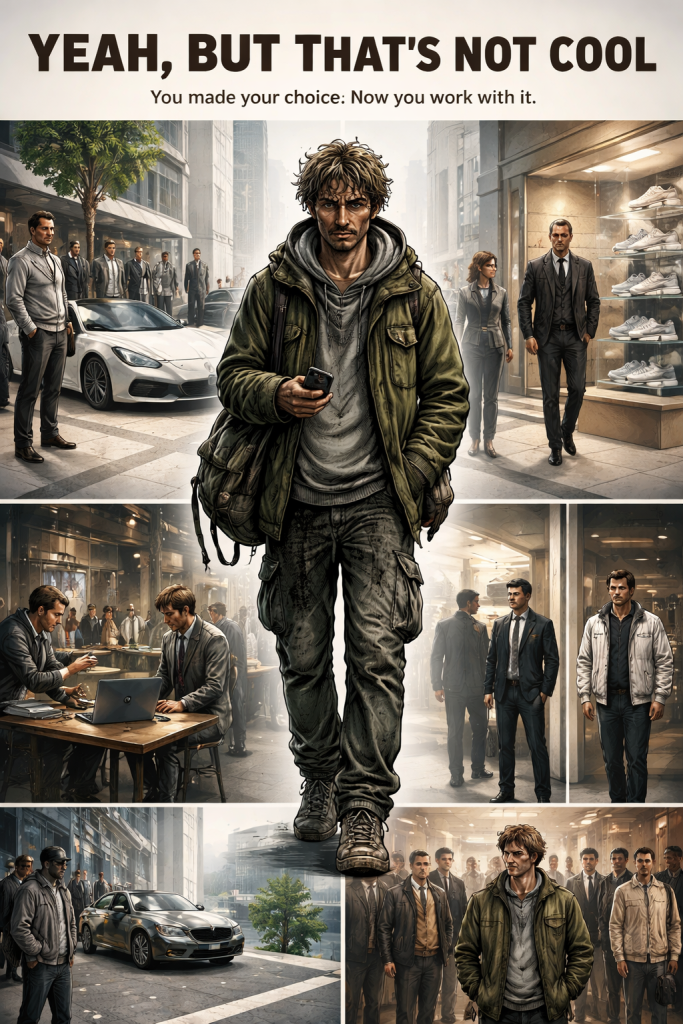
1. Core Premise
A protagonist lives in a hyper-curated luxury society where everything “cool” is socially contaminated. Every object — cars, shoes, tech, jackets, architecture, music — has been culturally claimed by status tribes that weaponize aesthetics for identity signaling.
Nothing is neutral anymore.
The protagonist refuses to participate.
So while everyone else performs coolness, he lives in deliberate uncoolness — not as rebellion, but as survival. He refuses to wear what they wear, drive what they drive, use what they use, or speak how they speak, because the culture surrounding those things is rotten.
This makes him appear strange, off-brand, and socially incompatible — but also one of the only authentic people left.
The world calls him uncool.
The audience realizes he’s the only one who actually is.
2. The World
Luxury Madness Society
The setting is a near-present hyper-European metropolis where:
- Everything is premium
- Everything is curated
- Everything is performative
- Everything is socially coded
- Nothing is genuine
People don’t choose things because they like them.
They choose things because:
- It signals tribe membership
- It signals ideological alignment
- It signals economic class
- It signals dominance
- It signals belonging
Coolness is no longer aesthetic.
Coolness is social obedience.
Cultural Contamination
Every desirable object has been socially captured:
- Cars owned by arrogant status elites
- Shoes associated with aggressive tribal identity
- Tech brands linked to ideological echo chambers
- Fashion tied to exclusionary social cliques
- Architecture signaling wealth segregation
- Music used as cultural gatekeeping
The protagonist keeps encountering:
“Yeah, that’s cool… but the people using it ruin it.”
This becomes the franchise’s central motif.
3. The Protagonist
The Uncool One
He looks slightly off.
Not poor.
Not rich.
Not trendy.
Not outdated.
Just… wrong.
His clothes don’t match cultural expectations.
His gear is mismatched.
His vehicle is unusual.
His tech is patched together.
His lifestyle is inconsistent.
He’s not anti-cool.
He’s anti-contaminated.
He doesn’t reject style.
He rejects the social garbage attached to it.
Character Traits
- Observant
- Quietly confrontational
- Emotionally grounded
- Socially alienated
- Morally stubborn
- Resistant to peer pressure
- Visually unconventional
- Not performative
- Doesn’t seek approval
- Doesn’t explain himself
He simply refuses.
And keeps refusing.
4. Tone & Genre
Genre mix:
- Social satire
- Psychological drama
- Slow-burn rebellion
- Urban surrealism
- Anti-fashion dystopia
- Philosophical indie narrative
Tone:
Dry.
Observational.
Uncomfortable.
Funny in a painful way.
Sharp but quiet.
No explosions.
The conflict is social pressure.
5. Core Theme
The franchise asks:
What happens when everything cool becomes socially toxic?
And:
Is authenticity worth social isolation?
And:
If every tribe is corrupted… is refusing all tribes the only freedom?
6. Recurring Situations
The Car Situation
He sees a beautiful car.
Someone says:
“That’s cool.”
Then he sees the driver.
He immediately loses interest.
He walks away.
The Shoe Situation
Everyone is wearing a specific brand.
He refuses.
Now he’s “uncool”.
But he won’t participate.
The Tech Situation
A device is perfect.
But everyone using it behaves horribly.
He refuses to buy it.
He uses something strange instead.
The Jacket Situation
A jacket is stylish.
But it’s become a social uniform.
He refuses.
He wears something odd.
This pattern repeats across the entire franchise.
7. Visual Identity
World aesthetic:
- Polished minimalism
- High-end European design
- Quiet wealth environments
- Architectural perfection
- Clean branding everywhere
- Uniform-looking people
Protagonist aesthetic:
- Mismatched textures
- Handmade elements
- Off-brand pieces
- Mixed eras
- Improvised repairs
- Functional over stylish
He visually breaks the world.
8. Supporting Characters
The Cool Enforcers
People who police taste.
They don’t threaten him.
They just judge him.
Constantly.
The Quiet Observers
People who secretly agree with him.
But they don’t dare live like him.
They stay silent.
The Brand Loyalists
People fully absorbed into identity consumption.
They are hostile toward deviation.
The Copycats
Later in the story, some begin copying his uncoolness.
Ironically turning uncool into cool.
Which annoys him.
9. Narrative Structure
Part 1 — The Isolation
He refuses everything.
People distance themselves.
He becomes visibly outside society.
Part 2 — The Pressure
Friends push him to conform.
Employers question him.
Strangers mock him.
He refuses.
Part 3 — The Cracks
Others begin noticing the artificiality.
They start doubting the cool system.
Part 4 — The Contamination Collapse
Coolness collapses.
Everything becomes parody.
Nobody knows what’s authentic anymore.
Part 5 — The Twist
The protagonist becomes unintentionally cool.
He hates it.
10. Tagline Options
- “Everything cool is ruined.”
- “You made your choice.”
- “Now you live with it.”
- “Cool isn’t cool anymore.”
- “I refuse to belong.”
- “Authenticity looks strange.”
- “Yeah… but that’s not cool.”
11. Franchise Media Possibilities
Video Game
Narrative exploration of social spaces and choices
Film
Slow-burn social satire drama
Graphic Novel
Observational vignettes
Series
Episode-per-object structure
Art Book
Anti-fashion philosophy
Installation Exhibition
“Contaminated Cool” gallery
12. The Core Philosophy
The world isn’t fake.
The world is over-curated.
The protagonist isn’t rebelling.
He’s refusing contamination.
He doesn’t want to be unique.
He just wants things to be genuine.
But in a world where everything is socially weaponized…
Genuine looks strange.
And strange becomes the last form of freedom.