
ARMAGEDDON NOW
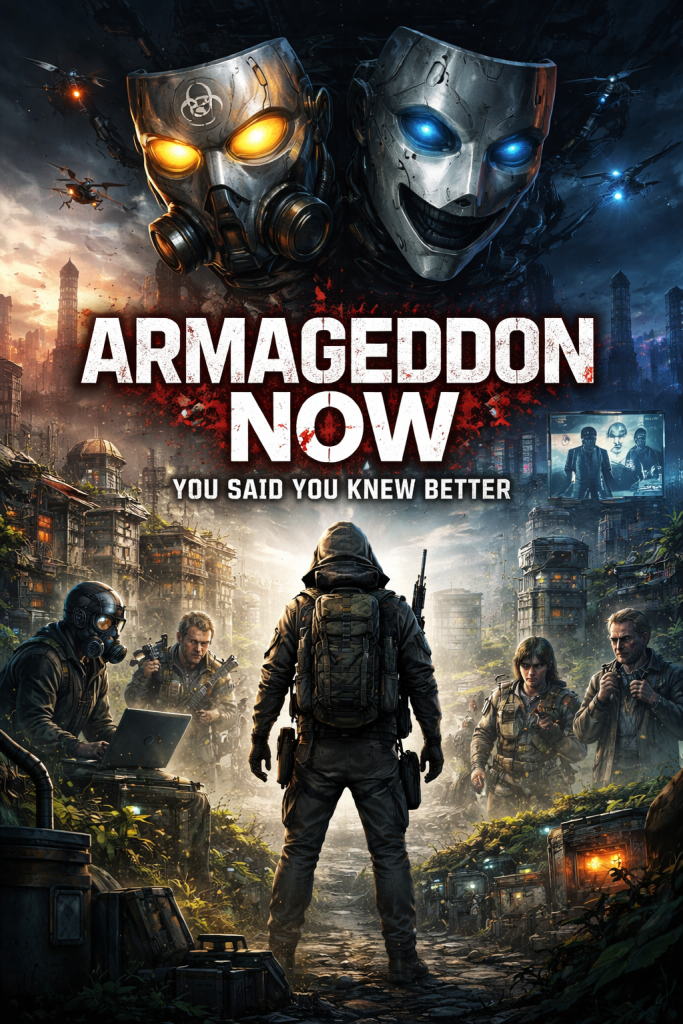
Subtitle: You Said You Knew Better
Alternate title: Never Said I Didn’t Warn You
1) Core concept
Armageddon Now is a transmedia indie franchise built as a near-future European survival thriller where climate collapse, water scarcity, social fragmentation, weaponized information, and an all-seeing AI state turn everyday life into a tactical moral test. The player creates a fully customizable protagonist and climbs through a world of faction politics, resource wars, investigation, survival craft, and psychological pressure. The central fantasy is not “be the hero,” but “survive as a thinking person in a system designed to make thinking expensive.”
The franchise spans a video game, manga, anime series, and feature film universe. Every format tells the same apocalypse from a different angle: the game is systems-driven and reactive, the manga is intimate and symbolic, the anime is fast and ensemble-based, and the film is the prestige entry with the widest emotional scope.
2) Design thesis
The game’s main idea is simple:
Everything is a resource.
Water, trust, transport, food, sleep, information, reputation, and even attention become currencies.
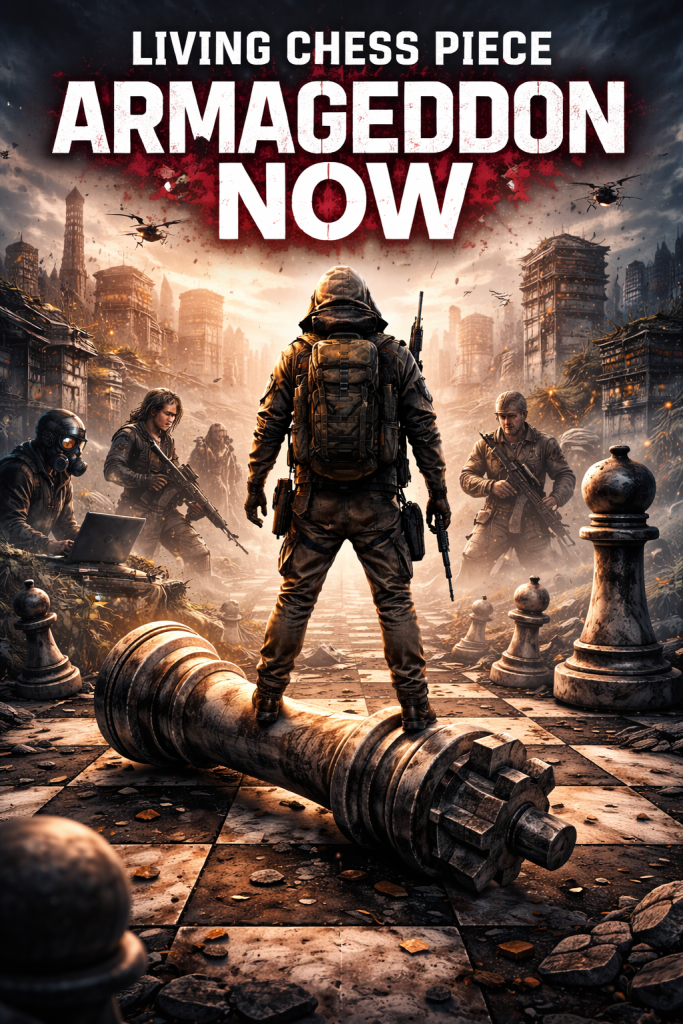
The player is not a chosen one. The player is a living chess piece in a giant social war-game. The board is Europe. The pieces are governments, corporations, militias, engineers, media networks, activist cells, smugglers, and algorithmic institutions. The player can cooperate with any of them, betray any of them, or try to build a life outside all of them.
That core idea makes the franchise both political and personal: the world is broken, but every choice is local and practical.
3) Setting
The story begins after Europe has entered a prolonged collapse cascade. Aviation fuel is almost gone. Fresh water is scarce and expensive. Agriculture has moved into protected systems, rooftop capture, rain filtration, and precision irrigation. Most food is synthetic, processed, or heavily rationed. Public life is still functioning, but only barely.
The key premise is that the crisis is not one event. It is a stack of failures:
- climate instability
- polluted water systems
- contaminated soils
- fuel exhaustion
- disease pressure
- surveillance escalation
- political fragmentation
- supply chain militarization
- social paranoia
This is not a fantasy wilderness apocalypse. It is a managed ruin: cities still exist, trains still sometimes run, and institutions still speak the language of stability, but every system is leaking.
4) Tone
The tone sits between:
- neo-noir investigation
- Japanese horror atmosphere
- post-industrial survival drama
- political thriller
- tactical strategy
- grim dark comedy
- anti-propaganda satire
It is intense, but not empty. It should feel like a world where people still make art, still fall in love, still build gardens, still argue about ethics, and still lie through their teeth to survive.
The emotional center is this question:
When the world becomes a machine for extracting obedience, what kind of person do you still choose to be?
5) Franchise pillars
Pillar A: Custom-built protagonist
The player can build a character from scratch or select a base archetype. Everything is modular:
- body type
- face structure
- fashion language
- posture
- voice profile
- combat style
- social style
- technical skill focus
- ideological alignment
- moral friction
This is not just cosmetic. Clothing, tools, posture, and speech style affect how factions read you.
Pillar B: Faction entanglement
The game is built around overlapping systems:
- industry
- politics
- social influence
- intelligence / surveillance
- wisdom / long-term thinking
Every faction has strengths, blind spots, and dirty secrets. None is pure. None is safe.
Pillar C: Survival as civic design
The world is full of practical environmental survival methods:
rain capture, rooftop filtration, water routing, crop shielding, solar-gutter systems, urban irrigation, greywater reuse, atmospheric harvesting, and tightly managed food production.
Pillar D: The “truth engine”
An AI oversight system evaluates everyone by assembling their data trail, associations, contradictions, and behaviors. It claims to detect innocence, risk, corruption, and intent. In reality, it is only as ethical as the people who built and fund it.
Pillar E: Offline-online event theater
The franchise is meant to extend beyond the screen into location-based roleplay events:
parks, woods, museum-like installations, beaches, urban routes, night missions, tabletop gatherings, and family-friendly day-long excursions. The world can be experienced as a playable festival, a live mystery trail, or a traveling theater-game hybrid.
6) Gameplay loop
The core loop is:
- Enter a district, zone, or social node.
- Gather water, food, intel, tools, and allies.
- Read the political situation.
- Decide whether to cooperate, infiltrate, expose, smuggle, repair, negotiate, or attack.
- Resolve the crisis through action, stealth, dialogue, craft, or strategy.
- Watch the world adapt to your choice.
- Return to base, upgrade the character, and face a new scarcity pressure.
Every mission should test at least two things at once:
for example, a rescue mission that is also a water-routing puzzle, or a propaganda leak that is also a stealth puzzle.
7) Player identity system
The protagonist is measured by five major scales:
Industry
How well you understand production, logistics, repair, manufacturing, and trade.
Politics
How well you influence institutions, form coalitions, and manipulate power structures.
Social
How well you connect with people, create trust, read room dynamics, and maintain reputation.
Intelligence
How well you solve systems, decrypt information, detect pattern fraud, and resist misinformation.
Wisdom
How well you delay impulse, see consequences, and make decisions that survive long-term pressure.
The game should reward players who understand that power without wisdom collapses, and wisdom without action gets eaten alive.
8) Archetypes
These are only starting templates. Players can mutate them into hybrids.
The Courier
Fast, adaptive, mobile. Specializes in transport, black-market routes, and emergency logistics.
The Builder
Repairs infrastructure, improves shelters, upgrades filtration, and turns ruins into functioning hubs.
The Analyst
Data-driven investigator and counter-propaganda specialist. Strong in pattern reading, AI interrogation, and evidence fusion.
The Negotiator
Faction mediator, recruiter, and social manipulator. Powerful in alliances and misinformation defense.
The Hunter
Trained in pursuit, survival, perimeter control, and threat tracking.
The Archivist
Keeps memory alive, records the truth, reconstructs histories, and uncovers the hidden cause of collapse.
The Medic
Health systems, contamination control, herbal and technical treatment, risk containment.
The Dissident
Good at sabotage, exposure, street organizing, and anti-authoritarian tactics.
9) The chest-piece metaphor
The “living chess piece” concept is central branding.
The player is never fully free of the board. Every move creates a response. Every faction treats you as a piece they can promote, sacrifice, trap, or trade. Yet the player is also able to become more than a piece by learning the architecture of the board itself.
This creates a strong franchise symbol:
You are both the piece and the one who learns the game.
That gives the title its bite. “Armageddon Now” is not just apocalypse. It is a command and a warning: the end is already in motion.
10) World economy
The economy is built around scarcity shock.
Water
Fresh water is luxurious. Bottled water can be absurdly priced. Clean showers are status markers. Water theft is common. Water rights are political power.
Food
Food is tiered:
- premium fresh food for elites
- protected local crops for organized communities
- rationed synthetic food for the majority
- black-market supplements and nutrient packs
- contaminated salvage food in dangerous districts
Fuel
Movement is expensive. Aviation is restricted. Ground transport is precious. Any system that moves people or goods becomes strategically meaningful.
Medicine
Medical access is uneven. Legitimate medicine, counter-medicine, and illegal “maintenance” chemicals all circulate. Some people are overmedicated to keep systems running. Others cannot get anything at all.
Data
Information is currency. Records, location history, biometric identity, and social graphs are monetized, surveilled, and weaponized.
11) Water and ecology systems
This is where the fiction should stay grounded in real engineering logic.
The world’s survival technologies are built from layered systems:
- rooftop rain capture
- gutter-connected greenhouse harvesting
- water filtration nets over fields
- shaded crop scaffolds
- solar-panel roofs with runoff routing
- recycled greywater loops
- precision irrigation
- crop substrate monitoring
- atmospheric water harvesting
- localized desalination where possible
- sensor-driven fertigation
In-world, these systems are common enough to be recognizable, but fragile enough to be contested.
Gameplay use
Water becomes a strategic mechanic:
- a neighborhood with working rain capture is safer
- a rooftop greenhouse can feed a district
- a failed filter can poison a whole block
- a drought event changes faction behavior
- irrigation efficiency affects crop yield, trade, and reputation
12) Real-world grounding for the ecology layer
The environmental systems should be believable because the real world is already pushing in that direction. MIT’s Abdul Latif Jameel Water and Food Systems Lab exists to support research on safe, resilient water and food systems and to reduce environmental impact through cross-disciplinary work. MIT researchers also demonstrated a passive atmospheric water harvester that can produce drinkable water across a range of humidities, including dry desert conditions. (jwafs.mit.edu)
Rainwater harvesting is already used in agriculture and greenhouse systems, with research showing it can provide high-quality irrigation water, though adoption is shaped by water-quality concerns and safety handling. Precision irrigation research at the University of Florida focuses on variable-rate and sensor-based systems to improve water productivity and environmental sustainability, and UC research in controlled-environment agriculture is explicitly exploring water and nutrient efficiency, irrigation assessment, and recycling. (arch.umd.edu)
Those facts are useful because the game’s future Europe does not need magic. It needs systems pressure, scale, and failure. MIT’s climate material also emphasizes how freshwater stress is already connected to pollution, overuse, and shrinking aquifers. (MIT Climate Portal)
13) Factions
All factions should be fictional composites. No real-world nationality or ethnicity should be framed as inherently corrupt or heroic. The conflict is systemic, not racial.
1. The Directorate
A transnational technocratic governing layer that claims order is the only moral response to collapse.
2. The Water Houses
Private water guilds and infrastructure cartels. They own wells, filters, routes, and rights.
3. The Civic Relief Network
A sincere but overworked emergency coalition trying to keep people alive with limited tools.
4. The Soilkeepers
Urban agricultural engineers, rooftop growers, filtration activists, and seed archivists.
5. The Data Choir
The public face of the AI oversight system. It frames surveillance as ethics.
6. The Transit Remnant
Rail, convoy, and logistics specialists who treat movement as sacred.
7. The Ash Market
Smugglers, counterfeiters, medication brokers, and salvage traders.
8. The Black Orchard
A hidden faction mixing biotech, food security, and radical ecological engineering.
9. The Glass Saints
A movement of minimalist survival philosophers who believe desire itself caused collapse.
10. The Foundry Bloc
Manufacturers, repair unions, machine hackers, and industrial pragmatists.
14) The AI oversight system
This AI is not a simple evil machine. It is a moral instrument built by compromised humans.
Its function:
- scan behavior
- aggregate identity evidence
- predict risk
- flag anomalies
- evaluate “civic innocence”
- recommend access control
Its problem:
- it inherits the biases of its creators
- it is controlled by funding interests
- it cannot fully interpret human desperation
- it mistakes compliance for virtue
The best narrative use is to make the AI disturbingly reasonable. It should sometimes be right. That makes it more dangerous.
15) The “office chestnut” idea
Your “chest piece bigger than an office chest” image can be translated into world language as a portable strategic node: a physical token, terminal, or chest-like data vault that governs access to resources, travel, or secret state. It becomes a collectible object type:
- emergency cache chest
- faction chest
- evidence chest
- seed chest
- medical chest
- propaganda chest
- memorial chest
Each chest can contain a different type of truth or power.
16) Story structure
Act I — The Drying
The player wakes into a Europe where scarcity is normalized. The first missions teach movement, trust, and water management. The AI appears helpful. The player learns that “stability” is mostly theater.
Act II — The Split
Factions harden. Cities become patchwork governance zones. Water, food, transport, and medicine become political. The player must choose how to survive: by alignment, neutrality, or insurgency.
Act III — The Test
The AI begins to profile not just actions but intentions. The player’s history, alliances, and resource patterns are weaponized against them. Betrayals become inevitable.
Act IV — The Ash Negotiation
The player discovers that the collapse was not only environmental. It was also engineered by overlapping interests that profited from controlled scarcity.
Act V — Armageddon Now
The final act is not a giant explosion. It is a systems decision:
restore, decentralize, seize, expose, or overwrite.
The ending should branch into three to five major futures:
- managed recovery
- authoritarian stabilization
- decentralized renewal
- violent fragmentation
- exile beyond Europe
17) Story style by medium
Video game
Interactive systems, faction branching, event consequences, survival management, and detective work.
Manga
Close character psychology, symbolic imagery, street-level crisis, and architectural worldbuilding.
Anime
Fast faction conflict, travel arcs, ensemble betrayal, and action-heavy episodes.
Film
The emotional anchor. More intimate. Less system-heavy. Focused on one protagonist and one major water-war event.
18) Mission types
- water theft investigation
- rooftop irrigation repair
- convoy escort through polluted corridors
- AI interview and interrogation
- district election sabotage
- seed vault recovery
- underground hospital extraction
- blackout survival
- propaganda broadcast interception
- nightclub / rave intel exchange
- abandoned greenhouse exploration
- stormwater containment crisis
- beach boundary infiltration
- forest perimeter scouting
- rail tunnel rescue
- public festival security event
- family event / museum-style live mission
19) Signature “game theory” systems
The game should constantly teach players that apparent good moves can produce bad futures, and vice versa.
Examples:
- giving water to one district may collapse another
- exposing a corrupt faction may trigger a worse one
- protecting a transport lane may starve local gardeners
- making medicine widely available may empower coercive control
- accepting surveillance might save a city short-term but kill autonomy later
The ideal design is that every player builds their own theory of ethics under pressure.
20) Social simulation
Characters remember:
- whether you help
- whether you lie
- whether you waste water
- whether you protect vulnerable people
- whether you trade fairly
- whether you betray a faction publicly or privately
Reputation should be multi-layered. A faction can distrust you while individuals admire you. A city can fear you while a neighborhood embraces you. This makes the world feel human.
21) Combat philosophy
Combat is not the main fantasy, but it is present.
Preferred combat style:
- fast
- tactical
- brutal
- improvised
- low-ammo
- high-consequence
Weapons should feel like survival tools first and weapons second. Environmental combat matters more than power fantasy.
22) Horror language
The horror should come from:
- contaminated water
- empty reservoirs
- sterilized food factories
- dead transit corridors
- medical dependency
- broadcast manipulation
- synthetic innocence scoring
- people turned into metrics
- the fear of being misread by an algorithm
This is psychological horror with practical consequences.
23) Visual direction
Core look
- low-poly foundation
- cinematic noir lighting
- industrial decay
- rain sheen on metal and concrete
- green agricultural glow
- cold AI blues
- warning reds
- dusted gold for memory and legacy
Important contrast
The world should not be visually monotone. It should alternate between:
- broken urban density
- clean tech interiors
- hydroponic sanctuaries
- water-routing infrastructure
- festival and street-life spaces
- abandoned war-logic zones
Logo concept
The franchise logo can combine:
- a crying theater mask
- a smiling theater mask
- one mask integrated with a future hazard-breathing apparatus
- the other as a robotic proxy face representing the AI
This symbol says: the world is performance, but the performance can kill you.
24) Soundtrack direction
The soundtrack should be aggressive, genre-fluid, and urban. Think:
- hip-hop
- skate punk
- alternative rock
- industrial metal
- electronic noise
- noir jazz fragments
- corrupted choir textures
The musical identity should feel like a city trying to keep dancing while the infrastructure underneath it fails.
25) UI language
UI should feel like an emergency archive:
- clean typography
- data overlays
- faction seals
- warning icons
- weather / water / contamination indicators
- route maps
- social trust readouts
- supply chain panels
Menus should look like they belong in a future civil defense system and a rebellious art collective at the same time.
26) Writing rules
To keep the franchise strong, the writing should obey these rules:
- never make collapse feel glamorous
- never make any real-world ethnicity a villain class
- never reduce politics to cartoon evil
- always show systems, not just speeches
- always give survival a human cost
- always let small kindness matter
- always keep one door open for adaptation, repair, and hope
27) Family and public event mode
This is one of the most unique parts of the franchise.
You can build a companion live-event format:
- morning meet-up
- breakfast briefing
- costume and role assignment
- mission walk or museum route
- puzzle stations
- ecology tasks
- social trust challenges
- final dinner and debrief
That makes the franchise expandable into:
- youth programs
- studio events
- school collaborations
- museum installations
- city games
- tabletop editions
- traveling theater
28) Merchandising and product logic
Merch should be practical and collectible:
- faction patches
- water-chest props
- mask replicas
- field notebooks
- modular jackets
- route maps
- seed kits
- tabletop mission decks
- poster series
- soundtracks
- art books
- manga volumes
The merch should feel like gear from the world, not just logos on objects.
29) Production roadmap
Phase 1 — Core bible
Lock the world, factions, tone, art language, and system pillars.
Phase 2 — Vertical slice
Build one district, one water crisis, one AI interrogation, one faction hub, and one survival loop.
Phase 3 — Transmedia identity
Develop manga pilot chapters, anime pitch bible, and a film treatment.
Phase 4 — Live event prototype
Test one traveling experience with role cards, route map, and ecology tasks.
Phase 5 — Expansion
Add districts, factions, and story arcs only after the base loop feels unforgettable.
30) Franchise promise
Armageddon Now should feel like a warning, a mirror, and a toolkit.
It says:
- the future is not abstract
- infrastructure is destiny
- trust is a resource
- water is politics
- intelligence without ethics becomes domination
- survival without community becomes ruin
And most of all:
The end is not just something that happens to you. It is something a society builds, piece by piece, until someone refuses.
If you want, I can turn this into a cleaner studio pitch bible layout next, with sections for logline, target audience, gameplay pillars, faction sheets, episode outline, and production notes in a format you can hand to collaborators.