
Below is a full franchise bible for Chessies World, structured as a deployable document you can use for investors, partners, and alignment with TU Delft.
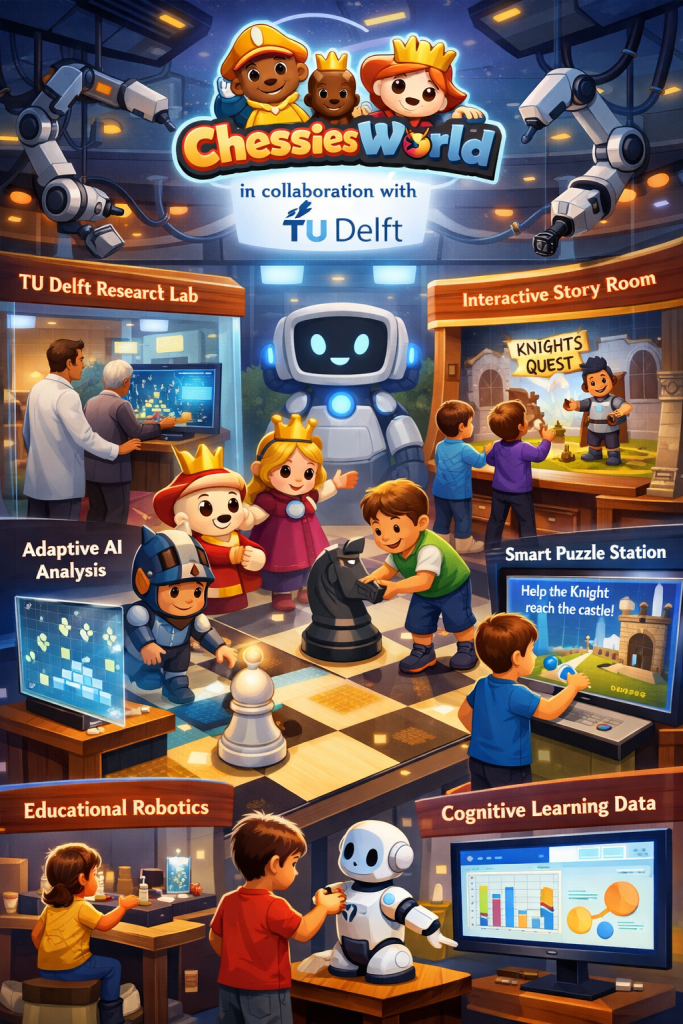
CHESSIES WORLD
Franchise Bible (v1.0)
1. Brand Foundation
1.1 Brand Definition
Chessies World is a child-centered, story-driven strategy playground where chess becomes an interactive adventure powered by AI and physical play.
Core Proposition:
“We teach children how to think—through play, story, and strategy.”
1.2 Vision
To become the global standard for cognitive play environments, merging entertainment, education, and applied intelligence.
1.3 Mission
Make strategic thinking accessible from age 4+ Replace passive screen time with interactive intelligence play Build the first franchiseable cognitive playground system
1.4 Brand Pillars
Play First – fun precedes learning Story Always – every interaction is narrative-driven Adaptive Intelligence – experience adjusts per child Physical + Digital Fusion – no pure screen environments Positive Reinforcement – no punishment, only progression
2. Intellectual Property System
2.1 The Chessies Universe
Core Characters
Kingi – empathetic leader Queenie – problem solver Nico the Knight – playful explorer Rooko – reliable builder Bishy & Bashy – magical twins Pawny – the child avatar
2.2 Narrative Structure
Every experience follows:
Problem Introduction Guided Interaction Child Decision Point System Feedback Resolution + Reward
Inspired structurally by Dora the Explorer, but technologically adaptive.
2.3 Episode Library (Minimum Viable Set)
The Lost Queen Knight’s First Quest The Rook Tower Defense Pawny’s Promotion Journey
Each episode:
15–30 minutes Modular Replayable with variation
3. Experience Architecture
3.1 Spatial Model (Standard Unit)
Zones:
A. Adventure Floor
Large interactive chessboard Motion-tracked play Group participation
B. Puzzle Stations
AI-driven challenges Individual + cooperative play
C. Story Rooms
Immersive narrative environments Projection + sound + tactile elements
D. TU Delft Intelligence Lab
(Co-branded zone)
Experimental systems Visible innovation layer
E. Parent Lounge
Café model Full visibility into play areas
3.2 Experience Flow
Check-in (app or desk) Character onboarding Episode assignment Free exploration / guided play Reward + progression update
4. Technology Stack
4.1 Core Systems
Adaptive Learning Engine
(Co-developed with TU Delft)
Tracks behavior patterns Adjusts difficulty dynamically
Smart Chess Infrastructure
Sensor-enabled boards Connected physical pieces Real-time feedback systems
Narrative AI Layer
Context-aware characters Voice + visual guidance Personalized interaction
Data Platform
Anonymized cognitive data Learning analytics Parent dashboards
4.2 App Ecosystem
Features:
Child profile + progression Booking & scheduling At-home mini-games Parent insights
5. Franchise Model
5.1 Unit Types
Flagship (500–1000 m²)
Full experience TU Delft Lab included Event capacity
Standard Unit (200–400 m²)
Core zones Scalable format
Micro Unit (100–200 m²)
Mall / transit version Limited storytelling High throughput
5.2 Investment Overview
CAPEX (indicative ranges)
Build-out: €250K – €900K Technology: €100K – €300K Theming: €80K – €250K
5.3 Revenue Streams
Primary:
Entry tickets Memberships Birthday parties School programs
Secondary:
Merchandise App subscriptions Licensing
5.4 Franchise Fees
Initial fee: €25K – €75K Royalty: 6–10% Tech subscription: mandatory
6. Operations Manual (Core Principles)
6.1 Staff Roles
“Guides” (not employees)
In-character facilitators Assist without instructing directly Encourage decision-making
Tech Operators
Maintain systems Monitor gameplay analytics
6.2 Service Standard
Every child is greeted by name (via system) No negative feedback language Constant engagement loop
6.3 Safety & Compliance
Child-safe materials Full visibility design GDPR-compliant data systems
7. Design Language
7.1 Visual Identity
Soft geometric shapes Bright but controlled palette Rounded character forms
7.2 Material System
Durable, tactile surfaces Anti-slip flooring (interactive zones) Modular installations
7.3 Sound Design
Positive audio cues Character voices No overstimulation
8. Education Framework
8.1 Learning Outcomes
Strategic thinking Pattern recognition Decision confidence Spatial awareness
8.2 Age Segmentation
4–6: Exploration 7–9: Guided strategy 10–12: Competitive thinking
8.3 School Integration
Curriculum modules Field trips Teacher dashboards
9. TU Delft Integration Model
9.1 Structural Partnership
With TU Delft:
Joint R&D programs Student project pipeline Prototype testing
9.2 Chessies Intelligence Lab
Purpose:
Live experimentation Public-facing innovation Credibility anchor
9.3 Data Collaboration
Ethical data usage Research publications Continuous improvement loop
10. Marketing & Growth
10.1 Positioning
Not a play center. Not a school.
“The future of learning through play.”
10.2 Channels
Schools Parents Tech + education media
10.3 Partnerships
Educational institutions Tech companies Municipal programs
11. Expansion Strategy
Phase 1
Pilot near Delft
Phase 2
Rollout in Amsterdam, Rotterdam
Phase 3
EU scaling → global franchise
12. Risk Management
Key Risks
Overengineering tech Losing child simplicity High CAPEX without retention
Mitigation
Prototype before scaling Constant user testing Episode-based content refresh
13. Long-Term Vision
Chessies World evolves into:
1. Global IP Brand
Series, apps, merchandise
2. Educational Platform
Licensed to schools
3. Research Infrastructure
Benchmark in child cognition
Final Position
If executed correctly, Chessies World becomes:
A new category between Disney, education, and AI-driven interaction—anchored by real-world play.
Next Step Options
To move this from concept to execution, choose one:
Investor pitch deck (tight, fundable version) Flagship architectural layout (build-ready) Character design bible (visual + personality system) TU Delft partnership proposal (formal document)
Each of these turns this from idea → deployable asset.