Franchise Video Game Outline
Genre: Puzzle adventure / memory maze / sketchbook survival
Tone: Strange, funny, eerie, smart, visually iconic
Core fantasy: You are not lost because you are stupid. You are lost because you forgot to draw the map.
Core Concept
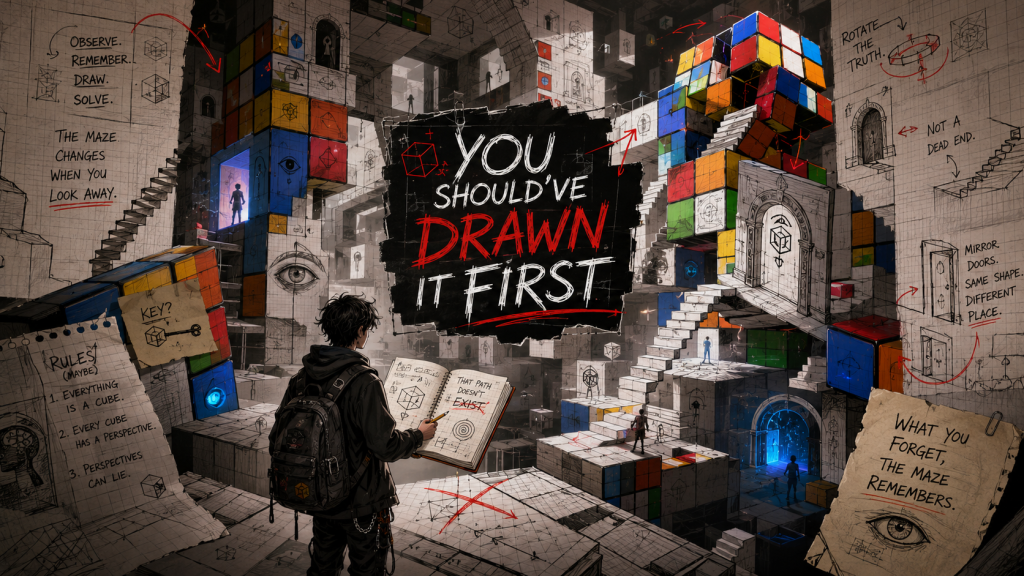
You Should’ve Drawn It First is a game about entering impossible Rubik’s Cube-like labyrinths where the only real weapon is observation.
Before each maze begins, the player stands outside the entrance and is shown a strange image, symbol, structure, creature, or architectural clue. The player has a limited amount of time to draw it inside an in-game sketchbook.
Once inside the labyrinth, the world begins shifting. Corridors rotate. Doors move. Symbols change meaning. Floors become walls. Staircases fold into cubes. The drawing made before entering becomes the player’s first clue.
But the maze is alive.
As the player moves through each level, they discover that the first drawing was never enough. They must keep adding notes, sketches, arrows, corrections, warnings, and symbols to survive.
The rule of the game is simple:
You should’ve drawn it first.
Franchise Premise
Every game in the franchise follows a different protagonist trapped inside a reality-bending maze system known as The Draft.
The Draft is an ancient puzzle dimension that punishes people who rush forward without understanding what they saw.
It does not reward speed.
It rewards attention.
Each maze tests a different kind of perception:
Memory.
Perspective.
Pattern recognition.
Symbol reading.
Spatial awareness.
Emotional interpretation.
Creative thinking.
The player does not just solve the maze.
The player learns how to see.
Main Gameplay Loop
Each level follows a clear ritual:
1. The Entrance Image
Before entering the labyrinth, the player is shown an image beside the door.
It may be:
A statue.
A wall drawing.
A broken machine.
A monster’s silhouette.
A room layout.
A sequence of symbols.
A warning sign.
A weird face.
A cube pattern.
A map that lies slightly.
The player has limited time to sketch it.
They do not need to be an artist. The game allows rough sketching, labels, arrows, circles, and text notes.
The point is not beauty.
The point is survival.
2. The Sketchbook
The sketchbook is the player’s main tool.
Inside it, the player can:
Draw the entrance clue.
Mark doors.
Write warnings.
Add symbols.
Compare previous sketches.
Rotate pages.
Tear pages out.
Overlay transparent notes.
Create mini-maps.
Mark traps.
Track moving rooms.
Record monster behavior.
Write “DO NOT TRUST THIS WALL” and be correct.
The sketchbook becomes a living archive of paranoia and intelligence.
3. Entering the Labyrinth
After the sketching timer ends, the player enters the maze.
The labyrinth behaves like a Rubik’s Cube:
Rooms rotate.
Corridors slide.
Color zones swap positions.
Doors reassign themselves.
A staircase may become a ceiling.
A symbol may open one door in Scene 2 and kill you in Scene 9.
A path that was safe may become a trap if the cube turns.
The player uses their drawing to identify patterns and survive.
4. Change Events
At key moments, the maze changes.
When it changes, the player hears a sound:
A cube click.
A pencil snap.
A page turning by itself.
A child laughing behind a wall.
A ruler slamming shut.
The player must pause and update the sketchbook.
A new note might save them later.
Failing to document changes makes the later parts harder.
5. Exit Test
At the end of each maze, the player reaches an exit chamber.
The chamber asks the player to prove they understood the level.
Not with a multiple-choice quiz.
With the sketchbook.
The player may need to:
Reconstruct a path.
Identify a fake symbol.
Show which room rotated.
Draw the missing side of a cube.
Match a creature to its shadow.
Mark the original entrance from memory.
Correct their own earlier drawing.
The game judges understanding, not drawing skill.
The 13 Levels / 13 Scenes
The first game has 13 levels and 13 scenes, each functioning like an episode in a larger mystery.
Each level introduces a new type of maze logic.
Level 1 — The Door That Was Already Open
Theme: Basic observation
Entrance image: A simple door with three symbols above it
Maze mechanic: One symbol is always missing from the real doors
Lesson: Draw first. Walk second.
This is the tutorial. The player learns that rushing into the labyrinth without drawing causes confusion immediately.
The first exit teaches the title of the game through failure:
“You should’ve drawn it first.”
Level 2 — The Hallway With Too Many Lefts
Theme: Directional memory
Entrance image: A hallway diagram with left turns marked
Maze mechanic: Left turns sometimes become right turns after cube rotation
Lesson: The map is not the territory, but the sketchbook remembers the first lie.
The player learns to mark orientation, not just shape.
Level 3 — The Laughing Blueprint
Theme: Architecture that mocks you
Entrance image: A blueprint with impossible rooms
Maze mechanic: The map changes only when the player is not looking
Lesson: Draw what changed, not what you wish stayed true.
The sketchbook starts becoming messy. That mess becomes useful.
Level 4 — The Staircase That Forgot Gravity
Theme: Vertical space
Entrance image: A tower cross-section
Maze mechanic: Floors rotate into walls
Lesson: Up is only temporary.
The player must start drawing cube faces, not flat maps.
Level 5 — The Room That Copies You
Theme: Reflection and duplication
Entrance image: A mirrored room with one wrong reflection
Maze mechanic: Duplicate rooms appear, but one detail is always incorrect
Lesson: Differences matter more than similarities.
This level introduces “false memory rooms.”
Level 6 — The Animal Made of Arrows
Theme: Creature behavior
Entrance image: A strange creature composed of directional arrows
Maze mechanic: A maze creature moves according to its own symbolic rules
Lesson: Monsters are also maps.
The player must draw how the creature moves to avoid it.
Level 7 — The Museum of Wrong Exits
Theme: False endings
Entrance image: Thirteen exit doors in a museum hall
Maze mechanic: Most exits loop backward unless matched to the original sketch
Lesson: Escape is a pattern, not a door.
This is the first major difficulty spike.
Level 8 — The Clock That Draws Back
Theme: Time pressure
Entrance image: A clock face with impossible numbers
Maze mechanic: Some rooms rewind the player’s movement but not their sketchbook
Lesson: Your notes can survive what your body cannot.
This level makes the sketchbook feel magical.
Level 9 — The City Inside the Cube
Theme: Scale
Entrance image: A tiny city folded into a cube
Maze mechanic: The maze becomes huge, but still follows cube logic
Lesson: A city is just a maze that got confident.
The player navigates streets, alleys, subway tunnels, rooftops, and cube-rotating districts.
Level 10 — The Page That Lies
Theme: Unreliable tools
Entrance image: A blank sketchbook page with a single black dot
Maze mechanic: Some notes in the sketchbook begin changing by themselves
Lesson: Even memory can be edited.
The player must learn to mark trusted notes versus corrupted notes.
Level 11 — The Labyrinth That Reads You
Theme: Psychological puzzle design
Entrance image: A portrait of the player character, unfinished
Maze mechanic: The maze changes based on repeated player habits
Lesson: The maze has been drawing you too.
If the player always turns left, the maze punishes left turns.
If the player avoids symbols, symbols become mandatory.
If the player over-sketches, pages become limited.
Level 12 — The Thirteenth Door
Theme: Pattern completion
Entrance image: Twelve doors and one empty space
Maze mechanic: The missing door must be constructed through correct observation
Lesson: The exit was never hidden. It was unfinished.
This level combines all previous mechanics.
The player must use drawings from all prior levels to create the thirteenth door.
Level 13 — The First Drawing
Theme: Origin and revelation
Entrance image: The very first drawing from Level 1, but altered
Maze mechanic: The entire game world folds into one giant cube
Lesson: You were not mapping the maze. You were teaching it how to become visible.
The player revisits fragments of every previous level, now twisted into one final labyrinth.
The sketchbook is full.
The maze is almost complete.
The Big Finale — The Blank Wall
At the end of Level 13, the player reaches a massive blank wall.
There is no door.
No symbol.
No clue.
No monster.
No sound.
Just a wall and the sketchbook.
The player must draw the exit themselves.
This is the final twist:
The game has trained the player for 13 levels to copy, observe, correct, and survive.
Now the player must create.
The maze does not open because the player found the answer.
It opens because the player finally understands the rule:
Drawing is not decoration. Drawing is thinking before moving.
The final line appears:
“You drew it first.”
Then the wall becomes a door.
Main Character
The protagonist can be customized, but the default character is:
Mika Vale
A young urban explorer, failed art student, and obsessive notebook keeper who enters The Draft after finding a strange sketchbook in an abandoned school.
Mika is not a chosen one.
Mika is just someone who pays attention.
The franchise can later introduce other protagonists, each with a different drawing style and reason for entering the maze.
Core Mechanics
Sketch Timing
Before each level, the player gets a limited sketch window.
Difficulty modes affect time:
Story Mode: Longer sketch time
Normal Mode: Balanced sketch time
Panic Mode: Very short sketch time
Ink Mode: No erasing
Blind Draft Mode: Entrance image disappears if you look away
Drawing Recognition
The game does not require perfect drawing.
It recognizes:
Shapes
Labels
Arrows
Circles
Numbers
Symbols
Connections
Room layouts
Relative positions
The system rewards meaningful notes over artistic skill.
A crude drawing with useful labels can beat a beautiful drawing with no information.
The Sketchbook Interface
The sketchbook should feel physical.
Pages can be flipped quickly.
Pages can be bookmarked.
Pages can be stained, torn, folded, or corrupted.
The player can pin a note to the corner of the screen.
Important pages can be layered over the current maze view as transparent guides.
The sketchbook is both inventory and memory.
Maze Rotation System
Each labyrinth is built like a cube system.
Possible transformations:
90-degree room rotation
Corridor swapping
Door reassignment
Symbol inversion
Gravity flips
Room duplication
Mirror states
Time rewinds
Memory corruption
Perspective shifts
The maze never changes randomly. It follows rules. The player must discover and document those rules.
Enemies and Hazards
The Erasers
Small white crawling creatures that try to remove notes from the sketchbook.
The Smudges
Shadowy forms that blur symbols on walls.
The Rulers
Tall, thin figures that force the maze into straight lines, crushing curved paths.
The Compass Liars
Floating compass creatures that always point somewhere convincing, but wrong.
The Red Pencil
A major recurring antagonist that corrects the player’s drawings in hostile ways.
It crosses things out.
It rewrites arrows.
It adds doors that do not exist.
It circles mistakes before they happen.
Visual Identity
The game should look like a collision between:
A Rubik’s Cube
A school notebook
A haunted architecture model
An impossible children’s puzzle book
A black-and-white comic
A design student’s panic attack
A maze drawn during detention
Visual style:
Black ink lines
Bright cube colors
Graph paper textures
Pencil scratches
Red correction marks
Handwritten warnings
Rotating geometric architecture
Sketchbook UI overlays
Big symbolic doors
Unfriendly educational posters
The game should feel playful and threatening at the same time.
Audio Identity
Sound is essential.
Key sounds:
Pencil scratching
Pages flipping
Cube clicking
Rulers snapping
Distant classroom bells
Footsteps inside walls
Doors folding
Graph paper tearing
Low mechanical breathing
Whispered warnings from old notes
The maze should sound like a school supply cabinet became haunted.
Franchise Potential
Game 1: You Should’ve Drawn It First
The origin story. The player discovers The Draft and survives the 13 labyrinth scenes.
Game 2: You Should’ve Drawn It First — Red Pencil
The Red Pencil becomes the main villain. The player’s sketchbook is actively edited against them.
Game 3: You Should’ve Drawn It First — The Wrong Map
A co-op game where two players see different maze layouts and must communicate through shared drawings.
Game 4: You Should’ve Drawn It First — City of Doors
The cube maze expands into an entire city where every building is a puzzle.
Animated Series
Each episode follows a different person trapped in a different maze, with a different drawing style.
Board Game / Card Game
Players draw clues, rotate maze tiles, and try to escape before their notes become useless.
Merchandise
Sketchbooks
Pencils
Graph paper posters
Rubik’s Cube-style maze toys
“Draw First. Panic Later.” shirts
Red Pencil villain figurines
Maze door art prints
Taglines
Draw first. Run second.
The maze remembers what you forgot.
Every wrong turn was already in your notebook.
A puzzle game for people who should have paid attention.
You are not lost. You are undocumented.
The exit exists, but only if you can prove you saw it.
Official Franchise Statement
You Should’ve Drawn It First is a puzzle adventure franchise about observation, memory, and the strange power of making marks before making moves. Set inside impossible Rubik’s Cube-like labyrinths, the game turns the player’s sketchbook into the most important tool in the world. Every level begins with a picture, a warning, or a clue that must be drawn before entering the maze. Once inside, the architecture shifts, the rules mutate, and the player must keep documenting reality before reality changes again.
Across 13 levels, 13 scenes, and one final confrontation with the blank wall, the game teaches one brutal lesson:
The maze was never impossible.
You just should’ve drawn it first.
0 comments