Full Franchise Concept Outline
A Stone Age modern-family educational comedy about safety, awareness, care, and growing up brave
1. Core Concept
Mama Mammoth is an animated children’s franchise set in a playful prehistoric world where everything is Stone Age-themed but strangely modern.
There are Stone Age tablets, Stone Age bicycles, Stone Age elevators, Stone Age traffic lights, Stone Age playgrounds, Stone Age supermarkets, Stone Age schoolbags, Stone Age phones, Stone Age scooters, Stone Age doorbells, Stone Age helmets, and Stone Age apps carved into rocks.
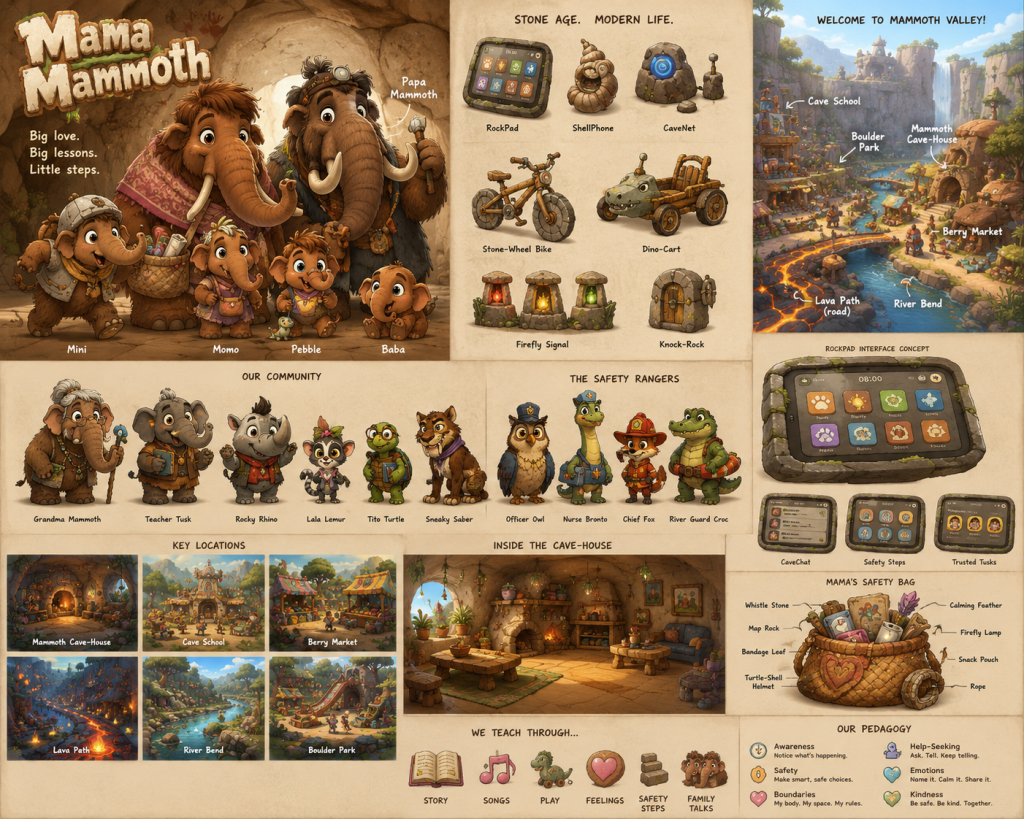
At the heart of the story is Mama Mammoth, a warm, clever, protective, funny mother who raises her children together with Papa Mammoth in a loving modern family. They live in a cozy cave-house full of stone gadgets, bone furniture, firefly lamps, carved-rock screens, and woolly blankets.
Every episode teaches children awareness, safety, emotional intelligence, social boundaries, and basic self-protection through playful prehistoric adventures.
The show is not scary. It is about learning how to notice danger, ask for help, trust your feelings, and make safe choices.
2. Franchise Logline
In a modern Stone Age world full of rock tablets, dino-buses, lava-crossings, mammoth bikes, and saber-tooth strangers, wise and loving Mama Mammoth teaches her children how to stay safe, kind, curious, and brave.
3. The Big Idea
Children live in a world full of things they do not fully understand yet: roads, strangers, technology, school, friends, animals, water, fire, online spaces, emotions, secrets, peer pressure, and risky behavior.
Mama Mammoth translates those real-life dangers into a funny Stone Age universe.
Instead of an iPad, the kids use a RockPad.
Instead of bicycles, they ride Stone-Wheel Scooters.
Instead of cars, there are Dino-Carts.
Instead of online chat, there is CaveChat.
Instead of traffic lights, there are Firefly Signals.
Instead of a playground slide, there is a Smooth Volcano Rock Slide.
The Stone Age setting gives the franchise humor and visual charm, while the lessons stay modern, useful, and grounded.
4. Main Educational Promise
The franchise teaches children:
Awareness
Noticing what is happening around you.
Safety
Understanding basic rules that protect you.
Boundaries
Knowing your body, your space, your feelings, and your right to say no.
Help-seeking
Knowing which trusted adults to go to.
Emotional regulation
Learning to calm down, name feelings, and solve problems.
Social skills
Sharing, apologizing, cooperating, and recognizing unfair behavior.
Digital safety
Using Stone Age technology as a metaphor for screens, messages, privacy, and online strangers.
Independence
Practicing safe choices without becoming fearful.
Kindness
Protecting yourself while still caring about others.
5. Tone
The tone is:
Warm
Funny
Softly educational
Family-centered
Slightly absurd
Visually playful
Emotionally safe
Adventure-based
Never preachy
Never panic-driven
Mama Mammoth does not scare her children into obedience. She teaches them to think.
The ideal feeling is:
“A hug with a safety lesson inside.”
6. Target Audience
Primary audience:
Children aged 3–7
Secondary audience:
Parents, teachers, caregivers, early childhood educators
Tertiary audience:
Educational platforms, schools, public safety campaigns, child development organizations
The franchise can work as:
Animated shorts
Picture books
Interactive learning apps
Classroom videos
Safety posters
Songs
Games
Parent guides
Educational workbooks
Public service campaigns
7. The World
The Stone Age Modern World
The world of Mama Mammoth is prehistoric, but socially and technologically modern.
Everything is invented through stone, wood, bone, vines, shells, fireflies, water wheels, dino power, and imagination.
Examples:
| Modern Thing | Stone Age Version |
| iPad | RockPad |
| Smartphone | ShellPhone |
| Bicycle | Stone-Wheel Bike |
| Car | Dino-Cart |
| Bus | Bronto-Bus |
| Traffic light | Firefly Signal |
| Internet | CaveNet |
| Video call | Smoke Signal Screen |
| Doorbell | Knock-Rock |
| School | Cave School |
| Supermarket | Berry Market |
| Elevator | Pulley Rock Lift |
| Skateboard | Bone Board |
| Helmet | Turtle-Shell Helmet |
| GPS | Map Rock |
| Password | Secret Cave Knock |
| Social media | WallShare |
| Playground | Boulder Park |
| Hospital | Healing Cave |
| Police/help service | Safety Rangers |
The humor comes from how modern life is recreated using prehistoric logic.
A Stone Age tablet needs to be polished.
A Stone Age bike has square wheels at first, until someone invents round ones.
A Stone Age notification is a tiny bird pecking at a rock screen.
A Stone Age password is a secret drum rhythm.
A Stone Age selfie is a cave painting you make very quickly.
8. Main Setting
Mammoth Valley
The family lives in Mammoth Valley, a colorful prehistoric community where different animal families live together.
Main locations:
The Mammoth Cave-House
A cozy family home with a kitchen fire, stone shelves, cave paintings, soft moss carpets, and a RockPad charging by warm sunlight.
Boulder Park
The local playground with climbing rocks, vine swings, mud puddles, fossil tunnels, and volcano slides.
Cave School
A friendly preschool/primary school where children learn counting, drawing, sharing, safety, and Stone Age science.
The Berry Market
A busy community market where many “stranger danger,” getting lost, manners, and money lessons happen.
The Lava Path
A dramatic but safe metaphor for road safety. Children learn to stop, look, listen, and cross with an adult.
The River Bend
Used for water safety episodes.
Tall Grass Trail
Used for lessons about staying close, visibility, wild animals, and not wandering away.
The Great Cave Wall
The Stone Age version of social media, where drawings, messages, and symbols are posted for everyone to see.
The Safety Tree
A community gathering place where Mama Mammoth sometimes teaches a small lesson using songs and games.
9. Main Characters
Mama Mammoth
Mama Mammoth is the emotional and educational center of the franchise.
She is:
Loving
Protective
Funny
Patient
Strong
Smart
Practical
Warm
Emotionally intelligent
Prepared for almost everything
She carries a big woven safety bag full of useful things:
A turtle-shell helmet
A rope
A snack pouch
A bandage leaf
A whistle stone
A small map rock
A calming feather
A “trusted grown-up” badge
A tiny firefly lamp
A soft blanket
A RockPad with family rules carved into it
Mama Mammoth knows dangers because she pays attention. She teaches without shaming. When the children make mistakes, she helps them understand what happened.
Her catchphrases could include:
“Stop, look, listen, think.”
“Big feelings need gentle feet.”
“A safe mammoth is a smart mammoth.”
“Your tummy feeling is trying to tell you something.”
“Brave means asking for help when you need it.”
Papa Mammoth
Papa Mammoth is a loving, hands-on father. He is warm, funny, creative, and sometimes a little clumsy with Stone Age technology.
He is not the “useless dad” stereotype. He is a capable parent, but his role is often more playful and experimental.
He builds inventions such as:
The Stone-Wheel Bike
The RockPad stand
The Dino-Cart seatbelt
The cave door safety lock
The family smoke-signal caller
The “no-slip” mud boots
Sometimes his inventions go wrong, which creates comedy and learning moments.
Papa Mammoth teaches:
Problem-solving
Trying again
Repairing mistakes
Apologizing
Teamwork
Body safety from a father’s perspective
Respecting Mama Mammoth’s knowledge
Showing boys and girls that caring is strong
His catchphrases:
“Let’s test it safely first.”
“Oops is how inventors learn.”
“Strong tusks, soft heart.”
The Children
The mammoth children represent different learning styles and childhood personalities.
Mini Mammoth
The eldest child. Curious, bold, energetic, and sometimes too confident.
Learns lessons about:
Taking turns
Road safety
Thinking before acting
Peer pressure
Being responsible with younger siblings
Not showing off in dangerous situations
Mini often says:
“I know, I know!”
And Mama gently replies:
“Knowing is good. Checking is better.”
Momo Mammoth
The middle child. Sensitive, imaginative, and emotionally expressive.
Learns lessons about:
Feelings
Fear
Saying no
Friendship problems
Secrets
Asking for comfort
Recognizing unsafe situations
Momo often senses when something feels wrong before others notice.
Key line:
“My belly feels wobbly.”
Mama teaches:
“A wobbly belly can be a warning bell.”
Pebble Mammoth
The youngest. Funny, impulsive, adorable, and physically adventurous.
Learns lessons about:
Not touching hot things
Staying close
Water safety
Small object safety
Listening to simple instructions
Using words instead of grabbing or biting
Pebble has a tiny toy called Tiny Tusky, used in emotional learning.
Optional Baby Character
Baba Mammoth
A toddler or baby sibling used for simple early safety lessons:
Hot/cold
Sharp/soft
Up/down
Near/far
Stop/go
Gentle hands
Safe touch
Holding hands
Baba mostly communicates through gestures, sounds, and repeated phrases.
10. Supporting Characters
Grandma Mammoth
Wise, funny, and slightly mystical. She remembers “the old old Stone Age,” before RockPads and Dino-Carts.
She teaches intergenerational wisdom:
Listening to elders
Traditions
Nature safety
Storytelling
Memory
Patience
She often says:
“Before RockPads, we had rock patience.”
Teacher Tusk
The children’s teacher at Cave School.
Kind, structured, inclusive. Helps connect home lessons to school life.
Teaches classroom safety, sharing, group rules, and problem-solving.
Rocky Rhino
Mini’s friend. Very enthusiastic, sometimes reckless.
Used for lessons about:
Peer pressure
Showing off
Running ahead
Unsafe dares
Apologizing after accidents
Lala Lemur
Fast, chatty, and social. Loves CaveChat and WallShare.
Used for digital safety stories:
Do not share personal information
Not every message is from a friend
Ask an adult before clicking a mysterious cave symbol
Private drawings stay private
Words can hurt even on a cave wall
Tito Turtle
Careful, slow, observant, and smart.
Represents children who need more time, routine, or reassurance.
Often helps the group notice details.
Sneaky Saber
Not a villain in a terrifying sense, but a recurring unsafe figure. Sometimes he is just selfish or tricky.
He can represent:
Strangers with bad intentions
Manipulative behavior
Unsafe offers
“Don’t tell your parents” situations
Taking things that are not his
Luring children away
He must be handled carefully. He should not traumatize young viewers. He is more sly and theatrical than realistic.
Mama’s lesson is always clear:
A person who asks you to keep unsafe secrets is not being safe.
The Safety Rangers
A friendly group of trusted community helpers.
Could include:
Officer Owl
Nurse Bronto
Fire Chief Fox
River Guard Croc
Crossing Guard Dodo
They teach that helpers are part of a safe community.
11. Educational Philosophy
The pedagogy of Mama Mammoth should be rooted in early childhood development.
Core Pedagogical Principles
1. Teach through story, not lectures
Children learn best when lessons are emotionally connected to characters and events.
Each episode gives the child a problem, a feeling, a choice, and a resolution.
2. Repeat simple safety language
The franchise should use repeated phrases children can remember.
Examples:
Stop. Look. Listen. Think.
No, go, tell.
Check first.
Ask a trusted grown-up.
Private means private.
My body belongs to me.
A surprise is happy soon. A secret that feels bad should be told.
Big feelings are okay. Unsafe actions are not okay.
3. Empower, do not frighten
Children should not finish an episode thinking, “The world is dangerous.”
They should think:
“I know what to do.”
“I can ask for help.”
“My feelings matter.”
“My grown-ups help keep me safe.”
“I can practice being careful.”
4. Model co-regulation
Mama Mammoth helps the children calm down before solving the problem.
Process:
Name the feeling
Breathe
Get safe
Talk about what happened
Practice the safer choice
Repair if needed
5. Use mistakes as learning moments
The children are allowed to make age-appropriate mistakes. The story does not shame them.
Mama does not say:
“You were bad.”
She says:
“That choice was not safe. Let’s learn what to do next time.”
6. Include parents and caregivers
Each episode can end with a small “Mama’s Safety Step” for grown-ups:
“Practice your family meeting place.”
“Teach your child three trusted adults.”
“Create a simple password rule.”
“Practice crossing the street together.”
“Talk about safe and unsafe secrets.”
7. Teach boundaries clearly
Boundary lessons should be direct but gentle.
Important concepts:
Your body belongs to you
You can say no to unwanted touch
You do not have to hug someone
Safe adults do not ask children to keep scary secrets
Tell a trusted adult if something feels wrong
Keep telling until someone helps
8. Include social-emotional learning
The show should combine safety with emotional development.
A child who can name fear, anger, shame, confusion, or pressure is more likely to ask for help.
12. Episode Structure
Each episode can run 5–11 minutes.
Standard Episode Formula
1. Everyday Stone Age Setup
The family is doing something normal but prehistoric-modern.
Example: riding Stone-Wheel Bikes to Boulder Park.
2. Exciting Child Goal
The child wants something.
Example: Mini wants to ride ahead without waiting.
3. Unsafe or Confusing Situation
A danger appears.
Example: Dino-Carts are crossing the Lava Path.
4. Emotional Reaction
The child feels excited, scared, embarrassed, angry, or pressured.
5. Mama’s Teaching Moment
Mama Mammoth explains the safety rule in simple language.
6. Practice Through Play
The children repeat the safe behavior.
7. Resolution
They solve the problem, help someone, or repair a mistake.
8. Song or Catchphrase
A short musical memory hook.
9. Grown-Up Tip
Optional short ending for parents or classroom use.
13. Example Episode Themes
Episode 1: The Stone-Wheel Bike
Mini gets a new Stone-Wheel Bike and wants to ride fast without a helmet.
Lesson:
Helmet safety
Checking equipment
Riding near grown-ups
Stopping at crossings
Key phrase:
“Shell on your head before wheels are sped.”
Episode 2: The RockPad Stranger
Lala Lemur gets a message on CaveChat from someone she does not know.
Lesson:
Digital safety
Do not share personal information
Tell a trusted adult
Online strangers are still strangers
Stone Age metaphor:
A mystery drawing appears on the RockPad from “CoolClaw99.”
Episode 3: Lost at the Berry Market
Pebble wanders away chasing a bouncing coconut.
Lesson:
What to do when lost
Stay where you are
Find a helper
Know your grown-up’s name
Do not leave with strangers
Key phrase:
“Stop your feet, stay in place, find a helper with a friendly face.”
Episode 4: The Hot Lava Soup
Pebble reaches for a hot cooking stone.
Lesson:
Hot objects
Kitchen safety
Asking before touching
Burn prevention
Episode 5: The Secret Cave
Sneaky Saber tells Momo about a “secret cave” and says not to tell Mama.
Lesson:
Safe vs unsafe secrets
Trusted adults
Body safety
Pressure and manipulation
Important phrasing:
“A surprise makes you happy soon. A bad secret feels heavy and should be told.”
Episode 6: The Firefly Crossing
The children learn how to cross the Dino-Cart path using Firefly Signals.
Lesson:
Road safety
Stop, look, listen
Holding hands
Waiting your turn
Episode 7: The Big Roar Feeling
Mini gets angry when Rocky Rhino wins a game.
Lesson:
Anger regulation
Safe body choices
Breathing
Repairing harm
Apologizing
Key phrase:
“Big roars are okay. Big stomps need space.”
Episode 8: The River Sparkles
The children want to play near the river without an adult.
Lesson:
Water safety
Staying away from deep water
Life jackets/turtle-shell floaters
Adult supervision
Episode 9: The Hug You Don’t Want
Grandma Mammoth visits and Momo does not feel like hugging.
Lesson:
Consent
Body autonomy
Polite alternatives
Adults respecting children’s boundaries
Mama says:
“You can say hello with a wave, a smile, or kind words. Your body is yours.”
Episode 10: The Cave Wall Drawing
Lala posts a silly drawing of Rocky Rhino on the Great Cave Wall.
Lesson:
Digital kindness
Consent before sharing
Embarrassment
Repairing social harm
Episode 11: The Thunder Cave
A storm comes, and the children learn what to do.
Lesson:
Weather safety
Emergency plans
Staying inside
Comforting fear
Episode 12: The Sharp Stone Problem
Papa’s tool bench looks fun, but some tools are dangerous.
Lesson:
Sharp objects
Tool safety
Asking permission
Safe helping
Episode 13: The New Babysitter
A new trusted adult comes to watch the children.
Lesson:
Family safety rules
Trusted adult lists
Emergency contacts
What to do if uncomfortable
Episode 14: The Dino-Cart Seatbelt
Papa builds a Dino-Cart and the children dislike sitting still.
Lesson:
Seatbelts
Travel safety
Why rules still matter during fun
Episode 15: The Dare at Boulder Park
Rocky dares Mini to climb too high.
Lesson:
Peer pressure
Saying no
Safe courage
Choosing friends who respect limits
Key phrase:
“A brave no is still brave.”
14. Safety Curriculum Map
Personal Safety
Body ownership
Safe and unsafe touch
Saying no
Telling trusted adults
Recognizing uncomfortable feelings
Safe secrets vs unsafe secrets
Environmental Safety
Fire
Water
Heights
Sharp objects
Animals
Weather
Roads
Getting lost
Playground equipment
Social Safety
Bullying
Peer pressure
Sharing
Apologies
Respect
Consent
Personal space
Group play
Digital Safety
Screen time
Passwords
Unknown contacts
Sharing images
Private information
Kind words online
Asking before downloading/clicking
Emotional Safety
Fear
Anger
Sadness
Jealousy
Embarrassment
Excitement
Calming strategies
Asking for comfort
Family Safety
Emergency plans
Trusted adults
Family meeting spot
House rules
Door safety
Answering messages
Going places with permission
15. Signature Educational Tools
The Safety Song
A recurring short song:
Stop, look, listen, think,
Take a breath before the brink.
Find your grown-up, use your voice,
Safe and kind is the mammoth choice.
Mama’s Safety Steps
Each lesson can be reduced to 3 or 4 steps.
Example for getting lost:
- Stop walking.
- Stay where you are.
- Look for a helper.
- Say your grown-up’s name.
Example for unsafe secrets:
- Notice the heavy feeling.
- Say no if you can.
- Go to a trusted adult.
- Keep telling until someone helps.
The Trusted Tusks
A recurring visual tool where each child names three trusted adults.
The “Trusted Tusks” can be shown as three small tusk symbols on a family safety chart.
The Wobbly Belly
A child-friendly metaphor for intuition.
When something feels wrong, Momo says:
“My belly feels wobbly.”
Mama teaches that this feeling deserves attention.
The Safe Circle
A visual concept used in books, classrooms, and apps.
At the center: the child.
Around them: family, teachers, helpers, safe friends.
Outside the circle: people they do not know well.
The lesson: different people have different levels of trust.
16. Visual Style
Overall Look
The visual identity should be:
Soft prehistoric modernism
Warm cave textures
Chunky shapes
Rounded characters
Natural materials
Friendly silhouettes
Expressive faces
Bright readable environments
Not too visually busy for young children
Color Palette
Earth tones with cheerful accents:
Warm clay
Soft stone grey
Moss green
Sky blue
Berry pink
Firefly yellow
Volcano orange
Bone white
Deep cave brown
For branding, Mama Mammoth herself should be instantly recognizable through a warm color silhouette, perhaps dusty rose, soft brown, or warm grey with a berry-colored scarf or patterned wrap.
Shape Language
Mama Mammoth: large, round, protective, soft
Papa Mammoth: broad, sturdy, slightly angular but friendly
Children: smaller round bodies with expressive hair/fur tufts
Sneaky Saber: longer, pointier, theatrical silhouette
Tito Turtle: low, round, stable
Rocky Rhino: blocky, energetic
17. Character Design Notes
Mama Mammoth Design
Large soft body
Kind eyes
Expressive eyebrows
Big curved tusks
Woolly hair tuft
Practical woven parent bag
Maybe a patterned Stone Age shawl
Warm, safe color palette
Always looks huggable but powerful
She should visually communicate:
“I can protect you.”
“I will listen to you.”
“I know what to do.”
Papa Mammoth Design
Slightly taller or broader
Tool belt made of vines
Gentle smile
Comedic invention goggles made from polished shells
Warm dad energy
Often carries bits of wood, stone, rope, or half-finished inventions
Children Design
Each child should be recognizable by silhouette and accessory.
Mini: little explorer scarf or helmet
Momo: soft leaf pouch or comfort charm
Pebble: tiny toy, messy tuft, oversized curiosity
Baba: baby wrap, tiny tusks, round eyes
18. Humor Engine
The comedy comes from:
Modern problems with Stone Age solutions
Papa’s inventions going slightly wrong
Children misunderstanding safety rules literally
Prehistoric animals acting like neighbors
Rock technology being slow or absurd
Cave paintings functioning like social media
Dino-Carts having personalities
Fireflies acting like traffic systems
Tiny birds delivering notifications
Mammoth family chaos
Example jokes:
The RockPad freezes because it is literally frozen in ice.
Papa says the ShellPhone has bad reception because a crab crawled away with it.
A “cloud backup” is a cloud-shaped rock shelf.
The Great Cave Wall gets “too many likes” because everyone puts handprints on it.
A password is “three stomps, two claps, one trumpet.”
19. Emotional Core
The real heart of the franchise is not danger. It is care.
Mama Mammoth teaches:
You are loved
You are allowed to ask questions
You can make mistakes
You can say no
You can tell the truth
You can ask for help
Your feelings matter
Safety is not punishment
Rules are a form of love
Papa Mammoth reinforces:
Caregiving is shared
Fathers teach safety too
Families talk
Families repair mistakes
Everyone learns together
The children should feel that the world is big, exciting, and manageable.
20. Format Options
Animated Series
11-minute episodes
Two 5-minute stories per episode
Ideal for preschool and early primary age
Micro Shorts
60–90 second safety lessons:
“Helmet First”
“Ask Before You Click”
“Safe Secrets”
“Hold Hands Near Lava”
“Your Body Is Yours”
Picture Books
Each book focuses on one lesson:
Mama Mammoth and the Stone-Wheel Bike
Mama Mammoth and the Wobbly Belly
Mama Mammoth and the Lost Little Pebble
Mama Mammoth and the RockPad Stranger
Mama Mammoth and the Hug You Don’t Want
Classroom Packs
Teacher guide
Discussion cards
Printable safety charts
Coloring pages
Role-play activities
Parent take-home sheets
App / Interactive RockPad
Mini-games:
Cross the Lava Path
Pack Mama’s Safety Bag
Choose the Trusted Adult
Spot the Unsafe Choice
Helmet Match
Feelings Cave
Safe or Unsafe Secret?
Songs
The franchise should have simple repeating songs:
The Stop-Look-Listen Song
The Trusted Grown-Up Song
The Helmet Song
The Wobbly Belly Song
The Kind Cave Wall Song
The Big Feelings Song
21. Episode Template Example
Episode Title: The RockPad Stranger
Lesson: Digital stranger safety
Characters: Mama, Papa, Mini, Momo, Lala Lemur, Sneaky Saber
Setting: Mammoth Cave-House and Great Cave Wall
Story
Lala Lemur shows Mini and Momo a funny message on her RockPad. Someone named “CoolClaw99” says they know a secret shortcut to the best berry field. Mini thinks it sounds exciting. Momo feels her belly go wobbly.
Mama notices the children whispering and asks what is happening. Lala says CoolClaw99 told her not to show grown-ups.
Mama gently explains:
“Safe friends do not ask you to hide things from the people who care for you.”
Papa tries to look up CoolClaw99 on the CaveNet, but the RockPad displays a drawing of a suspicious saber-tooth tail.
The children learn three rules:
Do not answer unknown messages alone.
Do not share where you live or where you are going.
Show a trusted grown-up.
They block CoolClaw99 by placing a heavy stone over the message hole. The family then creates a CaveChat safety rule chart.
Ending Song
If a message feels strange,
Do not go and arrange.
Show your grown-up, check it twice,
Safe before fun is always nice.
22. Pedagogical Notes for Sensitive Topics
Some topics need special care.
Stranger Danger
Do not teach “all strangers are bad.”
Teach:
Some strangers can help, like police, teachers, shop workers, or parents with children.
Never go anywhere with someone without checking with your grown-up.
Unsafe adults may ask children to keep secrets.
Children should trust their feelings and seek help.
Body Safety
Use clear, age-appropriate language.
Avoid shame.
Avoid graphic detail.
Emphasize:
Your body belongs to you.
You can say no.
You can tell a trusted adult.
You are not in trouble for telling.
Digital Safety
Keep it concrete:
Do not share name, home, school, or location.
Ask before sending pictures.
Tell a grown-up if a message feels weird.
Kindness matters online too.
Fear
Avoid making children hypervigilant.
The show should balance caution with joy.
The message is:
“Most days are safe and fun. Safety skills help us when something is confusing.”
23. Franchise Identity
Title
Mama Mammoth
Possible Subtitle
Big Love. Big Lessons. Little Steps.
Alternative Taglines
Stone Age safety for modern little humans.
A prehistoric family with very modern lessons.
Learning to be safe, kind, and brave.
Big tusks, bigger heart.
Modern parenting, Mammoth style.
24. Brand Values
The brand stands for:
Care
Safety
Family
Trust
Curiosity
Kindness
Courage
Emotional intelligence
Practical wisdom
Child empowerment
Community protection
Modern parenting
25. Merchandising and Educational Products
Toys
Mama Mammoth plush with safety bag
Papa Mammoth inventor figure
Mini Stone-Wheel Bike toy
Pebble and Tiny Tusky plush
RockPad toy
Dino-Cart vehicle
Safety Ranger figures
Books
Board books for toddlers
Picture books for preschool
Activity books
Parent-child safety conversation books
Classroom editions
Printable Tools
Trusted adult chart
Emergency plan sheet
Feelings thermometer
Safe/unsafe secret cards
Road safety poster
Digital safety pledge
Body boundary coloring sheet
Games
Memory cards: safe choice / unsafe choice
Board game: Journey through Mammoth Valley
App game: Mama’s Safety Bag
Classroom role-play cards
26. Possible Season One Outline
Season One Theme
“Learning the Big Safety Basics”
- The Stone-Wheel Bike — helmet and riding safety
- Lost at the Berry Market — what to do when lost
- The Firefly Crossing — road safety
- The Hot Lava Soup — kitchen safety
- The Hug You Don’t Want — body boundaries
- The RockPad Stranger — digital safety
- The Big Roar Feeling — anger regulation
- The River Sparkles — water safety
- The Secret Cave — unsafe secrets
- The Dino-Cart Seatbelt — travel safety
- The Dare at Boulder Park — peer pressure
- The Thunder Cave — storm safety
- The Cave Wall Drawing — online/social kindness
- The Sharp Stone Problem — tool safety
- The New Babysitter — trusted adults
- The Tall Grass Trail — staying close outdoors
- Papa’s Wobbly Invention — testing before using
- Grandma’s Old Map — asking for directions/help
- The Sharing Stomp — conflict resolution
- The Mammoth Family Safety Day — recap special
27. Longer Franchise Arc
The franchise can grow from basic safety into broader child development.
Stage 1: Home and Body Safety
For younger children.
Topics:
Hot things
Sharp things
Getting lost
Body boundaries
Trusted adults
Simple feelings
Stage 2: Community Awareness
For slightly older children.
Topics:
Roads
Water
Public places
Friends
School
Bullying
Peer pressure
Stage 3: Digital and Social Awareness
For modern childhood.
Topics:
Screens
Messages
Privacy
Photos
Kindness
Rumors
Online games
Stage 4: Independence
For older children.
Topics:
Walking to school
Sleepovers
Group trips
Making choices
Speaking up
Helping others safely
28. Why the Stone Age Setting Works
The Stone Age makes serious lessons feel safe and playful.
A normal episode about internet safety could feel too adult.
But a RockPad with a suspicious cave drawing becomes funny and understandable.
A normal traffic lesson might feel boring.
But crossing a Lava Path with Firefly Signals becomes memorable.
A normal body boundaries lesson might feel awkward.
But a story about Momo not wanting a giant mammoth hug makes it gentle, clear, and child-friendly.
The Stone Age world creates distance, humor, and metaphor. That makes difficult subjects easier to teach.
29. Sample Dialogue
Scene: Momo does not want to hug a visiting relative
Grandma Mammoth:
Come here, little Momo! Grandma wants a big mammoth squeeze!
Momo:
I don’t feel like a squeeze today.
Grandma Mammoth:
Oh! Then what kind of hello would feel good?
Momo:
Maybe a trunk wave.
Mama Mammoth:
That is a wonderful choice. Your body is yours, Momo.
Papa Mammoth:
I’m choosing a trunk wave too. Very elegant. Very modern Stone Age.
Pebble:
I choose snack hello!
Mama Mammoth:
Snack hello comes after hand-washing hello.
30. Sample Safety Song
“No, Go, Tell”
If something feels wrong,
You can be strong.
Say no, go, tell,
You know yourself well.
Find someone true,
Who listens to you.
Say no, go, tell,
Safe mammoths do well.
31. Parent and Teacher Layer
Every episode can include an optional adult-facing note.
Example:
Today’s Mama Mammoth Lesson: Getting Lost
Practice with your child:
Their full name
Your name
A family meeting spot
How to identify safe helpers
Staying in one place when lost
Calling loudly: “I need help finding my grown-up.”
Adult note:
Avoid teaching children to hide when lost. Teach them to stay visible, stay put, and ask appropriate helpers.
32. Franchise Potential
Mama Mammoth can become more than a cartoon. It can become a child safety ecosystem.
It can support:
Streaming animation
YouTube shorts
Public safety campaigns
School curriculum
Parenting guides
Museum installations
Children’s books
Interactive apps
Educational games
Safety merchandise
Pediatric waiting room videos
Teacher training materials
Social-emotional learning programs
The concept is flexible because almost every modern safety issue can be translated into a Stone Age metaphor.
33. Final Franchise Statement
Mama Mammoth is a loving prehistoric-modern family franchise where everyday childhood risks become funny, memorable Stone Age adventures.
Mama Mammoth and Papa Mammoth raise their children with warmth, structure, humor, and emotional intelligence. They do not simply tell children what not to do. They teach them how to notice, think, speak up, ask for help, and make safer choices.
It is a franchise about protection without panic.
It says to children:
The world is big.
You are still learning.
Your feelings matter.
Your voice matters.
Your family helps you.
Safety can be practiced.
Bravery can be gentle.
And Mama Mammoth is always nearby with a soft heart, strong tusks, and a very full safety bag.
0 comments