

A game about winning the wrong thing very loudly.
1. Core Concept
Battle Parade is a satirical strategy game franchise about a world obsessed with celebrating battles while completely misunderstanding the larger war.
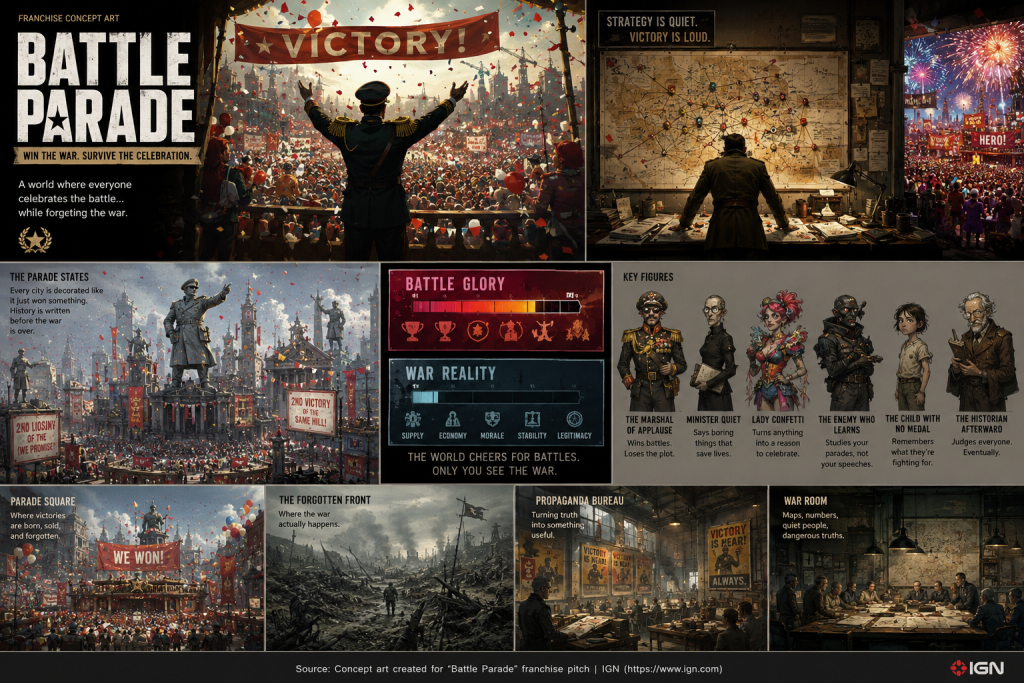
Every faction wants the glory of a battle victory: banners, speeches, medals, fireworks, songs, heroic statues, dramatic news coverage, and public applause. But the actual objective of the game is not to win individual battles.
The real objective is to win the war.
The problem is that every time players win a battle, the world rewards them so loudly that it becomes tempting to forget the bigger strategic picture. The game constantly tests whether the player can resist symbolic victories, public pressure, emotional propaganda, and short-term applause in order to achieve a deeper, long-term victory.
The central contradiction:
Everyone celebrates the battle.
Only the strategist understands the war.
2. Franchise Premise
In the world of Battle Parade, nations, movements, corporations, rebel armies, media empires, and ideological clubs are locked in a permanent conflict called The Great Campaign.
Nobody agrees on when the war started. Nobody agrees what victory means. Nobody even agrees who the enemy really is.
But everyone agrees on one thing:
Winning a battle feels amazing.
So the world has built an entire culture around battle celebrations. Cities have victory squares. Every small tactical success is turned into a national holiday. Generals become celebrities. News channels broadcast “Victory Countdown” specials. Toy companies sell miniature battle heroes before the war is even over.
Meanwhile, the actual war continues.
Resources collapse. Alliances shift. Civilians lose trust. Supply lines break. The economy rots. The enemy adapts. The future becomes unstable.
The player’s job is to win the war in a civilization that only understands the theater of winning battles.
3. Genre
Primary genre: Grand strategy / political satire / tactical management
Secondary genre: Narrative simulation / propaganda management / social systems game
The franchise can exist as:
A mainline strategy game
A card game
A tabletop board game
An animated series
A comic or graphic novel
A political satire web series
A mobile spin-off about propaganda and celebration management
A party game about claiming victory before understanding the situation
4. Main Game Objective
The player must achieve War Victory, not Battle Victory.
Battle victories are only temporary achievements. They may help, but they can also distract, exhaust, or mislead the population.
The player wins the war by managing deeper systems:
Political stability
Public morale
Supply chains
Economic survival
Alliances
Information control
Civilian trust
Long-term strategy
Enemy adaptation
Post-war legitimacy
Moral cost
Historical memory
A player can win every battle and still lose the war.
A player can lose several battles and still win the war.
The franchise’s central design philosophy:
A battle is an event.
A war is a system.
5. Core Gameplay Loop
The player begins each campaign with a faction, a public narrative, limited resources, and a war goal.
Each turn or chapter contains several layers:
First, the player chooses military, diplomatic, economic, cultural, or intelligence actions.
Then a battle or crisis occurs.
Afterward, the population, press, allies, enemies, and internal factions react.
If the player wins a battle, celebration pressure increases. The public demands parades, monuments, speeches, and rewards.
If the player refuses to celebrate, morale may drop.
If the player celebrates too much, strategic focus declines.
If the player loses a battle but protects the long-term war plan, the public may panic while the actual war position improves.
The player is constantly forced to ask:
Do I take the applause now, or preserve the future?
6. The Celebration System
The most important franchise mechanic is the Celebration System.
After every battle, the player must decide how much society celebrates.
Celebration options include:
Small announcement
Military parade
Hero ceremony
National holiday
Propaganda campaign
Victory statue
Public execution of blame figures
Media spectacle
Merchandising campaign
Historical rewrite
Myth-making campaign
Celebrations have benefits:
Morale increases
Recruitment improves
Enemies may be intimidated
Allies may respect strength
Political approval rises
Factions become temporarily unified
But celebrations also have costs:
Resources are wasted
Complacency grows
Commanders become vain
Public expectations become unrealistic
Enemies learn from your propaganda
The war goal becomes distorted
Future losses feel more humiliating
Truth becomes harder to manage
The player may create a society that is incredibly happy about victories while unknowingly walking toward defeat.
7. The War Meter vs. Battle Meter
The interface deliberately tricks the player.
There are two major meters:
Battle Glory
This meter is flashy, loud, colorful, and constantly praised by advisors. It rises when the player wins battles, gives speeches, defeats visible enemies, captures symbolic locations, and generates public celebration.
War Reality
This meter is quiet, cold, and harder to improve. It measures whether the player is actually closer to ending the war successfully.
A brilliant design twist:
The game constantly tempts the player to optimize Battle Glory, because it feels good and gives immediate feedback.
But the ending is determined by War Reality.
8. Satirical Theme
The franchise satirizes:
Political spectacle
Military propaganda
Corporate victory culture
Social media outrage cycles
Short-term thinking
PR over substance
Symbolic wins
Misunderstood leadership
Public addiction to announcements
Movements that confuse visibility with victory
Governments that confuse dominance with stability
Companies that celebrate launches instead of outcomes
The game is not only about military war. “War” can represent any long-term struggle: political, cultural, economic, social, ecological, or ideological.
The phrase “battle but not the war” becomes the franchise’s central joke and warning.
9. Story World
The setting is a surreal militarized festival-world called The Parade States.
Every city is decorated like it just won something. Confetti machines are installed in government buildings. Battlefields have souvenir shops. News anchors wear medals. Children learn patriotic victory dances before they learn history.
The world’s calendar is full of invented victories:
Victory of the Northern Hill
Second Victory of the Same Hill
Victory of Almost Winning
Victory of Strategic Retreat Rebranded as Advance
Victory Day of the Great Announcement
Victory of Not Losing as Badly as Expected
In this world, history is written before the war is over.
10. Factions
The Banner Republic
A democratic state addicted to public approval. Strong morale, weak patience. Every battle becomes an election campaign.
The Iron Choir
A disciplined authoritarian empire that never admits defeat. Excellent coordination, but truth is illegal, making adaptation difficult.
The Free Companies
Corporate mercenary city-states. They can win battles efficiently but only if the war remains profitable.
The Children of the Final Victory
A revolutionary movement that believes one glorious battle will solve everything. Inspiring, unstable, and vulnerable to myth.
The Archive Union
Historians, analysts, and planners trying to win through memory, logistics, and truth. Weak public appeal, powerful long-term strategy.
The Parade Church
A religious-media faction that worships victory itself. They do not care who wins as long as someone celebrates.
11. Main Characters
The Marshal of Applause
A celebrity general who wins battles for the cameras and accidentally destroys the long-term strategy.
Minister Quiet
The player’s strategic advisor. Hated by the public because they always say boring but correct things.
Lady Confetti
A propaganda genius who can turn any disaster into a celebration.
The Enemy Who Learns
The opposing commander who studies your celebrations to understand your weaknesses.
The Child With No Medal
A civilian witness who reminds the player what the war is actually costing.
The Historian Afterward
A narrator from the future who comments on how ridiculous the present looked once the results were known.
12. Narrative Structure
The story is divided into campaigns called Wars of Misunderstanding.
Each campaign begins with a simple public slogan:
“Take the Hill.”
“Defend the Flag.”
“Punish the Enemy.”
“Secure the Future.”
“End the Crisis.”
“Restore Greatness.”
But over time, the player discovers that the slogan is not the real war.
Example campaign:
The public wants to capture Victory Hill.
Capturing it gives massive Battle Glory.
But holding it drains supply lines, exposes civilians, and gives the enemy time to regroup.
The real path to winning the war may be to abandon the hill, negotiate with a rival, secure food routes, and let the enemy exhaust itself.
The public will call this cowardice.
History may call it victory.
13. Player Choice Philosophy
The player is not asked:
“Can you win?”
The player is asked:
“Can you still think clearly while everyone is cheering?”
Choices are morally and strategically complicated. A battle win may boost morale but prolong the war. A battle loss may save lives. A truthful speech may reduce public support but prevent future collapse. A lie may unify society but poison the post-war world.
There are no clean victories, only consequences.
14. Endings
The Parade Ending
The player wins many battles, becomes beloved, holds massive celebrations, and loses the war. The final scene is a parade marching through a collapsing capital.
The Silent Victory Ending
The player wins the war with minimal celebration. The public barely understands what happened. History later recognizes the achievement.
The Myth Ending
The player creates such powerful propaganda that nobody knows whether the war was won or lost. The society survives inside its own legend.
The Broken Trophy Ending
The player wins the war but destroys the values they claimed to defend.
The True Campaign Ending
The player balances morale, truth, sacrifice, strategy, and restraint. The war ends, and the culture of empty celebration begins to change.
15. Visual Identity
The franchise should look like a mix of:
Military parade posters
Political cartoons
Board game maps
Propaganda leaflets
Festival banners
War-room diagrams
Comic-noir satire
Bright confetti over ruined architecture
The signature visual image:
A general standing on a stage under fireworks, holding a tiny captured flag, while behind the stage the entire war map is burning.
Color direction:
Black and white strategy-map base
Red, pink, or gold celebration accents
Heavy ink lines
Sticker-like medals and slogans
Confetti as visual noise
Clean war-room UI fighting against chaotic public spectacle
16. Tone
The tone is darkly funny, intelligent, theatrical, and tragic.
It should feel like:
A victory speech delivered during a power outage
A strategy game interrupted by a party planner
A war room invaded by marketing people
A political cartoon that became a simulation
A parade accidentally marching into history’s trash can
The comedy comes from everyone using victory language incorrectly.
The tragedy comes from the fact that the consequences are real.
17. Franchise Taglines
Win the war. Survive the celebration.
Everybody loves a battle. Nobody understands the war.
Victory is loud. Strategy is quiet.
The parade starts before the war is over.
Lose the applause. Win the future.
They won the battle. Then they celebrated until they lost everything.
18. Expansion Ideas
Expansion 1: The Media Front
Adds newspapers, broadcasters, influencers, rumor networks, and public opinion manipulation.
Expansion 2: Civilian Memory
Adds post-war trials, monuments, schoolbooks, museums, and generational trauma.
Expansion 3: Corporate Campaign
Turns the war into a business simulation where companies celebrate quarterly victories while destroying long-term survival.
Expansion 4: Revolution Mode
Players lead a movement where symbolic street victories can either build real change or become empty performance.
Expansion 5: Multiplayer: Parade of Fools
Each player tries to win their own war while sabotaging others through fake celebrations, false victories, and public pressure.
19. Why This Franchise Works
The concept has strong franchise potential because it is both strategic and symbolic.
It works as a game because the battle-versus-war distinction creates meaningful mechanics.
It works as satire because modern culture constantly rewards visible short-term wins over long-term success.
It works as a story because every character can misunderstand victory in a different way.
It works visually because celebration and destruction create a powerful contrast.
And it works philosophically because the player eventually realizes:
The hardest enemy is not the army across the field.
The hardest enemy is the applause after the first win.
0 comments