Core Premise
The Bone Breaker is an urban crime-noir franchise about an average-looking underworld enforcer with an unforgettable calling card: a mini sledgehammer. Sometimes one. Sometimes two. One in the left hand, one in the right.


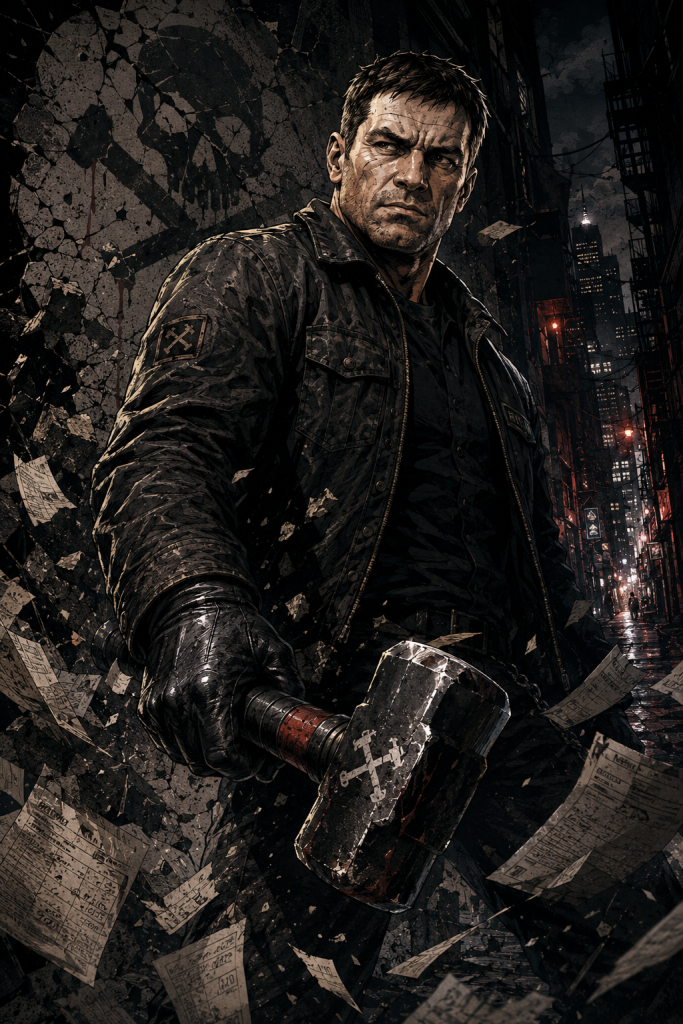
He is not superhuman. He is not a masked hero. He is not a sadist.
He is a working-class bruiser hired to collect debts from criminals, gangsters, crooked businessmen, scam artists, and violent predators who thought they could ignore the bill. But he lives by one unbreakable rule:
Never punish the innocent.
If an employer lies to him, manipulates him, or causes him to hurt someone who does not deserve it, The Bone Breaker turns around and becomes their problem.
That is the heart of the franchise.
He may be an enforcer, but he is not a weapon for cowards. He is not there to crush the weak. He is there for the people who believed power meant they would never have to pay.
Logline
An ordinary-looking debt enforcer armed with a mini sledgehammer becomes an underworld legend by breaking criminals who refuse to pay — but when he discovers an innocent person has been targeted, he turns his hammer against the very people who hired him.
Tone
Crime noir meets street myth.
The world should feel gritty, funny, brutal, moral, and slightly larger than life. Think back alleys, pawn shops, betting rooms, neon cafés, underground fight clubs, cheap suits, dirty money, and whispered warnings:
“Pay what you owe. Or he’ll come knocking.”
The violence is stylized, not realistic gore. The hammer is iconic, almost cartoonish in silhouette, but the consequences are serious. Every swing should mean something. The Bone Breaker does not attack randomly. He is not chaos. He is judgment with a receipt.
Main Character
Name / Alias
The Bone Breaker
His real name can remain mysterious at first. Different people know different versions. Some call him:
- Breaker
- The Collector
- Hammerhand
- The Debt Man
- BB
- The Man With the Small Hammer
The joke in the underworld is that people laugh when they first see the mini sledgehammer.
They stop laughing after the first swing.
Character Description
He is average height. Average build. Average face. The kind of man you would not notice in a supermarket queue, bus stop, or corner snack bar.
That is what makes him frightening.
He does not walk into a room like a movie villain. He walks in like a guy who came to repair the heating. Calm. Practical. Tired. Carrying a small tool bag.
Inside the bag: one or two mini sledgehammers.
He does not dress like a gangster. He might wear a work jacket, old boots, gloves, plain black jeans, maybe a beanie or flat cap. His style is blue-collar, not theatrical.
His presence says:
This is not personal. This is the invoice.
The Hammer Rule
The mini sledgehammer is not just a weapon. It is a symbol.
The Bone Breaker believes large weapons are for men trying to feel powerful. A mini sledgehammer is practical. Close-range. Honest. It does not pretend to be elegant.
Sometimes he uses one.
Sometimes he uses two.
When he carries two, everyone knows the situation has escalated.
One hammer means: you still have a chance to explain.
Two hammers means: you already wasted it.
Moral Code
The franchise lives or dies by his code.
The Bone Breaker’s Rules
- Never touch the innocent.
- Never punish someone weaker just because they are available.
- Never work for a liar twice.
- Always confirm the debt.
- Criminals can be collected from. Victims cannot.
- If the employer lies, the employer becomes the job.
- Fear is acceptable. Cruelty is not.
- The hammer is for consequences, not entertainment.
This makes him dangerous to both sides. Criminals fear him because he comes to collect. Employers fear him because he cannot be fully controlled.
Core Conflict
The Bone Breaker works in the criminal economy, but he does not fully belong to it.
He is useful to crime bosses because he gets results. But he is also a liability because he has ethics. He asks questions. He checks stories. He notices when a “debt” is actually extortion. He notices when a frightened shopkeeper is not a criminal. He notices when a young runner is being used as bait.
The main engine of the franchise is simple:
Every job begins as collection. Every story becomes investigation.
He arrives to break someone. Then he has to decide whether they are truly guilty.
Franchise Theme
Power is not justice. But consequences matter.
The Bone Breaker exists in a world where police are slow, courts are corrupt, gangs own neighborhoods, and debt is used as a weapon. He is not a clean hero. He does ugly work. But he draws a line that many “respectable” people do not.
The central question:
Can a violent man still be moral if he only turns violence against those who exploit others?
The franchise should never make him too clean. He is not a superhero. He is an enforcer with a conscience. That contradiction is the concept.
Visual Identity
Logo / Poster Image
A plain black silhouette of a man holding a mini sledgehammer at his side.
Behind him, a cracked white wall.
Title in rough block lettering:
THE BONE BREAKER
Possible subtitle treatment:
PAY WHAT YOU OWE.
OR EXPLAIN IT TO THE HAMMER.
Color Palette
- Black
- Bone white
- Dirty concrete grey
- Rust red
- Neon pink accent for NotYouAgain-style branding
- Occasional yellow streetlight glow
Graphic Style
High-contrast crime-comic style. Thick black shadows. Harsh white highlights. Impact lines. Broken typography. Hammer icons. Debt slips. Cracked tiles. Blood should be minimal and graphic, not splatter-heavy.
The world can feel like a noir comic printed on cheap paper, with modern urban grime and a dark comedic edge.
Character Personality
The Bone Breaker is calm, practical, and strangely polite.
He does not make long speeches. He asks simple questions.
Examples:
“You owe money?”
“To who?”
“For what?”
“Did you hurt anyone?”
“Are they lying to me?”
He has a dry sense of humor, but he is not goofy. He is emotionally controlled because he has seen what happens when violent men enjoy their work.
He does not enjoy it.
That makes him scarier.
Signature Dialogue
“I don’t break poor people. I break problems.”
“You forgot to pay. That happens. Now we discuss consequences.”
“You lied about the debt. That makes this your invoice.”
“I was hired to punish a criminal. You gave me an innocent. That was stupid.”
“I’m not here for the weak. I’m here for the ones standing on them.”
“One hammer is business. Two hammers is correction.”
Supporting Characters
1.
Mara Voss — The Accountant
A forensic bookkeeper who secretly helps The Bone Breaker verify debts. She can trace fake loans, laundering schemes, shell companies, gambling scams, and protection rackets.
She is not impressed by him. She thinks violence is inefficient. But she respects his code.
Dynamic: brains and blunt force.
2.
Little Saint — The Street Informant
A young courier who knows every alley, club, kebab shop, pawn counter, and illegal poker room in the city. He gives Breaker tips but constantly tries to look tougher than he is.
Breaker protects him without admitting it.
3.
Father Kade — The Ex-Boxer Priest
A former fighter who now runs a community shelter. He knows Breaker from the past and acts as his moral warning system.
He often tells him:
“A line is only a line if you stop before crossing it.”
4.
Nina “Nine Lives” Vale — Rival Collector
A sleek, stylish enforcer who believes Breaker’s moral code is a weakness. She uses fear, blackmail, seduction, and precision violence. Sometimes enemy, sometimes ally.
She thinks he is old-fashioned.
He thinks she is what happens when talent loses its soul.
5.
Mr. Chapel — The Employer
A polished crime broker who hires collectors, fixers, cleaners, and negotiators. He sees Breaker as a useful old-world tool, but becomes increasingly frustrated by his refusal to obey blindly.
Chapel may become a major antagonist.
Villain Types
The strongest villains are not random thugs. They are people who abuse systems.
Recurring villain categories:
- Loan sharks who trap families in fake debts
- Gang bosses who use children as runners
- Casino owners who rig addiction into profit
- Influencers laundering criminal money
- Corrupt police feeding names to gangs
- Corporate landlords using criminals to clear buildings
- Fake charities stealing from vulnerable people
- Human traffickers hiding behind “security businesses”
- Crypto scammers who ruined ordinary people, then hired protection
- Crime bosses who pretend to be community leaders
The Bone Breaker is not interested in petty survival crime. He goes after predators.
Story Engine
Each episode, comic issue, or chapter can follow a structure:
1. The Job
Breaker is hired to collect from someone who “forgot to pay.”
2. The Visit
He arrives with the hammer. The target panics, lies, fights, or pleads.
3. The Doubt
Something does not match. The target may be guilty, but not of what the employer claimed.
4. The Verification
Breaker investigates the debt, often with Mara or street contacts.
5. The Turn
He discovers the employer has hidden something: an innocent victim, a fake debt, a setup, or a larger crime.
6. The Correction
The hammer changes direction.
7. The Receipt
The guilty party is left alive, humiliated, broken in reputation or body, and forced to pay what they truly owe.
Season One / Book One Arc
Title:
The First Swing
The Bone Breaker is known as a reliable enforcer in the city’s criminal underworld. He collects from criminals who owe money to worse criminals. He believes his work is dirty but contained.
Then he is sent to punish a small-time gambling debtor. The man claims he never borrowed money. Breaker almost dismisses him — until he sees the debtor’s daughter hiding in the bathroom with a hospital bracelet and a stack of fake loan documents.
Breaker investigates and discovers a network of manufactured debts designed to seize homes, businesses, and people. His employers are not collecting debts. They are creating victims.
Breaker turns on the network.
By the end of the first arc, the underworld learns a new rule:
Do not hire The Bone Breaker with a dirty file.
Major Arc Ideas
Arc 1:
The Wrong Door
Breaker is sent to punish a shop owner accused of hiding gang money. The shop owner is innocent. The real criminal is using his store as a mail drop without his knowledge.
Theme: collateral damage.
Arc 2:
Two Hammers
A rival gang frames Breaker by copying his hammer style and attacking innocent people. To clear his name, Breaker carries two hammers for the first time in the series.
Theme: reputation as weapon.
Arc 3:
The Soft Men
A group of wealthy criminals hire street thugs to do their violence while pretending to be respectable. Breaker decides to skip the thugs and visit the boardroom.
Theme: cowardice behind money.
Arc 4:
Employee of the Month
Breaker discovers his own employer has been sending him after people who were never guilty. This becomes personal. The employer thought Breaker was just muscle.
Mistake.
Theme: loyalty versus truth.
Arc 5:
The Innocent Mistake
Breaker actually hurts someone who turns out to be innocent. This should be a major emotional turning point. He does not excuse himself. He does not say, “I was only following orders.” He investigates, compensates the victim, protects their family, and then hunts the person who fed him the lie.
Theme: responsibility.
Arc 6:
The Debt City
The city itself is revealed as one massive debt machine: rent, drugs, gambling, prison contracts, illegal loans, protection rackets, political favors. Breaker realizes he has spent years breaking symptoms, not the system.
Theme: can one man with a hammer fight a machine?
Format Potential
Comic Series
Probably the strongest format. Visually iconic, episodic, stylish, and perfect for a cult antihero.
Animated Adult Series
A noir action-comedy with stylized violence, social commentary, and recurring villains.
Live-Action Series
Could work as a gritty street-level crime show with dark humor.
Video Game
A side-scrolling beat-’em-up or tactical brawler where the player investigates debts before choosing who to confront. The moral code becomes a gameplay system.
Graphic Novel
A complete origin story showing how an ordinary enforcer became the underworld’s most dangerous ethical problem.
Game Concept Variant
Title:
The Bone Breaker: Payback Ledger
Gameplay loop:
- Receive a debt contract.
- Investigate the claim.
- Question targets.
- Decide whether the debt is legitimate.
- Confront the guilty party.
- Avoid harming innocents.
- Punish employers who lie.
The player is rewarded not for maximum violence, but for correct judgment.
Mistakes matter. If you hurt the innocent, the story changes. Allies lose trust. The underworld uses it against you. Breaker must make amends.
This gives the franchise a unique mechanic:
Violence is easy. Verification is hard.
Rules of Violence
To keep the concept strong and not cheap:
- He does not kill unless the story absolutely demands extreme stakes.
- He targets hands, legs, tools, weapons, doors, cars, safes, phones, symbols of power.
- The hammer often breaks property before people.
- He gives guilty people a chance to tell the truth.
- He does not attack children, civilians, addicts, exploited workers, or people under coercion.
- He does not enjoy pain.
- He never uses violence to impress an audience.
This keeps him from becoming a bully character.
The Franchise Promise
Every story should deliver:
- A criminal who thought they were untouchable.
- A debt that is more complicated than it first appears.
- A moral test for Breaker.
- A brutal but clever confrontation.
- A reversal where the real villain realizes they hired the wrong man.
- A final image involving the hammer, the receipt, or the debt being paid.
Taglines
He collects from criminals. He protects the innocent. He breaks the lie.
Some debts are paid in cash. Some in bone.
Never hire him with a false invoice.
The weak are not his target. The powerful are not his problem. They are his schedule.
One hammer for business. Two for betrayal.
Franchise Bible Summary
The Bone Breaker is a working-class crime-noir antihero franchise about an enforcer with a mini sledgehammer and a strict moral code. He collects from criminals who forgot to pay, but he never punishes the innocent. When employers manipulate him into hurting the wrong person, he turns on them without hesitation.
The concept is built around contrast: a violent man with ethics, a criminal worker with a justice instinct, an ordinary face carrying an unforgettable weapon. He is feared not because he is the strongest man in the city, but because once he knows the truth, he cannot be bought off.
The hammer does not make him special.
The line he refuses to cross does.
0 comments