
Franchise Concept Outline
Core Logline
When the systems that promised to protect democratic freedom turn cold, corrupted, confused, or weaponized, one person is pushed toward a “dead drop”: a place where reputation, safety, rights, and future all fall away. But before the final drop happens, something stronger appears: neighbours, friends, coworkers, strangers, witnesses, and believers forming a living net around them.
The system may abandon you.
The community will not.
The Big Idea
Community Will Save Us! is a social thriller, human drama, and civic resistance franchise about what happens when an ordinary person becomes the target of a collapsing support structure.
The protagonist is not saved by superheroes, billionaires, secret agents, or institutions. They are saved by the people close enough to see the truth.
The neighbour who heard what really happened.
The coworker who refuses to sign a false statement.
The friend who archives every message.
The shopkeeper who remembers the timeline.
The teacher who speaks up.
The nurse, the driver, the cleaner, the student, the retired lawyer, the cousin, the old lady across the street who saw everything from her window.
Together, they become a human firewall.
Genre
Civic noir / social conspiracy drama / community resistance thriller
Tone-wise, it sits somewhere between:
- gritty urban drama
- political thriller
- neighbourhood ensemble story
- investigative mystery
- emotional survival tale
- hopeful resistance fiction
It is dark, but not hopeless. The world can be brutal, but the franchise’s heart is warm.
Central Theme
The franchise is built on one sentence:
When the official story becomes a weapon, the people who know you become the truth.
The story explores how freedom is not only defended by courts, documents, elections, or laws. Those things matter, but when they fail, freedom survives through human relationships.
A democracy is not just a building.
It is not just a flag.
It is not just a constitution.
It is a network of people refusing to let each other disappear.
The “Dead Drop” Concept
In spy language, a dead drop is a hidden place where information is left behind.
In this franchise, the Dead Drop becomes a metaphor for the place society throws people when it no longer wants to hear them.
A person reaches the Dead Drop when:
- nobody believes their side anymore
- their reputation is destroyed
- institutions stop answering
- friends are pressured to distance themselves
- paperwork becomes a maze
- media, rumours, or gossip rewrite their identity
- the person becomes isolated
- the truth is buried under noise
The villainous force does not always kill the person physically. It tries to erase them socially, legally, emotionally, and historically.
The community’s job is to stop that fall.
Franchise Premise
Every season, film, book, comic arc, or game chapter follows a person or group being pushed toward social destruction by a machine bigger than themselves.
Sometimes the machine is a corrupt local council.
Sometimes it is a company.
Sometimes it is a police file gone wrong.
Sometimes it is a landlord network.
Sometimes it is a political smear.
Sometimes it is a school board, a care institution, a media storm, an algorithm, or a bureaucratic error nobody wants to correct.
The protagonist begins alone.
Then one person stands beside them.
Then another.
Then another.
Eventually, the community becomes visible.
Not as a mob.
Not as revenge.
As protection.
Main Character Archetype
The One Who Fell
The lead character changes per story or season, but the archetype remains the same.
They are an ordinary person who believed the system would protect them.
They did what they were supposed to do.
They filed the complaint.
They followed procedure.
They waited.
They trusted the rules.
And then the rules turned against them.
They are not perfect. That is important. The franchise should never make them a saint. They are human. They may be angry, tired, stubborn, messy, sarcastic, afraid, and sometimes wrong.
But they are not what the official story says they are.
Their arc is not about becoming powerful alone.
Their arc is about learning to accept help without shame.
The Community Ensemble
The true hero of the franchise is not one person. It is the network.
1. The Neighbour
The person next door who sees the small details everyone else ignores. They know when someone came home, who visited, when the lights were on, when the shouting started, when the police arrived, when the van was parked outside.
They represent memory.
2. The Coworker
The one who knows the protagonist’s actual character. They saw the pressure building. They know which boss lied, which document changed, which email vanished.
They represent witness.
3. The Friend
The emotional anchor. They do not need proof before they show up. They bring food, charge phones, stay overnight, sit in waiting rooms, and stop the protagonist from disappearing into fear.
They represent loyalty.
4. The Archivist
A local nerd, librarian, journalist, activist, designer, hacker, or obsessive note-taker who collects everything: screenshots, letters, camera footage, timelines, public records, metadata, old articles, meeting minutes.
They represent evidence.
5. The Elder
Someone who has seen this pattern before. They may be retired, dismissed, underestimated, or considered “out of touch,” but they understand power better than anyone.
They represent history.
6. The Reluctant Insider
Someone still inside the institution, company, or system causing harm. They are afraid to speak, but eventually they leak the missing piece.
They represent conscience.
7. The Public Voice
A teacher, artist, local broadcaster, street poet, podcaster, pastor, union organiser, community leader, or neighbourhood figure who can turn hidden suffering into public attention.
They represent amplification.
The Antagonistic Force
The enemy is rarely one moustache-twirling villain. The enemy is usually a structure.
The Machine
The Machine can be:
- bureaucracy without empathy
- corrupted leadership
- institutional self-protection
- coordinated lying
- digital surveillance
- automated suspicion
- reputation destruction
- economic pressure
- legal intimidation
- social isolation
- media distortion
The Machine’s greatest weapon is not violence.
Its greatest weapon is making the target feel alone.
Its second weapon is making everyone else afraid to stand near them.
That is why community becomes revolutionary.
Signature Franchise Rule
Every story must contain this moment:
The Standby Moment
The protagonist is alone in a public or semi-public space: a hallway, office, courtroom, school meeting, police lobby, housing board, hospital reception, workplace hearing, immigration desk, or community centre.
They are about to be dismissed, humiliated, removed, or silenced.
Then someone steps next to them.
Then another person.
Then another.
No speeches at first. Just presence.
The room changes.
The Machine expected one isolated person.
Instead, it now faces a community.
This is the emotional core of the franchise.
Visual Identity
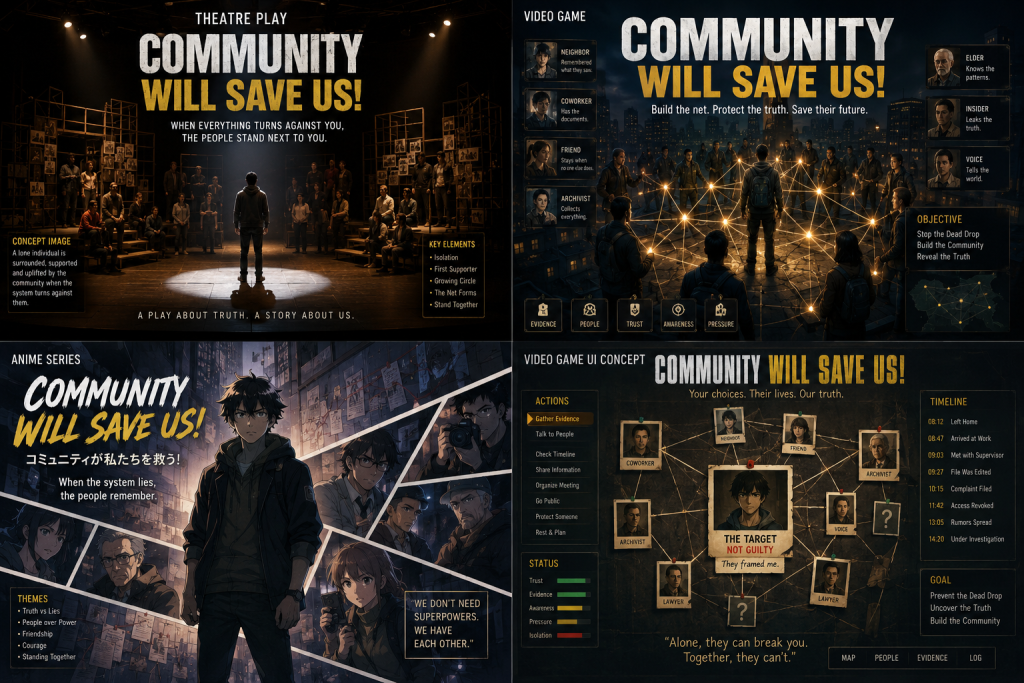
Main Symbol: The Net
The franchise symbol is a simple net pattern made from human figures, hands, windows, phone screens, front doors, and streetlights.
The net should feel handmade, not corporate.
It can appear as:
- chalk lines on pavement
- thread on a map
- taped photos on a wall
- phone contact lines
- apartment windows lighting up one by one
- hands linking across a street
- a web of witness statements
- a neighbourhood map turning into a shield
Color Palette
A strong brand direction:
- black and white civic-noir base
- warm human yellow or streetlight amber
- emergency red used sparingly
- democratic blue only when used critically or ironically
- handwritten notes, stamped files, photocopied documents
- posters, flyers, stickers, protest signs, community bulletin boards
The visual style should contrast cold institutions with warm communities.
The Machine is glass, steel, fluorescent light, forms, screens, locks, cameras.
The Community is kitchens, bikes, stairwells, shops, gardens, WhatsApp groups, handwritten signs, local radio, food containers, borrowed chargers, keys, umbrellas, and people waiting outside in the rain.
Tone
The tone should be emotionally serious, but never miserable for its own sake.
It should include:
- tension
- paranoia
- anger
- humour under pressure
- neighbourhood warmth
- stubborn hope
- moral clarity
- messy humanity
- moments of absurd bureaucracy
- moments where ordinary people become unexpectedly heroic
A key tonal rule:
The franchise may show fear, but it must never worship despair.
Franchise Formats
Television Series
Each season follows one major case. Episodes reveal how the protagonist was isolated, how the Machine operates, and how the community slowly builds the net.
Season Structure
Episode 1: The Fall Begins
The protagonist is accused, abandoned, fired, evicted, threatened, or erased.
Episode 2: Nobody Answers
The official support systems fail.
Episode 3: First Witness
One person refuses to believe the official story.
Episode 4: The Timeline
The community starts collecting evidence.
Episode 5: Pressure Campaign
The Machine tries to scare people away.
Episode 6: The Net Forms
Neighbours, coworkers, and friends coordinate.
Episode 7: Public Light
The hidden story becomes visible.
Episode 8: The Standby Moment
The community physically shows up.
Episode 9: Counterattack
The Machine retaliates.
Episode 10: We Were Here
Victory may not be perfect, but the person is no longer alone, no longer erased, and no longer falling.
Comic / Graphic Novel
A high-contrast civic-noir comic style would work extremely well.
Recurring visual motif: the protagonist falling through black space while hands, strings, windows, and names form beneath them into a net.
Each chapter could focus on one witness.
Chapter titles:
- The Window Across the Street
- The Email That Wouldn’t Delete
- The Woman at Reception
- The Man with the Spare Key
- The Lunchroom Witness
- The Neighbourhood Map
- The Day Everyone Came
Film Version
A feature film version could be tighter and more emotional.
One person is framed, silenced, or institutionally abandoned. The first half is isolation. The second half is the slow awakening of everyone around them.
The climax is not a fistfight.
It is a room full of people refusing to leave.
Final image: the protagonist walking home, not as a fugitive, but surrounded by their people.
Game Version
A narrative investigation game where the player builds the community net.
Gameplay mechanics:
- collect witness statements
- connect timelines
- protect vulnerable witnesses
- choose who to trust
- manage fear and public pressure
- uncover contradictions
- organise community meetings
- decide when to go public
- prevent the protagonist from reaching the Dead Drop
The “health bar” is not physical health. It is isolation.
When isolation reaches 100%, the Machine wins.
The player reduces isolation by building trust, gathering proof, and creating public solidarity.
Main Slogan Options
- When the system drops you, the people catch you.
- No one falls alone.
- The truth needs witnesses.
- Freedom lives next door.
- They built a case. We built a net.
- The community will save us.
- Stand close. Stand together.
- A democracy is only alive when people show up.
Pilot Story Concept
Title: Community Will Save Us! — Season One: The Dead Drop
A local maintenance worker, school assistant, designer, courier, or municipal employee discovers wrongdoing inside an institution that publicly claims to protect citizens. When they report it, the story is turned against them.
Suddenly, they are described as unstable, dangerous, dishonest, aggressive, or unreliable.
Their access is revoked.
Their messages disappear.
Their friends get warned.
Their workplace distances itself.
Their rent becomes uncertain.
Their name circulates in whispers.
At first, even the protagonist starts wondering if fighting back is pointless.
Then a neighbour knocks.
She says: “I saw who came by that night.”
Then a coworker texts: “They changed the file after you left.”
Then a local shop owner says: “You were here at that time. I have the receipt.”
Then a retired lawyer from the building says: “Bring me everything.”
Then the group chat begins.
What started as one person’s collapse becomes a neighbourhood investigation.
The Machine expected silence.
Instead, it gets a map, a timeline, witnesses, documents, recordings, and twenty-seven people standing outside the hearing room.
Recurring Motifs
The Group Chat
The modern village square. Chaotic, funny, emotional, messy, full of typos, voice notes, warnings, screenshots, and sudden courage.
The Kitchen Table
Where strategy happens. Not in boardrooms. Around tea, coffee, soup, cigarettes, old laptops, and exhausted people.
The Window
A symbol of witness. Someone always saw something.
The Spare Key
A symbol of trust. Someone gives the protagonist a place to sleep, hide, breathe, or recover.
The Printed Timeline
The community turns confusion into order. Dates, names, receipts, locations, contradictions.
The Walk Together
Whenever the protagonist must face the Machine, they do not go alone.
Character Philosophy
The franchise should avoid making community look perfect.
Communities can gossip.
Communities can be afraid.
Communities can misunderstand.
Communities can fail at first.
But the heroic community is the one that corrects itself.
Someone says: “Maybe we shouldn’t get involved.”
Someone else answers: “That is exactly how they win.”
The franchise is about people choosing involvement over comfort.
The Moral Engine
Every story asks:
What do you do when helping someone becomes inconvenient?
Do you still stand next to them when your job is at risk?
When your name may be dragged in?
When your landlord may retaliate?
When the police ask questions?
When your friends tell you to stay out of it?
When the official story sounds easier to believe?
The heroes are not fearless.
They are afraid and show up anyway.
Villain Philosophy
The Machine believes:
“Everyone is alone eventually.”
The Community answers:
“Not this one.”
That simple opposition can power the whole franchise.
Franchise Bible Statement
Community Will Save Us! is a franchise about ordinary people becoming extraordinary because someone near them is about to disappear into the machinery of power.
It is not about naive optimism. It knows systems fail. It knows institutions protect themselves. It knows lies travel fast. It knows fear works.
But it also knows that a neighbour with a memory, a friend with a couch, a coworker with a screenshot, a grandmother with patience, a student with a camera, and a room full of people refusing to move can become stronger than a false official story.
The franchise believes democracy is not only defended at the top.
It is defended in stairwells.
In lunchrooms.
In group chats.
In kitchens.
In local shops.
In witness statements.
In people saying: “I know them. That is not what happened.”
When everything turns against you, what saves you is not always power.
Sometimes it is the people who still stand close enough to catch you.
COMMUNITY WILL SAVE US!
No one falls alone.
0 comments