
A franchise spin-off concept inspired by James Herbert’s The Rats universe
Rights note / source acknowledgement:
Ratarmy is conceived as an unofficial derivative franchise pitch inspired by the rat-horror world created by James Herbert, especially The Rats (1974), Lair (1979), and Domain (1984). Herbert’s The Rats was his debut horror novel and introduced oversized, hyper-aggressive black rats attacking humans in London; Domain later pushed the mythology into nuclear-apocalypse territory, with rats surviving and rising after London is devastated by nuclear war. Any official production would require permission from the James Herbert estate / rights holders.
Core franchise premise
Ratarmy takes place after the logic of Domain: humanity thinks the nuclear event created the end of civilization, but the truth is worse. The rats did not merely survive the fallout. They adapted to it.
In the contaminated underworld beneath London, rats exposed to radiation, chemical runoff, bunker waste, and infected human corpses develop a new plague ecology: nuclear infection. Their bites no longer just kill. They contaminate. They turn wounds into glowing necrotic lesions, drive survivors into fevered hallucinations, and mark the infected as prey.
The rats are no longer scattered vermin. They are a military organism.
They move in squads.
They sabotage shelters.
They drag bodies into ventilation shafts.
They learn human fear.
And beneath the ruins, a pale mutant queen-rat intelligence begins building something between a nest, a religion, and an army.
Franchise positioning
Genre: Nuclear horror / survival horror / creature apocalypse / urban siege
Tone: Bleak, filthy, brutal, political, claustrophobic
Franchise DNA: The Rats meets Aliens, 28 Days Later, Metro 2033, The Descent, Threads, and Resident Evil
Tagline:
“After the blast, the rats inherited the earth.”
The franchise should feel like the best horror level in a video game expanded into an entire mythology: dark tunnels, contaminated schools, sealed bunkers, hospitals full of bite victims, flooded Tube stations, military checkpoints, collapsing tower blocks, and rat swarms moving like black water.
1. The mythos
The Black Strain
The original giant black rats from Herbert’s world are the foundation. In Ratarmy, their mutation becomes militarized by the nuclear aftermath.
The new strain is called:
R-N7: The Black Glow
A post-nuclear infection carried through:
- rat bites
- rat urine
- corpse contamination
- aerosolized nest spores
- infected water
- human survivors eating contaminated food
The infection does not turn people into zombies. That would be too easy. It turns people into beacons.
The infected sweat pheromones that attract rats. Their blood becomes warm, metallic, and detectable from long distances. The rats can smell panic, fever, and radiation sickness. The longer someone survives infection, the more the swarm wants them.
2. The central horror idea
The rats are not monsters invading civilization.
They are civilization’s replacement.
They understand tunnels better than humans.
They reproduce faster.
They can eat the dead.
They can live in poison.
They thrive in what humans made unlivable.
That makes Ratarmy a horror franchise about consequences: urban neglect, nuclear policy, class abandonment, government secrecy, and the idea that the creatures underneath the city were always waiting for humanity to ruin the surface.
This directly respects the original Herbert lineage, where the rat horror is tied to urban decay, post-war London memory, and social breakdown; Domain in particular uses nuclear catastrophe as the setting in which rats and human collapse become inseparable.
3. Main setting
London: The Gnawed City
The franchise is set across layered Londons:
Surface London
A gray wasteland of ash, sirens, quarantine towers, crashed buses, burned estates, dead pigeons, military leaflets, and survivors hiding above ground because the underground belongs to the rats.
The Tube
The main horror playground. Dark platforms. Emergency lights. Screaming from tunnels. Rats moving behind tiled walls. Trains converted into barricades. Entire stations turned into nests.
Government Bunkers
The elite tried to survive underground. Unfortunately, underground is rat territory. Some bunkers become sealed tombs. Others become laboratories.
The Warm Zones
Radioactive heat pockets where rats breed faster. Human Geiger counters click before the swarm appears.
The Nest Cathedral
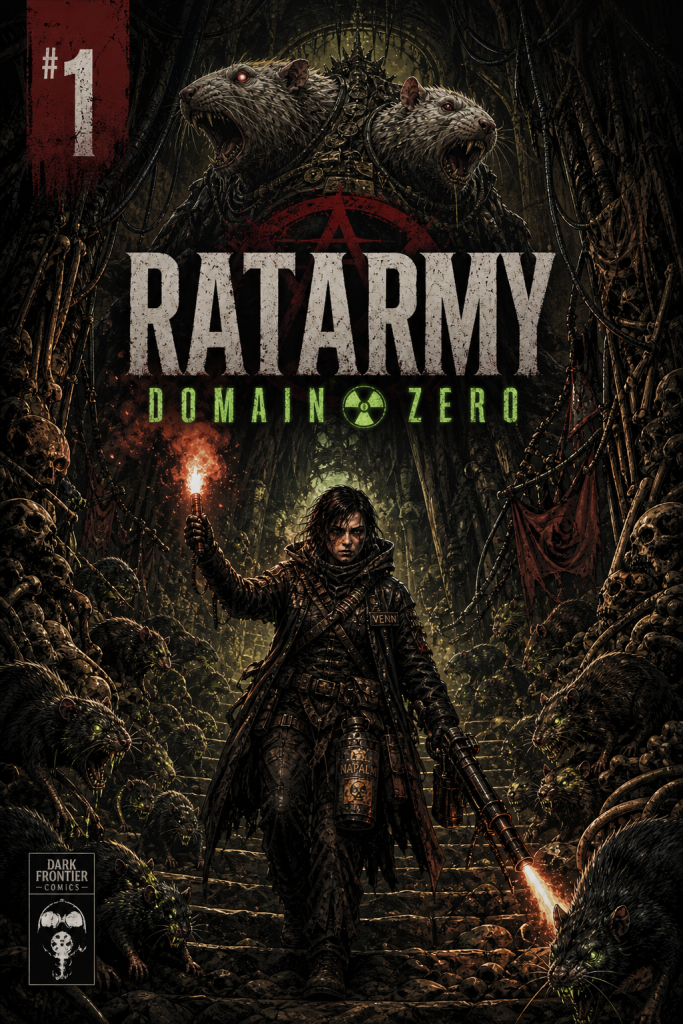
A vast underground rat city made from bones, insulation foam, chewed cables, clothing, human hair, plastic, and irradiated meat. At its center lives the franchise’s queen intelligence.
4. The rats
Standard Black Rats
Dog-sized, fast, coordinated, vicious. The direct inheritance from Herbert’s original horror logic.
Glowbacks
Rats with radiation burns along their spines. Their fur has fallen out in patches. Their bite causes fever and sensory distortion.
Nest Priests
Pale, hairless rats that do not attack first. They direct swarms through ultrasonic calls. They are the tactical officers of the Ratarmy.
Bone Carriers
Large rats that drag body parts back to the nest. They wear scraps of flesh, bone, and cloth as accidental armor.
Tunnel Mothers
Pregnant mega-rats that produce infected litters at terrifying speed. Killing one can release hundreds of newborn rats.
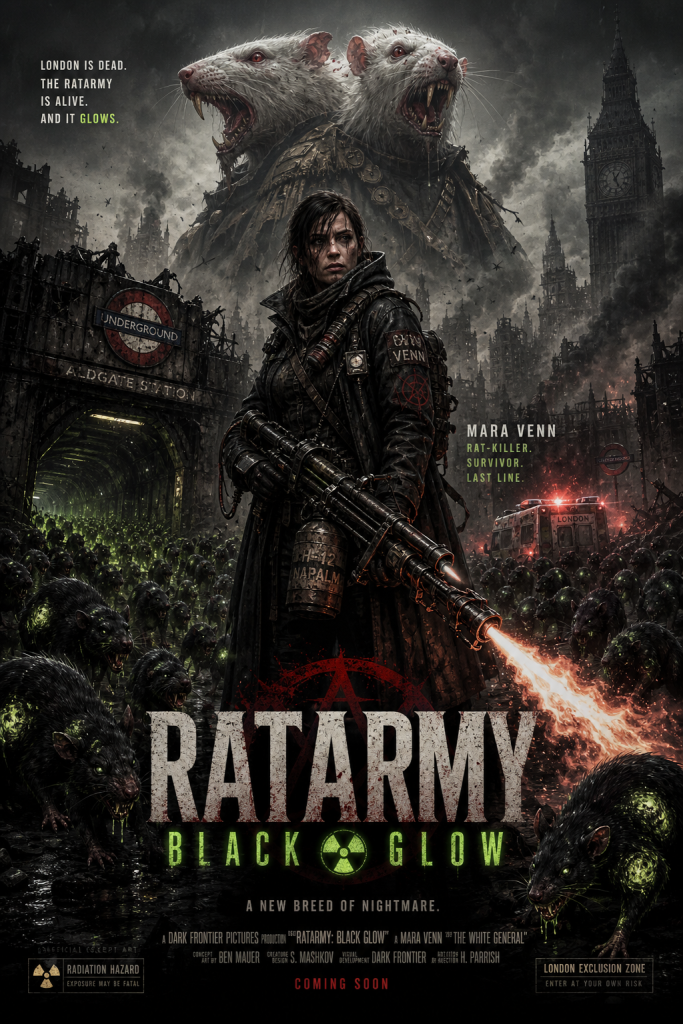
The White General
A two-headed albino mutant descended conceptually from the monstrous genetic line implied in The Rats. Not a copy-paste, but a mythic continuation: the rats’ command intelligence made visible. Herbert’s original novel ends with the survival of a female rat and the birth of another white two-headed mutant, so Ratarmy uses that idea as ancestral horror rather than pretending it is new.
5. Human factions
The Shelterborn
People raised or trapped in bunkers after the blast. They fear the surface, but they fear the tunnels more.
The Bite Wardens
Medical survivors who operate quarantine clinics. They amputate bite wounds fast. Sometimes too fast.
The Ministry Remnant
A surviving government/military faction that knows the rats were studied before the nuclear event. They are not heroes. They want to weaponize the infection.
The Scavenger Choir
Children and teenagers who move through rooftops, churches, shopping centers, and elevated train lines. They sing or whistle to detect echo changes in tunnels.
The Vermin Saints
A cult that believes the rats are the rightful inheritors of the earth. They feed people to the nests to avoid being attacked.
The Ratcatchers
The franchise’s anti-hero faction. Ex-transport workers, pest controllers, soldiers, sewer engineers, nurses, art teachers, squatters, and criminals who understand the old city better than the authorities do.
6. Main characters
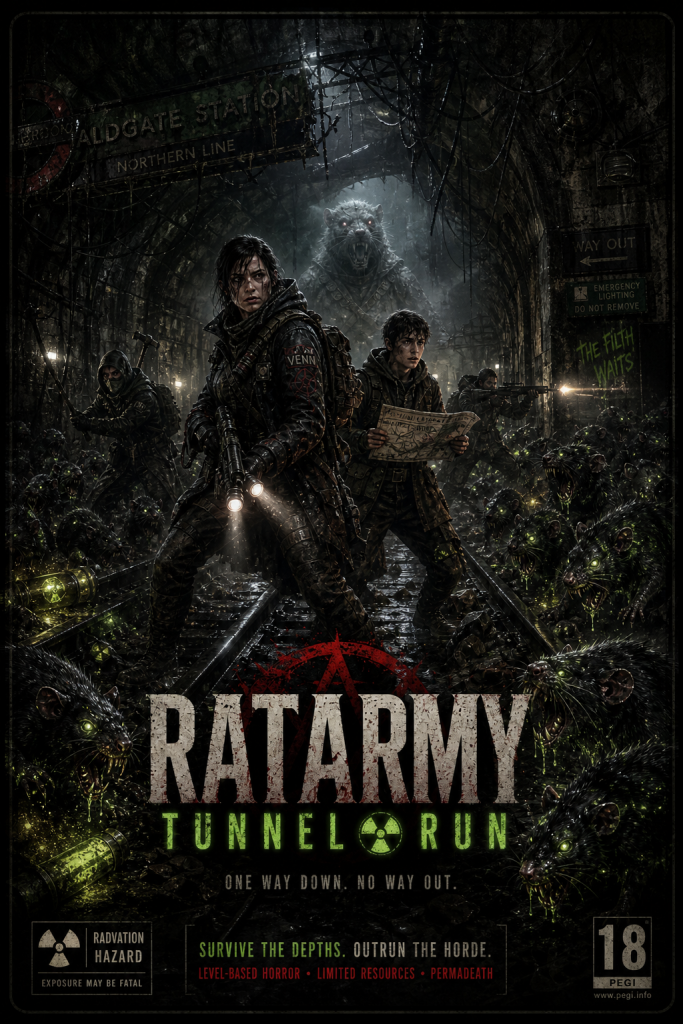
Mara Venn
A former pest-control officer who knows rat behavior better than anyone alive. She is practical, brutal, and disgusted by government incompetence. Her signature weapon is a modified thermal lance used to burn nests out of walls.
Eli Croft
A teenage courier born after the blast. He has never seen a clean sky. He can hear certain rat frequencies after surviving a childhood bite.
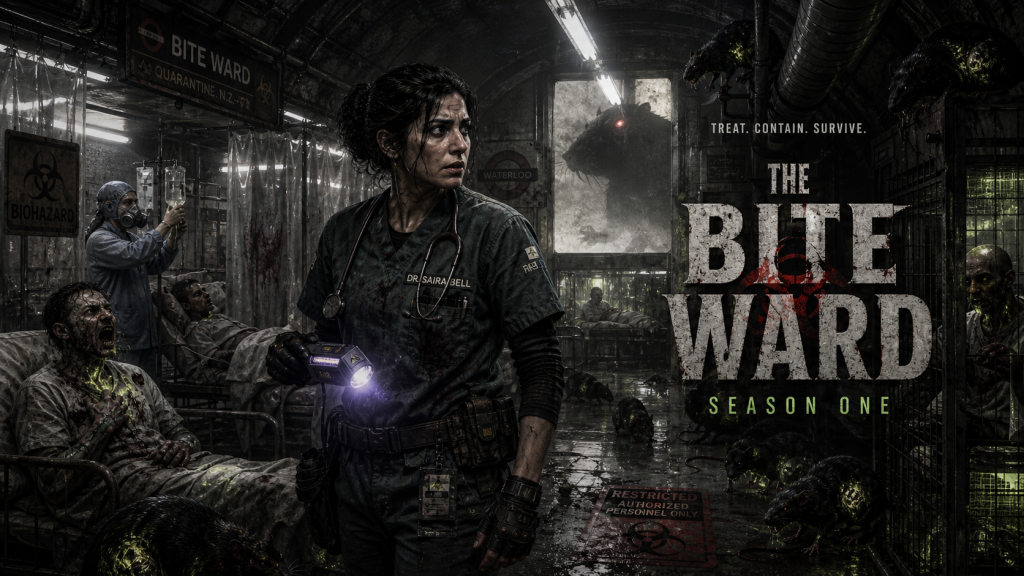
Dr. Saira Bell
A bunker virologist who discovers that the infection is not just biological. It is behavioral. The rats are using disease as a hunting map.
Moses Pike
An ex-Tube engineer who has memorized abandoned service routes. He treats London like a corpse he still loves.
“Saint” Agnes Row
Leader of the Vermin Saints. She believes humanity had its chance and failed. She may be insane, or she may understand the new world better than anyone.
The White General
Not a speaking villain. Not a cartoon mastermind. It is a presence. It appears in security footage, reflections, fever dreams, and the final moments before an attack.
7. Franchise structure
Film One: RATARMY: BLACK GLOW
A sealed survivor bunker loses contact with its surface scouts. When bite victims begin glowing under UV medical lamps, Mara Venn is brought in to identify the contamination. She discovers the bunker’s ventilation system has already been mapped by rats.
The film becomes a siege story: humans trapped inside a supposed safe place while the rats dismantle it from within.
Final image: the bunker doors open at dawn, revealing thousands of rats arranged in the street like an army waiting for orders.
Film Two: RATARMY: THE WARM ZONES
The survivors travel across ruined London to reach a rumored clean-water facility. Along the way, they discover places where radiation heat has accelerated rat evolution.
This is the expansion film: bigger world, bigger nests, stranger mutations. The Ministry Remnant appears and reveals they once tracked the original black rat outbreaks but buried the evidence.
Final image: a map of Britain marked with infected cities. London was not the only nest.
Film Three: RATARMY: DOMAIN ZERO
The heroes descend into the original source zone beneath London, where the rats have built the Nest Cathedral. The White General is revealed not as one creature, but as a recurring genetic command-form: whenever one dies, another is born.
The humans cannot “defeat” the rats. They can only decide whether to destroy the city completely or learn how to survive beside the new dominant species.
Final image: a child survivor leaves food at a tunnel mouth. The rats do not attack. They watch.
8. Prestige TV spin-off
THE BITE WARD
A six-part horror medical drama set in an underground quarantine hospital.
Each episode follows a different infected patient:
- The Courier — a boy who survived a bite and can predict swarm movement.
- The Soldier — a Ministry Remnant officer carrying classified files.
- The Mother — a pregnant woman bitten while scavenging baby formula.
- The Saint — a cultist who wants the infection to complete her.
- The Doctor — Saira Bell realizes she is infected.
- The Ward — the hospital itself becomes bait.
Tone: Chernobyl meets The Thing with rats inside the walls.
9. Video game adaptation
RATARMY: TUNNEL RUN
Genre: First-person survival horror / stealth / resource management
Core fantasy: You are not fighting one monster. You are managing swarm pressure.
Gameplay loop
- search abandoned buildings
- seal vents
- treat bites
- manage infection
- listen for swarm movement
- choose whether to use loud weapons
- burn nests
- rescue or abandon infected survivors
- navigate Tube tunnels with failing batteries
Signature mechanic: The Swarm Meter
The rats are always aware of sound, heat, blood, and infection. The more careless you are, the more coordinated the rats become.
Signature horror moment
You enter a station platform. It looks empty. Then every advertisement poster on the wall begins to ripple because rats are moving behind them.
10. Visual style
Palette: soot black, corpse white, hazard yellow, Geiger green, dried blood red
Texture: wet concrete, torn insulation, ash, fur, rust, warning tape, chewed plastic
Camera language: low angles, tunnel vision, emergency lighting, CCTV footage, bodycam panic
Sound design: claws behind plaster, distant squealing, Geiger clicking, ventilation drones, children whispering “don’t bleed”
The rats should not be cute. They should look intelligent in the worst possible way.
11. Themes
Class abandonment
The poor are bitten first. The rich hide underground and discover they have moved into the rats’ kingdom.
Nuclear inheritance
The old world’s weapons create the new world’s predators.
Urban revenge
The city’s neglected spaces become alive.
Infection as information
The plague is not just a disease; it is a communication system between prey and predator.
Humanity as infestation
The franchise keeps asking: what if the rats are not invading our world, but cleaning up after us?
12. Franchise bible summary
Ratarmy is a horror franchise built as a respectful synthesis from James Herbert’s rat-apocalypse lineage. It does not erase the source. It openly stands on it.
Where The Rats made the city fear what lived beneath it, and Domain placed that horror inside nuclear ruin, Ratarmy asks what happens next:
After nuclear collapse, the rats organize.
After infection, humans become trackable.
After government failure, the underground becomes a battlefield.
After civilization dies, the vermin inherit strategy.
Final franchise line:
“They were pests when we owned the city. They became soldiers when we destroyed it.”
0 comments