

Subtitle: Twenty-One Generations
BUSHMASTER is a darkly comic jungle survival franchise about a self-declared expert colonist who arrives in an ancient rainforest armed with books, maps, theories, tools, and total confidence — only to discover that every rule he knows is wrong, late, stolen, or dangerously incomplete.
Opposite him is the real Bushmaster: a sharp, dry, Indigenous jungle expert from a lineage that has survived the forest for generations. He does not need to prove anything. He lives there. He watches the outsider explain the jungle badly, corrects him with one sentence, and lets reality do the rest.
The franchise is built around one core joke with endless depth:
The colonist thinks knowledge makes him superior.
The Bushmaster knows survival is relationship, memory, humility, and attention.
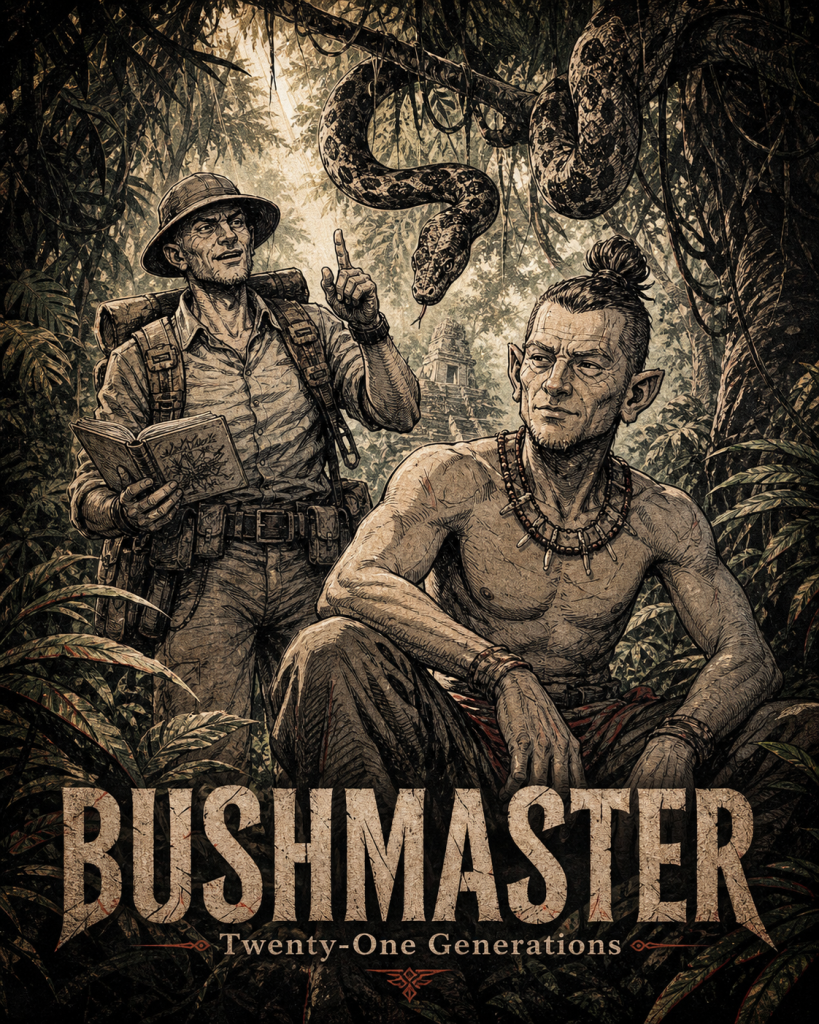
Core Premise
A European explorer, academic, missionary, entrepreneur, or government “specialist” enters the jungle with a professional manual and a colonial mindset. He believes he is there to map, classify, improve, rescue, or monetize the forest.
He meets The Bushmaster, a local survival master who has seen this type before.
At first, the outsider speaks like an expert.
Then the jungle answers.
A snake drops from a tree.
A “medicinal” plant is misidentified.
A path disappears.
A fruit bites back.
The water has opinions.
A bird repeats his arrogance back at him.
The Bushmaster calmly updates the lesson:
“Twenty-one generations.”
Each episode, comic, game level, or book chapter begins with imported certainty and ends with embodied knowledge winning.
Franchise Logline
When a self-important colonial survival expert enters the rainforest to teach the locals how to survive, he is forced to learn from the one man who has already survived it for twenty-one generations: the Bushmaster.
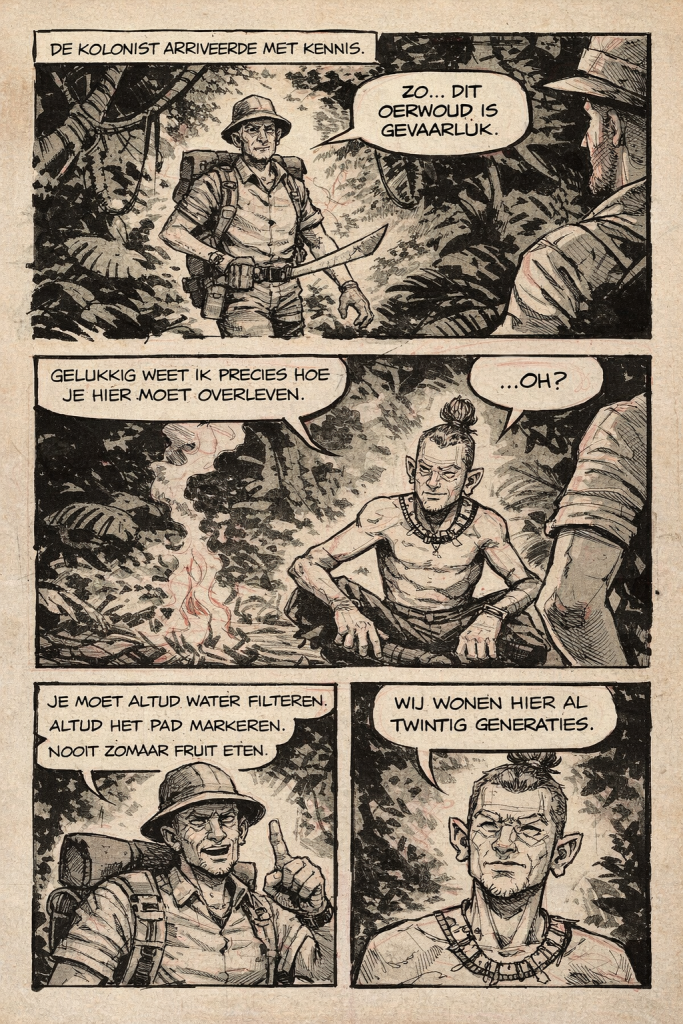
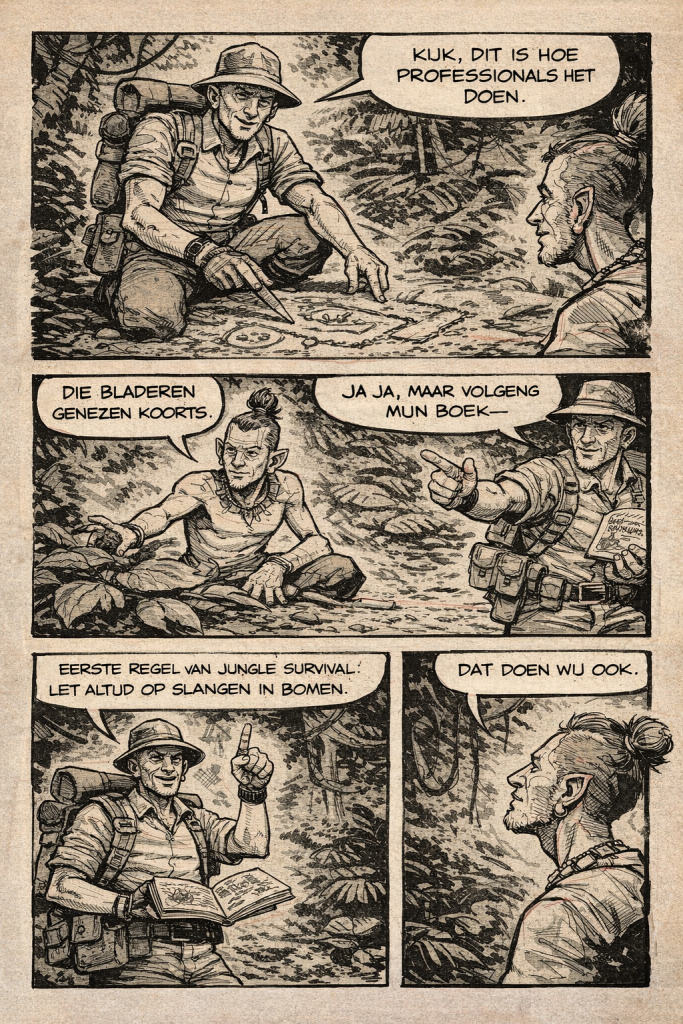
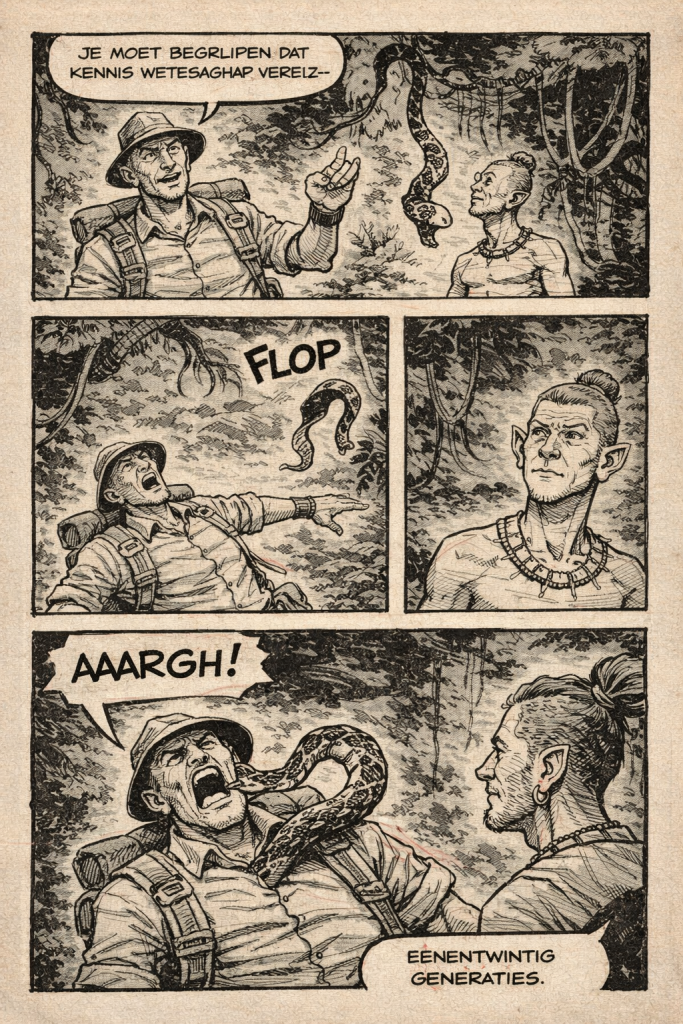
Tone
Satirical jungle adventure.
Dark comedy.
Anti-colonial survival farce.
Educational without becoming polite.
The tone should feel like:
- A vintage adventure comic turned inside out.
- A survival manual that keeps humiliating its author.
- A buddy comedy where only one buddy knows they are in a buddy comedy.
- A jungle horror story for arrogant experts.
- A field guide written by the forest itself.
It should be funny, sharp, and visually beautiful, but never soft. The jungle is not a theme park. The joke is not that the outsider gets hurt for no reason. The joke is that arrogance has consequences.
Main Characters
1. The Bushmaster
The true protagonist.
He is calm, lean, observant, and extremely unimpressed. His knowledge is not mystical, magical, or exoticized. It is practical, inherited, tested, revised, and lived.
He knows plants, animals, weather, tracks, water, insects, silence, smell, rot, timing, and people. He has no need to dominate the jungle because he understands that domination is how fools die.
Personality: dry, patient until he is not, funny without smiling, brutally economical with words.
Signature line:
“We live here.”
Or, after the outsider survives something stupid:
“Twenty-one generations.”
2. The Colonist
The recurring fool, but not a one-note villain.
He is educated, enthusiastic, and dangerous because he believes being educated makes him right. He carries books, instruments, maps, flags, patents, permits, notebooks, and a heroic self-image.
Depending on the version, he may be an explorer, professor, consultant, missionary, investor, influencer, colonial officer, NGO expert, or corporate survival trainer.
Personality: confident, performative, insecure, lecture-prone, always “according to my book.”
Visual cue: too much gear, too clean at the start, progressively shredded by the jungle.
3. The Jungle
Not a backdrop. A character.
The jungle is ancient, alive, funny, hostile, generous, indifferent, and exact. It does not punish morality. It corrects bad assumptions.
It has recurring “voices”: birds that mimic, insects that swarm at dramatic timing, vines that behave like slapstick traps, frogs that appear like judges, and snakes that deliver punchlines physically.
4. The Bushmaster Snake
The franchise symbol.
The snake is both literal and mythic. Sometimes it is just a snake. Sometimes it appears like the jungle’s silent editor, dropping into a scene whenever someone says something stupid enough to deserve nature’s rebuttal.
It should never become a cute mascot. It is elegant, dangerous, and inevitable.
The Engine of the Franchise
Every story follows a clean, repeatable structure:
1. The outsider arrives with a rule.
Example:
“Never drink untreated water.”
“Always mark the trail.”
“Avoid these plants.”
“Snakes cannot climb this high.”
“According to science…”
2. The Bushmaster quietly complicates it.
He explains that the rule may be useful somewhere else, in a different season, for a different forest, with different animals, under different weather.
3. The outsider ignores nuance.
He performs expertise for the audience, his notebook, or his superiors.
4. The jungle responds.
A slapstick disaster, survival crisis, or beautifully drawn ecological correction.
5. The Bushmaster solves it simply.
Not with spectacle, but with knowledge.
6. The final line reverses the power dynamic.
Usually short, dry, and devastating.
Example:
Colonist:
“By my calculation, we are perfectly safe.”
Bushmaster:
“Your calculation is standing on an anthill.”
Themes
Knowledge vs. Wisdom
The franchise is not anti-science. It is anti-arrogance. The outsider’s problem is not that he reads books. His problem is that he mistakes books for reality.
Indigenous Knowledge as Living Technology
The Bushmaster’s knowledge is not folklore decoration. It is a survival system, scientific in the deepest sense: tested over time, adjusted by observation, and transmitted through practice.
The Jungle Cannot Be Owned
Maps fail. Names fail. Fences rot. Extractive logic collapses. The forest remains.
Comedy as Correction
Every joke is a tiny decolonization. The person who thinks he is the teacher becomes the lesson.
Survival Is Relationship
Water, food, shelter, medicine, navigation, danger — none of these exist as isolated “tips.” They are part of a living network.
Visual Style
The reference images already define a strong franchise language:
Black-and-white ink comic.
Rough paper texture.
Vintage adventure-strip layout.
Heavy jungle blacks.
Sharp hatching.
Hand-lettered Dutch-style speech balloons.
Thin red editorial sketch marks hidden under final ink.
The finished style should feel like a high-end European graphic novel crossed with a colonial field journal that has been vandalized by truth.
Signature Visual Rules
- The colonist is drawn with straight lines, rigid posture, equipment, rectangles, straps, notebooks.
- The Bushmaster is drawn with relaxed curves, asymmetry, organic silhouette, grounded posture.
- The jungle should visually swallow panels as the story progresses.
- Speech balloons from the colonist are large and over-explanatory.
- Speech balloons from the Bushmaster are short and devastating.
- The snake often appears in panel borders, vines, shadows, or negative space before becoming visible.
- The final panel of each strip should feel like a visual punchline.
Format Possibilities
1. Graphic Novel Series
Volume 1: The Man With the Manual
The colonist arrives to “document” the forest and quickly becomes dependent on the man he intended to study.
Volume 2: The Map That Lied
A colonial map leads an expedition into territory the mapmaker never understood.
Volume 3: Twenty-One Generations
The Bushmaster’s lineage, family, rivals, losses, teachers, and responsibilities become central.
Volume 4: The Forest Has Notes
The jungle itself becomes the counter-author to the colonist’s book.
2. Animated Series
Short episodes, 8–12 minutes each.
Every episode begins with a “survival lesson” title card:
- Lesson 01: Do Not Lecture the River
- Lesson 02: The Fruit Is Not Your Friend
- Lesson 03: The Snake Heard You
- Lesson 04: A Map Is Not a Memory
- Lesson 05: Never Trust a Quiet Bird
- Lesson 06: Your Boots Are Loud
- Lesson 07: Fire Is Also Hungry
- Lesson 08: The Jungle Does Not Care About Your Degree
The animation should preserve the inked comic look: limited color, paper texture, moving panels, animated hatching, expressive shadows.
3. Survival Comedy Game
A narrative survival game where the player begins as the colonist and slowly learns that success requires listening.
The central mechanic: unlearning.
The player starts with a manual full of wrong or incomplete assumptions. Each failed attempt unlocks corrections from the Bushmaster.
Game Systems
- Track reading
- Water judgment
- Plant identification
- Animal warning signs
- Weather pattern recognition
- Silence meter
- Arrogance meter
- Trust meter
- Manual correction system
The funniest mechanic: the more the player lectures, the more danger increases.
4. Field Guide / Art Book
A fake survival manual filled with colonial notes, crossed-out corrections, Bushmaster annotations, snake diagrams, plant pages, map fragments, and comic strips.
Title:
The Bushmaster Survival Guide
Corrected Edition
Inside, every “official” rule is marked up by the Bushmaster.
Example:
Rule: “Boil all water.”
Correction: “Good. But first ask why the water is dead.”
Rule: “Follow the moss.”
Correction: “Follow your eyes. Moss did not sign your contract.”
Episode / Chapter Examples
Episode 1: This Jungle Is Dangerous
The colonist arrives and announces that the forest is hostile. The Bushmaster asks hostile to whom. The colonist explains his equipment. The jungle immediately steals half of it.
Final line:
“The forest did not attack you. It inspected you.”
Episode 2: According to My Book
The colonist identifies a harmless-looking plant as medicinal. The Bushmaster says it depends on which part, which season, which preparation, and who is asking.
The colonist eats it anyway.
Final line:
“Your book skipped the chewing chapter.”
Episode 3: Snakes in Trees
The colonist gives a lecture about ground-level snake awareness. The Bushmaster looks up. The colonist does not.
A snake falls.
Final line:
“Twenty-one generations.”
Episode 4: The Professional Way
The colonist marks a trail with symbols. The Bushmaster points out that the marks also tell predators, rivals, insects, and thieves exactly where he is.
Final line:
“Very professional. Everyone can find you now.”
Episode 5: The Map
The colonist insists the map shows a river crossing. The Bushmaster says the river moved three seasons ago.
The colonist says rivers do not move.
The river moves.
Final line:
“Tell the map.”
Episode 6: The Cure
The colonist dismisses leaf medicine as superstition. Later, fever hits. The Bushmaster treats him while explaining dosage, preparation, and observation.
Final line:
“Superstition is what you call knowledge before you need it.”
Franchise Identity
Main Title Treatment
BUSHMASTER should be bold, hand-inked, slightly uneven, like it was carved into a field journal with a knife.
The “S” can subtly resemble a snake.
Color System
Primary:
- Bone paper
- Deep black ink
- Dirty grey wash
- Faded red pencil correction marks
Optional accent:
- Poison green, used extremely rarely
- Dried blood red for danger marks
- Weathered yellow for aged documents
Logo Concept
A coiled bushmaster snake forming a circular seal. Inside the coil: a broken compass, a leaf, and one watchful human eye.
Around the seal:
BUSHMASTER
TWENTY-ONE GENERATIONS
Character Design Direction
The Colonist
- Safari hat
- Rolled sleeves
- Belt full of tools
- Overstuffed backpack
- Notebook always visible
- Clean-shaven at first, increasingly ruined
- Body language: pointing, explaining, leaning forward, occupying space
The Bushmaster
- Minimal gear
- Sharp profile
- Strong eyes
- Necklace or inherited object
- Hair tied up
- Barefoot or practical footwear depending on setting
- Body language: seated, still, watching, listening, conserving energy
The Snake
- Patterned like ink shadows
- Often hidden in foliage
- Appears before the colonist notices
- No cartoon eyes
- Elegant menace
Merchandise & Product Lines
Product
Concept
Graphic novel hardcovers
Premium black-and-white editions with textured paper
Survival Guide art book
Fake colonial manual corrected by the Bushmaster
Field notebook
Pages with printed “wrong rule / real rule” structure
Enamel pins
Snake coil, broken compass, “Twenty-One Generations”
Posters
Large inked jungle panels with minimal typography
T-shirts
“Tell the map.” / “The snake heard you.” / “We live here.”
Tarot-style card set
Jungle Lessons: River, Snake, Leaf, Fire, Silence
Board game
Cooperative survival game where arrogance kills the party
RPG supplement
Jungle campaign setting focused on ecology, knowledge, and consequences
Animation pitch bible
High-end studio package with panel-to-screen visual development
Bigger Franchise Potential
The concept can expand beyond one colonist.
Each season or book can introduce a different kind of “expert”:
- The Missionary
- The Botanist
- The Soldier
- The Influencer
- The Corporate Extractor
- The Crypto Conservationist
- The Documentary Host
- The AI Survey Drone Operator
- The Academic Who Has Never Been Bitten
- The Museum Collector
The Bushmaster remains the constant. The jungle remains the judge.
The Franchise Promise
Every installment delivers three things:
- A beautiful jungle adventure
- A brutal comedy of arrogance
- A real reversal of who gets to be called knowledgeable
The audience comes for the snake gag.
They stay because the Bushmaster is right.
Final Pitch
BUSHMASTER is a satirical adventure franchise about the collapse of imported certainty. It uses the language of old colonial jungle comics — the explorer, the map, the survival lesson, the dangerous wilderness — and flips the whole machine.
The colonist arrives with knowledge.
The Bushmaster has memory.
The colonist brings books.
The Bushmaster brings twenty-one generations.
And somewhere above them, in the branches, the snake is already listening.
0 comments