

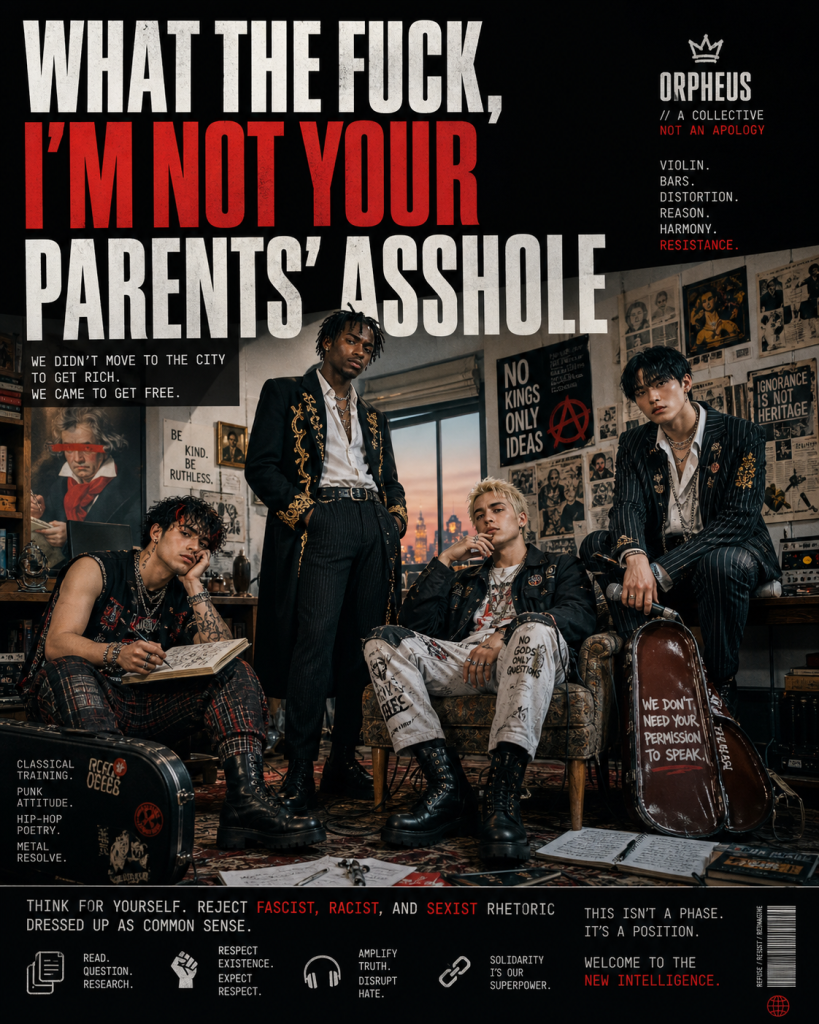
WHAT THE FUCK, I’M NOT YOUR PARENTS’ ASSHOLE
A metropolitan youth-commentary music franchise about intelligence, identity, resistance, and refusing to inherit other people’s prejudice.
1. Core Concept
WHAT THE FUCK, I’M NOT YOUR PARENTS’ ASSHOLE is a music-driven youth franchise built around four alternative, genre-fluid metropolitan misfits who look like a boy band, perform like a punk opera, argue like philosophers, and speak like they have already survived ten cultural collapses.
They are not “rebels without a cause.”
They are rebels with homework.
The group blends punk, hip-hop, metal, classical music, spoken word, satire, and public argument into a sharp live-performance universe. Their central conflict is not fame, romance, or popularity. Their conflict is with the dead weight of inherited stupidity: lazy racism, sexism, fascist nostalgia, performative toughness, and young people repeating old people’s bigotry because they think it makes them sound mature.
The franchise is about youth commentary that does not sound naive. It sounds educated, angry, funny, stylish, and dangerous in the right way.
2. Franchise Logline
Four hyper-intelligent metropolitan misfits form a genre-fluid performance collective that turns concerts, apartment arguments, public confrontations, and cultural meltdowns into a sharp satirical rebellion against prejudice disguised as “common sense.”
3. Short Pitch
Imagine a boy band that was raised by punk flyers, hip-hop battles, black metal record sleeves, classical conservatory trauma, public libraries, cheap city rooms, and a refusal to become anyone’s obedient cultural mascot.
They live together, rehearse together, argue together, and perform together in dense urban accommodation spaces: rented rooms, shared apartments, rehearsal basements, temporary housing, backstage corridors, student flats, hotel rooms, night trains, cultural residencies, and half-legal creative spaces.
Every episode, song, poster, concert, or comic chapter begins from one question:
Who taught you to think like that — and why are you repeating it?
4. Title Meaning
WHAT THE FUCK, I’M NOT YOUR PARENTS’ ASSHOLE is not just shock language. It is the franchise thesis.
It means:
You do not get to dump your inherited fear onto me.
You do not get to make me perform your old social rules.
You do not get to call your prejudice “tradition.”
You do not get to confuse cruelty with wisdom.
You do not get to make young people your mouthpiece.
The title should feel like a concert title, a manifesto, a social-media detonation, and a warning label.
5. Tone
The tone is:
Sharp. Urban. Funny. Intelligent. Confrontational. Stylish. Profane. Moral without being preachy.
It should feel like:
A punk zine with a library card.
A hip-hop cypher in a philosophy seminar.
A classical quartet after three espressos and one eviction notice.
A metal show where the encore is a public ethics lesson.
A boy band if every member had read too much, slept too little, and refused to smile on command.
The franchise should never feel like bland activism. It should feel alive, witty, irritated, theatrical, and dangerous to stupid ideas.
6. The Band / Collective
Main Group Name Options
The poster suggests ORPHEUS // A COLLECTIVE. That is strong and should be kept as the “serious” name.
Possible full naming system:
ORPHEUS // A COLLECTIVE
Public-facing performance unit.
WTFINYPA
Abbreviated campaign, tour, merch, and symbol system.
Not An Apology
Album title, manifesto phrase, or recurring slogan.
New Intelligence
Movement name, fanbase, or second-season arc.
7. Main Members
The group should be four distinct archetypes, each representing a different intelligence and musical language.
1. THE ORATOR
Role: vocalist, lyricist, public speaker, hip-hop / spoken word engine
Visual: tailored punk, gold embroidery, street-preacher elegance, combat boots, rings, long coat
Energy: calm, intimidating, precise
Core wound: tired of being treated as symbolic instead of human
Strength: can destroy an argument in three sentences
Weakness: sometimes mistakes emotional distance for discipline
Instrument / mode: voice, bars, essays, live crowd confrontation
Signature line:
“Don’t quote history at me if you only read the parts that excused you.”
The Orator is the moral spine of the group. Not the leader exactly, but the person who can stop a room from lying to itself.
2. THE NOISE THEORIST
Role: producer, sampler, beatmaker, electronic disruption, hip-hop/punk hybrid
Visual: headphones, sleeveless tops, utility pieces, patched gear, DIY tech
Energy: restless, fast, analytical
Core wound: grew up surrounded by people who called intelligence “attitude”
Strength: hears patterns in chaos
Weakness: burns out because everything feels urgent
Instrument / mode: sampler, drum machine, field recordings, distorted beats
Signature line:
“Your opinion has a rhythm. Unfortunately, it’s a march.”
The Noise Theorist turns arguments, street sounds, news clips, family fights, and public stupidity into percussion.
3. THE CLASSICAL DAMAGE
Role: strings, arrangement, harmony, emotional architecture
Visual: cello/violin case, black tailoring, gothic jewelry, formalwear broken into streetwear
Energy: elegant, intense, slightly haunted
Core wound: trained to be perfect, learned perfection was another kind of cage
Strength: brings beauty into rage
Weakness: can become elitist when threatened
Instrument / mode: cello, violin, piano, orchestral motifs, counter-melodies
Signature line:
“Civilization is not manners. Civilization is what you refuse to normalize.”
The Classical Damage gives the franchise its tragic, cinematic dimension. They make the rebellion sound expensive, ancient, and wounded.
4. THE BEAUTIFUL PROBLEM
Role: visual identity, guitar/bass, fashion, provocation, emotional volatility
Visual: pinstripes, eyeliner, metal jewelry, punk romance, sharp androgyny
Energy: glamorous, sarcastic, unstable in a productive way
Core wound: constantly told to “pick a side,” “act normal,” or “be easier to understand”
Strength: turns identity into a weaponized art form
Weakness: can confuse being seen with being safe
Instrument / mode: guitar, bass, hooks, visual performance, public mischief
Signature line:
“You don’t hate confusion. You hate not being in charge of the categories.”
The Beautiful Problem is the most visibly iconic member. They become the poster, meme, fashion silhouette, and chaos generator.
8. Group Dynamic
The four members are not a traditional band with one frontman. They operate more like a creative cell.
Their arguments are part of the franchise.
They fight about:
What counts as resistance.
Whether anger is useful or addictive.
Whether beauty makes politics stronger or weaker.
Whether intelligence can become arrogance.
Whether young people owe patience to people who refuse to learn.
Whether the city liberates them or simply sells them a more expensive cage.
Their chemistry should feel like a mix of bandmates, roommates, siblings, rivals, lovers-in-the-abstract, and co-defendants.
9. World
The world is not fantasy, but it should feel heightened.
Everything happens in places where people are temporarily contained:
Shared apartments.
Basements.
Hostels.
Student housing.
Backstage rooms.
Hotel corridors.
Night buses.
Train stations.
Emergency accommodation.
Artist residencies.
Squats.
Short-term rentals.
Community centers.
Rooftops.
Rehearsal studios.
Cheap kitchens after midnight.
This “accommodation central” environment is important. They are always housed, but never fully settled. Always inside, but never safe. Always in transit, even when sitting still.
The city is a pressure cooker. The apartment is a stage. The rehearsal room is a courtroom. The concert is the verdict.
10. Visual Identity
Core Palette
Black.
White.
Red.
Occasional dirty cream paper.
Optional hot pink for special editions or zine variants.
Texture
Photocopied paper.
Torn posters.
Old classical portraits vandalized with red bars.
Graffiti slogans.
Barcode graphics.
Instrument cases with stickers.
Luxury tailoring damaged by real life.
Urban windows at night.
Book piles.
Sheet music.
Cables.
Boots.
Rugs.
Cheap lamps.
Expensive thoughts in poor rooms.
Typography
Huge condensed uppercase.
Distressed sans-serif.
Typewriter captions.
Handwritten slogans.
Blackletter hints only when connected to metal/classical references.
Never too clean. Never corporate. Never cute.
Symbols
Crown.
Anarchy-style circle mark.
Violin case.
Broken chain.
Brain.
Raised fist.
Safety pin.
Barcode.
Red eye-bar over classical portraits.
“WTF” monogram.
“NOT AN APOLOGY” stamp.
11. Thematic Pillars
1. Youth with Depth
The franchise rejects the idea that young people are shallow by default. These characters are young, but they think historically, morally, musically, and structurally.
2. Anti-Parroting
The main enemy is not age. The enemy is repetition without thought. Especially young people repeating prejudice because they think cruelty sounds adult.
3. Genre Fluidity
The music refuses category. Punk, hip-hop, metal, classical, electronic, poetry, and theory all collide.
4. Accommodation as Pressure
The characters are always in shared or temporary spaces. The lack of stable private space makes every conversation public, every conflict overheard, every rehearsal political.
5. Beauty as Resistance
The group is stylish because style is part of the argument. Beauty is not decoration; it is proof of self-authorship.
6. Intelligence as a Weapon
The franchise celebrates wit, study, research, and verbal precision. Not academic elitism, but street-level intelligence with receipts.
12. Musical Identity
The sound should be built around collision.
Core Ingredients
Distorted punk bass.
Trap drums and boom-bap breaks.
Metal guitar textures.
Classical strings.
Choir-like gang vocals.
Spoken-word monologues.
Industrial noise.
Baroque flourishes.
Public argument samples.
Crowd chants.
Sudden silence.
Song Types
The Manifesto Track
Big slogans, chantable hooks, confrontational.
The Apartment Track
Intimate, bitter, funny, based on roommate conflict.
The Public Fight Track
Built around overheard prejudice, street arguments, viral clips.
The Classical Collapse Track
Beautiful strings gradually destroyed by distortion.
The Anti-Anthem
A song that refuses to become easy inspiration.
The Crowd Trial
Live call-and-response where the audience becomes part of the argument.
13. Sample Album Titles
NOT AN APOLOGY
New Intelligence
No Kings, Only Ideas
Common Sense Is Where Prejudice Hides
Speak in Cages / Sing in Cages
The Future Isn’t Polite
We Came to Get Free
Respect Existence, Expect Respect
Violins, Bars, Distortion, Reason
Be Kind. Be Ruthless.
14. Sample Tracklist
- What the Fuck, I’m Not Your Parents’ Asshole
- No Kings, Only Ideas
- Your Opinion Has a Uniform
- We Didn’t Move to the City to Get Rich
- Common Sense Costume Party
- Classical Training / Punk Attitude
- Speak in Cages
- Be Kind. Be Ruthless.
- Ignorance Is Not Heritage
- New Intelligence
- The Future Isn’t Polite
- Not an Apology
15. Series Format Options
A. Animated Adult Music Series
A sharp, stylized series following the group through rehearsals, concerts, public confrontations, and chaotic accommodation life. Each episode builds toward a performance.
B. Live-Action Dramedy
Urban, dialogue-heavy, music-driven. Think backstage chaos, apartment politics, creative process, and social satire.
C. Graphic Novel / Zine Series
Each issue focuses on one gig, one room, one argument, one song, and one ideological confrontation.
D. Transmedia Band Franchise
Real songs, fake tour posters, music videos, character social feeds, live visual performances, merch, and fictional interviews.
Best approach: transmedia first. Treat them like a real band from the start.
16. Episode / Issue Formula
Each story begins with a social irritation.
Someone says something lazy.
Someone repeats a fascist, racist, or sexist idea as if it is “just being honest.”
Someone mistakes cruelty for intelligence.
Someone asks the group to behave, simplify, smile, or be marketable.
Then:
The group argues internally.
They break the topic apart through music, research, jokes, and personal experience.
The accommodation space becomes unbearable.
A rehearsal mutates into a confrontation.
The final performance turns the argument into art.
End result: not a lecture, but a cultural slap.
17. Sample Episodes
Episode 1: Not Your Parents’ Asshole
The group is booked for a “youth culture” event, only to discover the sponsors want them to perform a safe, decorative version of rebellion. They rewrite the entire set overnight.
Episode 2: Common Sense
A young influencer goes viral for repeating reactionary talking points and calling them “common sense.” The group samples the clip into a brutal track.
Episode 3: No Kings, Only Ideas
A fight breaks out over tradition, monarchy, status, and obedience after one member defaces a classical portrait with a red bar over the eyes.
Episode 4: Speak in Cages
A venue asks them to remove “political content.” They respond by performing the quietest, most devastating song of the season.
Episode 5: Be Kind. Be Ruthless.
The group debates whether kindness means patience or whether, sometimes, kindness requires refusing to tolerate harmful bullshit.
Episode 6: The Future Isn’t Polite
A younger fan confronts them: are they actually helping, or just making anger fashionable?
Episode 7: Accommodation Central
Their living situation collapses during a residency. Every member’s private coping mechanism becomes public.
Episode 8: New Intelligence
The season finale. A concert becomes a public counter-ritual against inherited fear, lazy nostalgia, and fashionable ignorance.
18. Dialogue Style
Dialogue should be fast, articulate, profane, and layered.
Not everyone speaks the same way. Some are poetic. Some are surgical. Some are sarcastic. Some speak through references, samples, or music.
Example lines:
“Being offensive is easy. Being accurate is harder.”
“You don’t have an opinion. You have a family curse with Wi-Fi.”
“Tradition is not automatically wisdom. Sometimes it’s just peer pressure from dead people.”
“You keep saying ‘normal’ like it’s a moral achievement.”
“If your freedom requires someone else to disappear, that’s not freedom. That’s interior decorating for fascists.”
“Don’t confuse volume with courage.”
“We are not here to be your edgy children. We are here to be the consequence.”
19. Antagonists
The franchise should avoid cartoon villains only. The enemies are social patterns.
Recurring antagonist types
The Young Reactionary
A young person who thinks old prejudice makes them sound brave.
The Liberal Manager
Claims to support the group but wants every sharp edge removed.
The Nostalgia Dealer
Sells a fake past as identity.
The Culture Vulture
Wants the aesthetic without the politics.
The Respectability Cop
Insists the group would be more persuasive if they were nicer, cleaner, quieter, less themselves.
The Algorithm
Not a person, but a force constantly rewarding simplification, outrage, and bad-faith performance.
20. Audience
Primary audience:
Young adults, alternative youth, music fans, design culture people, queer/fluid fashion scenes, punk/hip-hop/metal crossover audiences, zine readers, political satire fans, and people tired of shallow online discourse.
Secondary audience:
Older viewers who understand youth culture is often smarter than institutions give it credit for.
The franchise should not beg for mainstream approval. It should be strong enough that mainstream culture has to come to it.
21. Merch & Visual Products
Tour posters.
Patch sets.
Sticker sheets.
Zines.
Instrument-case decals.
Black hoodies with red typography.
White shirts with “NOT AN APOLOGY.”
Tote bags reading “READ. QUESTION. RESEARCH.”
Bandanas with symbol system.
Vinyl records with foldout manifesto posters.
Fake ticket stubs.
Character portrait cards.
Accommodation Central room maps.
Lyric booklets styled like court evidence.
22. Slogans
Not an apology.
No kings, only ideas.
Think for yourself.
Ignorance is not heritage.
Respect existence. Expect respect.
The future isn’t polite.
We came to get free.
We don’t perform for your prejudice.
Common sense is where cowardice hides.
Read. Question. Research.
New generation. Sharp minds. Loud truths.
We don’t need your permission to speak.
23. Franchise Promise
Every piece of the franchise must deliver at least three things:
- A sharp visual hit
It should look like a poster someone would steal from a wall. - A strong cultural argument
It must have something to say beyond “rebellion looks cool.” - A musical or rhythmic identity
Even when it is a comic, poster, or episode, it should feel like music is pushing through it.
24. Final Positioning Statement
WHAT THE FUCK, I’M NOT YOUR PARENTS’ ASSHOLE is a franchise about young people who refuse to become decorative rebels, obedient children, marketable identities, or mouthpieces for inherited hate.
It is a band.
It is a show.
It is a zine.
It is a concert.
It is a public argument with better clothes.
It is youth commentary with teeth.
The message is simple:
Grow up. Think harder. Stop parroting prejudice. And don’t confuse being loud with being right.
0 comments