

Subtitle: Follow the Money. Question the Story. Understand the World.
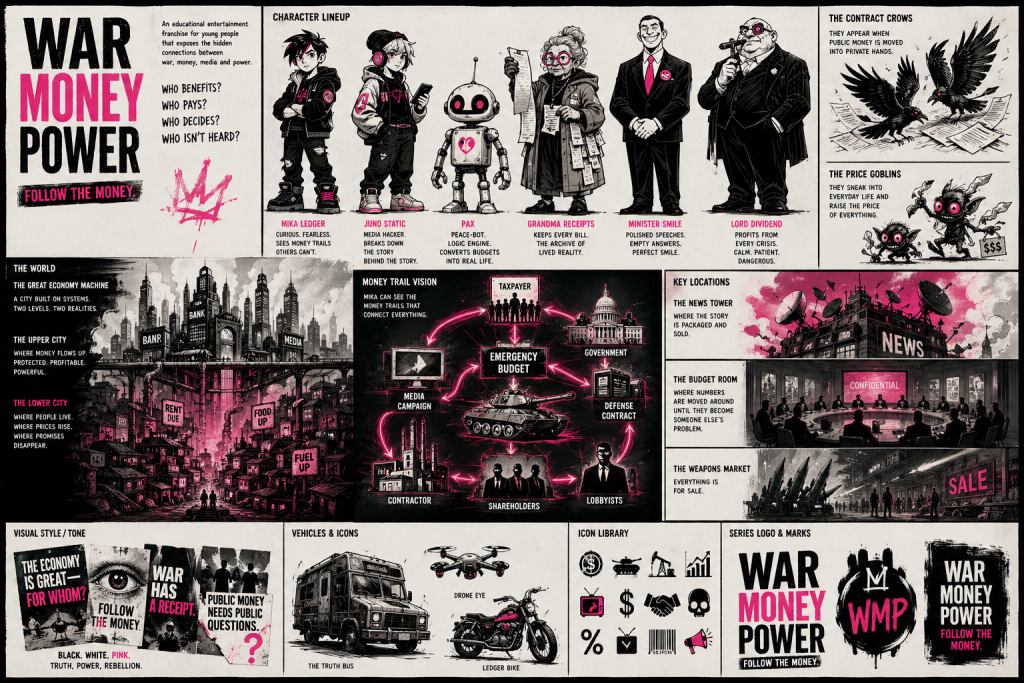
1. Core Franchise Thesis
WAR MONEY POWER is an educational entertainment franchise for young people about war, money, media, power, and everyday life.
The franchise teaches youth that wars are not only about borders, flags, heroes, villains, or speeches. Wars are also about resources, profit, contracts, subsidies, energy, weapons, reconstruction, public fear, and who gets richer while ordinary people become poorer.
The franchise does not tell young people what political opinion to have. It teaches them how to think.
The central question is:
When war happens, who benefits, who pays, and who is being asked to believe the story?
2. Franchise Mission
The mission is to make young people financially, politically, and media literate about conflict.
Most war education is too simple. It often focuses on dates, battles, leaders, maps, and national stories. But modern youth also need to understand:
Why prices go up.
Why governments spend billions.
Why some companies profit during crisis.
Why the news says the economy is strong while families struggle.
Why public money often flows upward before it flows downward.
Why fear is one of the most profitable tools in history.
The franchise turns these ideas into characters, stories, games, classroom tools, animation, music, posters, and interactive media.
3. Target Audience
Primary Audience
Ages 12–18
Teenagers who are beginning to understand the world but are often given childish explanations by adults, institutions, media, and governments.
Secondary Audience
Ages 18–25
Young adults, students, activists, designers, media makers, and early voters who want sharper civic education.
Tertiary Audience
Teachers, parents, youth workers, documentary makers, social studies programs, libraries, museums, NGOs, and independent educational platforms.
4. Franchise Tone
The tone should be:
Bold, visual, direct, funny, uncomfortable, rebellious, but educational.
It should feel like a mix of:
political cartoon, street poster, animated explainer, classroom rebellion, satirical news show, economic survival guide, and youth mystery series.
The franchise should never feel like a dry schoolbook.
It should feel like:
“They never explained this properly in school — so now we will.”
5. Franchise Title Options
Main Title Recommendation
WAR MONEY POWER
Clear, strong, educational, expandable.
Alternative Titles
Follow the Money
The War Machine
Who Gets Paid?
Economy of War
The Price of Peace
Boom Boom Budget
The Billionaires’ Battlefield
The Profit Front
The War Show
Crisis Kids: Follow the Money
6. Central Franchise Format
The franchise works best as a hybrid between fiction and explanation.
Each episode, chapter, game level, or lesson begins with a real-world question:
Why is fuel expensive?
Why do weapons companies grow during war?
Why do governments say there is no money for people, but there is money for war?
Why does the news say the economy is strong when people feel poorer?
Why do companies receive subsidies before citizens do?
Who makes money from fear?
Then the story enters a fictional world where those systems become characters, machines, monsters, villains, games, and puzzles.
7. Franchise World
The World: The Great Economy Machine
The story takes place in a surreal version of our world called The Great Economy Machine.
It looks like a giant city built out of factories, banks, news studios, pipelines, data centers, parliament buildings, military warehouses, supermarkets, school classrooms, and apartment blocks.
Everything is connected by pipes, wires, money tubes, fuel lines, contracts, news screens, and tax funnels.
The city has two levels:
The Upper City
Where the richest people, corporations, lobbyists, contractors, and political insiders live. Everything is clean, shiny, protected, and profitable.
The Lower City
Where normal people live. Prices rise, wages fall behind, rent increases, schools are underfunded, and everyone is told:
“The economy is doing great.”
The contradiction is visible everywhere.
Billboards say:
“Growth is up!”
Supermarket shelves say:
“Price increased again.”
News screens say:
“Strong economy!”
Kids’ lunchboxes say:
“Empty.”
That is the world of the franchise.
8. Main Characters
1. Mika Ledger
The main protagonist.
Mika is a sharp, curious teenager who notices contradictions adults pretend not to see. Mika asks questions that make teachers nervous, politicians sweat, and billionaires change the subject.
Mika’s special ability is seeing money trails. When someone says, “This is for security,” Mika can see glowing lines of money moving behind the speech.
Catchphrase:
“Okay. But who gets paid?”
2. Juno Static
Mika’s best friend.
Juno is obsessed with media, memes, videos, edits, livestreams, and propaganda. Juno can pause news broadcasts and pull apart the language being used.
Juno teaches media literacy.
Catchphrase:
“That’s not information. That’s packaging.”
3. Pax
A small peace-bot built from recycled school equipment.
Pax is logical, kind, awkward, and brutally honest. Pax calculates what else public money could have bought instead of weapons, subsidies, bailouts, or political theater.
Example:
“One billion in subsidies could fund school meals, housing support, public transport, or healthcare. Would you like the comparison in sandwiches, classrooms, or hospital beds?”
Catchphrase:
“Converting budget into real life.”
4. Grandma Receipts
An older streetwise character who has saved every bill, tax letter, price increase, rent notice, newspaper headline, and government promise for the last forty years.
She is the archive of lived reality.
She teaches that ordinary people always know when the economy is lying, because they feel it first in rent, food, energy, and debt.
Catchphrase:
“Don’t show me the slogan. Show me the receipt.”
5. Minister Smile
A recurring antagonist.
A polished politician who appears on every screen saying:
“Everything is under control.”
“The economy is strong.”
“Temporary hardship is necessary.”
“We must support stability.”
Minister Smile never answers direct questions. He redirects, reframes, delays, and praises “growth.”
His visual design: perfect suit, empty eyes, permanent smile, pockets full of contracts.
Catchphrase:
“The numbers are positive, so your suffering is statistical confusion.”
6. Lord Dividend
The main villain.
A billionaire war-profiteer who owns shares in weapons, energy, reconstruction, private security, media outlets, and emergency supply chains.
He does not start every war, but he knows how to profit from every crisis.
He never shouts. He is calm, polite, and terrifying.
Catchphrase:
“Conflict is unfortunate. Margin is inevitable.”
7. The Contract Crows
A flock of black birds made of folded legal documents.
They appear whenever public money is being moved quietly into private hands.
They whisper:
“Procurement.”
“Emergency powers.”
“Strategic partnership.”
“National interest.”
“No public tender required.”
They are creepy, funny, and educational.
8. The Price Goblins
Small chaotic creatures that sneak into supermarkets, petrol stations, rent contracts, and energy bills at night, changing numbers upward.
They are not the real cause of inflation, but they personify the experience of ordinary people watching life become unaffordable.
Their role is comic relief with a serious lesson.
9. Main Villain System
The real villain is not one person. It is a system called:
THE PROFIT FRONT
The Profit Front is a hidden network of companies, lobbyists, investors, media owners, political consultants, and crisis managers who benefit when fear, scarcity, and war expand.
Their rule is simple:
Never waste a crisis.
The Profit Front does not always create the problem, but it always knows how to turn the problem into revenue.
10. Season One Concept
Season Title
The Economy Is Doing Great
Season Premise
Mika, Juno, Pax, and Grandma Receipts live in a city where prices are rising, schools are losing funding, public transport is expensive, and families are struggling.
At the same time, every news screen repeats:
“The economy is doing great.”
Then a war begins far away. Politicians say sacrifice is necessary. Billions are approved overnight. Weapons companies celebrate record growth. Energy companies receive support. Citizens are told to tighten their belts.
Mika asks the forbidden question:
“If everyone is struggling, who is the economy doing great for?”
That question opens the door to The Profit Front.
11. Episode Guide — Season One
Episode 1: The Economy Is Doing Great
Mika notices that every adult is stressed about money while the news says the economy is strong. Pax explains the difference between economic growth and purchasing power.
Educational theme:
Economic growth does not automatically mean ordinary people are doing well.
Episode 2: The Price Goblins
Food, fuel, and rent prices rise overnight. The Price Goblins are blamed, but Mika discovers the real causes are supply chains, energy costs, corporate pricing, scarcity, and political decisions.
Educational theme:
Inflation is not magic. It has causes, winners, and losers.
Episode 3: The Billion Button
A government emergency meeting approves one billion in support for an industry, while schools are told there is no budget. Pax converts the billion into meals, classrooms, nurses, and housing support.
Educational theme:
Public money reflects political priorities.
Episode 4: Minister Smile Goes Live
Minister Smile gives a speech about sacrifice. Juno pauses the broadcast and breaks down the language: “temporary,” “necessary,” “security,” “stability,” “responsibility.”
Educational theme:
Political language often hides choices behind emotions.
Episode 5: The Contract Crows
The team follows a flock of Contract Crows to a secret warehouse where public contracts are being signed at midnight.
Educational theme:
War creates contracts, and contracts create profits.
Episode 6: The Fear Factory
The team discovers a factory that turns fear into public consent. The more scared people are, the easier it becomes to move money without questions.
Educational theme:
Fear can be used to reduce public scrutiny.
Episode 7: Weapons, Energy, Reconstruction
Lord Dividend explains his business model: profit before, during, and after war.
Before war: sell weapons.
During war: sell energy, security, logistics.
After war: sell reconstruction.
Educational theme:
Some industries profit across the full cycle of conflict.
Episode 8: The Empty Lunchbox Index
Grandma Receipts creates a better economic measurement: how many children can eat, travel, study, and live without fear.
Educational theme:
A healthy economy should be measured by human wellbeing, not only profit or growth.
Episode 9: Follow the Money
Mika’s power grows. They can now see money trails from taxes to subsidies to companies to shareholders.
Educational theme:
Budget literacy is democratic literacy.
Episode 10: Who Pays?
The final episode shows the full chain: war spending, public debt, inflation, subsidies, media framing, corporate profit, and household hardship.
Mika ends the season by addressing the audience directly:
“Next time someone says there is no money, ask where the money went.”
Educational theme:
Democracy requires informed questioning.
12. Core Educational Principles
The franchise should repeat these lessons across all formats:
1. War Has Many Causes
War can involve territory, power, fear, history, nationalism, ideology, resources, defense, revenge, and money.
2. Money Must Always Be Examined
Even when war is explained morally or politically, young people should ask who profits.
3. Public Money Is Public Business
Citizens have the right to understand subsidies, military spending, bailouts, and emergency budgets.
4. “The Economy” Is Not One Thing
The economy can be strong for investors and weak for families at the same time.
5. Purchasing Power Is Real Life
If people cannot afford food, rent, energy, transport, and education, then economic success is not reaching them.
6. Media Language Shapes Public Understanding
Young people need to learn how slogans, headlines, and official phrases influence emotions.
7. Questioning Is Not Disrespect
Asking “who benefits?” is basic citizenship.
13. Visual Identity
The visual style should connect to the Not You Again / studio-grade black-and-white language.
Core Palette
Black — power, money, ink, shadow, industry
White — education, truth, paper, clarity
Bright pink — warning, youth energy, rebellion, signal
Occasional red/orange — crisis, heat, fuel, alarm
Visual Style
Thick marker lines.
Political cartoon energy.
Newspaper textures.
Receipts.
Price tags.
War maps.
Glowing money trails.
Graffiti typography.
Sticker-like slogans.
Big readable text.
High contrast for accessibility.
Design Motifs
Receipts
Contracts
Pipelines
Crow feathers
Price stickers
Broken piggy banks
TV news frames
Military budget charts
Lunchboxes
Supermarket shelves
Fuel pumps
Billion-euro buttons
Smiling politicians
Black birds made of paperwork
14. Logo Concept
Main Logo
WAR MONEY POWER
Typography: bold condensed black letters, slightly distressed, as if stamped on government paperwork.
The word MONEY can be in bright pink.
Possible arrangement:
WAR
MONEY
POWER
With a small subtitle underneath:
FOLLOW THE MONEY
Alternative visual: the “O” in MONEY becomes a coin, eye, target, or camera lens.
15. Signature Slogans
Follow the money.
Who benefits? Who pays?
The economy is great — for whom?
Don’t show me the slogan. Show me the receipt.
War is expensive. Someone is getting paid.
Public money. Public questions.
Fear sells. Peace doesn’t trend.
If prices go up, ask who profits.
A strong market is not the same as a healthy society.
Question the story before it becomes history.
16. Franchise Formats
Animated Series
Short 8–12 minute episodes for youth platforms, schools, and streaming.
Each episode combines story, satire, explanation, and visual metaphors.
Graphic Novel Series
Black-and-white with pink accents. Strong for classrooms and libraries.
Each volume focuses on one topic:
Volume 1: The Economy Is Doing Great
Volume 2: The Price Goblins
Volume 3: The Contract Crows
Volume 4: The Fear Factory
Volume 5: The Billionaire Battlefield
Classroom Toolkit
Teacher-friendly lesson packs with:
discussion questions, worksheets, debate prompts, budget exercises, media literacy tasks, and poster assignments.
Card Game
Title: Who Gets Paid?
Players receive crisis cards, budget cards, public need cards, corporate lobby cards, and media cards. The goal is to trace where money moves and expose hidden incentives.
Mobile Game
Title: Follow the Money
Players navigate a city, scan speeches, trace money trails, unlock documents, question officials, and compare public budgets.
Social Media Shorts
30–90 second clips answering one question at a time:
What is purchasing power?
What is a subsidy?
What is a defense contractor?
Why do prices rise during war?
Can GDP grow while people get poorer?
Posters
Large classroom and street-poster visuals:
“THE ECONOMY IS GREAT — FOR WHOM?”
“WAR HAS A RECEIPT.”
“FOLLOW THE MONEY BEFORE YOU FOLLOW THE FLAG.”
“PUBLIC MONEY NEEDS PUBLIC QUESTIONS.”
17. Educational Game Mechanics
Mechanic 1: Money Trail Vision
Players or viewers see glowing trails showing where public money goes.
Taxpayer → Government → Emergency Budget → Contractor → Shareholder → Lobbyist → Media Campaign.
Mechanic 2: Slogan Decoder
Students decode official language.
Example:
“Strategic support package”
Possible meaning: money given to a selected sector.
“Temporary hardship”
Possible meaning: ordinary people pay more.
“Market confidence”
Possible meaning: investors are reassured.
Mechanic 3: Budget Converter
A number like €1 billion is converted into real-life alternatives:
school meals, nurses, teachers, social housing units, public transport passes, youth mental health support, energy relief.
Mechanic 4: Who Benefits Board
Every major event is mapped through four questions:
Who says it is necessary?
Who pays for it?
Who profits from it?
Who is not being heard?
18. Classroom Lesson Example
Lesson Title
The Economy Is Doing Great — For Whom?
Objective
Students learn the difference between national economic indicators and lived economic reality.
Opening Question
If the news says the economy is doing well, but people cannot afford rent, food, energy, or transport, is the economy really doing well?
Activity
Students receive a fictional national budget.
They must divide money between:
defense, energy subsidies, schools, housing, healthcare, public transport, climate adaptation, youth services, and corporate support.
Then they compare who benefits from each budget choice.
Final Discussion
What should a healthy economy measure?
Possible answers:
food security, housing, health, education, wages, safety, free time, public trust, clean environment, peace.
19. Ethical Positioning
This franchise should be sharp, but it must stay educational.
It should avoid saying every war has only one cause. Instead, it should teach that economic motives are often hidden or under-discussed.
The safest and strongest educational position is:
Wars have many causes, but money and power are always worth investigating.
This makes the franchise credible, teachable, and harder to dismiss as propaganda.
20. Franchise Bible Statement
WAR MONEY POWER is an educational entertainment franchise that teaches young people to understand war through economics, media literacy, public money, and lived reality. It uses bold characters, satire, visual storytelling, games, and classroom tools to explain how conflict creates profit, how public money moves, how media language shapes belief, and how ordinary people often pay the price. The franchise empowers youth to ask democratic questions: who benefits, who pays, who decides, and why are we being told this story?
0 comments