
Subtitle
The ball went out. The dog did not bring it back. Then heaven got involved.
1. Core Concept
Fetch Never Happened is a supernatural comedy-adventure franchise about a dead man arriving in heaven with one very specific request:
He does not want eternal peace.
He does not want forgiveness.
He does not want to become an angel.
He wants to be reincarnated as his own Manchester terrier.
Why?
Because the dog had the best life he had ever seen.
No rent.
No tax.
No guilt.
No career.
No heartbreak.
Just instinct, speed, chaos, sunlight, smells, and the ancient holy duty of hunting rats.
The man tells God he finally understands the meaning of paradise: being small, fast, fearless, and permanently excited by things hiding under sheds.
God listens.
Then God asks one question:
“And what about the ball?”
Because in the man’s old life, there was one mystery that never got solved.
Every time he threw the ball, the dog chased it…
but somehow, the ball never came back.
Not once.
The dog always returned happy, muddy, victorious, and completely empty-mouthed.
The man thought the dog was stupid.
He was wrong.
The dog was involved in something much bigger.
2. Franchise Logline
After dying and asking God to reincarnate him as his mischievous Manchester terrier, a restless man is reborn into a secret animal underworld where every “lost” ball is part of a cosmic war between dogs, rats, birds, angels, and the forgotten machinery of heaven.
3. The Big Franchise Engine
The central joke becomes the central mythology:
Dogs do not fail to bring the ball back.
Dogs choose not to.
Every thrown ball enters a hidden system.
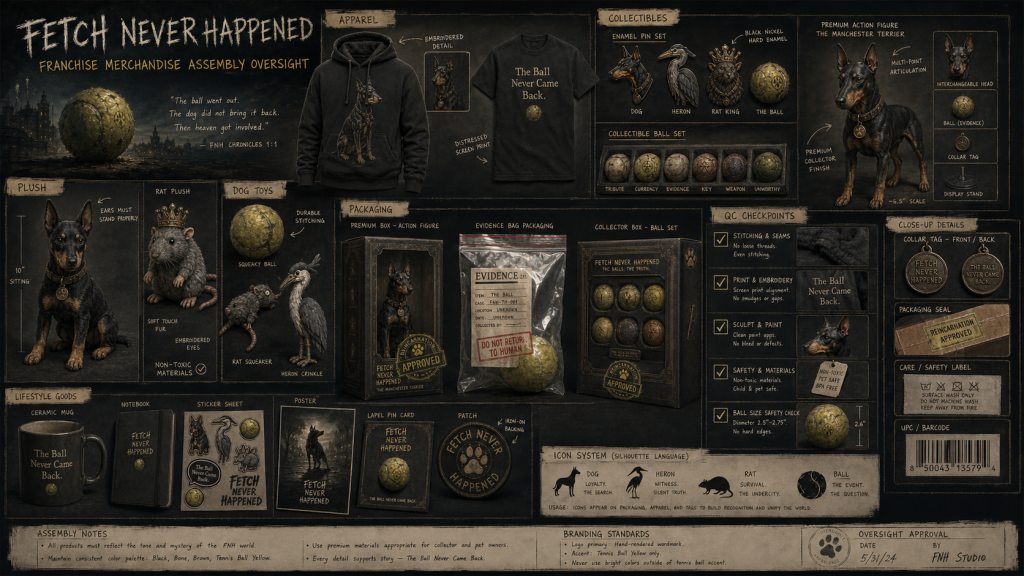
Some balls become currency.
Some are offerings.
Some are weapons.
Some are keys.
Some contain human memories.
Some are evidence.
Some should never be returned.
The man, now reborn as a Manchester terrier, discovers that every dog park, alley, canal bank, backyard, and abandoned construction site is part of an invisible world operating beneath human awareness.
The dog was never “just playing fetch.”
The dog was doing missions.
4. Tone
The tone sits between:
The Big Lebowski — laid-back absurd philosophy, accidental hero energy.
Men in Black — secret world hidden inside normal life.
All Dogs Go to Heaven — spiritual animal mythology.
Wallace & Gromit — physical comedy, inventions, chases, visual gags.
John Wick, but for terriers — intense underworld rules treated with ridiculous seriousness.
The franchise should feel funny, strange, emotional, stylish, and occasionally profound.
The comedy comes from animals taking their roles very seriously while humans misunderstand everything.
5. Genre
Supernatural comedy
Animal adventure
Urban fantasy
Afterlife satire
Buddy action
Family animation / adult crossover comedy depending on format
6. Target Audience
Primary audience: teens and adults who enjoy surreal comedy, animal characters, mythological world-building, and emotionally weird stories.
Secondary audience: family viewers, dog lovers, animation fans, comedy-adventure fans, and anyone who has ever thrown a ball for a dog and wondered what the hell the dog was actually doing.
7. Main Character
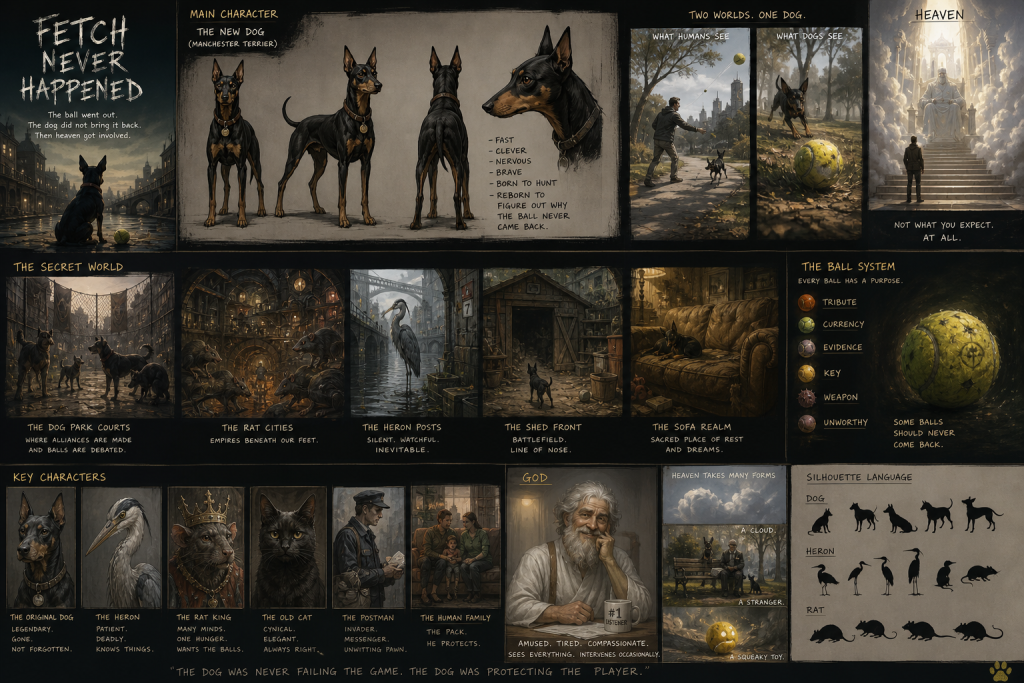
ALF / THE MAN / “THE NEW DOG”
A man who lived a complicated, tired, overthinking human life. He had jobs, relationships, responsibilities, regrets, and a dog who seemed happier than any person he knew.
In heaven, he realizes he does not want another human chance. He wants something simpler and wilder.
When reincarnated as a Manchester terrier, he expects freedom.
Instead, he gets recruited.
Character flaw
He still thinks like a human. He wants explanations, fairness, logic, and closure.
Dog lesson
The world is not understood by thinking.
It is understood by chasing.
Core emotional arc
He learns that joy is not stupidity. Instinct is not ignorance. Play is not meaningless. Sometimes the most serious mission in the universe looks like a dog running after a ball.
8. The Dog Form
Manchester Terrier
The perfect reincarnation choice.
Sleek.
Fast.
Sharp.
Nervous intelligence.
Rat-hunting history.
Elegant but slightly manic.
Small enough to be underestimated.
Brave enough to make that everyone else’s problem.
The Manchester terrier becomes the franchise’s central heroic silhouette: black-and-tan, alert ears, tight body, suspicious eyes, explosive speed.
He is part gentleman, part assassin, part household goblin.
9. Alternative Reincarnation Temptation
The Heron
Before the final reincarnation, God offers alternatives.
The man considers becoming a heron, because herons also hunt small creatures and stand around like ancient judgmental priests.
This becomes a recurring cosmic joke.
Herons in this universe are not peaceful birds.
They are tall, silent, canal-side executioners with long beaks and unreadable spiritual authority.
They know things.
Dogs fear nothing except vacuum cleaners, fireworks, and herons who stare too long.
10. God
God is not presented as grand and untouchable.
God is calm, dry, amused, and deeply tired of everyone asking to come back as billionaires, eagles, dolphins, or “someone taller.”
When the man asks to come back as a Manchester terrier, God is genuinely interested.
Not because it is ridiculous.
Because it may be the first honest reincarnation request in centuries.
God’s view
Humans always ask for power.
Dogs already understand heaven.
God’s role
God does not control the story like a puppet master. God opens the door and watches what happens.
God occasionally appears in strange forms: a voice from a squeaky toy, a reflection in a water bowl, an old man on a park bench, a cloud shaped like a tennis ball.
11. The Central Mythology
The Ball System
Every ball thrown by a human becomes charged with intention.
Joy.
Frustration.
Loneliness.
Hope.
Control.
Love.
Dogs chase these balls because they are not just toys. They are emotional objects carrying human energy.
When a dog does not bring the ball back, one of several things may have happened:
1. The ball became tribute
Offered to an ancient dog pack spirit.
2. The ball became evidence
Hidden from rats who use human memories to build underground empires.
3. The ball became currency
Traded in the animal black market.
4. The ball became a key
Opening forgotten gates between earth, heaven, and the animal underworld.
5. The ball was judged unworthy
Some balls are simply bad balls.
6. The dog got distracted
This remains legally acceptable under dog law.
12. The Secret Animal World
Humans see parks, canals, basements, sheds, kitchens, alleys, attics, rooftops.
Animals see kingdoms.
Key Territories
The Dog Park Courts
Where dogs negotiate territory, gossip, alliances, ball rights, and forbidden smells.
The Rat Cities
Underground empires built beneath human infrastructure. Rats are clever, organized, theatrical, and obsessed with stolen crumbs, cables, and secrets.
The Heron Posts
Canal-side surveillance zones controlled by herons. They rarely move, but they see everything.
The Compost Oracle
A rotting garden heap that knows the future because everything eventually ends up in it.
The Shed Front
The great battlefield between terriers and rats.
The Sofa Realm
A sacred domestic temple where dogs recover, dream, and accidentally kick humans in their sleep.
The Heaven Kennels
A celestial waiting area for dogs who have finished their earthly assignments but refuse to stop barking at eternity.
13. Main Supporting Characters
THE ORIGINAL DOG
The man’s former Manchester terrier.
The dog who never brought the ball back.
Now revealed to have been a legendary field agent in the hidden animal world.
He was not disobedient.
He was protecting the household from forces the man never understood.
Depending on the version, the original dog may be:
A mentor spirit.
A rival reincarnated elsewhere.
A mythic absent hero.
Or the mystery the new dog must solve.
THE HERON
A tall, severe, canal-dwelling bird who speaks rarely and judges constantly.
The heron hunts rats, but not for fun. For balance.
The heron becomes the terrier’s uneasy ally.
Their dynamic:
The dog is chaos.
The heron is silence.
The dog asks questions.
The heron stares.
The dog runs into danger.
The heron was already there.
THE RAT KING
Not one rat, but many.
A collective criminal mind living under the city. The Rat King believes humans are collapsing and animals should inherit the world.
The Rat King hates dogs, fears herons, and wants control over the lost balls because the balls contain emotional energy.
With enough lost balls, the rats can build a machine that rewrites instinct itself.
A world without chase.
A world without play.
A world without dogs being dogs.
THE OLD STREET CAT
A cynical, elegant cat who knows all shortcuts between life, death, kitchens, and rooftops.
The cat does not believe in loyalty, but keeps helping anyway.
The cat claims to hate dogs.
This is obviously false.
THE POSTMAN
The human villain who is not really a villain.
From the dog perspective, he is an invading armored courier entering the territory every day.
From the mythological perspective, postmen unknowingly carry messages between human fate-lines.
The dog’s hatred of the postman may accidentally save the universe more than once.
THE HUMAN FAMILY
The man’s former family, now seen from the dog’s point of view.
They do not know their old husband/father/friend has returned as the dog.
This creates the emotional spine of the franchise.
He can smell their sadness.
He can sense their memories.
He can comfort them.
But he cannot explain himself.
He wanted a simple life.
Instead, he gets one last chance to love without language.
14. Core Themes
Joy is sacred
The franchise treats play as a cosmic force.
Animals are not simple
They are living in worlds humans barely notice.
Reincarnation is not escape
The man becomes a dog to avoid human pain, but discovers love follows him.
Instinct has wisdom
Not everything needs to be solved intellectually.
The ball matters
Every small ritual between human and animal contains meaning.
Death is not the end
But it may come with a leash.
15. Franchise Format Options
Animated Series
Best format for long-term world-building.
Episodes follow missions involving lost balls, rat plots, household drama, animal politics, and spiritual absurdity.
Feature Film
The origin story: man dies, meets God, becomes the dog, discovers the lost ball conspiracy, and chooses his new purpose.
Graphic Novel
Strong visual potential: black-and-white animal noir with sudden bright color accents for balls, heaven, and emotional memory.
Adult Comedy Series
A darker, stranger version with philosophical dialogue, deadpan God scenes, and more surreal animal politics.
Family Adventure Franchise
A warmer version focused on friendship, home, courage, and the secret lives of dogs.
16. Pilot / Film Outline
Act I — The Last Throw
A tired man plays fetch with his Manchester terrier.
He throws the ball.
The dog runs.
The dog comes back without it.
Again.
The man laughs, annoyed. This has happened for years.
Later, the man dies unexpectedly.
He arrives in heaven.
God asks what he wants.
The man says he wants to come back as his dog.
God asks why.
The man says:
“Because he looked like he was having the time of his life.”
God smiles.
Then the man is reborn.
Act II — The First Smell
He wakes up as a Manchester terrier puppy.
The world is overwhelming.
Smell has architecture.
Sound has texture.
Fear has flavor.
Joy is physical.
He is adopted by someone connected to his old life.
He slowly realizes he is near his former family.
Then he sees a ball.
The human throws it.
His new body takes over.
He runs.
For one perfect second, he understands everything.
Then the ball rolls under a shed and disappears into a tunnel.
A rat speaks.
“Finally. We’ve been waiting for you.”
Act III — The Ball Underworld
The dog discovers that his previous Manchester terrier was part of an ancient order of rat hunters and ball guardians.
The rats are collecting lost balls.
The heron warns him not to interfere.
The cat tells him to interfere immediately because it will be funny.
The dog learns that one special ball—the first ball his human ever threw—contains a memory powerful enough to reopen the path between earth and heaven.
The Rat King wants it.
God watches.
The dog must choose:
Return the ball to the human…
or keep it away forever to protect them.
17. Season One Arc
Season Title
The Ball That Would Not Come Back
The new dog learns the rules of the animal world while trying to understand why his original dog never returned the ball.
Each episode reveals a different reason dogs “lose” things.
By the finale, he discovers that the original dog hid one final ball because it contained the man’s unfinished grief.
Bringing it back would restore his human memories completely.
But remembering everything may make it impossible for him to remain a dog.
The season ends with the dog holding the ball in his mouth at last.
His human family calls him.
For the first time in franchise history, he can bring the ball back.
He pauses.
Cut to black.
18. Episode Engine
Each episode begins with an ordinary human event that animals understand completely differently.
Examples:
“The Ball in the Wall”
A ball disappears into a wall cavity and awakens a rat archive.
“The Heron Does Not Blink”
The terrier must negotiate with a heron who has been standing in the same canal for three days guarding a dead angel’s feather.
“Postman at 11:04”
The dog discovers the postman is unknowingly delivering cursed letters written by squirrels.
“The Vacuum Prophecy”
A vacuum cleaner becomes the center of a false religion among house pets.
“Good Boy Protocol”
Every time a human says “good boy,” the dog receives a tiny burst of divine power.
“The Ball Pit Incident”
A children’s indoor play area is revealed as a dangerous portal zone where thousands of abandoned balls whisper.
“Rat Wedding”
The dog must infiltrate a royal rat wedding under a bakery.
“The Stick That Came Back Wrong”
A stick returned from the park is not a stick. It is a branch from the Tree of Judgment.
19. Visual Identity
Core look
Stylish black-and-white urban animal noir with selective color.
The dog world is textured, scratchy, kinetic, and low to the ground.
Humans are filmed or drawn from below: shoes, hands, voices, furniture, doors, dropped food.
Animals get cinematic hero framing.
Color rules
Mostly black, white, grey, tan, muddy brown.
The ball is always visually important.
A red ball, pink ball, yellow tennis ball, or glowing heavenly ball can become the episode’s key visual symbol.
Camera language
Dog POV should feel fast, chaotic, nose-led, close to the ground.
Heron POV is still, tall, cold, and symmetrical.
Rat POV is crowded, twitchy, tunnel-like, clever, and paranoid.
Heaven POV is absurdly calm.
20. Dialogue Style
Dogs speak in urgent emotional logic.
Cats speak in sarcasm.
Rats speak like politicians, criminals, and theatre directors.
Herons speak like ancient monks with murder weapons for faces.
God speaks like someone who has seen every possible mistake and still finds humans funny.
Sample dialogue
Man in heaven:
“I want to go back.”
God:
“As a better man?”
Man:
“No. As the dog.”
God:
“That is either the stupidest request I have received today or the first intelligent one.”
New Dog:
“Why didn’t he bring the ball back?”
Cat:
“Because some balls are not meant for humans.”
New Dog:
“It was a tennis ball.”
Cat:
“That is exactly what it wanted you to think.”
Heron:
“Rats do not fear teeth.”
Dog:
“They should.”
Heron:
“They fear patience.”
Dog:
“I don’t have that.”
Heron:
“I noticed.”
21. Franchise Rules
- Every lost ball has a story.
- Dogs understand heaven better than humans do.
- Rats are never random.
- Herons know more than they say.
- Cats are always involved, even when they deny it.
- Humans misunderstand 90% of what is happening.
- The dog may save the universe and still get distracted by cheese.
- The ball coming back is never guaranteed.
22. Emotional Core
Under the absurdity, the story is about grief, reincarnation, loyalty, and the secret emotional lives between humans and animals.
The man wants to become a dog because he thinks dogs are free from sadness.
But dogs are not free from love.
And love includes waiting at doors, protecting sleeping people, sensing pain, guarding homes, and sometimes refusing to bring back the ball because the human is not ready for what it contains.
The franchise’s emotional power comes from this idea:
The dog was never failing the game.
The dog was protecting the player.
23. Long-Term Mythology
Across multiple seasons or films, the franchise can expand into:
The First Dog
The original divine animal who taught humans play.
The Lost Ball Archive
A celestial vault containing every ball never returned.
The Rat Machine
An underground device built from stolen memory objects.
The Heron Council
A silent tribunal of birds who regulate life, death, patience, and canals.
The Human Return Problem
The dog may eventually get the chance to become human again.
But by then, he may no longer want to.
The Final Fetch
The ultimate franchise ending: one last throw, one last chase, one last decision about whether the ball should finally come back.
24. Brand Promise
Fetch Never Happened promises a story where the dumbest dog behavior turns out to be sacred, tactical, emotionally intelligent, and possibly world-saving.
It is a franchise about a man who dies, asks God for the weirdest second chance possible, and discovers that being a dog is not an escape from meaning.
It is meaning at full speed.
Tongue out.
Ears back.
Mud everywhere.
Rat detected.
Ball missing.
Perfect.
0 comments