“REDLINE REBELS”
Subtitle: Four Weirdos. One Broken City. Zero Permission.
Core Concept
Redline Rebels is an animated / graphic-novel / game-ready franchise about four hyper-stylized misfit artists, hackers, street philosophers, and anti-heroes who live inside a city where creativity has been criminalized, culture is algorithmically filtered, and every public space is controlled by image-police, brand-cults, and corporate “taste committees.”
The entire world is built from the visual language of the sketch: red pencil lines, raw construction marks, exaggerated heads, angular silhouettes, expressive hair, crooked fashion, sharp hands, unfinished bodies, attitude-first character design.
The franchise does not hide the sketchiness. The sketch is the world.
Everything looks like it was drawn in a notebook during a meeting you were not supposed to survive.
1. Franchise Title
REDLINE REBELS
Alternative titles:
The Red Pencil Crew
Sketch City Outlaws
The Wrong Draft
Unapproved Characters
The Margin Kids
Final Version Not Found
Best franchise title:
REDLINE REBELS
Because it turns the red sketch lines into a symbol: these characters are the edits, the corrections, the forbidden marks, the unfinished versions that refuse to be erased.
2. Main Tagline
“They were never supposed to make it past the sketch.”
Secondary taglines:
“Rough lines. Sharp minds.”
“The system hates unfinished people.”
“No clean lines. No clean rules.”
“Born in the margins. Built for the takeover.”
3. Genre
Animated urban fantasy / design-punk / comedy-action / coming-of-age rebellion.
Tone mix:
Gorillaz attitude
Scott Pilgrim energy
Spider-Verse visual confidence
Teenage Mutant Ninja Turtles crew chemistry
A punk design-studio manifesto disguised as entertainment
But the concept should stay original: it is not about superheroes. It is about characters who realize the world edits people into submission.
4. Visual Identity
The sketch gives the franchise its complete identity.
Core style
Red pencil artwork
Cream paper backgrounds
Visible construction lines
Ink overlays in later versions
Characters with exaggerated heads and long thin bodies
Sharp hands, angular gestures, asymmetrical fashion
Half-finished anatomy as a stylistic feature
Raw, rebellious, editorial, animated notebook aesthetic
Color system
Primary palette:
Red pencil / blood red / correction red
Warm paper cream
Black ink
White highlights
Expansion palette:
Neon pink for rebellion signals
Dirty yellow for city lights
Industrial blue-grey for authority zones
Toxic green for corrupted tech
Deep black for underground scenes
Franchise logo idea
A rough hand-drawn title:
REDLINE REBELS
The word REDLINE drawn like aggressive editorial marks.
The word REBELS built from uneven block letters, as if each character contributed one letter.
A red pencil slash cuts through the logo like a warning mark.
5. World Premise
The story takes place in Draft City, a layered metropolis where everything is designed, approved, packaged, and controlled by a massive cultural authority called:
THE FINAL BOARD
The Final Board decides what art is acceptable, what fashion is allowed, what music can be heard, what language can be published, what personalities are marketable, and what people are allowed to become.
Anyone too strange, too raw, too emotional, too funny, too intense, too ugly, too unfinished, or too original is labeled:
A BAD DRAFT
Bad Drafts are pushed into the margins of society.
But in the underground, the Bad Drafts have begun organizing.
Their symbol is the red pencil line.
Not the polished black final line.
Not the approved corporate vector.
The red line underneath everything.
The red line is where the real idea lives.
6. The Main Crew
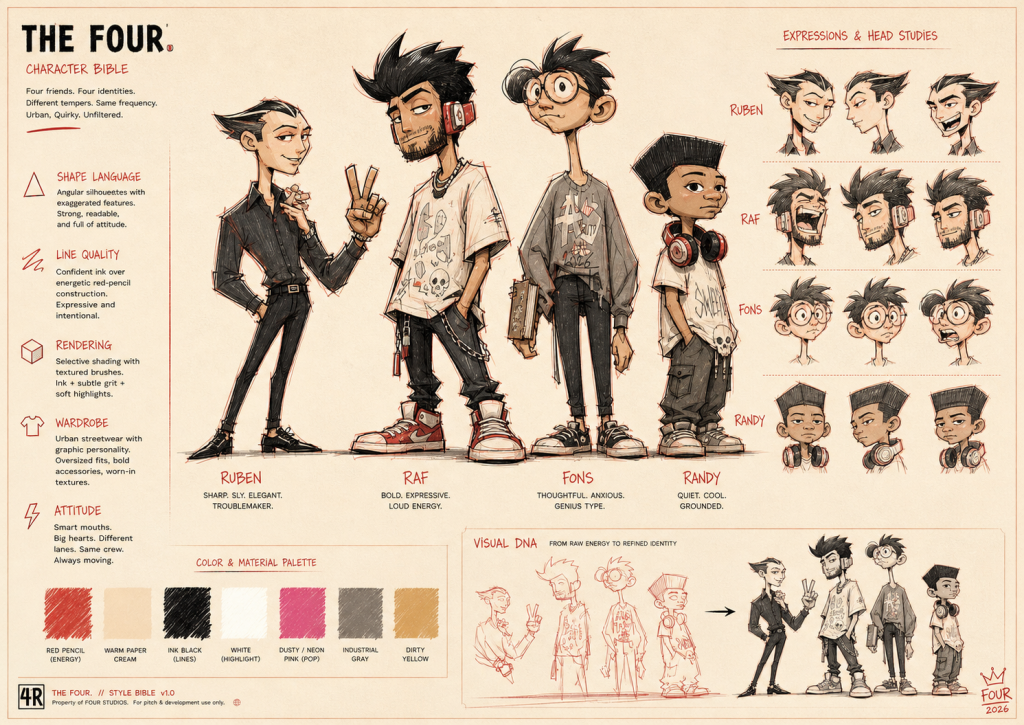
The sketch shows four strong archetypes. Each character should feel like a different creative weapon.
6.1 Ruben
The Knife-Smile Strategist
Ruben is the left-side character: slim, sharp, suspicious, cool, with swept hair and a knowing expression. He looks like someone who is always three insults ahead of the room.
Role in the crew
Ruben is the social engineer, negotiator, rumor broker, and tactical manipulator. He can talk his way into locked buildings, out of arrests, and through elite parties where nobody realizes he is stealing their secrets.
Personality
Dry humor
Elegant but dangerous
Sharp observer
Half-charming, half-threatening
Always watching people’s hands, eyes, and lies
Feels older than he is
Visual markers
Pointed hair
Angular face
Thin neck
Sharp collar
Expressive fingers
A small object in hand: lighter, mic, stylus, lockpick, or cigarette-shaped data tool
Character conflict
Ruben acts detached, but secretly fears being ordinary. He wants control because chaos once humiliated him. His arc is about learning that trust is not weakness.
Catchphrase
“Relax. I already lied for us.”
6.2 Raf
The Loud Heart / Street Myth
Raf is the big central-left character with the towering hair, beard, oversized head, and peace sign. He is the face people remember. A walking poster. A human alarm system.
Role in the crew
Raf is the public distraction, hype machine, performer, graffiti tactician, and accidental leader. When something needs to explode, trend, distract, inspire, or embarrass authority, Raf is first in.
Personality
Loud
Warm
Impulsive
Ridiculously loyal
Funny under pressure
Emotionally transparent
Always making a scene even when stealth is required
Visual markers
Massive flame-like hair
Beard
Big hand gestures
Peace sign
Patchy shirt or vest
Expressive eyes
A body that feels too thin for the huge head and huge personality
Character conflict
Raf wants to be taken seriously, but he hides his intelligence behind chaos. His arc is about realizing that being funny does not make him disposable.
Catchphrase
“Good news: they noticed us.”
6.3 Fons
The Broken Genius / Signal Ghost
Fons is the right-page central character with round glasses, messy intellectual hair, long thin neck, and anxious expression. He looks like the thinker, coder, artist, and reluctant prophet of the group.
Role in the crew
Fons is the systems hacker, archivist, designer, map-maker, and conspiracy analyst. He understands the hidden structure of Draft City and sees patterns nobody else can see.
Personality
Brilliant
Nervous
Intense
Sensitive
Overloaded by details
Capable of terrifying clarity
Always carrying too much information in his head
Visual markers
Huge round glasses
Thin face
Messy hair
Long oversized shirt
Graphic symbol on the chest
Slouched body
Hands often hidden or tense
A sketchbook, hacked tablet, or old camera
Character conflict
Fons believes he must solve everything alone. His arc is about learning that vision only becomes real when shared with others.
Catchphrase
“That’s not a glitch. That’s the pattern.”
6.4 Randy
The Heavy Beat / Silent Weapon
Randy is the right-side character with the blocky high hair, headphones around the neck, detached stare, and skull-like graphic. He is the quiet one who looks unimpressed by everything.
Role in the crew
Randy is the sound designer, underground DJ, mechanic, rhythm fighter, and muscle of the group. He uses sound as a weapon: bass frequencies, pirate broadcasts, sonic locks, crowd control, emotional manipulation through music.
Personality
Quiet
Blunt
Loyal
Deadpan funny
Physically grounded
Hates fake enthusiasm
Feels everything but says almost nothing
Visual markers
Tall flat-top / geometric hair
Large headphones
Rounded shoulders
Heavy hands
Skull motif
Minimal facial expression
Compact body language
Character conflict
Randy has trained himself not to react because reaction gets used against you. His arc is about allowing himself to care openly.
Catchphrase
“Turn it up. I’m done explaining.”
7. Crew Dynamic
The franchise lives or dies by the chemistry.
Ruben + Raf
Ruben plans. Raf ruins the plan loudly.
But Raf’s chaos often creates the opening Ruben needed.
Fons + Randy
Fons hears hidden systems. Randy hears hidden frequencies.
Together they can decode the city.
Raf + Randy
Raf talks too much. Randy says almost nothing.
They are secretly the emotional core of the group.
Ruben + Fons
Ruben manipulates people. Fons manipulates systems.
They respect each other but often disagree about ethics.
Whole group dynamic
They are not clean heroes.
They are not villains.
They are the people you call when the official solution is the problem.
8. Main Antagonist
The Final Board
A faceless cultural-control institution made of critics, brand executives, political image managers, AI moderation engines, and taste consultants.
They do not destroy creativity directly. They “improve” it until nothing dangerous remains.
Their motto:
“Everything can be corrected.”
They operate through:
Cleaners — agents who erase unauthorized art
Curators — elite tastemakers who decide what gets seen
Ghost Editors — AI systems that rewrite people’s speech and memory
The Approval Choir — influencers who repeat official taste
White Room Schools — institutions where children are trained to become acceptable
9. Core Conflict
The Redline Rebels discover that Draft City was built on stolen unfinished ideas. Every “approved” product, fashion, app, logo, song, and political slogan came from the underground, extracted from rejected artists and cleaned for mass consumption.
The Final Board does not create.
It harvests.
The crew’s mission becomes bigger than street rebellion:
They must return the stolen drafts to the people who made them.
That means exposing archives, breaking into memory vaults, hijacking public screens, corrupting clean corporate visuals with raw red sketch lines, and teaching the city how to become unfinished again.
10. Season One Outline
Episode 1 — Bad Drafts
Raf’s illegal street performance gets the crew chased by Cleaners. Fons discovers that the security drones are scanning for “creative irregularities.” Ruben negotiates an escape through an underground market. Randy disables a checkpoint with a bass pulse.
End reveal: the Final Board has a file on all four of them.
Episode 2 — The Margin Market
The crew visits a hidden bazaar where rejected artists trade unfinished songs, broken fonts, illegal colors, and banned jokes. A young designer asks them to recover a stolen logo from a corporate tower.
Episode 3 — Approved Personality
Ruben infiltrates an elite party where people wear personality filters. Raf becomes accidentally famous after insulting the wrong curator. Fons learns the filters are rewriting people’s memories.
Episode 4 — Bass Trap
Randy’s old DJ crew is forced to perform propaganda music for the Final Board. He must choose between staying invisible or becoming a target.
Episode 5 — The Red Pencil Virus
Fons creates a visual virus that turns every official screen into rough red sketch lines. It works too well and starts revealing hidden messages from the city itself.
Episode 6 — Clean Lines
The crew enters a white corporate district where everything is symmetrical, silent, polished, and dead. Raf begins to disappear because his chaotic identity cannot be processed there.
Episode 7 — Ruben’s Lie
Ruben’s past catches up with him. He once worked as a junior manipulator for the Board. The crew must decide whether his betrayal was survival or strategy.
Episode 8 — Skull Frequency
Randy discovers a banned sound buried under the city: a rhythm that can synchronize crowds and break obedience loops.
Episode 9 — The Archive of First Versions
The crew breaks into the Final Board’s underground vault and finds the stolen first drafts of thousands of people. Every rejected idea is alive, pulsing, unfinished.
Episode 10 — Never Final
The Rebels hijack the city’s annual Approval Ceremony. Instead of destroying the Board, they release every stolen draft into the public network.
The city becomes messy, loud, handmade, contradictory, alive.
Final line:
“No final version.”
11. Feature Film Concept
REDLINE REBELS: THE FIRST DRAFT WAR
The movie expands beyond Draft City. The crew discovers that the Final Board is only one branch of a global system called The Clean Network, which turns every culture into approved content.
The Rebels travel through different visual worlds:
A fashion district made of paper dolls
A music city where sound has been muted
A children’s media zone where imagination is licensed
A political broadcast tower where truth is constantly redesigned
A dead museum of forbidden art styles
The film ends with the world’s clean surfaces cracking open into red construction lines.
12. Game Concept
Redline Rebels: Margin Run
A narrative action-adventure game with four playable characters.
Each character has unique mechanics:
Ruben — dialogue hacking, disguise, stealth, persuasion
Raf — crowd control, graffiti attacks, chaos combos
Fons — system hacking, puzzle solving, map distortion
Randy — sonic combat, rhythm attacks, environmental vibration
The player switches between characters to solve missions.
Visual style: 3D environments with 2D red sketch overlays, notebook UI, animated pencil marks, unfinished textures.
Core gameplay loop:
Infiltrate controlled zones
Find stolen drafts
Expose hidden systems
Recruit Bad Drafts
Upgrade the underground base
Broadcast rebellion art across the city
13. Tabletop RPG Concept
REDLINE REBELS: THE BAD DRAFT RPG
Players create their own rejected, unfinished, dangerous characters.
Instead of classes, the game uses Creative Faults.
Examples:
The Loud One — turns attention into power
The Quiet One — weaponizes stillness
The Wrong Genius — sees systems but risks overload
The Liar-Saint — manipulates truth for survival
The Broken Icon — inspires others through visible flaws
The Noise-Maker — controls rhythm, sound, and chaos
The Margin Witch — uses discarded objects and old marks
The Failed Prototype — unstable but powerful
Main dice mechanic:
Redline Dice
Players roll standard dice, but every failed roll adds a Redline Mark.
Redline Marks can later be spent to alter reality, change the scene, expose a lie, or rewrite a failed moment.
Failure becomes fuel.
That is the franchise philosophy.
14. Merchandising System
This concept has strong merch potential because the characters are visually iconic and easy to translate into products.
Core merch
Character stickers
Red pencil sketch posters
Notebook replicas
Cream paper sketchbooks
Patches
Pins
Hoodies
Oversized graphic shirts
Headphones inspired by Randy
Round glasses inspired by Fons
Raf peace-sign gloves
Ruben collar pins
Redline pencil sets
Limited-edition art prints
Vinyl figures
Designer toys
Skate decks
Zines
Character dossiers
Bad Draft membership cards
Premium collectibles
“First Draft” statue line
Red transparent vinyl figures
Animated cel-style wall art
Signed sketch reproduction books
Replica Final Board approval stamp
Underground radio prop
Randy soundwave poster
Fons conspiracy map
Raf illegal performance flyer
Ruben fake ID pack
15. Publishing Strategy
Phase 1 — Zine / Art Bible
Launch as a rough, stylish art zine:
Redline Rebels: The Unapproved Files
Contains character sketches, fake city documents, propaganda posters, underground flyers, handwritten notes, and short comic scenes.
This establishes the franchise as a design object first.
Phase 2 — Webcomic / Motion Comic
Short episodes released online.
Fast, sharp, visual-first storytelling.
Each episode ends with a graphic poster moment.
Phase 3 — Animated Pilot
A 12–18 minute pilot showing the crew’s first mission.
The animation should preserve sketch lines, rough poses, and red pencil marks.
Phase 4 — Game / RPG Expansion
Release the tabletop RPG or narrative mobile game as the fan-entry point.
Phase 5 — Full Series / Feature
Once the characters have cultural traction, expand into long-form animation.
16. Audience
Primary:
Teens and adults who love stylized animation, comics, underground culture, design, street art, music, and anti-corporate worldbuilding.
Secondary:
Artists, designers, skaters, musicians, zine makers, game players, animation fans, and people who feel like they never fit into polished systems.
Age range:
13+ for the animated series
16+ for the graphic novels and RPG
Adult collector market for premium merch
17. Themes
The value of unfinished people
The franchise says you do not need to become polished to become powerful.
Creativity as resistance
Art is not decoration. It is a weapon, a map, a memory system, and a survival tool.
Friendship between difficult people
The crew is not emotionally easy. That is the point. They learn to protect each other without becoming sanitized.
Failure as material
Mistakes are not removed. They are used.
Identity against correction
The enemy does not hate the characters because they are bad.
The enemy hates them because they cannot be standardized.
18. The Franchise Bible Statement
Redline Rebels is a franchise about the people who get called too much, too weird, too rough, too loud, too quiet, too emotional, too unfinished, too difficult, too intense, too unmarketable.
The world tells them they are bad drafts.
They prove that the first draft was the only honest one.
The sketch is not a step toward the final version.
0 comments