Subtitle
“Nobody asked him to be the adult.”
Core idea
A modern slacker-philosopher, somewhere between The Big Lebowski’s Dude and a burned-out urban mystic, lives his life avoiding responsibility with style, cheap wisdom, and a permanent cloud of bad decisions. His only real friend is a tough, sarcastic, Bruce-Willis-like ex-action-type guy: bald-ish, bruised, divorced, dry as concrete, always looking like he just survived an explosion nobody else noticed.
Together they are dragged into the chaos of a broken modern family: an exhausted single mother, a failed relationship, and two daughters at the beginning of puberty who are smarter, meaner, funnier, and more emotionally dangerous than every criminal, landlord, debt collector, ex-lover, and neighborhood lunatic combined.
The franchise is a dark comedy / urban family action-drama / absurd buddy saga about masculinity collapsing, fatherhood arriving unwanted, and a household becoming a battlefield of hormones, trauma, rent, love, and bad advice.
Main title options
1. BUDDY SYSTEM
Best franchise title. It captures the male friendship, the broken family dynamic, and the forced emotional survival setup.
2. THE WRONG DADS
More comedy-forward. Two men accidentally become father figures and are terrible at it before becoming weirdly good.
3. PUBERTY & PUNCHLINES
More sitcom/graphic-novel energy.
4. BROKEN HOME HEROES
More dramatic, better for streaming drama/comedy.
5. NOT THE FATHER
Sharp, funny, legally and emotionally loaded.
Franchise logline
A drifting modern-day Dude and his hard-boiled ex-action-hero best friend get pulled into the life of a recently separated mother and her two teenage daughters, becoming the world’s least qualified emotional support system while trying to survive family drama, street chaos, failed romance, and puberty-fueled psychological warfare.
Tone
Think:
The Big Lebowski
meets
Moonlighting-era Bruce Willis sarcasm
meets
Shameless family chaos
meets
Malcolm in the Middle emotional violence
meets
indie comic-book sketchbook energy
It should feel funny, messy, raw, slightly dangerous, and very human.
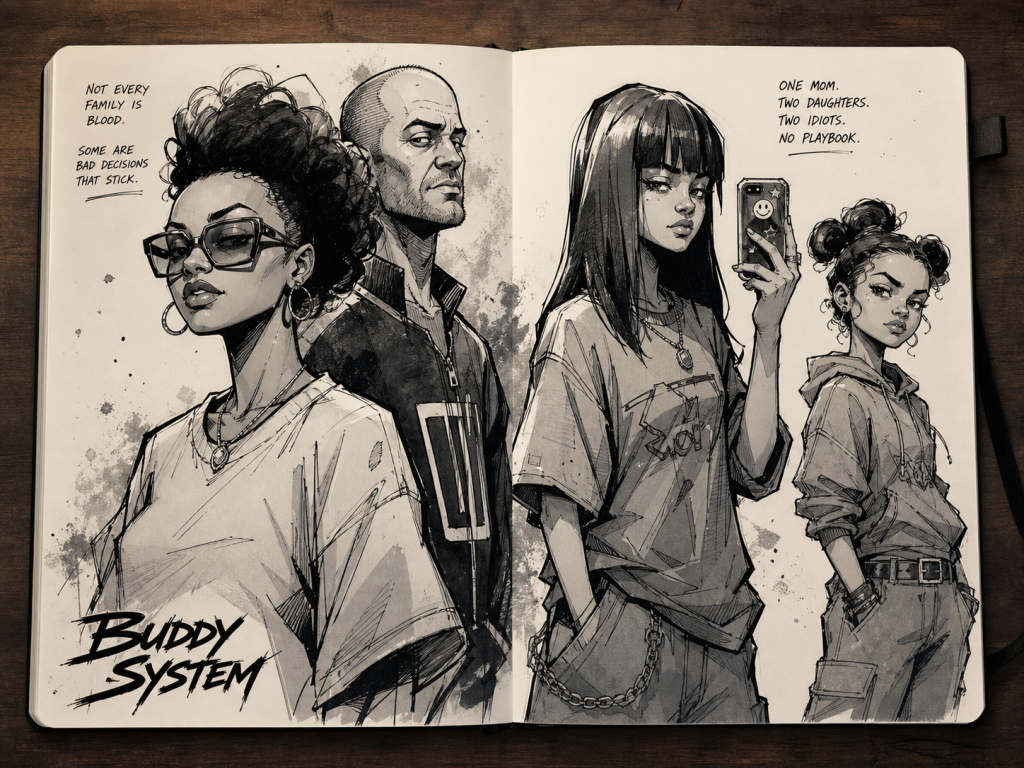
The sketch already has that energy: angular faces, rough confidence, characters who look like they have histories before the story even begins. Nobody looks clean. Everybody looks like they are hiding something or pretending not to care.
Main characters
1. The Modern Lebowski Guy
Working name: Milo “Mo” Voss
A lazy, stylish, half-spiritual, half-useless man in his late 30s or 40s. He wears sunglasses indoors, talks like he has discovered the meaning of life, but cannot organize his laundry.
He has charm, but no structure. He is emotionally intelligent in the most inconvenient way: he can read everyone’s soul but cannot answer a normal text message.
Role in the franchise:
The accidental heart. He becomes the girls’ weird uncle/father figure because he is the only adult who does not lie to them.
Character flaw:
Avoids all responsibility until responsibility starts calling him “dad-adjacent.”
Signature trait:
He gives terrible advice that somehow works.
2. The Bruce Willis Buddy
Working name: Jack Rourke
A tough, bruised, divorced, practical man with action-hero energy but no action-hero budget. He used to be something: security, military, police, bouncer, driver, fixer. Nobody knows the full truth, and he changes the story every time.
He has the face of a man who has been left by love and punched by life. He is not good at feelings, but he is loyal to the point of stupidity.
Role in the franchise:
The muscle, the cynic, the reluctant protector.
Character flaw:
Thinks emotional problems can be solved with intimidation, duct tape, or driving somewhere angrily.
Signature trait:
Always says, “I’m not getting involved,” immediately before getting extremely involved.
3. The Mother
Working name: Rosa Vale
Recently separated, exhausted, sharp, beautiful in a no-time-for-this way. She is trying to keep the house, the kids, the job, the bills, and her dignity from collapsing.
She does not need saving, which is exactly why the men keep trying and failing to save her.
Role in the franchise:
The emotional anchor. The real adult. The one person everyone underestimates.
Character flaw:
She has been strong for so long that she no longer knows how to receive help.
Signature trait:
Can destroy a man with one calm sentence.
4. Daughter One
Working name: Nova
Early puberty. Intense, artistic, dramatic, suspicious of everyone. She documents the family like a crime scene. She may be the narrator in some episodes or comics.
Role:
The observer. The one who sees through everyone’s bullshit.
Signature trait:
Draws people as monsters before admitting she likes them.
5. Daughter Two
Working name: Leni
Younger or same age range, chaotic, funny, impulsive, emotionally explosive. She weaponizes innocence. She asks questions adults are afraid to answer.
Role:
The chaos engine.
Signature trait:
Every simple errand becomes a neighborhood incident.
Core relationship engine
The whole franchise runs on this emotional machine:
Rosa does not want replacement fathers.
The girls do not want fake dads.
Mo does not want responsibility.
Jack does not want feelings.
The world keeps forcing them into a family shape anyway.
That is the hook.
They are not a traditional family. They are a collision.
Season / film one premise
Rosa’s relationship breaks apart badly. Her ex disappears in emotional, financial, or criminal ambiguity. Mo and Jack are supposed to help with one small thing: moving a couch, picking up a package, fixing a lock, watching the girls for one afternoon.
That one afternoon becomes the beginning of a disaster.
The girls discover something connected to the ex: debt, stolen money, a hidden phone, a strange bag, a landlord scam, or a local criminal situation. Mo wants to talk it out. Jack wants to break someone’s nose. Rosa wants everyone out of her kitchen.
By the end, the two men become part of the household orbit. Not officially. Not romantically simple. Not safely. But emotionally, they are in.
Franchise format
Streaming series
Best fit. 8 episodes per season. Each episode combines family chaos with an external street-level problem.
Graphic novel / zine
The sketch style makes this very strong as a raw black-and-white comic. Blue ballpoint sketch energy can become part of the identity.
Animated adult series
Could work if the rough drawing style is preserved: angular faces, expressive linework, exaggerated emotional violence.
Feature film
Also possible, but the characters feel better as a long-form franchise because the family dynamics need room to mutate.
Visual identity
The sketch suggests:
Black-and-white ink linework.
Dirty urban realism.
Character faces slightly exaggerated.
No polished superhero anatomy.
Fashion as personality armor.
Sunglasses, shaved heads, sharp cheekbones, tired eyes.
A mix of domestic interiors and street corners.
Comedy framed like noir.
The brand could use your NotYouAgain-style language well: raw marker typography, rough faces, black-and-white panels, occasional violent pink or yellow accent for emotional explosions.
Episode examples
Episode 1 — “The Couch Job”
Mo and Jack help Rosa move furniture after the breakup. The couch contains something that belongs to her ex. The girls know more than they admit.
Episode 2 — “Not My Kids”
Mo has to pick the girls up from school. He loses one emotionally, not physically. Jack tries to interrogate a teacher.
Episode 3 — “Puberty Is a Hostage Situation”
The household collapses over bras, privacy, phones, and one missing diary. A local tough guy arrives at the worst possible time.
Episode 4 — “The Ex Factor”
Rosa’s ex returns with apologies, lies, and a problem that follows him to the front door.
Episode 5 — “Dad Energy”
The girls accidentally start calling Jack for help. He pretends to hate it. He absolutely does not hate it.
Episode 6 — “The Mother Load”
Rosa breaks down for exactly seven minutes. Everyone panics because the strong one is offline.
Episode 7 — “Girl Fight”
Nova and Leni go to war. Mo tries peace talks. Jack prepares like it is a military operation.
Episode 8 — “Family, Legally Speaking”
Nobody is related. Everyone shows up anyway.
Franchise themes
The story is not just about comedy. It is about:
Broken masculinity becoming useful again.
Women carrying emotional economies.
Children seeing everything adults try to hide.
Friendship as survival.
The difference between being a father and being present.
Modern family as something built from ruins, not bloodlines.
Love after romantic failure.
Responsibility arriving disguised as inconvenience.
Tagline options
“They were not family. That was the problem.”
“Two idiots. One mother. Two daughters. No adult supervision.”
“He was not the father. He was just there.”
“Puberty hits harder than bullets.”
“A broken home. A bad plan. A beautiful disaster.”
Best polished pitch
BUDDY SYSTEM is a raw, black-comedy franchise about two emotionally damaged men who accidentally become the support structure for a recently separated mother and her two daughters entering puberty. One man is a lazy modern philosopher with Big Lebowski energy; the other is a bruised, Bruce-Willis-like survivor who treats family problems like hostage negotiations. Together they face the most dangerous mission of their lives: showing up. The result is a messy, funny, violent-hearted story about broken homes, reluctant fatherhood, female rage, friendship, and the accidental creation of a new kind of family.
0 comments