
A NotYouAgain.ai franchise about rebuilding work, identity, and power after hard labor breaks you.
Core premise
A person spends years doing physically brutal labor: lifting, carrying, standing, cleaning, building, hauling, surviving. Then the body starts saying no.
Back pain. Nerve pain. Exhaustion. Burnout. Injuries. Sleep problems. Anxiety. Loss of strength. Loss of income. Loss of status.
The world expects them to disappear.
Instead, they become something else.
They become a strategist.
A designer.
A researcher.
A publisher.
A cultural operator.
A creative director.
A studio founder.
A person who turns lived damage into professional intelligence.
The franchise follows the possibility of doing a job like Alfons Scholing: not a normal desk job, not a corporate ladder, not motivational fantasy, but a survival-based creative profession built from observation, systems thinking, design, media, AI, politics, street knowledge, and refusal.
1. Franchise title options
Main title
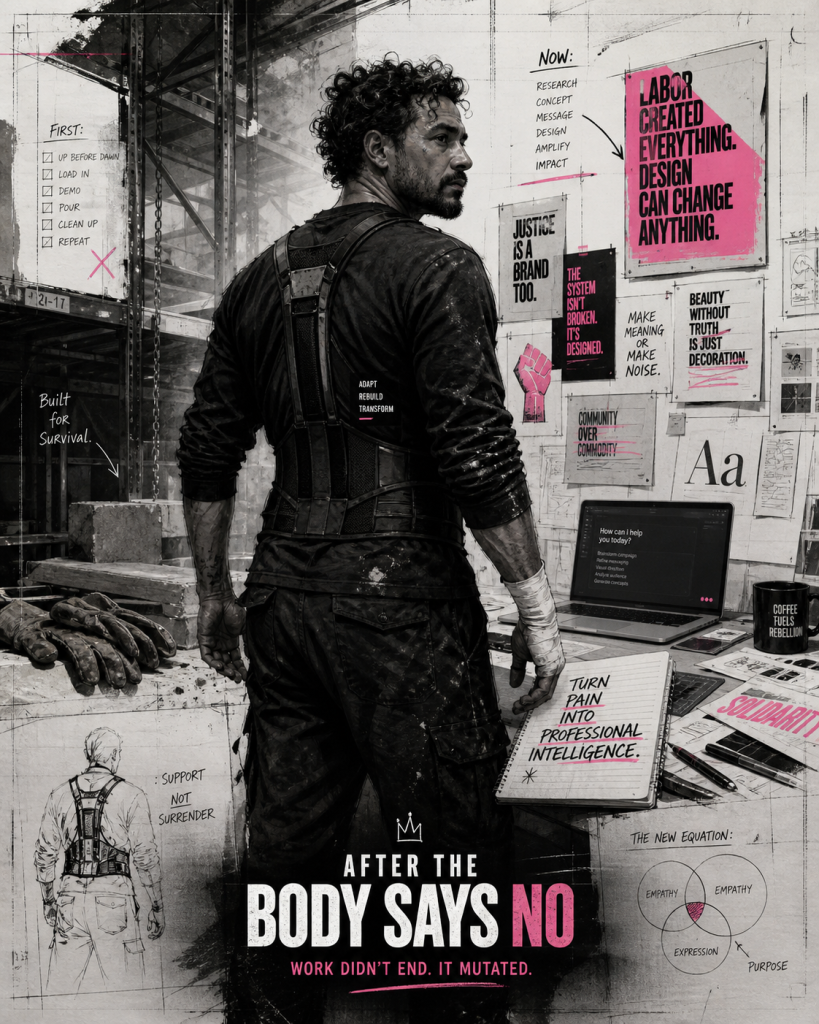
AFTER THE BODY SAYS NO
Subtitle
Work didn’t end. It mutated.
Alternative titles
NOT BUILT FOR THE FACTORY ANYMORE
The body quit. The mind unionized.
THE UNWELL DIRECTOR
From hard labor to hard vision.
LIGHT DUTY, HEAVY IDEAS
A franchise about disabled labor intelligence.
THE ALFONS JOB
How to become impossible to fire from your own mind.
BROKEN BACK OFFICE
Creative direction after physical collapse.
2. Genre
Social realist creative franchise
Workplace drama
Design manifesto
Anti-poverty cultural strategy
AI-era survival manual
Political comedy with pain in it
Studio-building mythology
Tone: black-and-white, direct, angry, poetic, funny, practical.
Visual language: ink on white paper, brutal black typography, handwritten annotations, medical forms, job applications, construction dust, coffee rings, pain maps, studio diagrams, phone screenshots, AI chats, invoices, protest posters.
3. Core question
What kind of work becomes possible when the body can no longer survive the work society assigns to it?
The answer is not “just get an office job.”
The answer is:
Build a new profession out of everything they underestimated in you.
4. The job like Alfons Scholing
This franchise defines the “Alfons Scholing job” as a hybrid role:
Creative Director of Survival Systems
A person who can:
Think visually.
Name patterns.
Turn chaos into concepts.
Build brands from nothing.
Use AI as a production partner.
Write manifestos.
Make websites.
Create posters.
Design campaigns.
Map networks.
Turn personal damage into public language.
Transform social exclusion into intellectual property.
Translate street-level experience into studio-grade output.
It is not one job title. It is a self-made professional operating system.
5. The transformation arc
Phase 1: The Body Job
The protagonist works physically heavy jobs. Warehouses, kitchens, cleaning crews, construction-adjacent labor, delivery, production lines, event build-ups, night shifts.
The work is honest, but the system is not.
The body becomes the first unpaid invoice.
Phase 2: The Breakdown
Something goes wrong.
Maybe the protagonist cannot lift anymore.
Maybe every shift becomes pain management.
Maybe they are told they are lazy.
Maybe doctors are vague.
Maybe employers disappear.
Maybe benefits become a bureaucratic maze.
Maybe friends say, “You should just find something lighter.”
But “lighter” does not exist when rent is heavy.
Phase 3: The Intelligence Nobody Paid For
While physically unwell, the protagonist realizes they have been developing another kind of intelligence the whole time:
Spatial intelligence from moving objects.
Rhythmic intelligence from repetitive work.
Social intelligence from surviving managers.
Political intelligence from being disposable.
Design intelligence from noticing systems.
Brand intelligence from reading culture.
Technical intelligence from adapting tools.
Emotional intelligence from hiding pain.
The franchise says: the hard labor worker was never “unskilled.”
They were running an advanced human operating system under bad conditions.
Phase 4: The Studio Turn
The protagonist stops asking, “What job will accept me?”
They start asking:
“What can I direct?”
“What can I publish?”
“What can I build?”
“What can I automate?”
“What can I sell?”
“What can I explain better than anyone?”
“What system hurt me, and how do I turn that into a product, poster, platform, or movement?”
That is where the Alfons-style job begins.
6. Main character archetype
The Injured Operator
Not a superhero. Not a guru. Not a polished LinkedIn success story.
A person with:
A damaged body.
A fast brain.
A suspicious attitude toward authority.
A drawer full of unfinished concepts.
A phone full of notes.
A history of being underestimated.
A deep understanding of work, class, pain, bureaucracy, design, and absurdity.
They do not “overcome” illness.
They negotiate with it daily and still produce culture.
7. Franchise structure
Season / Book / Chapter One
THE BODY CLOCKS OUT
The protagonist is forced out of physical labor. They experience shame, anger, fear, and bureaucratic humiliation.
Key episodes:
“Can You Still Lift 20 Kilos?”
“The Doctor Says Maybe”
“Light Duty Does Not Exist”
“The Rent Is Still Able-Bodied”
“Pain Is Not A Career Plan”
“The First Poster”
Season Two
THE MIND OPENS A STUDIO
The protagonist begins building a creative practice from bed, cafés, libraries, public computers, cheap phones, and AI tools.
Key episodes:
“The Laptop Becomes a Workshop”
“How To Invoice With No Status”
“Branding From the Bottom”
“The Client Does Not Understand Pain”
“The AI Intern”
“The First Professional Deck”
Season Three
THE UNWELL DIRECTOR
They become dangerous because they can explain the system better than the system can explain itself.
Key episodes:
“Design Is a Disability Access Tool”
“The Welfare Office Has Bad Typography”
“Every Injury Is Data”
“Studio Not You Again”
“The Creative Director Who Cannot Stand Up Today”
“The Body Is Closed, The Office Is Open”
Season Four
THE NEW LABOR CLASS
The protagonist helps others transition from broken labor markets into creative, digital, advisory, AI-assisted, and self-directed work.
Key episodes:
“Former Cleaners Make Better UX Designers”
“Warehouse Workers Understand Systems”
“The Pain Portfolio”
“Manual Labor Intelligence”
“The Anti-Resume”
“Work After Work”
8. The franchise manifesto
Manual labor is not low intelligence.
Manual labor teaches timing, rhythm, endurance, spatial awareness, crisis management, social reading, and system navigation.
Illness is not the end of usefulness.
The body may lose capacity, but the person may have accumulated rare knowledge.
A creative job is not a luxury.
For some people, creative direction, design, writing, strategy, AI work, and publishing are not hobbies. They are survival routes.
The future of work must include damaged bodies.
Not as charity.
Not as inspiration porn.
As professionals.
The worker who got hurt knows something the boardroom does not.
They know where the system breaks.
That makes them dangerous.
9. Brand identity
Visual system
Black ink on white paper.
Hard contrast.
Scanned notes.
Work gloves.
Medical diagrams.
Pain maps.
Grid systems.
Phone UI overlays.
Receipts.
Job applications.
Studio sketches.
Redacted documents.
Pink emergency highlights.
Typography
Heavy condensed black headers.
Handwritten annotations.
Monospace bureaucratic fragments.
Large accessible body text.
Icon set
A bent spine becoming a lightning bolt.
A work glove holding a pen.
A wheelchair wheel as a design grid.
A time clock transformed into a studio logo.
A hammer crossed with a stylus.
A sick note stamped “CREATIVE DIRECTOR.”
A body silhouette filled with interface windows.
10. Core products inside the franchise
1. The Pain Portfolio
A method for turning damaged work history into a professional creative portfolio.
Instead of hiding labor history, it reframes it:
“I understand logistics.”
“I understand repetition.”
“I understand bad systems.”
“I understand users under pressure.”
“I understand how tools fail.”
“I understand people who are tired.”
2. The Anti-Resume
A resume format for people whose careers were interrupted by illness, injury, poverty, care work, burnout, or instability.
Categories:
Systems survived
Tools learned
Patterns observed
Problems diagnosed
Creative outputs
Public value
Adaptive intelligence
3. The Light Duty Studio
A fictional and practical studio model for people who cannot do continuous physical labor anymore.
Services:
Brand concepts
AI-assisted design
Social campaigns
Web publishing
Poster systems
Accessibility reviews
Worker-centered UX critique
Naming and slogans
Cultural strategy
Franchise bibles
Visual activism
4. The Body Says No Toolkit
A workbook, zine, or online course.
Chapters:
What can you still do?
What must you never do again?
What intelligence did labor give you?
What tools can replace physical strain?
What can AI help you produce?
What can become a service?
What can become a public platform?
5. The Injured Worker Design School
A fictional academy and possible real program.
Courses:
Design after physical collapse
AI for disabled workers
Political poster making
How to build a studio from zero
Writing your own job title
Turning lived experience into intellectual property
How to speak to clients when your career path looks “messy”
11. The slogan system
The body quit. The mind clocked in.
Hard labor broke the body. It trained the director.
Unskilled? No. Unpaid intelligence.
Pain is not a brand, but it can become a briefing.
Light duty. Heavy vision.
The worker was never broken. The job description was.
From warehouse floor to worldbuilding.
The body says no. The studio says begin.
12. The central conflict
The protagonist is fighting several enemies at once:
Employers who only value physical output.
Systems that demand proof of pain.
Creative industries that prefer polished privilege.
Medical bureaucracy that turns suffering into paperwork.
Family or society saying, “Get a real job.”
Internal shame from no longer being able to work like before.
AI-era confusion about what human creativity is worth.
The deeper enemy is the idea that once your body becomes unreliable, your future becomes smaller.
The franchise says the opposite:
Your future may become stranger, sharper, and more self-authored.
13. Episode concept: “The Alfons Job”
A former labor worker is asked what he does now.
He cannot answer in one word.
He designs.
He writes.
He directs.
He researches.
He prompts.
He publishes.
He critiques.
He builds brands.
He invents concepts.
He maps power.
He turns personal and political chaos into usable form.
The person asking says, “So… unemployed?”
He says:
“No. I became the department they forgot to build.”
14. Franchise bible statement
After The Body Says No is a franchise about the people who are told their working life is over because their body can no longer survive hard labor. Instead of disappearing into shame, they discover that the same life that injured them also trained them to see systems, patterns, danger, absurdity, and truth.
The franchise turns physical collapse into creative infrastructure. It reframes damaged workers as strategists, designers, publishers, AI operators, cultural directors, and builders of new labor identities.
At its heart is the possibility of doing a job like Alfons Scholing: self-authored, multidisciplinary, politically aware, visually driven, and built from the wreckage of jobs that treated the body as disposable.
This is not a comeback story.
It is a hostile takeover of the word “work.”
0 comments