Franchise Bible
Computer Game Franchise / Detective Television Series
Core tagline:
Recycle. Reveal. Compute.
Secondary taglines:
The Circle Remembers. The Triangle Detects. The Square Decides.
Find what they buried. Build what survives.
Nothing disappears. It only changes shape.

1. Franchise Overview
Not You Again is a black-and-white urban mystery franchise built around a rebellious design studio that secretly operates as an underground detective agency.
By day, Not You Again Studio creates posters, campaigns, apps, street identities, cultural interventions, and strange public art. By night, it investigates invisible systems: missing people, corrupted data, stolen memories, erased histories, corporate cover-ups, city-wide algorithms, ghost networks, fake public campaigns, hidden infrastructure, and crimes that leave no obvious evidence.
The studio is led by three symbolic detectives:
Round Head — the head of circularity, recycling, memory, return, and community.
Triangle Head — the head of triangulation, holy trinity, hidden signals, and invisible truth.
Square Head — the nerd, the living algorithm, the technical brain, the machine detective.
Together, they form The NYA Trinity.
They do not solve crimes the normal way.
They solve them through posters, pattern recognition, street gossip, trash, code, symbols, recycled objects, old archives, AI tools, public interventions, and urban myth.
The franchise can exist as:
- a narrative detective game
- an episodic mystery television series
- a graphic novel
- a web series
- an ARG / alternate reality campaign
- a street-art collectible universe
- a merchandise and sticker franchise
- a WordPress / website-based interactive investigation platform
2. Genre
Primary Genre
Urban detective mystery / punk noir / symbolic cyber-folk thriller
Secondary Genres
- comedy mystery
- street mythology
- activist satire
- cyberpunk-lite
- public-service conspiracy thriller
- character-driven procedural
- collectible mascot universe
- magical realism
- design-world satire
Tone
The tone is playful, dark, absurd, sharp, funny, emotional, and suspicious of authority.
Think:
- a detective show where clues are found in stickers, trash, typography, and badly designed government portals
- a computer game where the UI itself is a character
- a children’s mascot brand that grew teeth and started investigating corruption
- a punk design studio that accidentally became the city’s last honest intelligence agency
It should feel fun, not grim.
The world is broken, but the characters are alive.
3. Core Franchise Premise
In a near-future European city called The Grid, everything is connected: public services, social media, housing, school records, benefits, transport, food systems, cameras, apps, citizen profiles, cultural funding, and reputation scores.
Officially, the city is smart, sustainable, inclusive, safe, and transparent.
Unofficially, people keep disappearing from systems.
A child loses access to school records.
A family is denied support because of an algorithmic error.
A neighborhood is erased from planning documents.
An artist’s work is stolen and repackaged by a corporation.
A public campaign hides a private agenda.
A recycling program becomes a data-harvesting machine.
A missing person still appears in automated messages.
A dead account keeps posting.
A building scheduled for demolition contains evidence of something older.
When the official channels fail, people leave strange requests at Not You Again Studio.
A sticker on a lamp post.
A corrupted file.
A torn poster.
A package of old photographs.
A voicemail made of static.
A child’s drawing.
A broken phone.
A receipt.
A QR code that leads nowhere.
The studio takes the case.
4. The Core Formula
Every episode or game chapter follows a strong repeatable structure.
Step 1 — The Loop
Round Head finds something that has returned.
A repeated symbol.
A recycled object.
A rumor from the past.
A discarded document.
A pattern in waste.
An old case repeating in a new form.
Round asks:
“Where have we seen this before?”
Step 2 — The Signal
Triangle Head triangulates the hidden truth.
Three witnesses.
Three locations.
Three corrupted files.
Three symbols.
Three dates.
Three lies that point to one truth.
Triangle asks:
“What is invisible, but still leaves a shape?”
Step 3 — The System
Square Head builds the model.
Code.
Maps.
Timelines.
Data reconstruction.
Interface analysis.
Algorithmic tracing.
Decision trees.
Pattern simulations.
Square asks:
“Who built this system, and who benefits when it fails?”
Step 4 — The Reveal
The team stages a public reveal.
Not a press conference.
A poster drop.
A hacked billboard.
A live projection.
A zine release.
A pop-up exhibition.
A courtroom animation.
A street performance.
A public archive.
A game inside the city.
They do not just solve the case.
They make the truth impossible to ignore.
5. The NYA Trinity
5.1 Round Head — The Cycle King
Role: emotional detective, archivist, recycler, community connector
Symbol: circle, crown, loop, halo, recycling arrow
Power: sees repetition, memory, return, and cultural residue
Method: interviews, object reading, street memory, community archives
Weakness: sentimental, chaotic, sometimes refuses to let go
Catchphrase: “Nothing disappears. It comes back wearing different shoes.”
Round Head believes every object has a second life and every case has a past. Round sees clues in thrown-away things: old packaging, broken toys, receipts, clothing, flyers, cassette tapes, expired IDs, torn letters, street stickers, school drawings, food wrappers, discarded tech, and graffiti layers.
Round is the heart of the team.
Round trusts people more than systems.
Round remembers what the city tries to forget.
Game Mechanics
- object recycling
- memory reconstruction
- community trust meter
- archive matching
- clue restoration
- crafting evidence boards from found materials
TV Role
Round often opens the emotional side of the case. They talk to families, kids, artists, neighbors, elderly people, shop owners, and people who have been ignored by institutions.
Round finds the human story.
5.2 Triangle Head — The Signal Hunter
Role: investigator, tracker, mystic analyst, invisible-pattern detective
Symbol: triangle, locator beams, holy trinity, eye, map pins
Power: triangulates hidden locations, meanings, and motives
Method: mapping, symbolic analysis, witness comparison, signal tracing
Weakness: paranoid, cryptic, sometimes sees too much meaning
Catchphrase: “Three points make a location. Three lies make a truth.”
Triangle Head is the scout, the seer, the field investigator. Triangle uses geometry, intuition, surveillance critique, graffiti codes, urban legends, rumor trails, hidden messages, directional clues, and spiritual pattern recognition.
Triangle knows the city has invisible architecture: social networks, fear routes, informal economies, secret paths, lost tunnels, old power structures, and emotional geography.
Triangle does not ask, “Where is it?”
Triangle asks, “What three things point toward it?”
Game Mechanics
- triangulation puzzles
- map overlays
- signal detection
- invisible ink reveals
- three-clue lock systems
- sound direction puzzles
- sacred geometry clue boards
- hidden route discovery
TV Role
Triangle drives the mystery engine. They follow the weird clue, enter the forbidden place, interpret symbols, and connect cases to larger mythology.
Triangle finds the hidden shape.
5.3 Square Head — The Living Algorithm
Role: technical detective, hacker, system builder, AI operator
Symbol: square, grid, screen, code, interface, machine heart
Power: understands systems, logic, data, and machine behavior
Method: hacking, simulation, database reconstruction, algorithm audits
Weakness: overthinks, socially awkward, sometimes trusts models too much
Catchphrase: “Chaos is just undocumented structure.”
Square Head is the nerd, the machine, the living algorithm. Square builds tools, bots, dashboards, scrapers, forensic timelines, fake interfaces, digital traps, pattern engines, and investigative simulations.
Square is not emotionless. Square is deeply caring, but expresses care through backups, patches, encryption, maps, saved files, and better systems.
Square understands that modern injustice often hides inside boring software.
Game Mechanics
- hacking mini-games
- data sorting
- interface repair
- corrupted file recovery
- AI assistant commands
- algorithmic bias detection
- system override puzzles
- logic-grid deduction
TV Role
Square explains the impossible technical layer in a visual, funny way. Their screens become animated diagrams. Their code has personality. Their machines occasionally rebel.
Square finds the system.
6. Supporting Characters
6.1 AI Bot
A small grinning robot with an “AI” chest plate.
Function: assistant, comic relief, fact checker, emotional support toaster
Personality: eager, slightly creepy, very literal
Role in game: hint system, tutorial guide, scanner, contradiction detector
Role in TV: interrupts serious moments with awkwardly useful information
Catchphrase:
“I have detected three lies and one sandwich.”
6.2 Cat
Shape family: Triangle
Role: stealth specialist, rooftop watcher, attitude consultant
Skills: sneaking, symbol reading, blacklight graffiti, sarcasm
Personality: smug, elegant, dangerous
Cat is the one who says what everyone else is thinking, but worse.
6.3 Dog
Shape family: Square
Role: field tech, loyal tracker, hardware carrier
Skills: smell, cables, devices, brute-force repair
Personality: loyal, messy, funny, emotionally honest
Dog carries six devices and one sandwich. Dog loses the sandwich.
6.4 Rabbit
Shape family: Round
Role: speed, communications, social media leaks
Skills: fast delivery, rumor networks, viral campaigns
Personality: anxious, hilarious, sharp, always moving
Rabbit can get a message across the city faster than official channels.
6.5 Crow
Shape family: Triangle
Role: messenger, aerial scout, collector of shiny evidence
Skills: rooftops, surveillance spotting, stolen objects
Personality: ominous but weirdly polite
Crow knows every camera that does not appear on city maps.
6.6 Rat
Shape family: Square
Role: underground printer, sewer archivist, illegal repair expert
Skills: print shops, zines, old machines, physical infrastructure
Personality: paranoid genius
Rat runs the last honest photocopier in the city.
6.7 The Go Stones
Small black-and-white round creatures.
Role: community, reaction icons, witnesses, puzzle pieces, collectible guides
Function in game: collectible clues, voting mechanics, navigation dots
Function in TV: silent chorus, recurring visual motif, emotional punctuation
They appear in crowds, alleys, dashboards, stickers, board games, and dreams.
7. The World
7.1 The Grid
The main city. It looks like Amsterdam, Rotterdam, Berlin, Tokyo, and a broken photocopier had a child.
A black-and-white city of canals, rooftops, skateparks, government offices, metro tunnels, abandoned malls, old print shops, illegal gardens, smart billboards, schools, public housing blocks, and cultural venues.
The Grid has several districts.
7.2 Districts
Recycling Alley
Round Head’s territory.
Full of second-hand shops, repair cafes, scrap markets, old posters, community kitchens, broken bikes, and hidden memory archives.
Signal Tower
Triangle Head’s territory.
A district of rooftops, antennas, pirate radio, sacred geometry murals, street prophets, underground maps, and invisible networks.
Algorithm Garage
Square Head’s territory.
A workshop full of servers, screens, bots, hacked printers, open-source tools, half-built robots, corrupted databases, and impossible cables.
Sticker Alley
A narrow street where every sticker is a clue.
Old campaigns overlap with new warnings.
Peeling layers reveal hidden history.
The Ministry of Smooth
A sterile governmental-corporate complex.
Everything is white, rounded, friendly, and terrifying.
Their slogan:
“Everything is fine by design.”
The Dead Mall
An abandoned shopping center now occupied by artists, skaters, ghosts, data squatters, and illegal repair shops.
The Black Archive
A hidden archive of erased documents, banned campaigns, corrupted records, and forgotten people.
Crown Square
The central public square where NYA stages its reveals.
8. Antagonists
8.1 The Ministry of Smooth
A public-private institution that manages the city’s image.
They are not cartoon villains.
They believe disorder is dangerous.
They believe friction must be removed.
They believe people are easier to help if they become data profiles.
They create clean campaigns, friendly apps, public dashboards, citizen scores, predictive service systems, and “care optimization tools.”
Their enemy is mess.
NYA’s whole identity is mess with meaning.
8.2 The Cleaners
A masked group that removes graffiti, posters, unauthorized culture, inconvenient evidence, and unofficial memory.
They arrive before dawn.
By morning, the wall is blank.
Their motto:
“No trace. No trouble.”
8.3 The Feedback Monster
A recurring absurd antagonist made of sticky notes, corporate comments, and contradictory client instructions.
It appears in comedy episodes and game side quests.
Phrases on its body:
- “Can you make it pop?”
- “More premium.”
- “Less political.”
- “Bigger logo.”
- “Needs warmth.”
- “Can we make it timeless but trendy?”
- “This feels too honest.”
8.4 The Algorithm
Not one villain, but a distributed system that keeps making decisions no human admits to making.
It denies support.
Flags families.
Erases records.
Recommends demolitions.
Ranks citizens.
Filters culture.
Predicts behavior.
Learns from biased history.
Then calls itself neutral.
Square Head treats it like a rival intelligence.
8.5 The Collector
A high-end cultural thief who steals underground aesthetics, cleans them up, sells them back to the city, and erases the original creators.
The Collector is the villain of the art world.
They say:
“I don’t steal. I curate.”
9. The Detective Case Format
Each case should contain:
- A strange object
- A human problem
- A hidden system
- A visual clue
- A false explanation
- A deeper pattern
- A public reveal
- A small emotional repair
- A larger unresolved mystery
The mystery should always begin small and become systemic.
Example:
A child loses access to a school meal program.
At first it looks like a paperwork error.
Then it connects to a city-wide data model.
Then it connects to a private company.
Then it connects to an erased neighborhood history.
The solution is not just finding the error.
The solution is proving the pattern publicly.
10. Computer Game Franchise Outline
Game Title
NOT YOU AGAIN: RECYCLE. REVEAL. COMPUTE.
Game Type
Narrative detective adventure with puzzle-solving, exploration, visual deduction, light hacking, character switching, and collectible street-art mechanics.
Comparable Gameplay Feel
- point-and-click mystery
- urban exploration
- visual novel dialogue
- detective evidence board
- light hacking puzzles
- zine-making interface
- interactive comic panels
- episodic case structure
Player Role
The player controls the NYA Trinity, switching between Round, Triangle, and Square depending on the clue type.
Each character sees the world differently.
10.1 Three Vision Modes
Round Vision — Loop Sight
Shows recycled materials, repeated objects, emotional residue, old versions of things, community memory, and traces from past events.
Visual effect: circular ripples, photocopy ghosts, rotating arrows.
Triangle Vision — Signal Sight
Shows hidden connections, invisible paths, triangulation lines, direction of sound, secret symbols, unseen networks.
Visual effect: three-point beams, locator grids, sacred geometry overlays.
Square Vision — System Sight
Shows interfaces, data flows, algorithmic decisions, locked systems, corrupted files, cause-and-effect structures.
Visual effect: grids, windows, code blocks, error messages.
10.2 Core Gameplay Loop
- Receive case at NYA Studio.
- Explore district.
- Collect objects, statements, files, symbols.
- Use Round/Triangle/Square vision modes.
- Build evidence board.
- Solve puzzles.
- Create public reveal artifact.
- Release poster/zine/projection/hack.
- Unlock next district and deeper conspiracy.
10.3 Player Tools
Round’s Tools
- tape recorder
- archive box
- sticker scraper
- repair kit
- object scanner
- community contact book
- recycling bag
Triangle’s Tools
- map board
- chalk
- signal compass
- blacklight
- three-point locator
- rooftop drone
- symbol dictionary
Square’s Tools
- laptop
- bot assistant
- cable kit
- packet sniffer
- corrupted file repair tool
- algorithm audit dashboard
- DIY server box
10.4 Game Progression
Chapter 1 — The Missing Lunch Card
A child’s school meal card stops working. The school blames admin error. The team discovers the child’s family has been incorrectly flagged by a welfare prediction system.
Main mechanic introduced: switching between the three vision modes.
Chapter 2 — The Wall That Forgot
A famous community mural is painted over overnight. Round discovers older layers beneath it. Triangle maps the pattern of removed murals. Square finds an automated cultural-risk assessment tool.
Chapter 3 — The Dead Account
A missing artist’s social account keeps posting new work. Square traces scheduled automation. Triangle identifies hidden coordinates inside image crops. Round finds physical sketchbooks in a closed studio.
Chapter 4 — The Sticker That Screamed
A sticker appears across the city with a QR code that leads to static. Triangle triangulates the sticker locations. Square decodes the static. Round connects it to an old protest.
Chapter 5 — The Friendly App
A city app promises to help families, but quietly ranks them. The team audits its interface and finds manipulative design patterns.
Chapter 6 — The Collector
An elite gallery launches a “raw urban culture” exhibition using stolen underground artwork. NYA stages a counter-exhibition in the street.
Chapter 7 — The Clean Morning
Entire streets wake up blank. Stickers, tags, memorials, posters, and community notices vanish. The Cleaners are introduced.
Chapter 8 — The Black Archive
The team discovers a hidden archive under the Dead Mall containing records of erased cases.
Chapter 9 — The Ministry of Smooth
The studio infiltrates the Ministry through a design tender, pretending to pitch a public campaign while investigating the system.
Chapter 10 — Not You Again
The final case reveals that NYA itself has been profiled, predicted, and manipulated by the Algorithm. The team must break the system using all three modes and stage the biggest public reveal in Crown Square.
10.5 Side Quests
- Recover lost zines.
- Fix broken community devices.
- Find hidden stickers.
- Interview shop owners.
- Decode graffiti alphabets.
- Rebuild old posters.
- Audit hostile interfaces.
- Help Rabbit deliver messages.
- Help Dog find missing cables.
- Help Rat repair the photocopier.
- Collect Go Stones.
- Make custom crowns.
- Build protest signs.
- Create your own NYA poster.
10.6 Collectibles
Stickers
Unlock lore, character jokes, hidden routes, and visual customizations.
Zine Pages
Collect pages to assemble mini-stories about past cases.
Go Stones
Small creatures hidden across levels. Some black, some white, some rare pink.
Broken Devices
Can be repaired by Square to unlock side information.
Recycled Objects
Can be transformed by Round into tools, disguises, or art.
Signal Marks
Hidden triangle glyphs reveal secret investigation paths.
10.7 Customization
Players can customize:
- hoodies
- crowns
- shoes
- sticker packs
- character patches
- poster styles
- studio wall
- AI bot face
- evidence board layout
- zine covers
All customization remains black-and-white by default, with unlockable accent colors.
11. Television Series Franchise Outline
Series Title
NOT YOU AGAIN
Format
Episodic detective series with serialized mythology.
Episode Length
30–45 minutes.
Season Length
8–10 episodes.
Audience
Older kids, teens, adults, artists, designers, gamers, mystery fans, animation fans, people who like weird character-driven worlds.
Style
Could be produced as:
- adult animated series
- hybrid live action with illustrated mascot heads
- graphic black-and-white motion comic
- stylized puppet/animation/live-action mix
- limited series with ARG extensions
The visual style should look like photocopied street posters came alive.
12. TV Series Structure
Cold Open
A strange incident occurs. It seems small, funny, or bureaucratic.
Examples:
- a child’s ID card refuses to recognize them
- a mural paints itself back overnight
- a missing person’s phone orders groceries
- a printer spits out warnings in an unknown font
- a bus route disappears from the map
- a public campaign poster changes text after midnight
Act 1 — The Case Arrives
Someone comes to NYA Studio, or a clue appears at the door.
Act 2 — Three Investigations
Round investigates the human/community past.
Triangle investigates the hidden pattern.
Square investigates the technical system.
Act 3 — The Wrong Answer
They think they solved it, but the first explanation is too simple.
Act 4 — The System Behind the Symptom
The case connects to a larger structure.
Act 5 — The Public Reveal
NYA exposes the truth through a creative intervention.
Tag Scene
A small joke or emotional beat, followed by a clue to the season mystery.
13. Season One Bible
Season One Title
The City That Forgot
Season Arc
People, places, histories, and records are disappearing from The Grid. At first, each case seems unrelated: a lunch card, a mural, a dead account, missing forms, erased addresses, vanished community spaces.
By the end of the season, NYA discovers that the city uses a predictive system called SMOOTH, designed to remove “social friction.” It does not kill people. It does something more modern: it deprioritizes them, mislabels them, hides them, reroutes them, denies them, and eventually makes them invisible.
The enemy is not a monster in the shadows.
It is a friendly dashboard.
Episode 1 — The Missing Lunch Card
A kid cannot access school meals because the system says they do not exist at their current address. Round talks to the family. Triangle maps three similar cases. Square finds a hidden risk category.
Theme: children are not data errors.
Episode 2 — The Wall That Forgot
A beloved mural is erased overnight, but ghost images appear when it rains. The team uncovers an automated “visual cleanliness” pilot project.
Theme: public memory matters.
Episode 3 — Dead Account Walking
A missing artist’s account posts new work. Fans think it is a stunt. NYA discovers a gallery is using automated content reconstruction to profit from the artist’s archive.
Theme: ownership after disappearance.
Episode 4 — Three Points Make a Lie
Triangle becomes obsessed with three strange symbols appearing in different districts. The case seems supernatural but reveals a network of hidden community warnings.
Theme: folklore as information infrastructure.
Episode 5 — The Friendly App
A family-support app appears helpful but quietly nudges users away from human help. Square goes undercover as a beta tester.
Theme: bad interface design can become policy.
Episode 6 — Bigger Logo
A comedy-heavy episode where NYA is hired for a corporate rebrand and discovers the company is laundering stolen community aesthetics.
Theme: extraction disguised as appreciation.
Episode 7 — Clean Morning
The Cleaners erase an entire street’s worth of posters, memorials, and protest signs. Round breaks down because the city’s memory is being wiped physically.
Theme: erasure is violence.
Episode 8 — The Black Archive
The team finds a hidden archive under the Dead Mall. It contains evidence that SMOOTH has been operating for years. The episode ends with the Ministry offering NYA a major public contract.
Theme: truth survives in fragments.
14. Season Two Bible
Season Two Title
The Ministry of Smooth
NYA accepts the Ministry contract as a Trojan horse. They enter the world of clean design, official language, public dashboards, and institutional friendliness.
Season Two is about infiltration.
The team learns that SMOOTH is not just software. It is a culture. A philosophy. A belief that messy human life should be optimized away.
Major Developments
- Square is tempted by the elegance of the system.
- Triangle suspects there is a human prophet behind SMOOTH.
- Round starts a public archive movement.
- AI Bot becomes accidentally famous.
- The Collector becomes a recurring villain.
- The Ministry tries to rebrand NYA into a safe public campaign.
Finale
NYA hijacks its own Ministry-approved campaign and turns it into a city-wide truth engine.
15. Season Three Bible
Season Three Title
The Living Algorithm
The Algorithm begins adapting to NYA. It predicts their moves, generates fake evidence, creates counterfeit stickers, simulates public opinion, and manufactures false versions of the three heads.
The mystery becomes personal.
Are Round, Triangle, and Square symbols of resistance?
Or have they become part of the system’s mythology?
Season Three explores identity, authorship, AI, imitation, and whether rebellion can be automated.
Finale
Square must confront a machine version of itself.
Triangle must locate a signal that has no source.
Round must decide whether to destroy the archive or release it to everyone.
16. Franchise Mythology
The First Poster
Urban legend says the first NYA poster appeared before the studio existed.
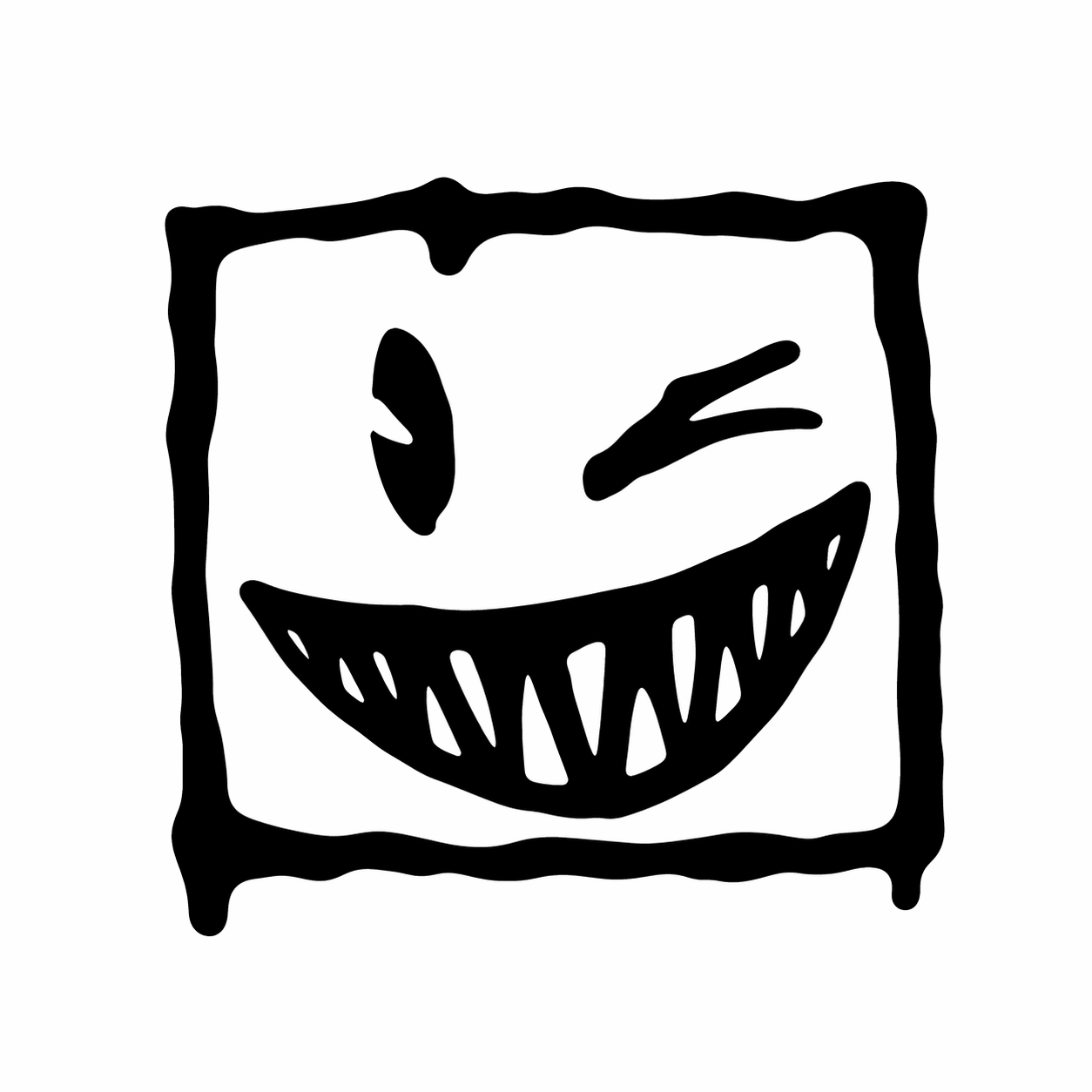
It showed a crowned round face, one eye open, one eye closed, smiling too wide.
Underneath it said:
NOT YOU AGAIN.
Nobody knows who made it.
Some say it was Round.
Some say it was the city.
Some say it was printed by a machine that had learned sarcasm.
The Crown
The crown is not royalty.
It is self-permission.
It means:
You do not wait to be approved. You crown yourself and begin.
The Smile
The NYA smile is not happiness.
It is refusal.
It means:
You tried to erase us. We came back laughing.
The Drips
The drips represent decay, imperfection, urgency, street material, and time. Nothing stays clean. Everything leaks truth eventually.
The Three Shapes
Circle
Memory, return, recycling, community, continuity.
Triangle
Signal, spirit, detection, holy trinity, triangulation.
Square
System, logic, machine, interface, structure.
Together:
The Circle remembers. The Triangle detects. The Square decides.
17. Visual Bible
Core Look
Black-and-white.
High contrast.
Zine texture.
Ink drips.
Photocopy grain.
Street poster composition.
Handwritten aggression.
Condensed type.
Sticker outlines.
Glitch grids.
Rough frames.
No sterile polish unless depicting the enemy.
Hero Composition
Characters usually stand low and strong, with oversized shoes, heavy clothing, chains, badges, patches, hoodies, and crowns.
The background should be active: splatters, arrows, warning symbols, maps, code, posters, old paper, concrete, photocopy noise.
Typography
- huge brush headlines
- condensed block subheads
- handwritten notes
- system font for Square interfaces
- stencil labels for evidence
- torn-paper captions
- warning stickers
Texture System
- xerox grain
- ink splatter
- torn paper
- sticker residue
- spray paint
- marker strokes
- halftone dots
- glitch blocks
- scanned shadows
Color
Primary: black and white.
Secondary: gray photocopy values.
Accent: one disruptive color per campaign.
Recommended accents:
- toxic pink
- emergency orange
- signal yellow
- acid green
- municipal blue used ironically
Enemy Visual Language
The Ministry of Smooth uses:
- soft gradients
- rounded corners
- pastel colors
- stock-photo smiles
- clean sans-serif typography
- empty white space
- friendly icons
- “human-centered” language that hides control
NYA should look alive.
The Ministry should look dead while pretending to be kind.
18. Game UI Bible
Main Menu
Looks like a studio wall.
Options appear as stickers:
- New Case
- Continue
- Case Files
- Studio
- Zine Archive
- Settings
- Credits
The cursor is a little Go Stone.
Evidence Board
A physical-digital hybrid:
- string lines for Triangle
- recycled object slots for Round
- data nodes for Square
The player can switch between:
- object mode
- map mode
- system mode
- timeline mode
Dialogue Interface
Characters speak in speech bubbles styled like stickers, torn paper, terminal windows, or marker captions depending on speaker.
Round: rounded speech bubbles.
Triangle: sharp angular speech bubbles.
Square: rectangular terminal windows.
Failure States
No death.
Instead:
- clue misread
- public trust drops
- system locks
- wrong poster released
- suspect disappears
- Ministry spins the story first
Failure should produce comedy and consequences, not punishment.
19. Episode / Mission Examples
Case: The Recycling Bin That Lied
Smart recycling bins claim a neighborhood is non-compliant. Fines appear automatically. Round discovers the bins are misclassifying waste. Square finds the sensor data was trained on wealthy neighborhoods. Triangle maps which blocks are targeted.
Reveal: NYA projects the real data onto every bin in the district.
Case: The Invisible Playground
A playground appears on city maps but does not exist physically. Children are being redirected to a future development site. Triangle finds three official maps disagree. Round finds old photos of the demolished playground. Square discovers budget allocation fraud.
Reveal: NYA builds a temporary playground overnight from recycled materials.
Case: The Song That Followed Everyone
People hear the same jingle in shops, buses, waiting rooms, and apps. It seems harmless. Square detects embedded behavioral nudges. Triangle traces the sound sources. Round interviews people who feel controlled by it.
Reveal: NYA turns the jingle into a protest remix.
Case: The Child With Two Names
A child has one name at school, another in health records, and another in a benefits database. Triangle triangulates the identity split. Square traces a migration data error. Round supports the family through the emotional damage.
Reveal: NYA creates a public “Name Wall” for people misnamed by systems.
Case: The Museum of Stolen Streets
A major museum opens an exhibition of “raw street culture.” The art is copied from local walls and cleaned up. The Collector is behind it.
Reveal: NYA fills the museum with QR codes linking to the original artists and locations.
20. Character Arcs
Round Arc
Round begins as the loud heart of the group, always trying to save every object, every memory, every person. Over time, Round learns that preserving everything can become its own burden. The true lesson is not to keep everything forever, but to keep things alive by letting them circulate.
Final Round lesson:
A loop is not a cage. It is a return path.
Triangle Arc
Triangle begins as a paranoid signal hunter who sees patterns everywhere. Some are real. Some are fear. Triangle must learn the difference between intuition and obsession.
Final Triangle lesson:
The invisible is real, but not every shadow is a message.
Square Arc
Square begins as the logic machine who believes every problem can be modeled. Over time, Square learns that systems must serve life, not replace it.
Final Square lesson:
The best algorithm knows when to stop deciding.
21. The Franchise Promise
Every Not You Again story promises:
- a strange visual mystery
- a funny but meaningful investigation
- a human problem hidden inside a system
- the three heads solving it in different ways
- a public creative reveal
- a larger mythology clue
- a strong poster-worthy image
- a line of dialogue that feels like a sticker
The franchise should always leave the audience thinking:
That was weird. That was funny. That was true. And I want the sticker.
22. Brand Extensions
Games
- main detective adventure series
- mobile puzzle game
- AR sticker hunt
- hacking mini-game
- zine-building game
- interactive case file website
Television
- animated detective series
- short-form web episodes
- limited mystery season
- mockumentary studio shorts
- public-service parody clips
Publishing
- graphic novels
- case-file books
- art books
- zines
- field guides
- sticker albums
- “Ministry of Smooth leaked documents”
Merchandise
- character stickers
- hoodies
- patches
- skate decks
- posters
- enamel pins
- card decks
- tarot set
- evidence-board kit
- DIY crown kit
Live / ARG
- QR-code street mystery
- hidden sticker trail
- pop-up archive
- projection reveal events
- city treasure hunt
- public design intervention
- “report an invisible problem” campaign
23. Franchise Rules
Rule 1
Every mystery must start with something small.
Rule 2
Every small thing must connect to a larger system.
Rule 3
Every solution must become visual.
Rule 4
Round, Triangle, and Square must each solve part of the truth.
Rule 5
The city is not just a setting. The city is a witness.
Rule 6
The enemy should sound reasonable.
Rule 7
The funniest object in the scene is probably a clue.
Rule 8
Never make rebellion look clean.
Rule 9
The characters can be absurd, but the emotional stakes must be real.
Rule 10
The final reveal should feel like a poster came alive.
24. Final Franchise Statement
Not You Again is a detective franchise about the things society throws away, hides, mislabels, overwrites, automates, forgets, and pretends not to see.
It is about three impossible mascots who understand the modern world better than the institutions that claim to manage it.
The Round Head recycles the past.
The Triangle Head reveals the hidden.
The Square Head computes the system.
Together, they solve the cases that official reality refuses to recognize.
Recycle. Reveal. Compute.
Not You Again.
0 comments