

Introduction
European governments increasingly deliver services online, requiring citizens to navigate multiple portals and authentication mechanisms. The Netherlands’ DigiD system demonstrates the benefits of a single digital identity: citizens can log in securely to many services—including tax administration, social insurance, education, municipalities and health care institutions—using one account . DigiD’s app supports login via a PIN, facial recognition or fingerprint and also offers SMS‑based verification . However, each Member State maintains its own identity solution and citizens still need separate accounts for border‑crossing services or for private-sector interactions. The EU’s new Digital Identity Wallet (EUDI) initiative shows how a federated identity can support secure verification, cross‑border interoperability and user‑controlled data . Building on these models, this report proposes an EUID application—a single interface for accessing all government‑related services and basic necessity providers across Europe.
Objectives and Scope
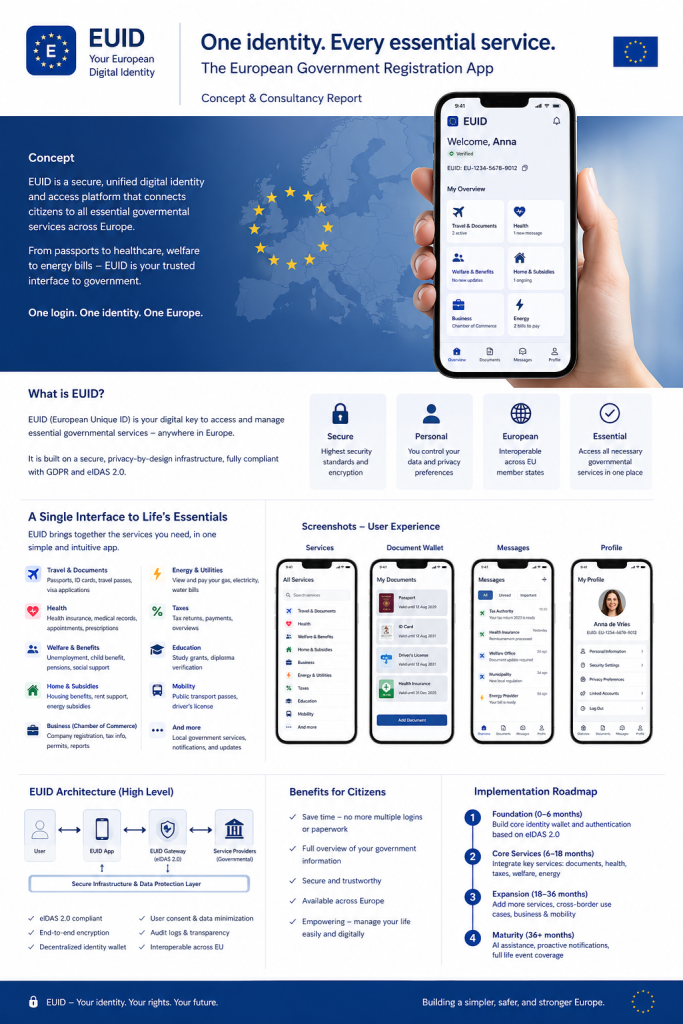
- Unified access to public services – EUID will allow citizens to apply for passports, identity cards, visas, travel passes, social welfare, housing subsidies, tax returns, health care reimbursements and business registration in one mobile app.
- Integration of basic necessities – utilities (gas, electricity and water), public transport, healthcare insurers and other regulated providers can connect to the EUID to verify users and exchange data with explicit consent.
- Cross‑border interoperability – EUID adopts the EU Digital Identity framework so that credentials are valid across member states. Citizens can use the app when moving between countries, working abroad or accessing EU‑wide programmes.
- Self‑sovereign and privacy‑preserving design – EUID will store verifiable credentials in a secure wallet on the user’s device. Users decide which attributes to share , limiting unnecessary data disclosure and complying with GDPR.
- High security & legal validity – The wallet uses strong encryption, multi‑factor authentication and digital signatures to ensure legal recognition of transactions across Europe .
Conceptual Architecture
EUID Wallet Structure
| Layer | Functions |
| User Interface | Mobile app and web portal with multilingual support, accessible design and integration with assistive technologies. Allows citizens to manage their EUID credentials, view notifications and submit applications. |
| Credential Wallet | Stores verifiable credentials such as passports, ID cards, driving licences, residence permits and diplomas. Supports secure digital identity verification , self‑sovereign control of data , and digital signature capabilities . |
| Authentication & Authorization | Multi‑factor authentication using device PIN, biometrics, FIDO2 tokens or smart‑cards. Adopts the highest security standards and provides strong digital signatures for legal validity . |
| Integration Layer (APIs) | Standardised APIs (REST/GraphQL) that allow government agencies, utilities and certified third parties to request, verify or issue credentials. Supports open ecosystem integration while enforcing consent, data minimisation and revocation. |
| Trust Framework | Based on the EU Digital Identity Architecture and Reference Framework (EUDI ARF), ensuring interoperability between national eID systems, compliance with eIDAS 2.0 and alignment with GDPR. |
Service Modules
- Identity and Travel – Users can apply for passports/ID cards, view travel history, manage visas and request EU travel passes. Using DigiD‑like identity verification and the EUDI wallet’s cross‑border interoperability , the app can seamlessly exchange data with consulates and border agencies.
- Citizenship and Civil Status – Registration of births, marriages, divorces and change of address with automatic updates to tax and social security records. Citizens use their EUID to submit documents and digitally sign applications.
- Work and Business – Access to employment services, unemployment benefits and training programmes. Integration with Chambers of Commerce to register businesses, submit annual returns and manage company authorisations. Digital signatures streamline business formation and compliance.
- Finance and Taxes – Single login for tax filings, subsidies (housing, energy and childcare) and pension updates. The EUDI wallet supports secure identity verification for banking and financial services while giving citizens control over their data .
- Health and Social Care – Access to health insurance, medical records, e‑prescriptions and appointment bookings. The wallet’s multi‑purpose functionality allows integration with healthcare providers and pharmacies .
- Utilities and Transport – Manage gas, electricity, water and telecom accounts; pay bills; monitor consumption and access subsidies. Public‑transport cards and travel passes can be issued and stored in the wallet, enabling seamless mobility. ID verification prevents fraud and ensures eligibility for discounted fares.
Security, Privacy and Data Protection
Multi‑factor authentication and biometrics. DigiD demonstrates several login methods: an app requiring a PIN and optionally facial recognition or fingerprint, SMS verification, username/password or use of identity cards for highly sensitive data . EUID should require at least two factors for high‑risk transactions and support biometric verification for convenience. Hardware‑secure elements on mobile devices store private keys.
User‑controlled disclosure. The EU Digital Identity Wallet emphasises user control; citizens decide which attributes to share . EUID will implement selective disclosure and zero‑knowledge proofs to reveal only necessary information (e.g., verifying age without sharing birthdate). Each data request will include a clear explanation and require explicit consent.
Encryption and digital signatures. The wallet uses end‑to‑end encryption of stored credentials and transport‑layer security for communications. Verifiable credentials are signed by issuing authorities and can be independently verified. Digital signatures provide legal validity for documents .
Regulatory compliance. EUID must comply with the EU’s eIDAS 2.0 regulation (electronic identification, authentication and trust services), GDPR and relevant national laws. The eIDAS framework ensures that digital identities and signatures are legally recognised across member states .
Fraud prevention and incident response. Lessons from DigiD emphasise vigilance: users are warned not to share login details and are advised to activate two‑step verification to prevent misuse . EUID should provide clear guidance, real‑time fraud detection, incident reporting tools and a 24/7 helpdesk.
User Experience and Inclusivity
- One‑stop interface – The app should present a dashboard with personalised tiles for services (passport renewal, tax filing, healthcare claims, utility bills). Users access new services by scanning QR codes or clicking deep links from partner websites.
- Transparency and consent – Each time data is shared, the app displays who is requesting it, which attributes will be released and for what purpose. Users can review their consent history and revoke access.
- Accessibility – Compliance with the Web Content Accessibility Guidelines (WCAG) ensures the app is usable by people with disabilities. Multilingual support and plain‑language explanations help non‑native speakers.
- Offline and remote usability – Citizens abroad should be able to apply for identity documents or renew credentials remotely. DigiD allows applications from abroad with a citizen service number (BSN) ; EUID should similarly accommodate expats, mobile workers and diaspora communities.
Integration and Interoperability
EUID’s success depends on broad integration:
- Government back‑offices – Ministries, municipal registries, tax agencies and social security offices need connectors to verify EUID credentials and issue digital documents. The EUDI ARF defines standard APIs and protocols to ease integration .
- Trusted private providers – Utilities, telecom operators, insurers, banks and transport operators can adopt EUID for KYC/AML purposes. The cross‑border interoperability of the wallet opens new markets and reduces verification costs for businesses .
- Cross‑border recognition – EUID credentials should be compatible with national eIDs and accepted by other EU countries. The concept of a recognised eID under eIDAS ensures that DigiD and similar systems are accepted in other European countries ; EUID will build on this by offering a unified interface.
Benefits and Value Proposition
| Stakeholder | Benefits |
| Citizens | Convenient single app for all government interactions; reduced need to remember multiple passwords; control over personal data; legal recognition across Europe; ability to sign documents digitally; easier access to benefits and subsidies; inclusivity for expats and persons with disabilities. |
| Governments | Improved efficiency in public service delivery; reduced fraud through strong verification ; simplified back‑office processes; enhanced cross‑border cooperation; better data quality and analytics; alignment with the EU’s digital single market objectives. |
| Businesses/Service Providers | Streamlined customer onboarding; reduced identity verification costs ; access to a larger EU‑wide customer base ; trust in transactions through high security standards and legal validity . |
Implementation Roadmap
- Policy and Legal Alignment (2026–2027) – Harmonise national laws with eIDAS 2.0 and define governance structures. Establish a pan‑European trust framework and liability rules for credential issuers and service providers.
- Technical Development (2026–2028) – Develop the EUID app and wallet following the EUDI ARF; conduct security audits; integrate with national identity databases; pilot with selected services (e.g., tax filing, passport renewal).
- Pilot Projects (2027–2028) – Launch pilots in several Member States to test cross‑border services, interoperability and user experience. Gather feedback and iterate on the app design and APIs.
- Scale‑up (2028–2030) – Gradually onboard additional services (utilities, healthcare, education, business registration) and expand acceptance to all EU countries. Provide continuous user support and communication campaigns to build trust.
- Continuous Improvement – Monitor security, privacy, and user satisfaction metrics; update standards; adopt new technologies (e.g., decentralised identifiers, quantum‑resistant cryptography) and ensure long‑term sustainability.
Challenges and Mitigation Strategies
- Privacy concerns – To counter fears of surveillance, EUID must emphasise user control and data minimisation , use open‑source code and undergo regular independent audits.
- Interoperability – Differences in national systems and legal requirements can hinder integration. Adherence to EUDI ARF and collaboration among Member States are essential .
- Digital divide – Not all citizens have smartphones or digital literacy. Provide alternative login options (smart cards, kiosks) and digital‑inclusion programmes. The DigiD experience shows that SMS verification and physical identity cards are necessary for accessibility .
- Security risks – The wallet will be a high‑value target. Employ multi‑layered security, continuous monitoring, and rapid incident response. Educate users about phishing and emphasise that credentials are strictly personal .
- Governance and Trust – Establish clear governance, including certification of wallet providers, liability for breaches, and procedures for revocation and recovery of credentials.
Conclusion
The EUID app represents a transformative opportunity for Europe to simplify access to government and essential services, enhance digital sovereignty, and promote economic integration. By building on successful national systems like DigiD—which allows citizens to log into tax agencies, social insurance, municipalities and health providers —and adopting the interoperable, privacy‑centric principles of the EU Digital Identity Wallet , EUID can deliver a secure, user‑controlled, and cross‑border digital identity. With careful planning, robust security, and inclusive design, the European Union can provide a single, trusted interface to everything governmental—and beyond—empowering citizens and businesses for the digital age.
0 comments