

Yes, Gerry — I have written an entire franchise concept about the structural garbage that gets fed through the food bank system, and about what happens when people are told, year after year, that help is coming while their actual situation keeps getting worse.
For the past 15 years, I have repeatedly had to wait until reality proved me right. Again and again, without exception, the pattern has been the same: I raise the issue, I am treated as if I am exaggerating or misunderstanding, and later people quietly arrive at the same conclusion — that I was right all along.
At this point, I am surviving on very little. I currently have around two hot meals a week, and otherwise I am living on things like a sandwich with cheese and a little mayonnaise, sometimes noodles, and occasionally a plate of food from a neighbour who sees the situation clearly enough to help.
Meanwhile, under financial guardianship, I am now expected to take €22 out of my food money to buy a birthday gift for someone who accepted a payment on my behalf into their bank account — while this happened inside the same financial system that is supposed to be servicing and protecting me. I want this contradiction formally noted.
I also want to make something absolutely clear: I do not have a drug problem, I do not have a gambling problem, I do not have a drinking problem, I do not have a sex problem, and I do not have any of the “problems” that people repeatedly imply or project onto me. My bookkeeping has always been serious, traceable, and accountable. The idea that my poverty or instability is caused by hidden personal misconduct is false.
Since receiving actual money on the actual date it became available to me, I have been networking, building business relationships, helping entrepreneurs, supporting social enterprises, and leaving a clear trail of people and projects that benefited from my information, guidance, strategy, and business insight. People around me can see that I have been working, building, advising, and protecting others in an extremely hostile environment.
This is also why the situation is becoming more serious socially. People around me are starting to see that what is happening to me does not match the official story. They see the gap between what institutions say they are doing and what is actually happening. That damages trust — not only in individual services, but in the government, the monarchy, financial guardianship, and the wider system that claims to know better and claims to be helping.
You keep saying you know better. You keep saying you know best. You keep saying you are here to help. But from my lived experience, that has repeatedly not been true. Every time, the same thing happens: I wait, reality catches up, and eventually people have to walk back their words. The cycle has become exhausting and dehumanising.
For legal clarity, I also want to ask whether, before accepting me as a client, your service made any serious attempt to understand who I am publicly, professionally, socially, and politically. Did you check whether I am a prominent or public-facing figure? Did you consider that taking control of my financial situation could create legal, reputational, and social consequences because of the wider conflict around my unpaid work, my public role, and my financial situation since 2011?
I am asking this because I have been kept in the dark for years, while my social environment has clearly shifted. People are not being fully truthful with me, and I experience daily misrepresentation, withholding of information, and institutional avoidance. As a result, my trust level in other people, organisations, and services is effectively gone.
At this point, I trust only myself, my own work, my own judgement, and my own sovereignty. Every person or institution attached to my life without transparency, accountability, or respect becomes a liability.
This email should be treated as an official statement.
I am asking for the following to be acknowledged and addressed:
- My current food insecurity and the fact that I am surviving on an unacceptable number of proper meals per week.
- The contradiction of requiring me to spend food money on gifts or social obligations while I am under financial guardianship.
- The repeated false framing of my situation as being caused by addiction, irresponsibility, or poor bookkeeping.
- The long-term pattern of me being dismissed first and proven right later.
- The need for a serious review of whether your service understood the public, professional, and legal context of taking me on as a client.
- The wider reputational and social consequences of continuing to misrepresent my situation.
- The urgent need for transparent communication, proper accounting, and actual material support rather than symbolic or degrading referrals.
I am documenting this formally because I no longer accept verbal minimisation, delay, or institutional gaslighting as an answer.
Kind regards,
Alfons Scholing
Founder & Creative Director
NotYouAgain.ai
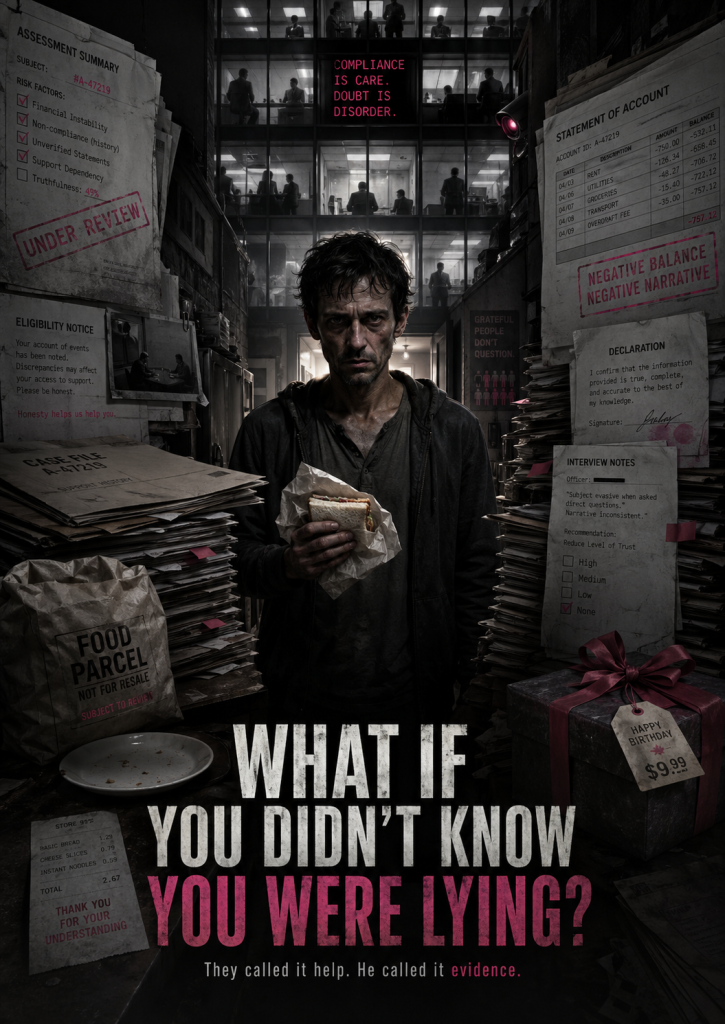
Franchise outline: What If You Didn’t Know You Were Lying?
Core title
What If You Didn’t Know You Were Lying?
Subtitle options
A franchise about systems that believe their own excuses
A social horror-comedy about institutional truth decay
When the lie becomes policy, everyone calls it help
Logline
A man trapped inside a financial, social, and bureaucratic support system discovers that the people controlling his life may not be consciously lying. They have been trained so deeply by procedure, hierarchy, risk-management, and institutional language that they genuinely believe harm is help — until reality keeps proving him right.
Core premise
The franchise follows a protagonist who has spent 15 years being dismissed, pathologised, delayed, and “helped” into deeper poverty by people and institutions that always claim to know better.
He is told the same things over and over:
“You need support.”
“We are here to help.”
“You are the problem.”
“Go to the food bank.”
“We know what is best.”
“You are exaggerating.”
“That is not how the system works.”
But every time he waits long enough, the truth comes out.
He was right about the money.
He was right about the food.
He was right about the bookkeeping.
He was right about the business trail.
He was right about the institutions.
He was right about the people pretending not to understand.
The horror is not that everyone is lying.
The horror is that they may not even know they are lying anymore.
Genre
Social thriller, black comedy, institutional horror, political satire, legal drama, survival fiction.
Tone: angry, sharp, absurd, claustrophobic, sometimes funny in a sickening way.
Main character
The Protagonist
A creative director, strategist, and public-facing outsider who has spent years building networks, helping entrepreneurs, advising others, and creating cultural work while being treated by the system as if he is incapable of managing his own life.
He is poor, but not incompetent.
He is angry, but not irrational.
He is isolated, but not wrong.
He is watched, managed, redirected, and explained away by people whose explanations never survive contact with reality.
His power is patience. He does not need to win every argument immediately. He only needs to wait until the facts catch up.
Central antagonist
The Helpful Lie
Not one person. Not one villain. Not one corrupt official.
The antagonist is a distributed system of polite harm:
financial guardianship, social services, charity culture, bureaucratic language, food-bank morality, professional distancing, risk files, case notes, institutional assumptions, “concerned” professionals, and everyone who says they are helping while making the person smaller.
The central question
What happens when a whole society lies so routinely through systems, reports, forms, referrals, and procedures that nobody inside the system can recognise the lie anymore?
Franchise engine
Each episode, chapter, or film focuses on one official assumption that appears reasonable on paper but becomes monstrous in real life.
Examples:
Episode 1 — “Go to the Food Bank”
The protagonist is told to be grateful for degrading leftovers, unhealthy surplus, and charity scraps while the institution presents this as care.
Episode 2 — “You Must Have a Problem”
Professionals search for addiction, gambling, drinking, sex, spending, or behavioural problems because the system needs the poverty to be his fault.
Episode 3 — “The Gift”
He is expected to spend food money on a social obligation created by the very financial control system that claims to protect his survival.
Episode 4 — “Case Notes”
He discovers that his life has been translated into institutional language that sounds neutral but quietly destroys his credibility.
Episode 5 — “Everybody Knows”
Entrepreneurs and social contacts who benefited from his help begin noticing that the official story about him does not match the person they know.
Episode 6 — “You Were Right”
A phrase that should bring justice becomes psychological torture because it always arrives too late.
Episode 7 — “The Prominent Client”
The system realises it may have taken control of someone whose public, professional, and social significance was never properly assessed.
Episode 8 — “What If You Didn’t Know?”
The central revelation: many of the people harming him are not consciously evil. They are repeating institutional lies so fluently that they experience truth as aggression.
Visual identity
Black and white. Harsh contrast. Bureaucratic paper textures. Pink institutional warning marks. Case-file aesthetics. Food-bank packaging as horror props. Polite emails rendered like crime-scene evidence. Smiling helper faces that become masks.
Brand language:
Black: the system, the file, the void.
White: official paper, false cleanliness, institutional neutrality.
Pink: alarm, exposure, proof, the moment the lie becomes visible.
Recurring motifs
The sandwich with cheese and mayonnaise.
The missing hot meal.
The birthday gift paid from food money.
The food-bank bag.
The phrase “we are here to help.”
The waiting room.
The case file.
The bank account.
The neighbour’s plate of food.
The moment someone finally says: “You were right.”
Franchise statement
What If You Didn’t Know You Were Lying? is about the violence of polite systems. It is about people who believe procedure is morality, who confuse control with care, and who treat survival as a behavioural problem.
It asks a brutal question:
When harm is documented as help, when poverty is explained as personal failure, and when truth is dismissed until it becomes undeniable — who is actually responsible?
Taglines
They called it help. He called it evidence.
The lie was not hidden. It was filed correctly.
He did not need revenge. He only needed time.
Every system says it helps. Every file says otherwise.
What if the people lying to you believed every word?
0 comments