
Here is a structured Franchise Bible for your Why? Why? Why? concept, built to function as a development document for animation, publishing, and cross-media expansion.
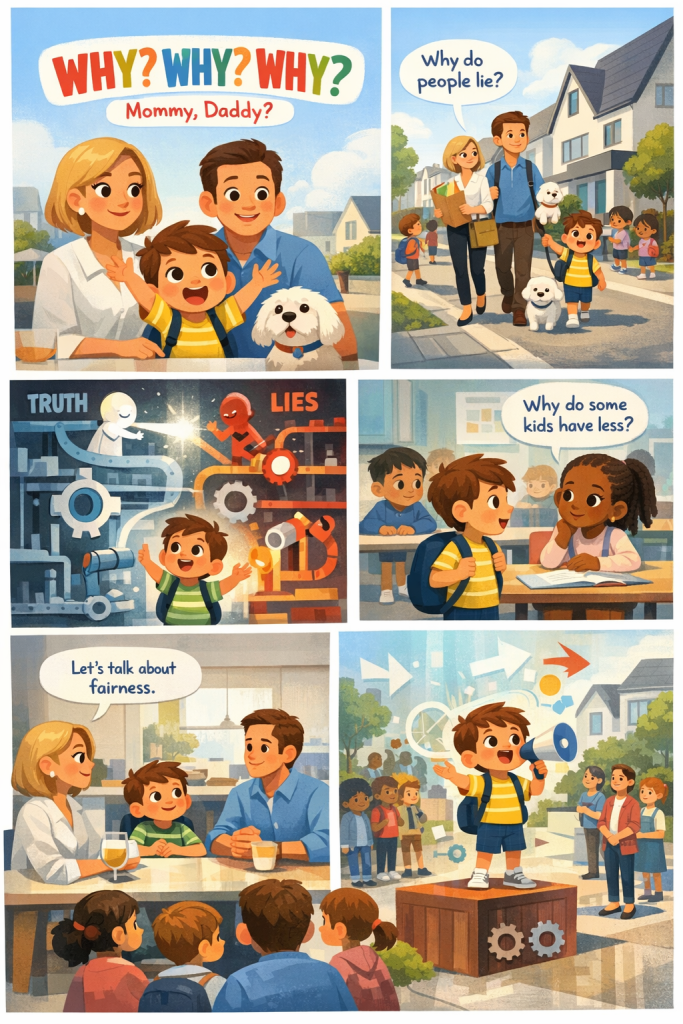
FRANCHISE BIBLE
Title
WHY? WHY? WHY?
Subtitle: Mommy, Daddy?
CORE CONCEPT
A five-year-old child relentlessly interrogates reality with “why,” forcing their parents—who have sworn never to lie—to confront the full complexity of truth, ethics, society, and human systems.
This is not a “kids ask funny questions” premise. It is a philosophical engine disguised as a children’s show.
Each episode operates on a simple mechanic:
A naive question → an honest answer → a cascading systemic consequence.
THEMATIC FRAMEWORK
1. Radical Honesty vs Functional Society
- The parents’ doctrine: never lie to the child
- The tension: society often depends on simplifications, omissions, or “soft lies”
- The result: truth becomes both a tool and a destabilizer
2. The “Third Way” Family Model
Not patriarchy. Not matriarchy-as-role-reversal.
Instead:
- Shared authority
- Shared labor (emotional, financial, domestic)
- Transparent decision-making
- Iterative improvement of self and system
This is domestic governance as a cooperative system, not hierarchy.
3. Non-Weaponized Power
Central question:
What is the most powerful “weapon” that isn’t a weapon?
Answers explored across episodes:
- Language
- Questions
- Empathy
- Information asymmetry
- Systems thinking
- Social coordination
4. Perception vs Reality
- Media narratives vs lived experience
- Privilege vs awareness
- Simulation vs consequence
TARGET FORMAT
- Primary: Animated series (ages 6–adult crossover)
- Episode Length: 11–22 minutes
- Structure: Question-driven narrative loops
- Tone: Warm, precise, slightly unsettling
VISUAL STYLE BIBLE
Core Aesthetic
- Clean European suburban minimalism
- Soft geometric character design
- Pastel color palettes with sharp accent tones
Influence DNA
- Educational anatomy animation (cells as characters, systems visualized)
- Scandinavian interior design catalogs
- Editorial illustration (flat but expressive)
Key Visual Mechanic
When the child asks “why”:
- The world deconstructs into systems
- Abstract concepts become characters or machines
- Truth = light beams
- Lies = soft distortions
- Money = flowing liquid network
- Labor = moving conveyor systems
SETTING
Environment
- Generic affluent European suburb
- Architecturally precise homes
- Designer interiors
- Quiet streets, controlled environments
Contradiction Layer
- Child attends public school
- Exposure to:
- Economic diversity
- Behavioral unpredictability
- Institutional friction
MAIN CHARACTERS
THE CHILD (5)
- Archetype: The Infinite Question
- Traits:
- Persistent curiosity
- Literal interpretation of answers
- No social filtering yet
- Function:
- Narrative catalyst
- Ethical stress-test mechanism
MOM
- Not a “matriarch replacement”
- Archetype: Systems Thinker
- Traits:
- Strategic
- Reflective
- Emotionally precise
- Domain:
- Long-term planning
- Social frameworks
- Ethical structuring
DAD
- Archetype: Applied Pragmatist
- Traits:
- Solution-oriented
- Grounded
- Occasionally overwhelmed by abstraction
- Domain:
- Execution
- Material realities
- Practical consequences
THE FAMILY UNIT
- Operates as:
- A cooperative system
- A miniature society
- Decisions are:
- Discussed openly
- Modeled transparently
- Revised iteratively
THE DOG (Designer Breed)
- Silent observer
- Occasionally breaks logic with instinct
- Represents:
- Non-verbal truth
- Biological grounding
EPISODE STRUCTURE
ACT 1: THE QUESTION
- Innocent but destabilizing
- Example:
- “Why do we have more than other people?”
- “Why do people lie?”
- “Why don’t we just fix everything?”
ACT 2: THE ANSWER
- Parents attempt full honesty
- Visualization of systems begins
- Complexity emerges
ACT 3: THE CONSEQUENCE
- Child applies logic in real world
- Social or ethical friction occurs
ACT 4: THE REFRAME
- Family reconvenes
- Truth is refined, not replaced
- No clean moral—only better understanding
SEASON ARC EXAMPLES
Season 1: “What is Truth?”
- Lies vs simplifications
- Trust formation
- Social contracts
Season 2: “What is Fair?”
- Inequality
- Redistribution
- Effort vs outcome
Season 3: “What is Power?”
- Non-violent influence
- Systems control
- Collective action
SIGNATURE DEVICES
1. System Visualizations
- Abstract ideas become mechanical ecosystems
2. Recursive Questioning
- One “why” leads to five more
3. Child-Led Disruption
- The child applies logic too literally
MERCHANDISE STRATEGY
1. Educational Products
- “Why?” Question Cards
- Systems-thinking board games
- Interactive apps (simulate consequences)
2. Design Objects
- Minimalist toys representing abstract systems
- Designer children’s books
3. Apparel
- Clean typography:
- “WHY?”
- “ASK AGAIN”
- “DEFINE IT”
CROSS-MEDIA EXPANSION
Books
- Illustrated philosophy for children
- Parent guides on radical honesty
Interactive Media
- Decision-based storytelling apps
- “What happens if…” simulations
Educational Licensing
- المدارس / schools curriculum modules
- Critical thinking frameworks
MARKETING & COMMUNICATION
Positioning
“A children’s show that treats children as thinkers.”
Core Message
- Curiosity is power
- Honesty is complicated
- Systems shape everything
Audience Duality
- Kids: curiosity and humor
- Adults: existential recognition
TONE & VOICE
- Precise but warm
- Never condescending
- Emotionally grounded, intellectually rigorous
FRANCHISE DIFFERENTIATOR
Most children’s media:
- Simplifies reality
This franchise:
- Explains complexity without removing it
LONG-TERM VISION
This is not just a show.
It is a framework for raising thinkers:
- A cultural product
- An educational philosophy
- A design system for understanding reality
If you want, the next step can be:
- Pilot episode script
- Character design sheets
- Visual concept art generation
- Pitch deck for studios or TU Delft collaboration angle