
Below is a franchise bible you can hand to collaborators (art, design, production, publishing). It’s structured to keep your original instinct—overload, confusion, systems under stress—while making it scalable, brand-safe, and commercially viable.
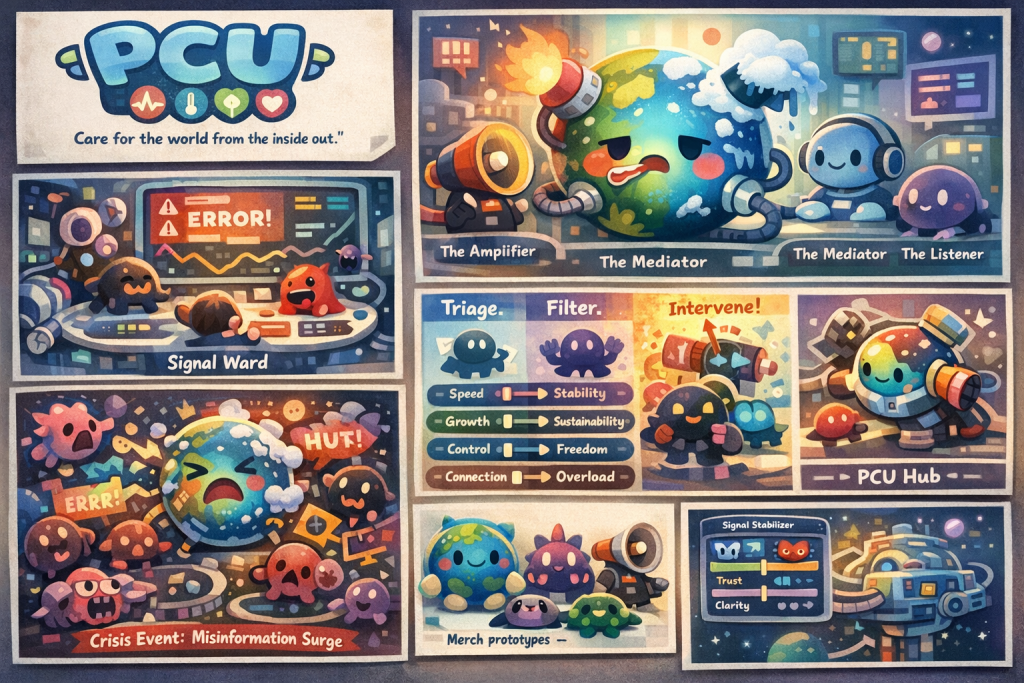
FRANCHISE BIBLE — PLANETARY CARE UNIT (PCU)
Working Tagline: “Care for the world from the inside out.”
1. Core Premise
A cosmic hospital treats entire planets as living organisms.
Earth is admitted with systemic overload: distorted signals, unstable feedback loops, and cascading imbalances.
Players join the Planetary Care Unit (PCU) to:
- triage symptoms
- filter noise from signal
- apply interventions
- stabilize dynamic systems
Thesis: Healthy worlds emerge from balanced systems—trust, fairness, care, and connection functioning together.
2. Tonal & Creative DNA
Tone Stack
- 60% playful / cozy
- 25% absurd / surreal
- 15% eerie (“friendly horror”)
Reference Anchors
- Once Upon a Time… Life — personified systems
- The Nightmare Before Christmas — whimsical macabre
- Two Point Hospital — systemic humor
Non-Negotiables
- No real-world parties or symbols
- No labeling groups as “disease”
- Consequences over moralizing
3. World Logic
The Hospital
A vast, modular structure that feels like:
- part clinic
- part control room
- part living organism
Departments are organs of a meta-body:
- tubes, conveyors, signal lines
- visible flows of information, resources, and care
The Patient: Earth
A chibi, expressive planet:
- surface displays symptoms (heat blush, storm tangles, glitch flicker)
- reacts emotionally to interventions
- never speaks directly; communicates through behavior
4. System Philosophy (Core Design Framework)
Everything runs on balancing axes:
- Speed ↔ Stability
- Growth ↔ Sustainability
- Control ↔ Freedom
- Connection ↔ Overload
And health variables:
- Trust
- Fairness
- Respect
- Care
- Signal Clarity
Design Rule:
Every intervention improves one variable and stresses another.
5. Gameplay Pillars
A. Triage
Identify symptoms across departments:
- overheating zones
- signal distortion
- resource strain
- conflict spikes
B. Signal Filtering
Core mechanic:
- mute noise
- prioritize inputs
- combine partial truths
C. Intervention
Deploy tools:
- friction (slow spread)
- bridging (connect groups)
- buffering (protect systems)
- redistribution (rebalance load)
D. Feedback
- immediate + delayed consequences
- second-order effects drive depth
E. Regulation States (Player Condition)
- Fight → fast, error-prone
- Flight → avoidance, backlog
- Freeze → clarity, slow action
Optimal play = controlled pacing.
6. Departments (Modular Expansion)
Signal Ward
- message flow, misinformation, noise creatures
Climate Ward
- temperature, storms, environmental balance
Resource Ward
- extraction vs regeneration
Cohesion Ward
- polarization, cooperation dynamics
Care Ward (Meta)
- trust, fairness, social recovery rates
Each ward = future standalone product.
7. Characters (Caretaker Entities)
All characters embody functions + biases:
- The Amplifier — boosts reach, risks volatility
- The Gatekeeper — adds friction, risks suppression
- The Mediator — reduces conflict, slower impact
- The Builder — strengthens systems, resource-heavy
- The Listener — increases trust, low throughput
- The Equalizer — redistributes load
Rule: No villains—only misapplied strengths.
8. Visual Style Bible
Shape Language
- rounded, soft geometry
- chibi proportions
- no sharp aggression
Line & Rendering
- clean outlines
- high readability
- minimal clutter
Color System
Each system has a palette:
- Signal → blues/purples
- Climate → reds/oranges/cyans
- Resource → greens/yellows
- Cohesion → pinks/teals
States:
- healthy = saturated, smooth gradients
- unstable = flicker, noise overlays
- critical = desaturated + distortion
Material Language
- felt, rubber, clay textures
- visible seams and stitching
- puppet-like construction
Animation Principles
- constant motion (flows, carriers, loops)
- exaggerated reactions
- readable cause-and-effect
9. UI / UX Language
- diegetic interfaces (inside the “body”)
- dashboards as living panels
- signals visualized as moving objects
Key UI metaphors:
- sliders = pressure valves
- maps = circulatory diagrams
- alerts = creatures, not text boxes
10. Narrative Architecture
Phase 1: Earth Intake
- onboarding
- learning system basics
Phase 2: Planet Cases
- each world = extreme imbalance
- hyper-order world
- chaos world
- overgrowth world
Phase 3: Hospital Instability
- meta-systems fail
- recursion: systems treating systems
11. Franchise Structure
Games
- PCU: Earth Case
- PCU: Signal Overload
- PCU: Runaway Growth
Series (Animation)
Educational storytelling using the same characters:
- episodic “inside the system” narratives
Interactive Education
- classroom versions
- simulation modules
12. Marketing & Communication Strategy
Positioning
“Cozy systems simulation with meaning”
Core Messaging
- “Fixing the world starts with understanding it”
- “Balance beats chaos”
- “Care is a system, not a slogan”
Audience Segments
- 12–18: accessible systems thinking
- 18–35: simulation / strategy players
- educators & institutions
Content Strategy
- short explainer animations (in-universe)
- dev diaries explaining systems
- interactive web demos
Partnership Angle
Strong fit with:
- educational institutions (e.g. TU Delft-style collaborations)
- NGOs (systems education, sustainability)
13. Merchandise Strategy
Core Products
- plushies (Earth, Noise Creatures, Caretakers)
- figurines (department characters)
- art books (systems diagrams + lore)
Functional Merchandise
- board game (balance systems physically)
- card game (signal vs noise mechanics)
- educational kits (classroom use)
Premium
- collectible “planet cases”
- modular playsets (hospital departments)
14. Brand Identity
Visual
- soft, rounded typography
- icon-based communication
- modular logo (PCU + department icons)
Voice
- calm, clear, slightly playful
- never preachy
- curious, not judgmental
15. Production Roadmap
Phase 1
- vertical slice (Signal Ward)
- core mechanics validation
Phase 2
- expand to 2–3 wards
- establish art pipeline
Phase 3
- narrative layering
- franchise positioning
16. Creative Guardrails (Critical)
Do:
- show systems
- reward balance
- let players discover meaning
Avoid:
- explicit political labeling
- moral absolutism
- oversimplification
Closing Note
This IP works because it transforms:
- confusion → clarity
- chaos → systems
- ideology → interaction
If executed correctly, players don’t feel told what’s right—
they experience why balance, care, and fairness create stability.
If you want, I can next turn this into:
- a pitch deck for investors/studios, or
- a fully scoped vertical slice document (mechanics, UI, assets, sprint plan)