

Core Franchise Title
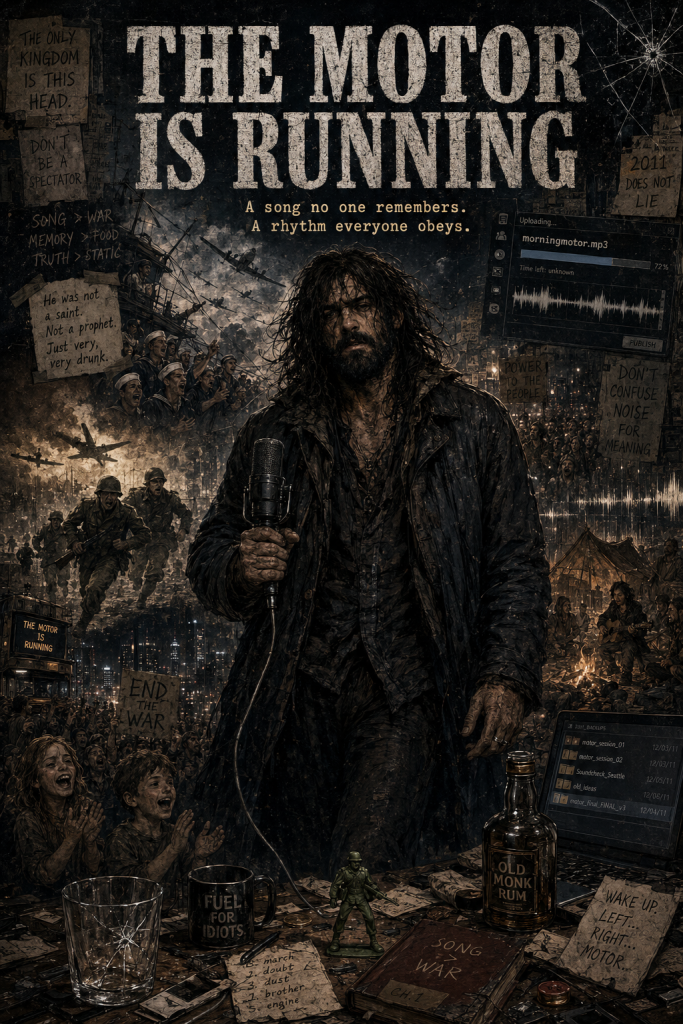
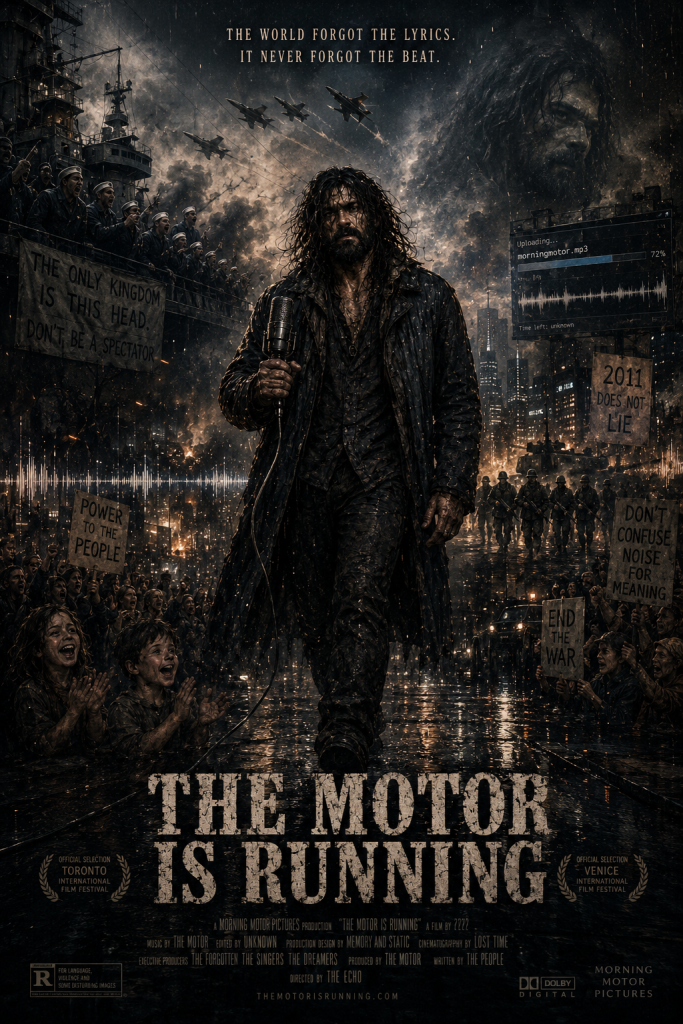
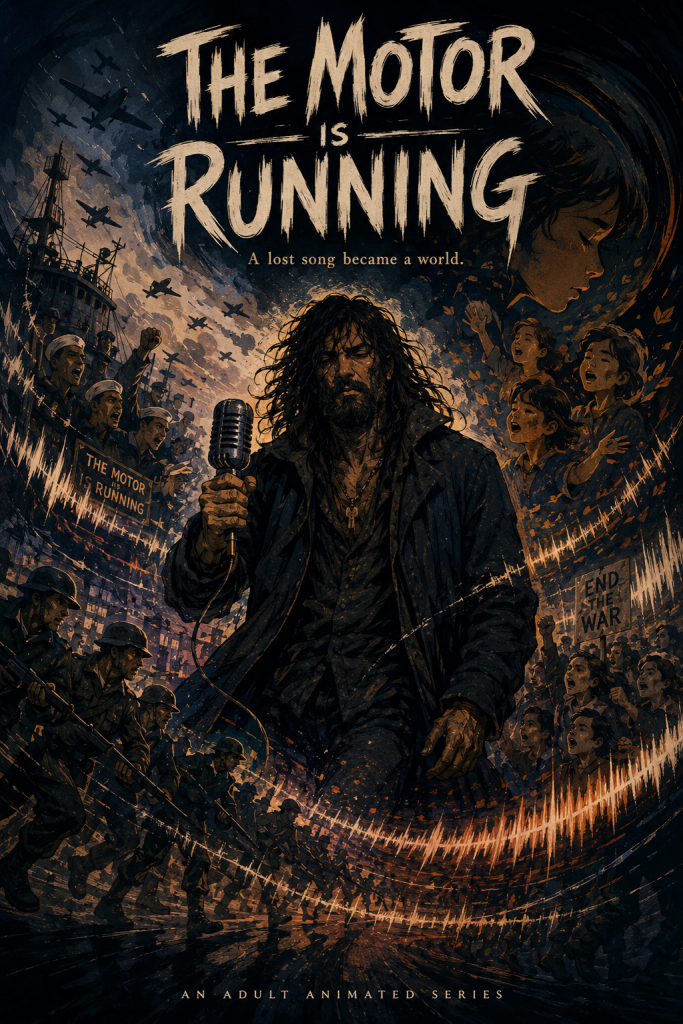
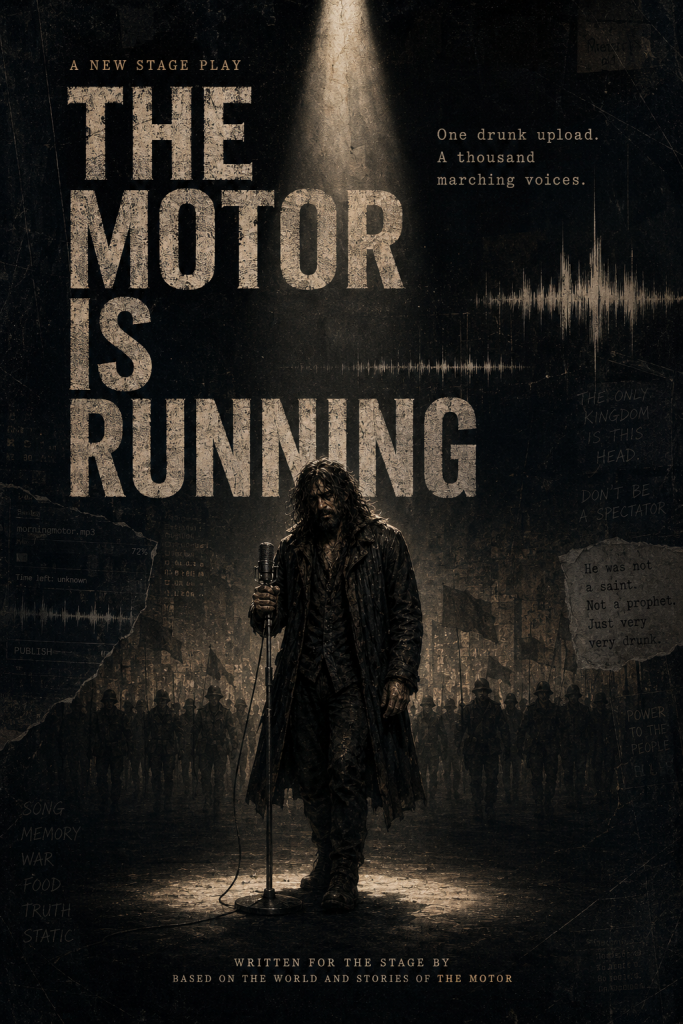
THE MOTOR IS RUNNING
Franchise Tagline
A song no one remembers. A rhythm everyone obeys.
Core Myth
Somewhere around 2011, a broke, drunk, half-holy nobody made a marching song during a blackout night, uploaded it anonymously, and forgot it by morning.
The internet did not.
The original file disappeared.
The lyrics rotted.
The rhythm survived.
From barracks to navy decks, from fighter cockpits to protest camps, from prison yards to playgrounds, the song mutated into hundreds of versions. Nobody could prove the original. Every group made it their own. Some used it for discipline. Some for rebellion. Some for grief. Some for war. Some for worship. Some for jokes.
The world began marching to a missing song.
The creator became known only as:
The Prophet Without Memory.
But he keeps saying:
“I was drunk.”
Nobody believes him.
1. The Franchise Engine
The Motor
The Motor is not a person, not a government project, not a religion, not a curse, not a simple meme.
It is a cultural machine.
It spreads through:
cadence, repetition, rhythm, stress, exhaustion, collective movement, and unfinished meaning.
The Motor works because people complete it themselves.
The original lyrics are gone, so every listener fills the gap with their own fear, loyalty, trauma, hope, ideology, or need.
That makes it infinitely adaptable.
Franchise Rule
The original song must never be fully revealed.
Never.
Fragments are allowed:
LEFT. RIGHT. MOTOR. WAKE UP. KEEP WALKING. HOME. BROTHER. BREATHE.
But the full original stays missing.
The mystery is the engine.
2. Genre Identity
THE MOTOR IS RUNNING is a hybrid franchise:
Military folklore
Internet mythology
Occult media mystery
Political satire
Psychological horror
Spiritual black comedy
Found-footage archive fiction
Graphic novel noir
Viral-culture thriller
Anti-prophet character study
The franchise should feel like:
a lost internet file became a religion, a weapon, a joke, a training tool, and a ghost story at the same time.
3. Core Tone
The tone is dark, funny, paranoid, poetic, and human.
It should never become generic apocalypse fiction.
The world does not end because of the song.
The world keeps going.
That is worse.
The Motor becomes embedded in normal life: gyms, schools, armies, shipping crews, influencers, police academies, protests, video games, therapy apps, prison yards, stadiums, churches, meditation retreats, and corporate leadership seminars.
The horror is not that everyone is possessed.
The horror is that everyone finds the song useful.
4. The Central Character
The Prophet Without Memory
Real name can remain uncertain, or change between sources. Some files call him M., some The Drunk Monk, some The Upload Saint, some Morningmotor, some The Idiot With a Microphone.
He is not Jesus.
He is not Buddha.
He is not holy.
He is not evil.
He is not chosen.
He is just the wrong man at the wrong time with the right rhythm.
Visual Identity
Long dark hair.
Beard.
Tired eyes.
Second-hand coat.
Cheap sandals or worn boots.
A face people project meaning onto.
Looks holy when silent, stupid when speaking, tragic when drunk.
Character Truth
He does not want disciples.
He does not want fame.
He does not want to lead.
He does not remember the night clearly.
He suspects he made the song.
He fears he made something that the world needed too badly.
His Main Line
“I was drunk.”
His Tragedy
He created something powerful only because he was at his weakest.
5. The Franchise Question
Every story in the franchise should circle one question:
Who owns meaning once it leaves the person who made it?
Secondary questions:
Can a rhythm be guilty?
Can a song become a weapon without lyrics?
Can a lost file become scripture?
Can a joke become history?
Can a creator refuse responsibility?
Can mass culture turn accident into destiny?
Can people march together without knowing where they are going?
6. Main Factions
A. The Archivists
Internet sleuths, lost-media hunters, waveform analysts, forum veterans, obsessive librarians, dead-link divers.
They want the original file.
They believe truth exists somewhere in a corrupted hard drive, cached page, military server, old phone, or forgotten blog.
Motto
Find the first sound.
Internal Conflict
Some want truth.
Some want fame.
Some want to destroy the original if they find it.
B. The Cadence Units
Soldiers, marines, sailors, pilots, police units, private military trainers, cadets.
They do not care about the origin.
They care that it works.
The Motor helps people move through pain.
Motto
Left. Right. Motor.
Internal Conflict
Some treat it as tradition.
Some treat it as psychological conditioning.
Some begin to fear they cannot train without it.
C. The Believers
Mystics, cultists, online prophets, failed monks, fringe churches, meditation influencers, apocalypse preachers.
They believe the missing lyrics were divine.
Some call the song a commandment.
Some call it a warning.
Some call it the first hymn of the machine age.
Motto
The missing word is God.
Internal Conflict
They fight over whether the Prophet Without Memory is holy, possessed, chosen, or irrelevant.
D. The Anti-Motor Movement
Anti-war activists, trauma survivors, ex-soldiers, radical artists, memory-rights lawyers, psychologists.
They believe the Motor is dangerous because it turns pain into obedience.
Motto
Stop marching. Start remembering.
Internal Conflict
Their protests often accidentally use the same rhythm, proving how hard the Motor is to escape.
E. The Exploiters
Brands, fitness apps, military contractors, influencers, political movements, media companies, game studios.
They do not care what the Motor means.
They care that people respond to it.
Motto
Engagement is obedience.
Internal Conflict
None at first. Later, some realize they are no longer controlling the rhythm. The rhythm is controlling them.
F. The Null Choir
A secretive group that believes the original song must never be found.
They erase files, corrupt archives, buy old hard drives, threaten researchers, and seed fake versions.
They may be protecting the world.
Or protecting the myth.
Or protecting the Prophet.
Motto
The original kills the infinite.
7. Key Myth Objects
The First File
Possibly titled:
morningmotor.mp3
march_for_no_one.wav
new_song_final_FINAL_real_3.mp3
use_this_at_sunrise.mp3
No one knows which is real.
The Cracked Glass
Seen on the desk during the drunken recording night. Later becomes a symbol among Believers: the vessel that broke but held the sound.
The Toy Soldier
A little green plastic soldier on the desk. Archivists use it as evidence connecting old screenshots to the Prophet.
The Buddha Ash Bowl
A cheap Buddha statue filled with cigarette ash and bottle caps. Believers interpret it as “the silent witness.”
The Microphone
A cheap home studio microphone. Claimed by collectors, faked by museums, worshipped by weirdos.
The Deleted Comment
The earliest surviving comment may have said:
“delete this before it becomes real.”
Some believe this was posted by the Prophet himself.
Some believe it was the first warning.
Some believe it was planted years later.
The Phrase
“The motor is running.”
Nobody knows whether it was a lyric, a comment, a username, a title, or collective hallucination.
8. Franchise Timeline
2011 — The Upload
The drunk night.
The first anonymous uploads.
The file spreads through tiny internet spaces.
2011–2012 — The Cadence Phase
Military barracks, marines, naval crews, pilots, and cadets begin adapting it.
2013–2015 — The Lost-Media Phase
The original file vanishes. Forums begin investigating. The song becomes a mystery.
2016–2019 — The Ideology Phase
Political movements, cults, sports groups, prison groups, protest camps, and brands adapt the rhythm.
2020–2023 — The App Phase
Fitness apps, meditation apps, military training software, productivity platforms, and short-form video all use Motor-like cadences.
2024–2026 — The Ownership Phase
Legal battles, documentaries, copycat prophets, AI reconstructions, deepfake “originals,” and global claims of ownership.
Future Era — The Engine Phase
The Motor becomes so embedded in culture that children know the rhythm without knowing the story.
The Prophet is either dead, missing, irrelevant, or walking anonymously through crowds.
9. Core Story Formats
A. Main Graphic Novel / Comic Series
Title:
THE MOTOR IS RUNNING
Format:
10-issue arc or webcomic season.
Core Story:
The original concept: drunk upload, forgotten creator, global mutation, search for the source, anti-prophet ending.
Visual Language:
Dirty documentary panels.
Screenshots.
Forum posts.
Military cadence scenes.
Crowd montage.
Noir interiors.
Holy-trash symbolism.
B. Streaming Series
Title:
MOTOR
Format:
8 episodes per season.
Season 1:
The lost song spreads from the drunk upload to global military folklore.
Season 2:
Archivists search for the original while factions weaponize the mystery.
Season 3:
AI reconstructions and fake originals trigger ideological conflict.
Season 4:
The Prophet disappears, and the world discovers the Motor no longer needs him.
Style:
Part drama, part fake documentary, part thriller, part archive horror.
Each episode opens with a different group singing a different version.
C. Found-Footage Web Archive
Title:
THE MOTOR ARCHIVE
A website or online interactive archive containing fake forum screenshots, corrupted audio fragments, military exercise clips, annotated waveforms, diary entries, recovered upload pages, fake documentaries, and contradictory witness reports.
The audience becomes the Archivists.
Key Rule:
Everything contradicts something else.
D. Podcast / Audio Drama
Title:
LEFT RIGHT MOTOR
An investigative audio series about the search for the original file.
Perfect because the franchise is about sound.
Episodes include interviews with soldiers, sailors, producers, cult survivors, lost-media hunters, and the Prophet himself.
Final episode contains a corrupted clip that may or may not be real.
E. Anthology Comics
Title:
MOTOR VERSIONS
Each issue follows one mutation of the song:
- The Prison Yard Version
- The Fighter Pilot Version
- The Children’s Clapping Game
- The Protest Version
- The Church Version
- The Stadium Version
- The Cult Version
- The Fitness App Version
- The Deepfake Original
- The Version No One Can Hear
F. Novel
Title:
THE PROPHET WITHOUT MEMORY
A literary, darkly comic novel from the creator’s point of view.
Less global spectacle, more interior collapse.
A man watches the world build a mythology around a night he cannot remember.
G. Video Game
Title:
MOTOR//ARCHIVE
Genre: investigative narrative game.
The player searches corrupted websites, old phones, military recordings, deleted forums, and audio waveforms.
Gameplay mechanics:
Compare fragments.
Identify rhythm patterns.
Decode metadata.
Choose which faction to help.
Decide whether to reveal or destroy possible originals.
Endings:
The Original Found
The Original Destroyed
The Fake Becomes Real
The Prophet Exposed
The Motor Continues
The Player Uploaded It
10. Main Characters Beyond the Prophet
Mara Voss — The Archivist
A lost-media researcher who has spent years chasing the original Motor file.
Smart, obsessive, exhausted. She believes truth matters, but slowly realizes truth may destroy the only thing holding the mystery together.
Arc
From rational investigator to unwilling myth-keeper.
Sergeant Caleb Rook — The Cadence Man
A veteran who first heard the song in basic training. He believes it saved lives because it kept terrified people moving.
He does not care where it came from.
Arc
From practical soldier to someone forced to confront how rhythm can become obedience.
Nadia Vale — The Anti-Motor Organizer
Former military psychologist turned activist. She studies group conditioning and believes the Motor is a social technology disguised as folklore.
Arc
From critic to accidental user of the rhythm during protests.
Eli “Loopdemon” Kade — The Remix Witness
A producer who sampled one of the early versions and accidentally helped push it into civilian culture.
He is funny, guilty, opportunistic, and unreliable.
Arc
From clout-chasing remixer to terrified witness.
Brother Janus — The Believer
Cultic, charismatic, soft-spoken. He claims the missing lyrics were not lost but hidden by design.
He does not need the Prophet to remember.
He says:
“Memory is a prison. Rhythm is older.”
Arc
From fringe preacher to dangerous interpreter.
The Null Choir Representative
Never one person for long. The Null Choir appears through erased posts, dead links, legal threats, corrupted files, and people who warn researchers to stop.
They may be a network, a hoax, or a shared name for everyone who has chosen silence.
Arc
They become more sympathetic as the franchise continues.
11. Visual Bible
Core Look
Gritty comic realism.
Dirty ink.
No clean superhero gloss.
Muted browns, greys, black, sickly yellow light, navy steel, wet asphalt, cheap monitor glow.
Recurring Visual Motifs
Boots hitting ground.
Hands tapping tables.
Waveforms.
Dead links.
Cracked glass.
Cheap microphones.
Religious objects used badly.
Military formations.
Crowds moving as one.
Faces in monitor light.
Old forum UI.
Rain on windows.
Dawn exercise yards.
Screens within panels.
Typography
Distressed title type.
Handwritten captions.
Jagged chant balloons.
Forum screenshots.
Corrupted file names.
Transcript blocks.
Redacted documents.
Color Logic
The Prophet’s world: dirty amber, smoke, brown, ash.
Military world: olive, steel, mud, dawn grey.
Navy world: blue-black, rust, salt, moonlight.
Sky version: cold blue, cockpit green, runway orange.
Internet archive: monitor blue, dead grey, yellowed paper.
Cult world: candle gold, shadow black, red thread.
Civilian mutation: many palettes, but always slightly contaminated by Motor darkness.
12. Sound Bible
The franchise must have a recognizable sonic identity.
The Rhythm
Simple enough for anyone to copy.
Suggested structure:
tap — tap — tap-tap
or
LEFT — RIGHT — MO-TOR
The exact rhythm can vary, but the audience should feel it returning everywhere.
Sound Motifs
Boots.
Fingers on wood.
Engines.
Breathing.
Crowd chant.
Static.
Distant upload notification.
Low mechanical drone.
A single bad microphone clipping.
Important Audio Rule
Never release the full “original” song as official canon.
Release versions.
Fragments.
Covers.
False originals.
Field recordings.
Corrupted samples.
The audience should always ask:
Is this the one?
The answer should always be:
Probably not.
13. Canon Rules
Rule 1 — The Original Is Missing
No story should definitively recover it.
Rule 2 — The Prophet Is Not Divine
Other people may believe he is. The franchise itself should not confirm it.
Rule 3 — The Motor Is Not Magic, But It May Feel Like Magic
Keep it ambiguous. Psychology, virality, trauma, rhythm, meme culture, and mass behavior explain most of it. But leave room for dread.
Rule 4 — Every Version Reveals the Group Singing It
The song is a mirror.
The soldiers reveal discipline.
The protestors reveal anger.
The children reveal play.
The believers reveal hunger for meaning.
The brands reveal exploitation.
The Prophet reveals absence.
Rule 5 — The Lyrics Must Contradict
No version can become definitive.
Rule 6 — The Motor Spreads Through Use, Not Belief
You do not have to believe in it. You only have to repeat it.
Rule 7 — The Joke Must Stay Alive
The story is tragic, but it must remember that this started as a drunken disaster.
14. Season / Volume Roadmap
Volume 1: The Drunk Upload
The origin myth, the first barracks, the spread, the forgotten creator.
Volume 2: Cadence War
Different military branches claim early ownership. Veterans and archivists clash over authenticity.
Volume 3: Lostwave Gospel
The internet search becomes religious. The Believers form around fragments.
Volume 4: The Anti-Motor Years
Activists try to stop the rhythm and accidentally make new versions.
Volume 5: The Deepfake Original
AI-generated “originals” flood the internet. One fake becomes more influential than the truth.
Volume 6: The Null Choir
The erasers step forward. They claim they have been protecting the world from the true file.
Volume 7: The Trial of the Prophet
The creator is dragged into court, media, and public spectacle. Everyone wants ownership, blame, or blessing.
Volume 8: Children of the Motor
A generation grows up knowing the rhythm as playground culture, with no idea it came from a drunk upload.
Volume 9: The Silent Version
People begin reporting a version of the Motor with no audible sound. Only movement. Only synchronization.
Volume 10: The Motor Keeps Running
The Prophet disappears into a crowd. The world keeps moving. The original remains missing.
15. Spin-Off Concepts
1. MOTOR: BARRACKS
A military anthology about different units adapting the song.
2. MOTOR: LOSTWAVE
Internet detectives hunt corrupted audio fragments.
3. MOTOR: NULL CHOIR
A thriller from the point of view of the people erasing the evidence.
4. MOTOR: CHILDREN’S VERSION
A horror-folk story about schoolyard clapping games and inherited rhythm.
5. MOTOR: THE FITNESS APP
Corporate satire about a wellness company turning the Motor into a productivity algorithm.
6. MOTOR: THE PILOT TAPES
Cold, minimal cockpit stories about fear, ritual, and breath.
7. MOTOR: THE PROTEST YEARS
A political street-level drama about chants, police lines, and the question of who owns public rhythm.
8. MOTOR: THE FAKE ORIGINAL
A media thriller about a fake leak that becomes more powerful than the missing truth.
16. Merchandise / World Objects
Not generic merch. Make it feel like artifacts from inside the world.
Archive folders.
Fake cassette tapes.
Corrupted file posters.
“delete this before it becomes real” stickers.
“LEFT RIGHT MOTOR” patches.
Field notebooks.
Cracked-glass iconography.
Toy soldier enamel pins.
Lost-media forum zines.
Boot camp cadence cards.
Null Choir black-on-black shirts.
Fake court documents.
Fake upload screenshots.
Waveform prints.
“THE ORIGINAL IS MISSING” posters.
17. Online / Transmedia Strategy
The Motor Archive Website
A fictional archive with:
dead links, fake file trees, corrupted audio snippets, forum screenshots, timeline fragments, faction pages, recovered comments, missing-person style Prophet documents, user-submitted versions.
Audience Participation
Fans can submit their own “versions” of the song, but never the original.
The official world can treat fan versions as “unverified mutations.”
Social Media Format
Short clips:
“Version 034: Prison Yard”
“Version 089: Navy Steel”
“Version 133: Playground”
“Version 201: Stadium”
“Version 404: File Not Found”
ARG Layer
Hidden metadata, QR codes, fake upload logs, forum usernames, corrupted waveforms.
But keep it artistically controlled. The mystery should feel deep, not gimmicky.
18. The Franchise’s Big Reveal Policy
The franchise should never answer:
“What were the original lyrics?”
But it can reveal:
The Prophet did upload something.
The first file was real.
Multiple early versions existed.
Someone edited one before it spread.
Someone deleted key evidence.
The Prophet may not have been alone that night.
The first comment may have been a warning.
The missing lyric may have been embarrassingly simple.
The Motor became powerful because people needed it.
The deepest reveal should not be supernatural.
The deepest reveal should be human:
The world wanted a command so badly that even a drunk noise became one.
19. Franchise Statement
THE MOTOR IS RUNNING is about the way culture turns accidents into myths, myths into tools, tools into weapons, and weapons back into jokes.
It is about authorship after upload.
It is about the body remembering what the mind rejects.
It is about soldiers, sailors, pilots, prisoners, children, protestors, influencers, cultists, and brands all finding themselves inside the same beat.
It is about a man who made something while broken, forgot it, and then had to watch the world call it destiny.
And it is about the most dangerous kind of song:
the one with no original left to correct anyone.
0 comments