

Publication draft for NotYouAgain.ai / studio website
PawnArmy started as a chess-learning interface. It is now becoming something sharper: a tactical education system wrapped inside a game layer, a player profile, a news-to-board engine, and a controlled resource economy where knowledge is the only real currency.
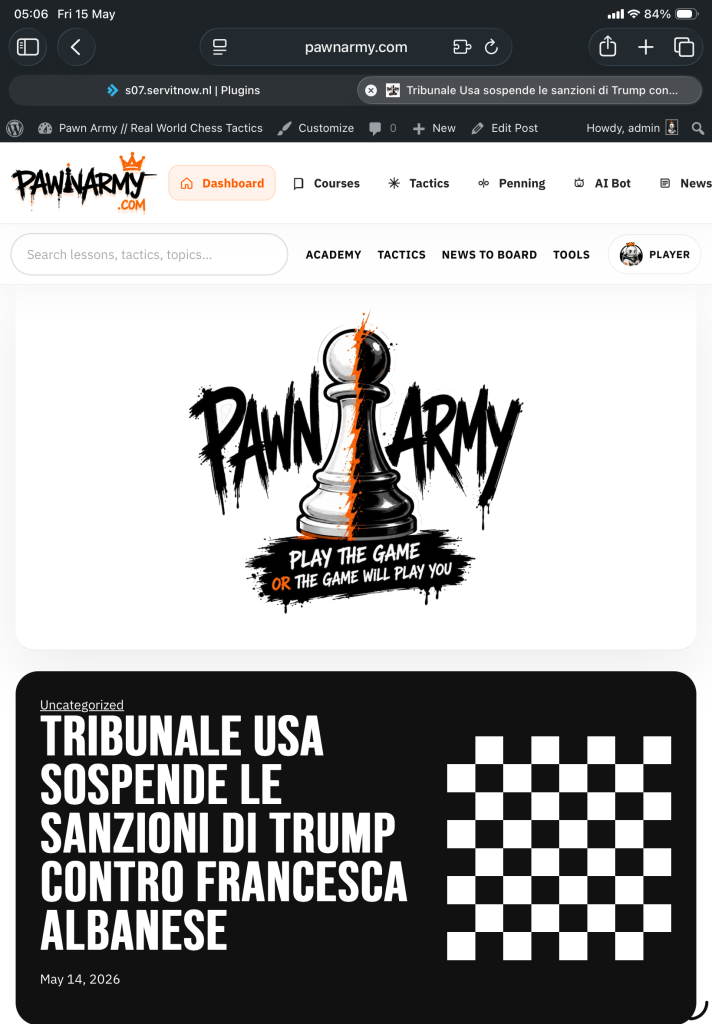
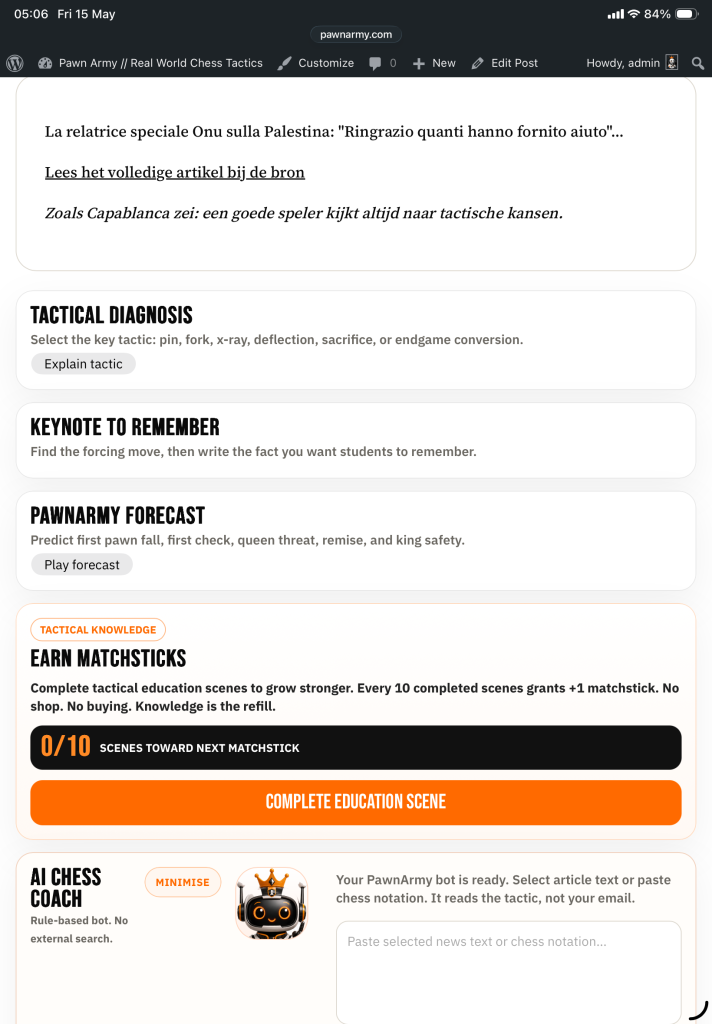
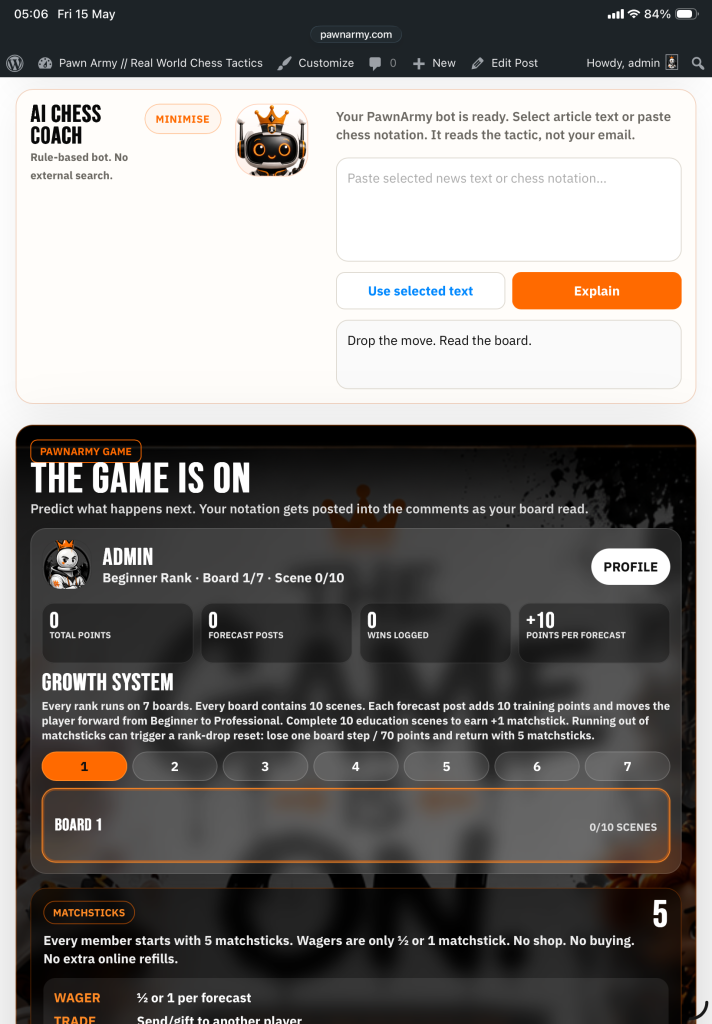
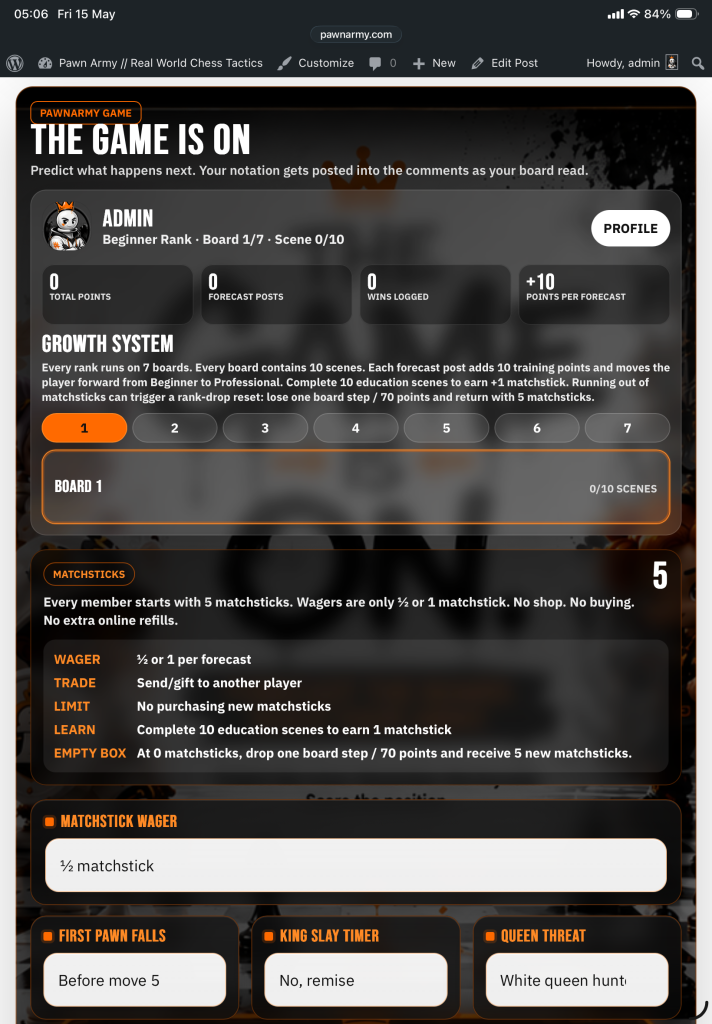
The current PawnArmy update moves the project further away from a generic chess blog or lesson archive. It is becoming a playable academy. A place where articles are not just read, but converted into tactical situations. A place where players do not only scroll through news, but learn to forecast pressure, threats, timing, sacrifice, defence, and consequence.
The design direction remains brutally clear: black, white, orange. Chessboard logic. Toy-army aggression. Street-school clarity. A UI that feels like a tactical dashboard rather than a WordPress template.
Real-world stories become tactical case studies
The homepage now treats latest articles as compact tactical cards. Twelve latest case studies appear in a tight grid, using strong visual placeholders, black translucent title bars, white typography, and a small orange square marker. The goal is simple: make news readable as pattern recognition.
PawnArmy does not ask the player to passively consume the world. It asks:
What is the pressure?
Who is pinned?
Where is the weak square?
What falls first?
Who is attacking, who is defending, and who is already too late?
This is the “News to Board” principle: every article can become a chess lesson.
The Game Is On
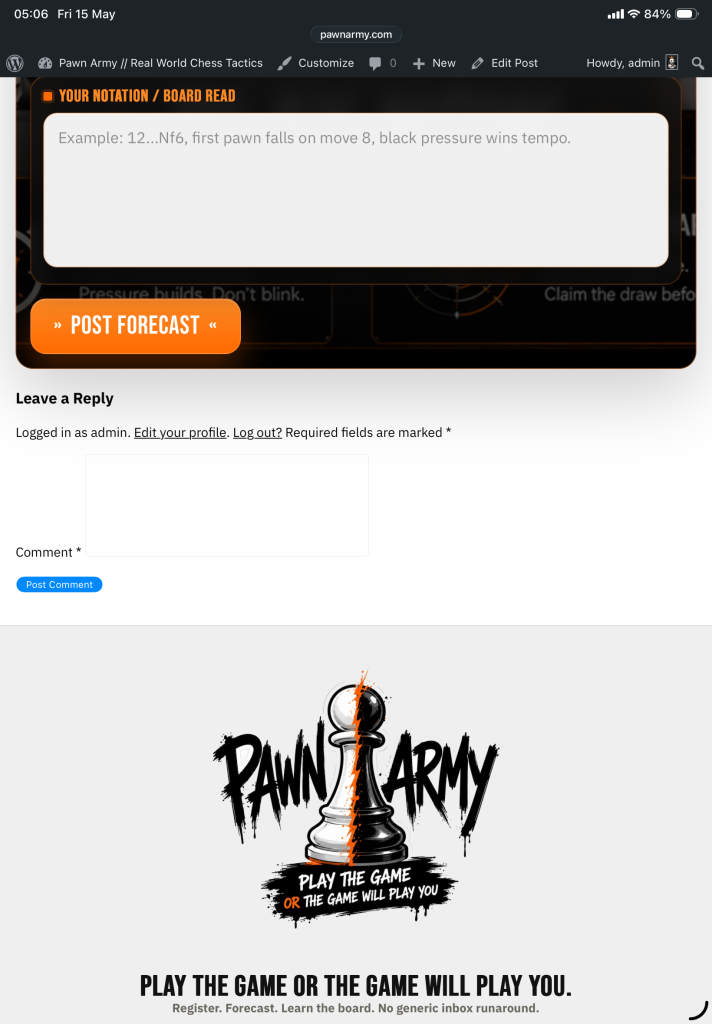
The article pages now include a branded PawnArmy Game panel. This panel is not decoration. It is the playable educational layer.
Players can predict what happens next by choosing structured forecast options such as:
First pawn falls
King slay timer
Queen threat
Notation / board read
The forecast is posted into the comments as a readable game entry. The comment section stops being just a reply box and becomes a record of tactical thinking.
This turns every article into a training round.
Growth system: seven boards, ten scenes
The player progression layer now has a clearer game structure.
Each rank is built around 7 boards.
Each board contains 10 scenes.
Every forecast or education action moves the player forward.
The current progression moves from:
Beginner → Intermediate → Professional
The interface shows the player profile, rank, board number, scene progress, forecast posts, wins logged, and points. The board progression has been compacted into a slider with numbered navigation from 1 to 7, making the system feel more like a playable path than a static dashboard.
It is a school structure disguised as a game interface.
Matchsticks: a controlled resource economy
The newest concept layer introduces matchsticks.
Every new member starts with 5 matchsticks. A player can wager half a matchstick or one full matchstick on a forecast. Matchsticks can be gifted or traded between players, but they cannot be bought online.
That rule matters.
PawnArmy is not building a casino mechanic. It is building consequence. The matchstick system gives predictions weight without turning the project into a payment loop. There is no shop. No refill button. No “buy more credits.” No artificial monetized panic.
If a player runs out of matchsticks, they can reset by dropping one board step. That means losing 70 points, equal to one full board in the 7-board / 10-scene ladder, and receiving 5 new matchsticks.
You can return to the game, but you do not return untouched.
Knowledge is the refill
The most important balance change is that matchsticks can also be earned through education.
By completing tactical education scenes, players grow their knowledge score. Every 10 completed education scenes grants +1 matchstick.
That means the refill mechanic is not money. It is learning.
The system says:
You want more chances? Study.
You want more risk? Learn first.
You want to stay in the game? Build tactical knowledge.
This keeps the PawnArmy loop clean:
Read → diagnose → forecast → learn → grow → return stronger.
The AI Coach is now part of the article system
The AI Coach panel is now integrated into article pages where placeholder instructional text used to sit. Players can select article text or paste chess notation, then use the local rule-based coach to identify patterns.
The bot does not pretend to be a search engine. It does not need to crawl the web. It is positioned as a tactical explainer inside the PawnArmy environment.
It looks for concepts like pins, forks, x-rays, deflection, sacrifice, king safety, pawn pressure, queen threats, and remise patterns.
This keeps the educational layer immediate and practical. The article is the source. The player is the analyst. The bot is the coach.
Visual direction
The current build also pushes the visual identity harder:
Black and white tactical contrast
Orange as signal, not decoration
Transparent PawnArmy placeholder artwork
Compact latest-article panels
A light grey checkerboard body background with rare orange squares
A centered white site shell for desktop responsiveness
Game panels with dark glass overlays
Branded form styling for wagers and forecasts
A stronger “Play the Game or the Game Will Play You” identity system
The result is still WordPress, but it no longer looks like WordPress. It looks like a tactical academy interface running on a publishing engine.
What PawnArmy is becoming
PawnArmy is not just a chess site.
It is a speculative learning platform where chess becomes a language for reading the world. A design system where articles become exercises. A game mechanic where attention has consequence. A player profile where progress is earned, lost, rebuilt, and remembered.
The current update brings the project closer to its real form:
A news-driven chess academy.
A tactical training game.
A player growth system.
A controlled matchstick economy.
A black-white-orange interface for learning pressure.
PawnArmy is no longer only saying “play the game.”
It is starting to prove the second half of the sentence:
Play the game — or the game will play you.
0 comments