

Five Creative Media Formats for the Franchise
1.
COMIX / GRAPHIC NOVEL SERIES
Format Title
Hey, Sorry — We’re All Out of Subtitles: The Comix Edition
Concept
A high-energy educational comedy comic series where every chapter follows a learner trying to survive one English-speaking situation across four English worlds: British, Australian, New Zealand, and American.
The comic uses visual language as part of the lesson. Speech bubbles crack, subtitles fail, words get crossed out, and the same phrase appears four different ways depending on country, accent, and social context.
Style
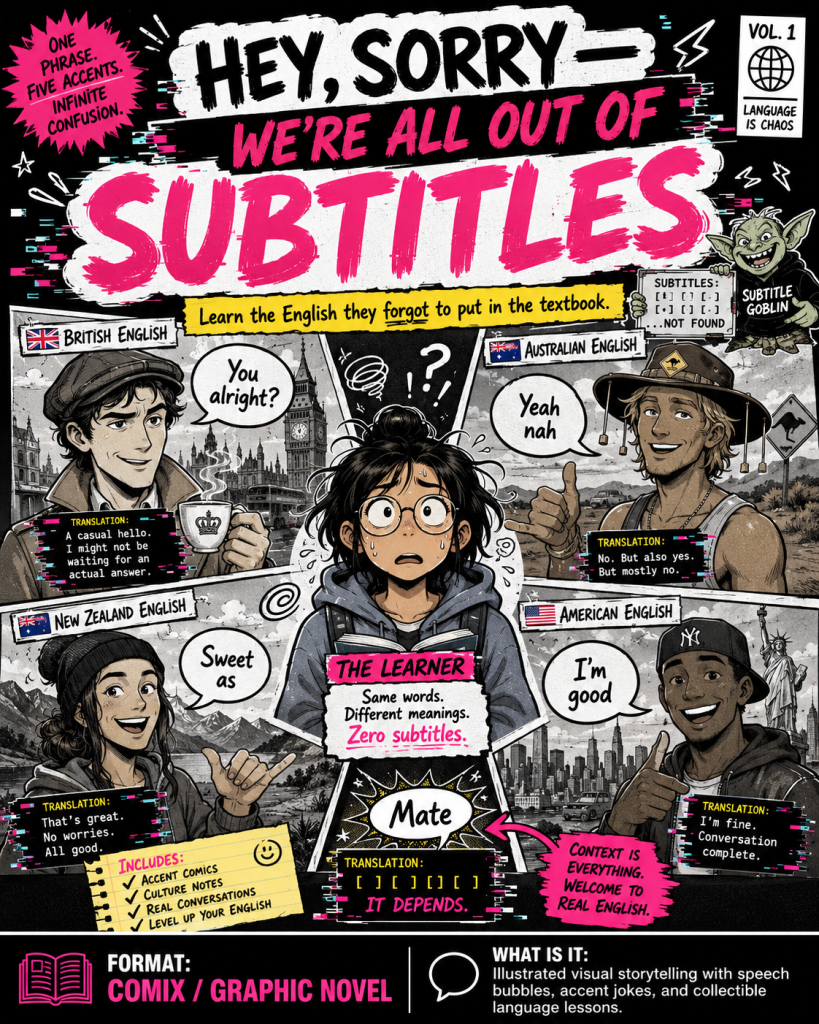
Black-and-white comic-noir language chaos with bright pink/yellow subtitle glitches. Think educational comic meets underground zine meets language survival manual.
Example Issue Titles
Issue #1: “You Alright?”
A learner thinks a British person is worried about their health. They are not.
Issue #2: “Yeah Nah”
The learner enters Australia and New Zealand and realizes yes and no have resigned from their jobs.
Issue #3: “Quite Good”
A simple compliment becomes an emotional crime scene.
Issue #4: “Mate”
One word. Four tones. Ten possible consequences.
Educational Device
Each comic ends with a one-page breakdown:
Phrase
Literal meaning
Actual meaning
Country/region
Safe response
Danger response
Footer Label
FORMAT: COMIX / GRAPHIC NOVEL
USE: Visual storytelling, language lessons, collectible issues, school editions, adult learning editions
2.
ANIMATED SHORTS SERIES
Format Title
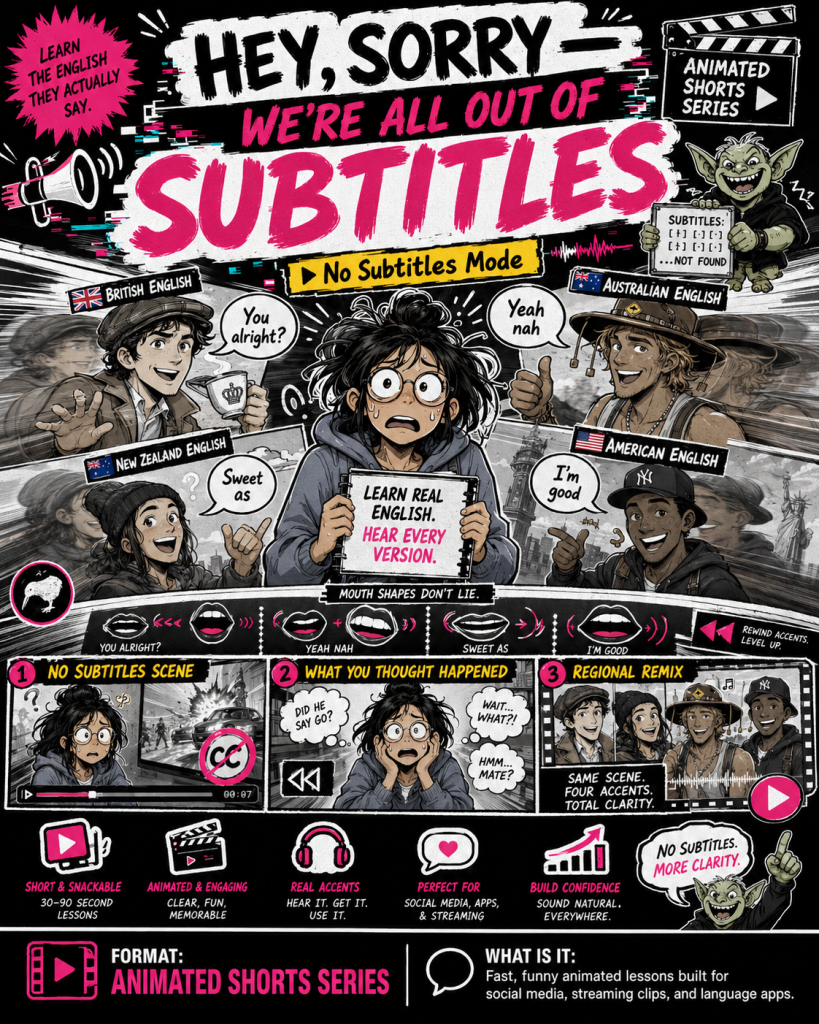
Hey, Sorry — We’re All Out of Subtitles: No Subtitles Mode
Concept
A short-form animated comedy series for YouTube, TikTok, Instagram, streaming platforms, and language apps.
Each episode is 2–6 minutes and focuses on one phrase, one accent problem, or one social misunderstanding.
The first version of the scene plays with no subtitles. Then the scene rewinds and the characters break it down.
Visual Style
Fast, graphic, sticker-like animation. Characters pop in and out of subtitle boxes. Mouth shapes exaggerate pronunciation. Accent differences become animated sound waves, broken captions, and warning signs.
Main Recurring Segments
No Subtitles Scene
The viewer hears the full-speed version.
What You Thought Happened
The learner’s incorrect interpretation.
What Actually Happened
The cultural and linguistic breakdown.
Regional Remix
UK, AU, NZ, and US versions of the same sentence.
Survival Phrase
The safest thing to say in real life.
Sample Episode
“Can I Get a Coffee?”
American: “Can I get a coffee?”
British: “Could I have a coffee, please?”
Australian: “Can I grab a coffee, mate?”
New Zealand: “Just a coffee, cheers.”
The episode teaches request styles, politeness, casualness, and how not to sound like a robot.
Footer Label
FORMAT: ANIMATED SHORTS SERIES
USE: Social media, YouTube, language learning apps, classroom warm-ups, viral education clips
3.
TELEVISION SERIES
Format Title
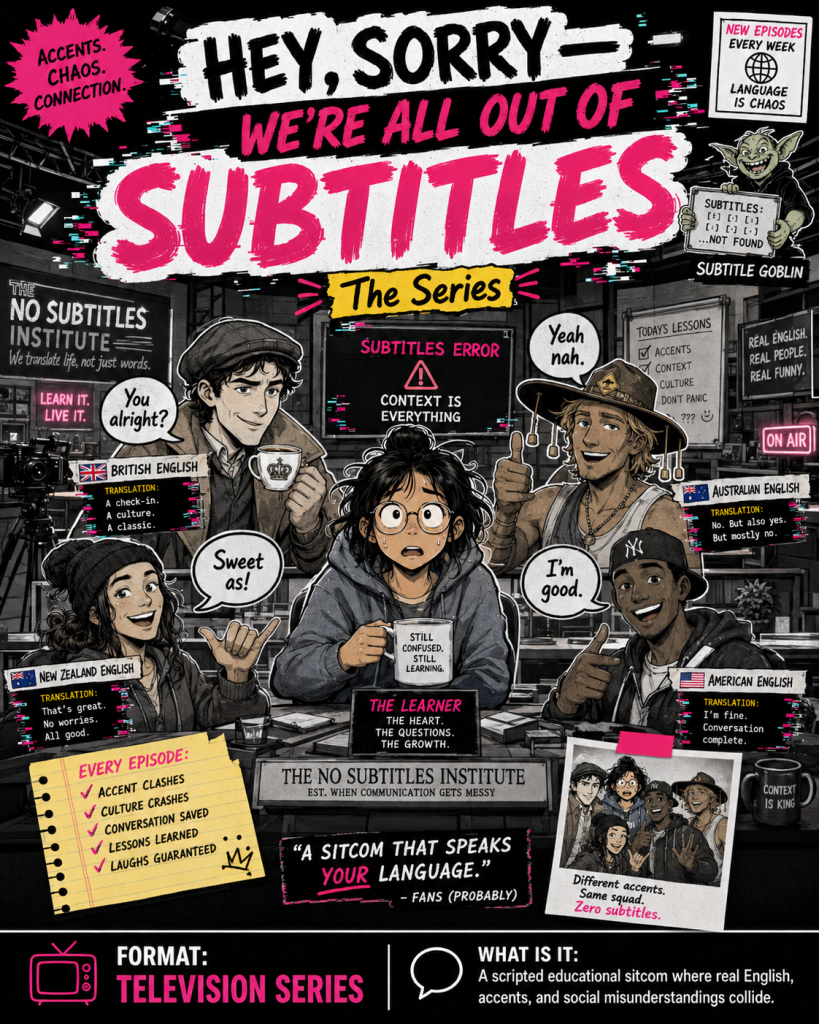
Hey, Sorry — We’re All Out of Subtitles: The Series
Concept
A scripted educational sitcom where an international group of learners attends a strange English fluency program called The No Subtitles Institute.
The school claims it can teach “real English.” Unfortunately, “real English” means being thrown into pubs, offices, airports, customer-service desks, awkward dinner parties, and international Zoom calls with no subtitles and no mercy.
Series Structure
Each episode is 22–30 minutes.
The sitcom plot carries the comedy, while the educational breakdowns are woven into the story through freeze-frames, subtitle failures, character commentary, and visual annotations.
Main Setting
The No Subtitles Institute
A language school that looks half classroom, half TV studio, half airport border-control desk.
Yes, that is three halves. That is English.
Episode Examples
Episode 1: “You Speak English, Apparently”
The learners arrive confident. They leave emotionally bilingual.
Episode 2: “The Politeness Trap”
A British teacher says, “That’s an interesting idea.” The class celebrates. They should not.
Episode 3: “Mate Crimes”
The Australian instructor teaches the class that “mate” can mean friend, stranger, enemy, warning, apology, or court summons.
Episode 4: “American Small Talk”
The class learns that “How are you?” is not always an invitation to explain your childhood.
Episode 5: “Sweet As”
The New Zealand instructor refuses to finish adjectives. The class files a grammatical complaint.
Footer Label
FORMAT: TELEVISION SERIES
USE: Sitcom, educational entertainment, streaming series, school licensing, adult language programming
4.
FEATURE FILM
Format Title
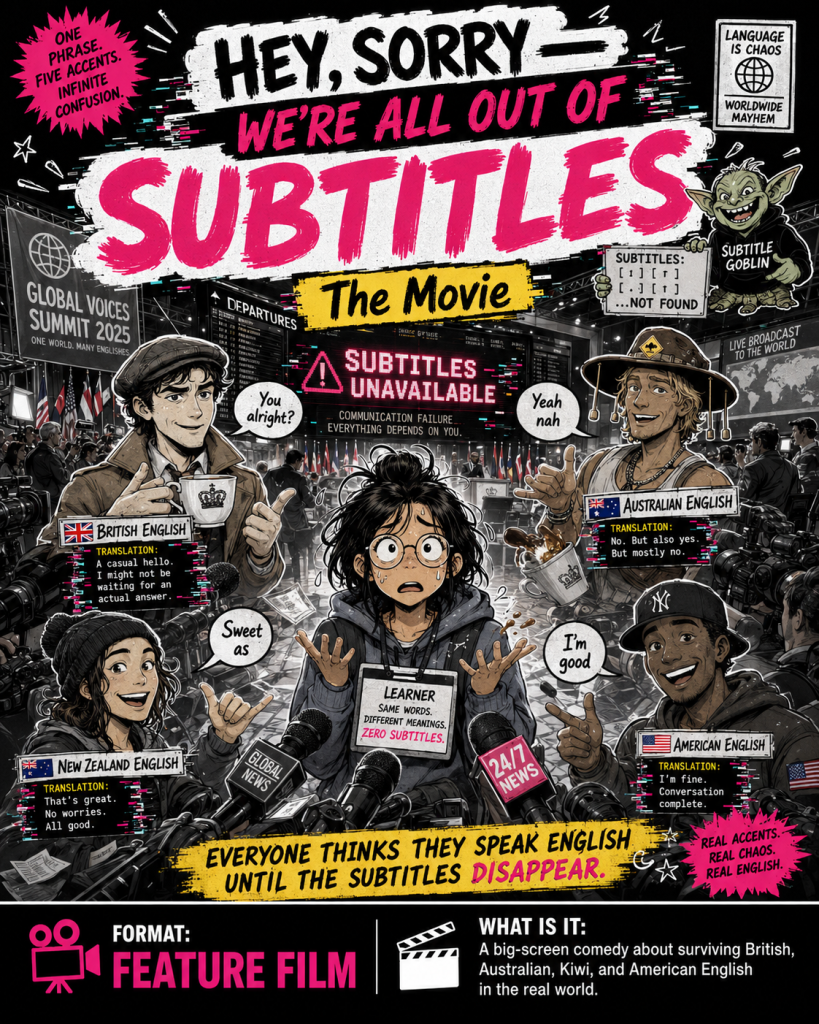
Hey, Sorry — We’re All Out of Subtitles: The Movie
Concept
A comedy feature film about a multilingual fraud who claims to speak perfect English on their CV and accidentally gets hired as the communications manager for a global cultural summit.
The summit includes British diplomats, American executives, Australian media people, New Zealand organizers, and several people who say “English is easy” before immediately ruining everything.
The hero must survive one week of misunderstandings without subtitles.
Genre
Language comedy, workplace disaster film, international farce.
Story Premise
The main character can pass written English tests, write formal emails, and use perfect grammar.
But they cannot understand:
- British understatement
- American enthusiasm
- Australian informality
- New Zealand minimalism
- sarcasm
- workplace politeness
- indirect rejection
- jokes
- invitations that are not invitations
The film becomes a race to decode English before the entire summit collapses.
Key Set Pieces
The Airport Scene
The hero misunderstands every announcement.
The Coffee Scene
Four people order coffee in four versions of English and somehow start a diplomatic incident.
The Dinner Scene
Everyone says “fine.” Nobody is fine.
The Press Conference Scene
The hero translates “with all due respect” literally and nearly starts a scandal.
The Final Speech
The hero finally understands that fluency is not perfect grammar. Fluency is knowing when not to speak like a textbook.
Footer Label
FORMAT: FEATURE FILM
USE: Comedy movie, international language learning campaign, festival-friendly educational entertainment, franchise launch vehicle
5.
THEATRE PLAY
Format Title
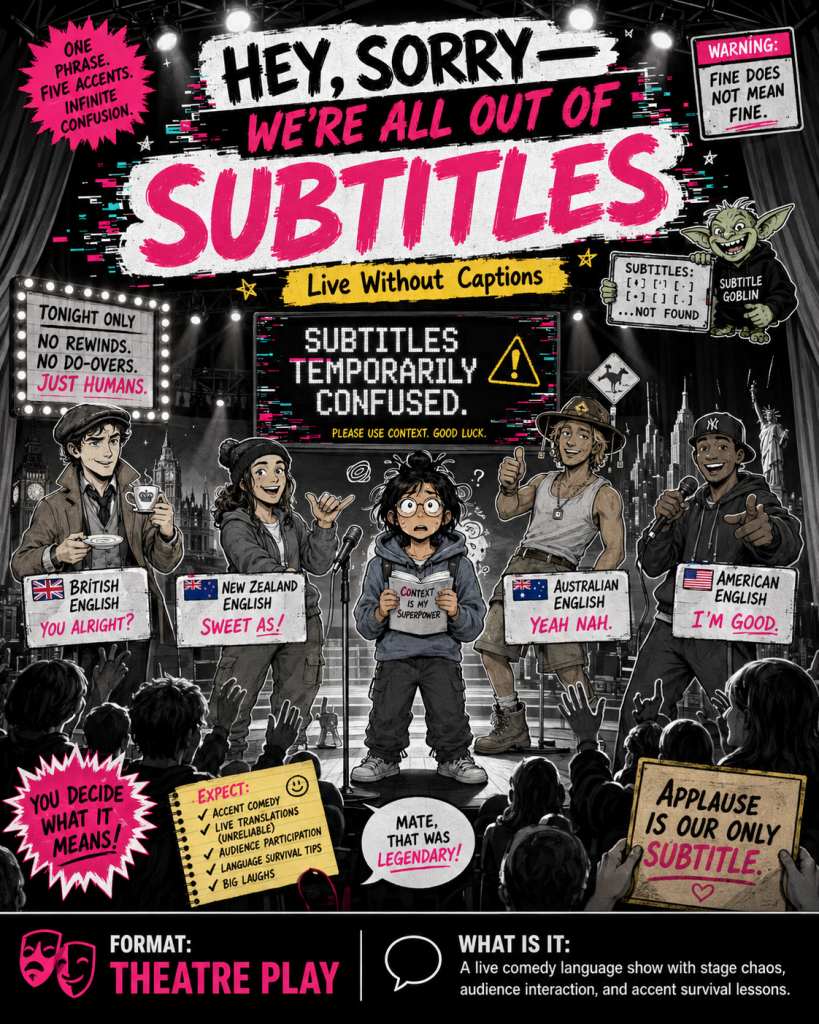
Hey, Sorry — We’re All Out of Subtitles: Live Without Captions
Concept
A stage comedy where the audience becomes part of the English lesson.
The play is set inside a failing live subtitle studio. The subtitle system breaks during an international English-language training event, forcing actors and audience members to decode real spoken English in real time.
Stage Setup
The stage has four zones:
UK Zone — dry, polite, dangerous
Australia Zone — relaxed, fast, slang-heavy
New Zealand Zone — understated, unfinished, calm
USA Zone — energetic, direct, emotionally loud
Above the stage is a large subtitle screen that keeps malfunctioning.
Example screen messages:
[SUBTITLES TEMPORARILY CONFUSED]
[TRANSLATION ERROR: POLITENESS DETECTED]
[WARNING: “FINE” DOES NOT MEAN FINE]
Interactive Element
The audience votes on what a phrase means.
Example:
“That’s bold.”
A. I admire your courage
B. That is a terrible decision
C. I am trying not to laugh
D. All of the above, depending on country and tone
The actors then perform all possible versions.
Performance Style
Part comedy play, part language lesson, part quiz show, part live cultural emergency.
Footer Label
FORMAT: THEATRE PLAY
USE: Live education, comedy theatre, school tours, language festivals, corporate communication training
Franchise Footer System
What Is What?
At the bottom of every product, episode, issue, script, poster, or digital release, the franchise can use a clear footer label system:
FORMAT: COMIX / GRAPHIC NOVEL
A printed or digital illustrated story format. Best for visual language jokes, speech bubbles, collectible lessons, and classroom handouts.
FORMAT: ANIMATED SHORTS SERIES
Short animated videos for online platforms. Best for quick lessons, viral clips, pronunciation jokes, and regional phrase comparisons.
FORMAT: TELEVISION SERIES
A longer scripted sitcom or educational entertainment show. Best for character development, repeated lessons, and season-based learning.
FORMAT: FEATURE FILM
A full-length comedy movie. Best for a big story, global audience, festival positioning, and franchise launch.
FORMAT: THEATRE PLAY
A live stage version. Best for schools, language festivals, corporate training, audience interaction, and performance-based learning.
Master Franchise Line
Hey, Sorry — We’re All Out of Subtitles can live as comics, animation, television, film, and theatre because the core idea is universal:
Everyone thinks they speak English until the subtitles disappear.
0 comments