Subtitle: You Brought a Knife — and It’s Going to Get Nuclear
Core Pitch
A theatre-first dark fantasy franchise about a world where every conflict begins as a performance, every argument becomes a duel, and every duel risks escalating into mythic catastrophe.
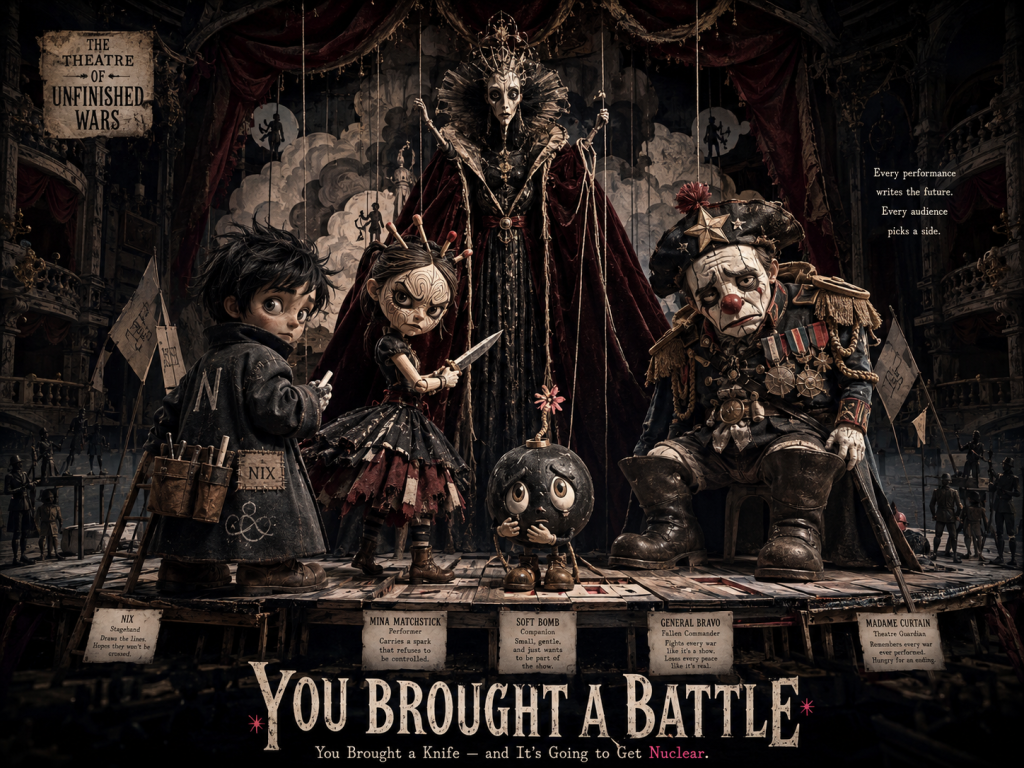
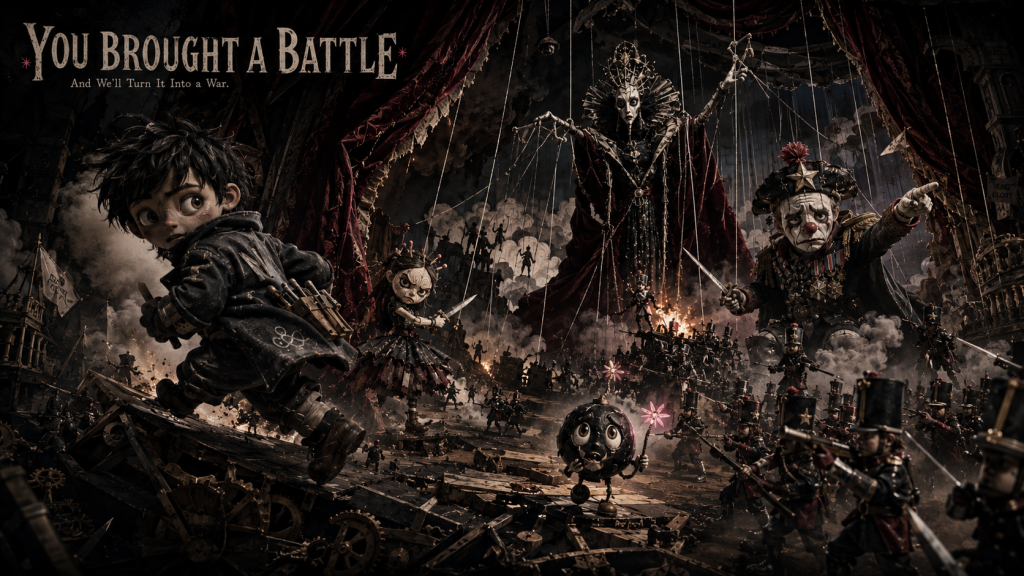
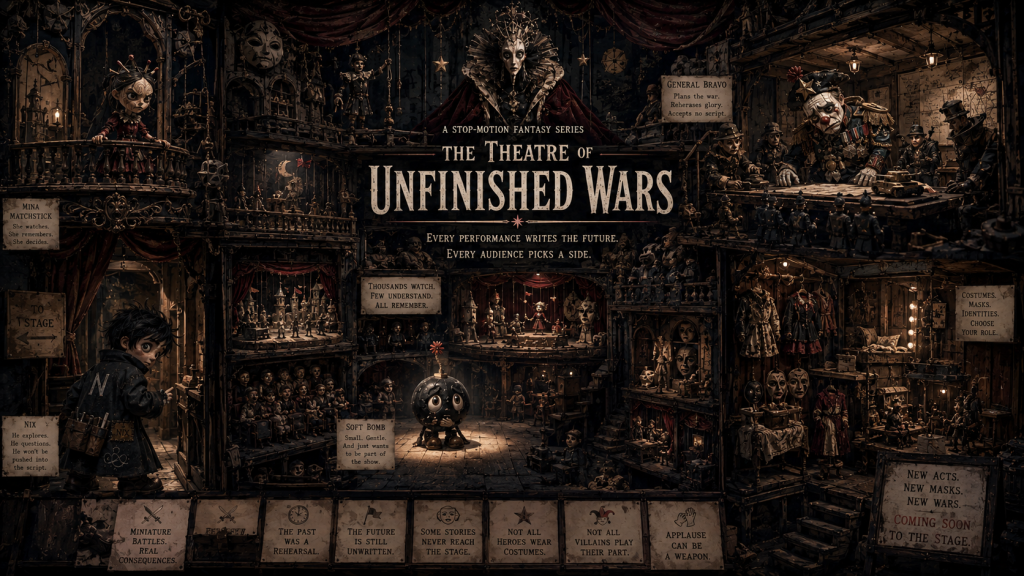
At the center is a travelling puppet-theatre company whose actors are not merely performers. They are living masks, carved faces, stitched bodies, stage spirits, child-warriors, clowns, generals, cowards, saints, and liars. They perform battles on stage to prevent real wars from happening outside the theatre.
But one night, someone brings a real knife into a fake battle.
The rules break.
The stage becomes a battlefield.
The audience becomes a nation.
The play refuses to end.
And the small symbolic conflict escalates into something apocalyptic: emotional, political, magical, theatrical, and finally nuclear.
This is a franchise about escalation: how a joke becomes an insult, how an insult becomes revenge, how revenge becomes ideology, how ideology becomes war, and how children must learn to stop adults from turning theatre into history.
LAIKA is a strong fit because the concept is built around handcrafted faces, puppets, masks, physical stages, theatrical lighting, emotional darkness, and handmade spectacle — exactly the kind of bold, tactile stop-motion world LAIKA is known for. The studio describes its work as combining classic stop-motion with state-of-the-art technology to create bold narratives that “surprise, thrill, and inspire,” and its features from Coraline through Missing Link have all been Oscar-nominated animated films.
The Big Idea
The franchise begins not with a movie, but with a stage production.
A real theatrical event.
A touring play.
A puppet opera.
A black-box spectacle.
A live stop-motion-inspired theatre ritual.
The stage version becomes the mythic source text. Every later version — film, television, comics, games, toys, sculptures, education — expands outward from the original theatrical incident: the night the fake battle became a real war.
The story has a simple commercial hook:
A children’s theatre troupe performs pretend wars so the world doesn’t have to fight real ones. Then one performer breaks the oldest rule: never bring a real weapon onto the stage.
That single violation unleashes the franchise.
Tone
Dark fairytale. Political fable. Puppet tragedy. Children’s war epic. Anti-war theatre myth.
Think:
LAIKA craftsmanship + Greek tragedy + Punch and Judy + anti-war satire + designer toy culture + magical realism + classroom ethics.
It should feel frightening, funny, beautiful, collectible, and meaningful.
Not “grimdark.”
Not superhero war.
Not military fantasy.
It is theatrical, symbolic, handmade, and emotionally intelligent.
The violence is stylized. The danger is real. The message is human.
Why It Works for LAIKA
LAIKA’s greatest strength is making tactile worlds feel emotionally alive: small handmade objects carrying enormous spiritual weight. This concept gives them a franchise where the puppets, faces, masks, costumes, props, weapons, and miniature theatres are not only production tools — they are the mythology itself.
The concept also fits LAIKA’s proven fascination with strange children, outsider heroes, hidden worlds, death, family, fear, courage, and moral imagination, seen across films like Coraline, ParaNorman, The Boxtrolls, Kubo and the Two Strings, and Missing Link. LAIKA’s official studio description emphasizes bold narratives and hybrid craft/technology, which makes this a natural vehicle for theatrical stop-motion innovation.
It also creates an unusually strong merchandise lane: not generic plush mascots, but collectible character faces, masks, busts, stage miniatures, puppet kits, war-room dioramas, designer toys, educational theatre boxes, and sculptural objects.
Franchise Format
1. Primary Medium: Theatre
The first expression should be a live stage production:
YOU BROUGHT A BATTLE
A touring theatre spectacle using masks, puppetry, projection, shadows, miniature sets, live narration, music, and mechanical stage effects.
The stage version should feel like a forbidden children’s play from a country that no longer exists.
The audience enters a theatre that looks like a military tribunal, a toy box, and a ruined opera house at the same time.
The show begins as comedy.
It becomes ritual.
It ends as a warning.
2. Feature Film
A LAIKA stop-motion feature expands the world and emotional arc.
The movie follows the central child protagonist discovering that every battle performed on the old theatre stage corresponds to a real conflict somewhere in the world. The theatre has been absorbing violence for generations — until now.
3. Television Series
An anthology/serialized series explores different “wars” performed by the troupe.
Each episode can be structured as a play-within-the-world:
- The Button War
- The Paper Crown Rebellion
- The Kitchen Knife Coup
- The War of the Left and Right Shoes
- The Dollhouse Siege
- The Parade That Wouldn’t Stop
- The Country Under the Bed
- The Last Laugh of General Nobody
This gives the series a strong procedural engine while still building a larger mythology.
4. Video Games
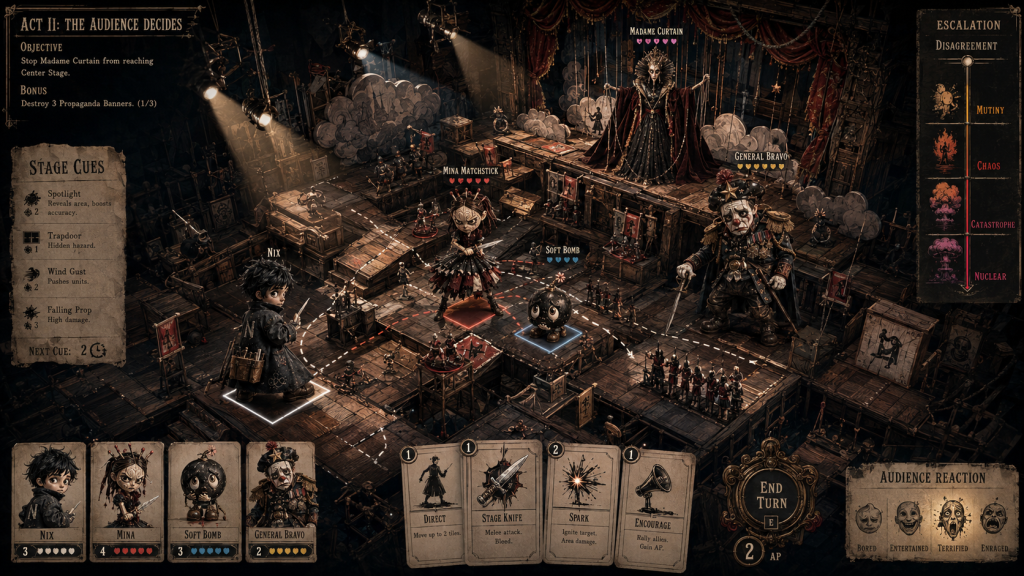
The game should not be a shooter. It should be a tactical theatre game.
Players stage conflicts, assign characters, place props, choose emotional dialogue, and try to prevent escalation.
The gameplay loop:
rehearse → perform → negotiate → sabotage → repair → escalate or de-escalate
The player wins not by destroying the enemy, but by preventing the war from becoming irreversible.
5. Comics and Graphic Novels
The comics can be harsher, more graphic, and more experimental than the film.
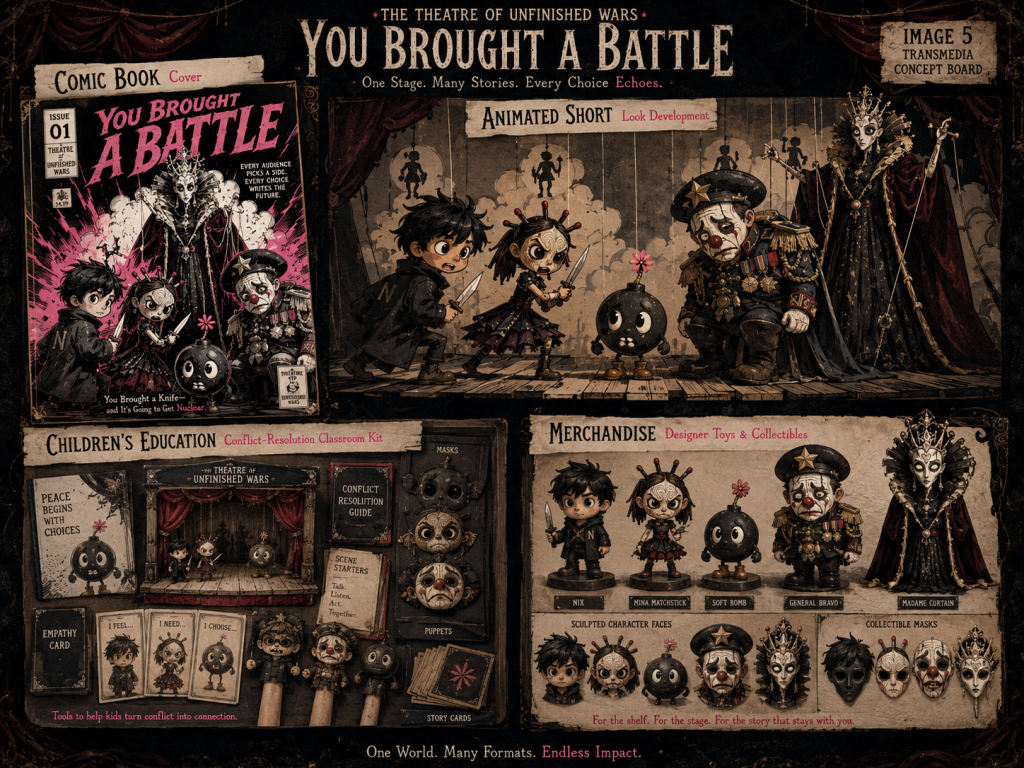
Black, white, and nuclear pink as the signature palette.
Stage directions appear as narration.
Speech bubbles look like torn paper labels.
Every issue is named after a theatrical command:
- Act I: Enter the Knife
- Act II: Cue the Cannons
- Act III: Applause for the Wounded
- Act IV: The Audience Takes Sides
- Finale: Nobody Leaves the Theatre
6. Animation Shorts
Short-form animated morality plays for younger audiences.
Each short focuses on a small conflict: sharing, lying, jealousy, bullying, revenge, pride, embarrassment. The lesson is always about escalation.
The phrase becomes educational:
“Did you bring a battle, or are you starting a war?”
7. Children’s Education
This is one of the strongest long-tail franchise opportunities.
The property can become a theatre-based conflict-resolution education system for schools.
Children use masks, roleplay, puppets, and stage cards to learn:
- how arguments escalate
- how to identify emotional triggers
- how to pause before retaliation
- how to negotiate
- how to apologize
- how propaganda works
- how group pressure works
- how “us versus them” thinking begins
- how imagination can prevent violence
The classroom kit could include:
- character masks
- emotion cards
- conflict cards
- miniature stage
- teacher guide
- printable scripts
- “battle-to-war” escalation map
- peace-ending alternatives
- design-your-own-character face templates
This gives the franchise ethical legitimacy beyond entertainment.
Story World
The Theatre
The central location is The Theatre of Unfinished Wars.
It moves.
Sometimes it is in an alley.
Sometimes under a school.
Sometimes inside a train station.
Sometimes at the edge of a battlefield.
Sometimes it appears in a child’s bedroom as a miniature cardboard stage.
The theatre has one rule:
All wars must be performed before they are fought.
The old belief is that if people can watch their hatred as theatre, they may choose not to make it history.
But the theatre is failing.
Audiences no longer understand metaphor.
Politicians want spectacle.
Children understand the danger before adults do.
The Stage
The stage is alive. It remembers every conflict ever performed on it.
Its curtains bleed ink.
Its trapdoors whisper.
Its lights expose lies.
Its props become real when used with hatred.
A wooden sword is safe.
A real knife is forbidden.
A toy cannon is safe.
A real bomb is impossible — until the final act.
The War
The “war” is not a normal military conflict. It is a contagious performance.
Once the theatre rules break, everyone begins acting out roles:
- The Coward
- The General
- The Traitor
- The Martyr
- The Hero
- The Enemy
- The Child
- The Audience
- The Applauding Crowd
The horror is that people stop being people and become parts in a script.
The children must rewrite the ending before the adults perform the apocalypse.
Main Characters
1.
Nix
The child protagonist.
A stagehand, not an actor. Nix fixes ropes, lights, curtains, props, and broken puppet faces. They understand the theatre better than the performers because they listen to the building.
Nix does not want to be a hero. Nix wants the show to stop.
Visual design: oversized coat, tool belt, chalk marks on hands, one eye always half-hidden by hair or shadow.
Toy potential: Nix with interchangeable tools, miniature stage lamp, broken mask accessory.
2.
General Bravo
A ridiculous, tragic military clown.
He believes every problem can be solved by making a bigger entrance. He wears medals he awarded to himself. He is funny until he becomes dangerous.
He begins as comic relief and slowly reveals the emotional emptiness underneath theatrical aggression.
Visual design: cracked porcelain face, huge moustache, tiny body, oversized boots, ceremonial baton.
Toy potential: designer vinyl figure, bronze bust, wind-up marching version.
3.
Mina Matchstick
The performer who brings the real knife.
Not evil. Angry.
She is tired of symbolic battles because symbolic battles never changed her real life. She wants consequences. She wants the audience to feel something real.
Her knife is the inciting object.
Visual design: burnt-red theatre coat, sharp eyebrows, carved wooden face, matchstick hairpins, one sleeve longer than the other.
Toy potential: limited-edition face sculpture with removable mask and forbidden knife prop.
4.
The Audience King
A monstrous collective character.
He is made of hundreds of tiny applauding faces. He grows stronger whenever the crowd cheers for violence.
Sometimes he appears as one giant head in the balcony.
Sometimes as many little masks whispering at once.
He represents mob mentality, spectacle, fandom toxicity, political manipulation, and the danger of watching cruelty as entertainment.
Visual design: stacked theatre masks, opera glasses, many mouths, velvet crown.
Toy potential: premium sculpture, modular face stack, blind-box mini masks.
5.
Soft Bomb
A small childlike bomb character who does not want to explode.
Soft Bomb is the emotional heart of the younger children’s version.
It was built to end the war, but it wants to become something else: a lantern, a drum, a moon, a toy, a seed.
Visual design: round black body, stitched fuse, worried eyes, tiny shoes.
Toy potential: plush, vinyl, night light, educational mascot.
6.
The Knife
The knife is treated almost like a character.
It never speaks, but it changes the lighting whenever it appears.
On stage, all weapons are supposed to be fake. The Knife is real. It cuts fabric, rope, illusion, and eventually the boundary between theatre and world.
Toy potential: not sold as a realistic weapon; instead represented as a symbolic acrylic stage prop, pendant, or sculptural object.
7.
Madame Curtain
The ancient theatre guardian.
She may be a person. She may be the curtain itself. She speaks in stage directions.
She has seen every war before.
Her face is half velvet, half bone.
She warns Nix:
“A battle has an ending. A war learns to feed itself.”
Toy potential: art doll, textile sculpture, collector’s mask.
Visual Identity
The franchise should have a strong collectible design language:
- black-and-white theatre world
- blood red or nuclear pink accent
- carved faces
- porcelain cracks
- stitched costumes
- military theatre uniforms
- toy weapons made from paper and wood
- stage lights as divine judgment
- oversized masks on tiny bodies
- miniature theatres inside larger theatres
- banners, medals, curtains, trapdoors, shadow puppets
- handmade imperfection as beauty
The characters should be designed so their faces can be separated from their bodies as collectible sculptural objects.
That becomes the merchandising signature:
Collect the faces. Rebuild the war. Rewrite the ending.
Designer Toys and Sculptures
This franchise should be built from day one with high-end objects in mind.
Product Lines
1. Character Face Sculptures
Wall-mounted or tabletop faces of the main characters.
Porcelain, resin, vinyl, wood-effect, bronze-effect, matte black, bone white, nuclear pink limited editions.
2. Blind Box “Audience Faces”
Hundreds of small audience masks.
Every buyer becomes part of the theatre.
Rare faces include:
- The Heckler
- The Applauder
- The Sleeper
- The Witness
- The Coward
- The Child Who Saw Everything
3. Miniature Stage Dioramas
Buildable theatre sets.
- The Broken Curtain
- The Knife Scene
- The Balcony of Applause
- The War Table
- The Trapdoor
- The Nuclear Finale
4. Soft Bomb Plush
The commercial emotional mascot.
Cute but meaningful.
A plush bomb who refuses to become a weapon.
5. Premium LAIKA Craft Editions
Museum-grade puppet replicas, face plates, stop-motion maquettes, production-style display boxes.
This aligns naturally with LAIKA’s reputation for puppets, practical craft, and facial replacement artistry; LAIKA has publicly showcased puppets from its films at licensing events, which shows how strong the studio’s physical-object culture already is.
Theatre Production Concept
Stage Title
YOU BROUGHT A BATTLE
Subtitle on poster: You Brought a Knife — and It’s Going to Get Nuclear
Structure
Act I — The Fake Battle
The troupe performs a comic war between two ridiculous kingdoms arguing over a chair.
The audience laughs.
Act II — The Real Knife
Mina breaks the rule and cuts the stage curtain.
The fake kingdoms begin bleeding into reality.
Act III — The Audience Chooses Sides
The audience is invited to cheer.
Their applause changes the story.
The more they cheer, the worse the war becomes.
Act IV — The War Performs Itself
No one is acting anymore.
The theatre locks.
The children search backstage for the original script.
Act V — The Nuclear Ending
Soft Bomb is brought onstage.
Everyone expects an explosion.
Instead, Nix rewrites the final cue.
The bomb becomes a light.
The war ends not with victory, but with refusal.
Feature Film Version
Logline
When a furious young actor brings a real knife into a magical theatre where pretend battles are staged to prevent real wars, a quiet stagehand must stop the performance from escalating into an apocalyptic conflict that turns the audience, actors, and world into enemies.
Emotional Arc
Nix begins as someone who hides backstage because they are afraid of conflict.
By the end, Nix learns that peace is not silence. Peace is an active performance that must be rehearsed, defended, and remade.
Mina begins believing symbolic performance is useless.
By the end, she understands that symbols are dangerous precisely because they are powerful.
General Bravo begins as a joke.
By the end, he almost becomes a dictator because everyone keeps laughing until it is too late.
Soft Bomb begins as a weapon.
By the end, it becomes the first new character not written by the old war script.
Television Expansion
Series Title
THE THEATRE OF UNFINISHED WARS
Each season explores a different wing of the theatre.
Season One: The Knife
The origin story.
Season Two: The Audience
How spectators become participants.
Season Three: The Costume Room
Characters discover the roles people are forced to wear.
Season Four: The Prop Department
Every object has a history. Every weapon was once something innocent.
Season Five: The Exit
The children try to leave the theatre and discover the outside world has become a stage too.
Video Game Concept
Title
YOU BROUGHT A BATTLE: STAGE WAR
Genre
Tactical narrative theatre game.
Core Mechanic
The player controls stage direction instead of soldiers.
You place lights, props, masks, entrances, exits, music, and dialogue choices to influence emotional escalation.
Every conflict has a meter:
Disagreement → Insult → Duel → Riot → Battle → War → Nuclear
The goal is not to “win the war.”
The goal is to prevent the war from needing to happen.
Game Modes
- Story campaign
- Classroom conflict simulator
- Co-op theatre mode
- Build-your-own-stage mode
- Character face designer
- Moral choice anthology
- “Bad Ending Museum” where failed wars become exhibits
Comic Book Direction
Visual Style
High-contrast black ink.
Theatre-poster compositions.
Nuclear pink highlights.
Speech bubbles shaped like stage labels.
Panel borders as curtains, ropes, floorboards, cracked masks.
Hook
The comics can show the darker historical wars the theatre has absorbed over centuries.
Each volume is a different “lost performance.”
Children’s Education Program
Title
Battle or War?
A classroom theatre kit for ages 7–12.
Educational Promise
Children learn that conflict is not automatically bad. Conflict can be performed, discussed, transformed, and resolved. The danger begins when people escalate without thinking.
Core Question
“What happened between the first angry word and the final explosion?”
Classroom Tools
- puppet roleplay
- mask-making
- escalation ladder
- apology scripts
- conflict cards
- peace rewrites
- group performance exercises
- emotional vocabulary
- anti-bullying modules
- media literacy modules
- propaganda and crowd behavior modules for older students
This gives the franchise moral depth and institutional value.
Merchandising Philosophy
The merchandise should not feel like ordinary character merch. It should feel like owning pieces of the theatre.
Key Slogan
Own the face. Change the role. Stop the war.
Collectible Categories
- Faces
- Masks
- Stage props
- Mini theatres
- Sculptural busts
- Character lamps
- Plush Soft Bomb
- Costume patches
- Theatre posters
- Classroom kits
- Art books
- Prop replica boxes
- Limited LAIKA maquettes
The most iconic object should be the Face Wall: collectors can assemble the audience by buying individual sculpted faces.
Brand Language
Main Title Treatment
YOU BROUGHT A BATTLE
large, theatrical, rough, poster-like.
Subtitle
You Brought a Knife — and It’s Going to Get Nuclear
smaller, dangerous, almost like a warning stamped across the poster.
Taglines
- Every war starts as a performance.
- Never bring a real knife to a pretend battle.
- The audience started clapping. That was the mistake.
- A battle ends. A war learns.
- Stop the show before the show becomes history.
- Some weapons are props. Some props are warnings.
- The final act is not written yet.
Why This Is a Franchise, Not Just a Film
Because every format has a natural role:
Theatre is the origin.
Film is the myth.
Television is the world.
Comics are the history.
Games are the system.
Education is the mission.
Designer toys are the physical culture.
Sculptures are the prestige collectibles.
Animation shorts are the bridge to younger audiences.
The concept is expandable without losing its center because the central metaphor is universal:
How do small conflicts become catastrophic, and who has the courage to interrupt the performance?
Final Pitch Paragraph
You Brought a Battle, But It’s Going to Finish With a War is a theatre-born, stop-motion-ready dark fantasy franchise about children, puppets, masks, and the terrifying mechanics of escalation. In a magical theatre where fake battles are performed to prevent real wars, one angry actor brings a real knife onto the stage and tears open the boundary between performance and catastrophe. As the audience begins choosing sides and the play turns nuclear, a quiet stagehand, a guilty performer, a ridiculous general, and a bomb that does not want to explode must rewrite the ending before the whole world becomes theatre. Designed for live stage, LAIKA stop-motion cinema, serialized television, tactical video games, comics, educational conflict-resolution programs, designer toys, and sculptural character faces, the franchise offers LAIKA a handmade, morally rich, visually iconic universe where every mask is collectible, every prop has consequence, and every child learns the most important question before the applause becomes dangerous: are we bringing a battle, or are we starting a war?
0 comments