The Luck of the Irish!
An anarchist-socialist democratic folk-noir franchise about history, dignity, memory, resistance, and the strange comedy of surviving bad luck.
Core idea
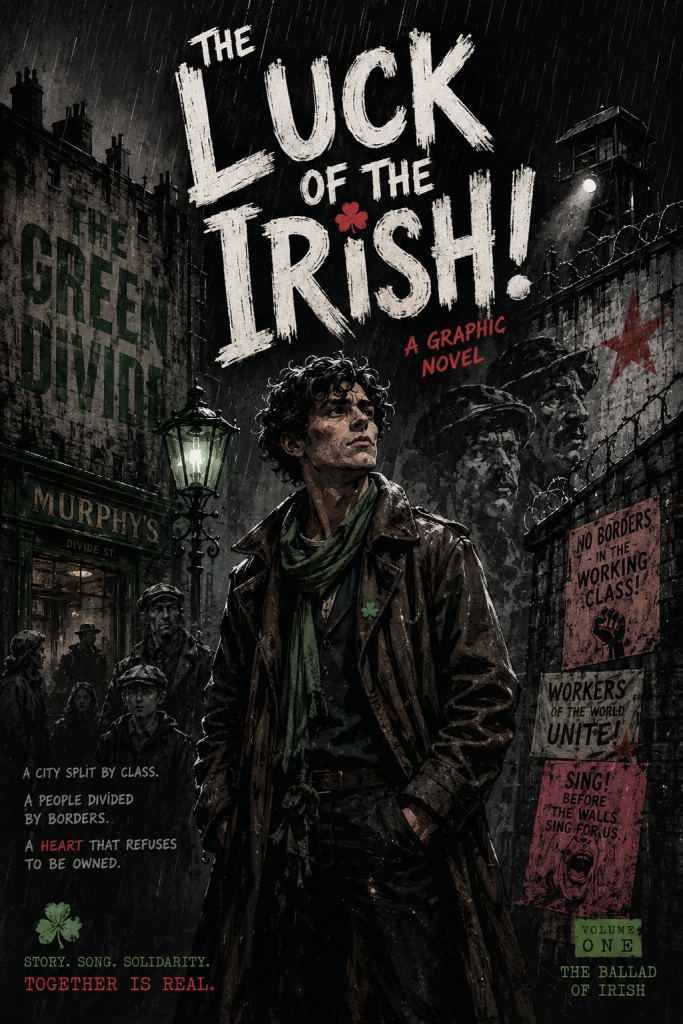
The Luck of the Irish! is an allegorical animated series, graphic novel, and narrative game franchise about a main character named Irish, a sharp, wounded, funny, stubborn wanderer born into a land where everyone keeps telling him he is “lucky” while history keeps proving otherwise.
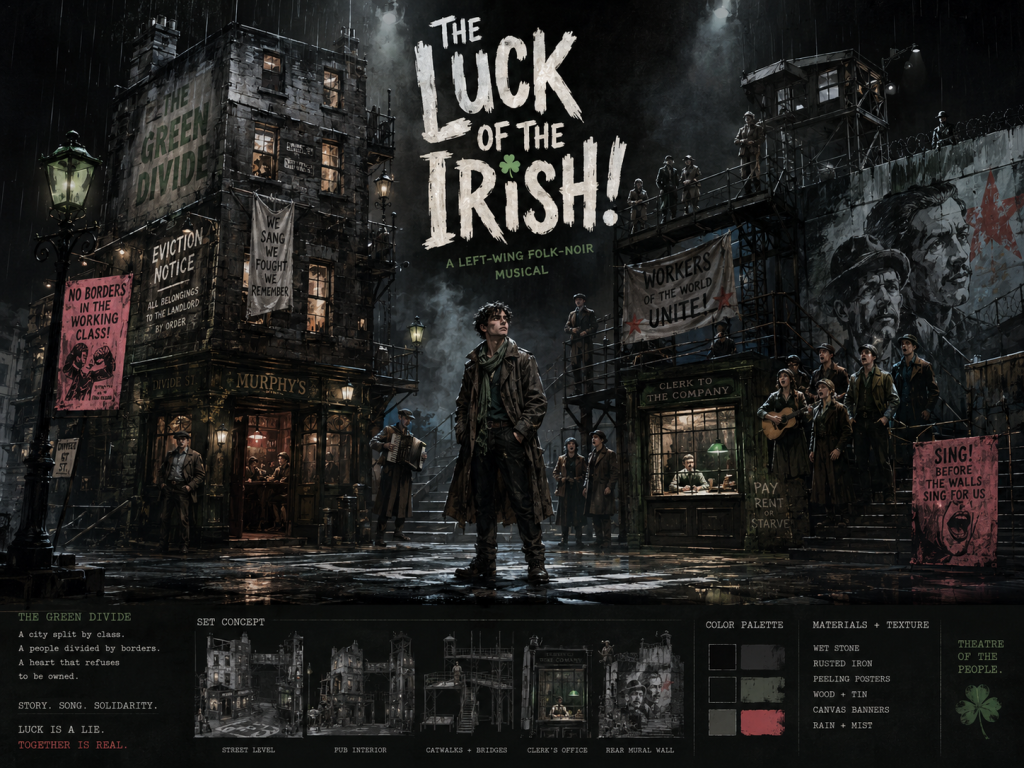
The world is not a direct documentary Ireland, but a reimagined symbolic island called The Green Divide: a beautiful, rain-soaked place of songs, borders, landlords, watchtowers, broken treaties, old myths, exported children, forbidden languages, rebel poets, grieving mothers, corrupt clergy, foreign money, labor unions, ghosts, and football fields where every match is secretly political.
The franchise teaches the Irish historical struggle through metaphor, emotion, and character — not by pointing fingers, but by making the audience feel the machinery of occupation, poverty, displacement, propaganda, state violence, migration, class struggle, and cultural survival.
The joke of the title is central:
Everyone says Irish has “the luck of the Irish.”
But Irish’s luck is mostly famine, eviction, surveillance, exile, betrayal, and being told to smile through it.
His real luck is that he keeps finding people who refuse to stop singing.
Political and philosophical DNA
The franchise draws from three broad traditions:
1.
Noam Chomsky mode
The story constantly questions power, media, state violence, propaganda, empire, and manufactured consent. Institutions are not evil because one villain runs them; they are dangerous because ordinary people are trained to obey them without asking who benefits.
In the story world, newspapers, priests, landlords, kings, police, banks, and “peace committees” all speak in polished language while poor people pay the price.
2.
Hannah Arendt mode
The franchise explores statelessness, bureaucracy, obedience, public truth, exile, and the banality of evil. The worst villains are not always monsters. Sometimes they are clerks, permit officers, border guards, school inspectors, and polite men who say:
“I’m only following procedure.”
Irish’s struggle is not only against cruelty. It is against systems that make cruelty look normal.
3.
Anarchist-socialist democratic mode
The heroes do not dream of replacing one king with another. They dream of local councils, worker-owned pubs, free schools, community kitchens, public memory, shared land, mutual aid, and direct democracy.
The moral center is:
No gods, no masters, no landlords, no empires — but plenty of neighbors, songs, bread, argument, and care.
Main character
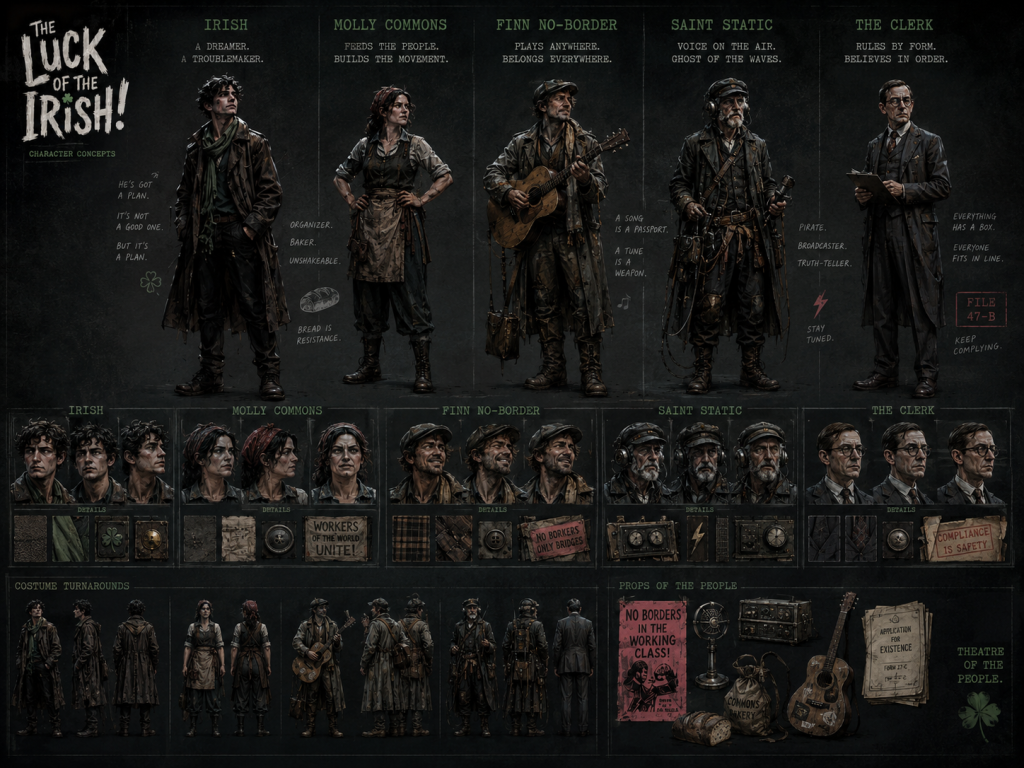
Irish
Irish is not “Ireland” as a country. Irish is a person, a mood, a ghost, a worker, a child of history, and a running joke with bruises.
He is unlucky in the practical sense: always late, always broke, always targeted, always blamed. But he is lucky in the mythic sense: he survives impossible things and keeps making art out of ruins.
Personality
Irish is funny, suspicious, generous, poetic, and angry in a way he tries to hide. He has the instinct of a street kid, the memory of an old rebel, and the heart of someone who has seen too many friends leave.
He does not want to become a martyr. He wants a normal life. That is what makes the story hurt.
Visual design
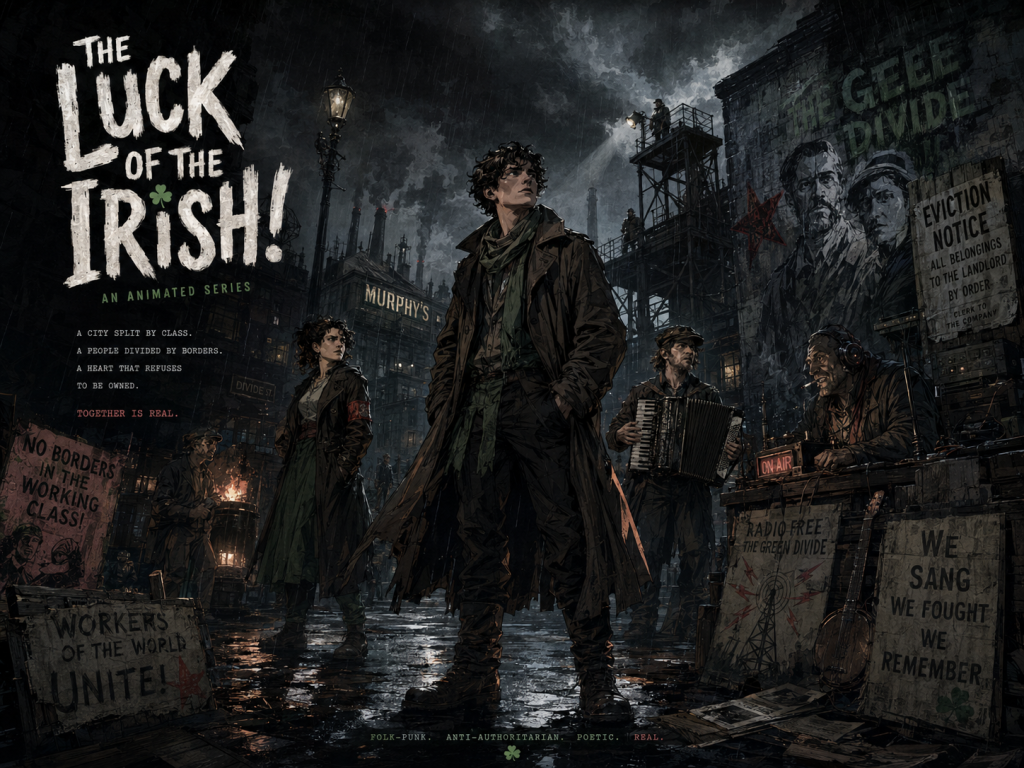
Irish should look iconic: long coat, worn boots, patched sleeves, maybe a green-black scarf, not too obvious, not leprechaun cliché. His silhouette should feel like a punk folk saint walking through rain under neon signs.
His face can be simple and expressive, almost comic-noir: big eyes, tired smile, sharp eyebrows. He carries a notebook full of songs, debts, names of the dead, jokes, and maps that never stay accurate.
Core contradiction
Irish is told he is lucky because his suffering has been romanticized by outsiders.
His journey is learning to reject romantic suffering and fight for ordinary dignity.
Supporting cast
Molly Commons
A community organizer, baker, smuggler of books, and unofficial mayor of the poor district. She believes revolution starts with feeding people.
She represents mutual aid, women’s labor, and the invisible infrastructure of resistance.
Finn No-Border
A wandering musician and ex-prisoner who knows every rebel song but refuses to sing the old ones the same way twice. He helps translate grief into rhythm.
He gives the franchise its U2-like emotional lift: big skies, aching guitars, moral urgency, spiritual doubt.
Saint Static
A pirate radio host broadcasting from rooftops, tunnels, churches, and abandoned factories. Nobody knows if Saint Static is one person or many.
They expose propaganda, read banned letters, and remix public truth.
The Clerk
One of the main antagonists. Calm, polite, well-dressed, never raises his voice. He represents bureaucracy as violence.
He never says “I hate you.”
He says:
“Your form was submitted after the deadline.”
Lord Weather
A landlord-industrialist who owns housing, rainwater rights, newspapers, and funeral insurance. He profits from crisis and sells nostalgia back to the people he exploited.
He is not cartoonishly evil. He is charming, philanthropic, and always photographed near children.
The Choir of the Unlucky
A recurring chorus of workers, ghosts, migrants, mothers, prisoners, dockers, schoolchildren, and pub philosophers. Sometimes they narrate. Sometimes they argue with the narrator.
They make the franchise feel theatrical, musical, and communal.
The world:
The Green Divide
The Green Divide is an island split by visible and invisible borders.
It contains:
The Rain Capital — a colonial administrative city full of statues, banks, courts, and polished lies.
The Bog Republics — rural communities where memory is hidden in songs and stones.
The Pale Glass District — wealthy, sanitized redevelopment zones built over working-class neighborhoods.
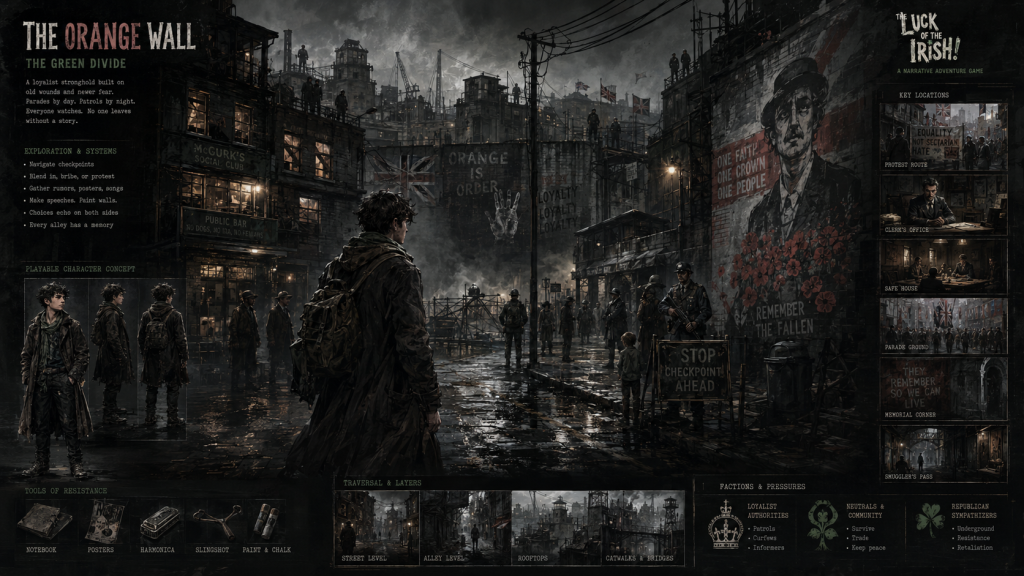
The Orange Wall — a tense border-zone of murals, flags, checkpoints, inherited fear, and families who remember different versions of the same street.
The Shipyards of Neverhome — where people build ships they cannot afford to board, except as emigrants.
The Archive of Missing Names — a forbidden library containing erased histories.
The Church of Proper Silence — an institution that teaches obedience, shame, and respectability.
The Department of Luck — a state office that publicly celebrates Irish culture while privately classifying Irish people as a problem.
The whole world is slightly magical, but not fantasy escapism. Magic is memory. Ghosts are history refusing to stay buried.
Tone
The tone should be:
Funny but wounded.
Political but not preachy.
Musical but not a musical.
Educational but never school-like.
Angry but humane.
Mythic but grounded in working-class life.
It should feel like:
A pub joke turning into a courtroom speech.
A children’s fable that adults slowly realize is about colonialism.
A punk folktale.
A revolutionary bedtime story.
A rain-soaked graphic novel with stadium-sized emotions.
U2-inspired emotional palette
The franchise should not copy U2 lyrics, names, or songs directly. Instead, each season or game level can carry a U2-like emotional architecture:
- huge moral questions
- spiritual doubt
- friendship under pressure
- city streets at night
- grief turning into public song
- romantic idealism colliding with politics
- anthemic endings
- guitars-as-weather energy
- hope that refuses to be naïve
- the feeling that private heartbreak and public history are the same wound
Each episode can have a “band feeling,” not a song reference. Think: open sky, ringing tension, bassline heartbeat, marching drums, fragile voice, massive chorus, then silence.
Format options
Animated series
A prestige adult animated series with 10 episodes per season. Visual style: black ink, green-gray rain, socialist poster shapes, punk collage, stained glass fragments, newspaper texture, and occasional bright neon.
Narrative game
A side-scrolling / isometric story game where every district is a “song-level.” The player moves through strikes, evictions, protests, archives, prisons, pubs, shipyards, border towns, and dream sequences.
Gameplay is based on choices, organizing, memory collection, public speeches, stealth, music, and community-building — not power fantasy violence.
Graphic novel / zine series
Each chapter looks like a political poster, a folk song, and a court document smashed together.
Season structure
Season One:
No One Here Is Lucky
Theme: occupation, poverty, language, eviction, childhood memory.
Irish grows up in a district where every family has a story they are not allowed to tell. The Department of Luck launches a tourism campaign celebrating “Irish charm” while evicting actual Irish families from their homes.
Irish discovers that his dead grandmother left him a notebook full of banned songs, maps, recipes, strike plans, and names crossed out by the state.
Episodes / levels
- The Lucky Boy
Irish is introduced as the unluckiest child in the Green Divide. The whole city celebrates him as a mascot while ignoring his eviction notice. - The House That Paid Rent Twice
A family home is claimed by two landlords, one bank, one church, and one empire. Irish learns that property law is just folklore with police. - The School of Proper Silence
Children are punished for speaking in old words. Language becomes resistance. - Saint Static Broadcasts at Midnight
Irish hears a pirate radio transmission naming crimes everyone pretends not to know. - Bread Before Flags
Molly Commons organizes a food strike when rival communities are baited into fighting each other. - The Clerk Smiles
Irish meets bureaucracy as an antagonist. No violence, just forms, deadlines, seals, and despair. - Songs for the Evicted
The community turns an eviction into a public performance, making shame impossible to privatize. - The Museum of Friendly Occupation
A state museum turns suffering into souvenir culture. Irish vandalizes it with facts. - The Rain Does Not Vote
A flood hits the poor district first. The rich call it natural disaster. Molly calls it policy. - The Luck Runs Out
Irish loses the house but finds the movement. The final image: the whole street walking into rain, singing without permission.
Season Two:
The Border Inside the House
Theme: partition, sectarianism, propaganda, divided memory.
Irish travels to the Orange Wall, where the border is not just a line on land. It is inside families, schools, songs, sports clubs, and funerals.
The season refuses simple good/bad binaries. It shows how empire teaches poor communities to fear each other while landlords and officials profit from division.
Episodes / levels
- Two Flags, One Rent
Two communities fight over symbols while the same company raises everyone’s rent. - The Parade Route
A march becomes a ritual of memory, intimidation, grief, and identity. - The Boy Across the Wall
Irish befriends someone he was taught to hate. - Murals That Stare Back
Painted walls become living archives. - The Policeman’s Son
A child inherits fear and uniformed silence. - The Peace Committee
Polite elites discuss reconciliation without inviting the people who buried the dead. - A Song With Two Choruses
Finn No-Border teaches two rival groups to recognize the same grief in different melodies. - The Archive of Missing Names
Irish finds records proving that history was edited to keep people apart. - No Victory in a Burning Street
A riot episode where the real antagonist is inherited trauma. - The Wall Learns to Listen
The season ends not with unity, but with the first honest conversation.
Season Three:
Exported Children
Theme: migration, diaspora, labor, identity, memory abroad.
Irish leaves the island, not as an adventurer but as someone pushed out by economics. He discovers the global Irish story: workers, nurses, builders, musicians, prisoners, exiles, undocumented migrants, and second-generation children who inherit songs before they inherit facts.
Episodes / levels
- The Shipyard of Neverhome
Irish boards a ship built by workers who cannot afford tickets. - The City That Mispronounced Him
Irish becomes a stereotype abroad. - Plastic Shamrocks
Diaspora culture is sold as costume while real migrants are exploited. - Union Pub
Irish finds radical solidarity among migrants from many colonized histories. - Letters That Arrive Too Late
A whole episode built around unread letters. - No Dogs, No Irish, No Memory
Housing discrimination becomes a ghost story. - The Ballad of the Illegal Aunt
A family secret reveals undocumented survival. - Workers of the Wet Floor
Irish joins a service-worker organizing campaign. - The Saint Patrick’s Day Problem
A parade becomes a battle over who controls identity. - Home Is a Verb
Irish realizes home is not only where you are from. It is what you build with others.
Season Four:
Peace Is Not the Same as Justice
Theme: post-conflict society, neoliberal redevelopment, memory markets, trauma management.
The Green Divide is now officially “peaceful,” but poor neighborhoods are still controlled by money, surveillance, and privatized history.
Former rebels become consultants. Former informers become landlords. Former victims become tourist content.
Irish has to ask: what happens after the slogans win but the people still cannot afford rent?
Episodes / levels
- The Good Friday Gift Shop
Peace is packaged, branded, and sold. - The Consultant Formerly Known as Rebel
A former revolutionary sells conflict-resolution workshops to banks. - Luxury Apartments Over Bones
Redevelopment turns memory into real estate. - The Trauma Survey
Residents are asked to quantify grief for funding. - The New Police, Same Boots
Institutional reform is tested on the street. - Truth Commission Karaoke
Everyone sings around the truth. - The Children of the Ceasefire
A generation inherits peace but not answers. - The Archive Opens
Public memory becomes dangerous again. - A Riot of Accountants
The season’s funniest episode: budget documents reveal the whole crime. - Justice Has a Longer Chorus
Irish learns that peace without equality is just quiet management.
Season Five:
The Republic of Unlucky People
Theme: democratic socialism, mutual aid, public ownership, climate, housing, future.
The final major arc asks what freedom actually looks like. Not flag freedom. Not market freedom. Real freedom: food, shelter, language, care, time, art, land, and democratic power.
Irish and Molly help build a network of neighborhood assemblies called The Republic of Unlucky People.
It is messy, funny, chaotic, imperfect, and more democratic than anything the island has seen.
Episodes / levels
- The Assembly in the Pub
The revolution begins with bad chairs and worse tea. - Land Back, Rent Down
A housing occupation becomes a constitutional crisis. - The Public Laundry
Care work becomes political infrastructure. - The Children Rewrite the Map
Schoolkids redesign the island without borders, landlords, or boring adults. - The Bank of Apologies
A financial institution is forced to pay moral debt. - Rain Commons
Climate crisis meets land justice. - The Day the Statues Walked Away
Old monuments abandon their pedestals out of embarrassment. - The General Strike Picnic
The whole island stops working and starts feeding each other. - The Clerk Joins the Queue
Even the bureaucrat discovers he is disposable to the system he served. - The Luck of the Irish
Finale. Irish is no longer “lucky” because he survives suffering. He is lucky because he is no longer alone.
Game version structure
Game title
The Luck of the Irish!: No One Here Is Lucky
Gameplay loop
Each level is a district, memory, or political crisis. The player must gather testimony, organize neighbors, evade bureaucracy, decode propaganda, restore songs, and make collective decisions.
The player does not “win” by defeating enemies alone. They win by building solidarity.
Core mechanics
Memory collection
Find hidden stories, names, songs, recipes, court records, and family objects.
Public truth system
Contradict official propaganda by assembling evidence.
Mutual aid meter
Communities survive when food, shelter, medicine, and trust are maintained.
Speech battles
Not combat rap battles, but public debates where rhetoric, facts, humor, and moral clarity matter.
Bureaucracy puzzles
Forms, permits, forged seals, loopholes, missing records, and absurd institutional language.
Song moments
Major emotional sequences where music changes the level, opens paths, or unites characters.
No hero savior ending
Irish can inspire people, but cannot liberate them alone.
Visual identity
Palette
Black, white, wet gray, deep green, dirty cream, rust orange, emergency red, neon pub-sign blue. Pink can be used as a NotYouAgain-style accent for protest posters, UI marks, subtitles, or punk sticker graphics.
Style
- comic-noir folk punk
- political poster design
- rainy urban myth
- rough ink
- collage textures
- documentary fragments
- pub signs
- old maps
- football scarves
- handwritten slogans
- official forms stamped over human faces
- murals that animate when nobody is watching
Logo idea
THE LUCK OF THE IRISH! in bold, battered lettering.
“The Luck” looks cheerful and commercial.
“of the Irish!” looks scratched in afterward, like graffiti correcting propaganda.
A small four-leaf clover appears in the logo, but one leaf is a tear, one is a fist, one is a coin, and one is a flame.
The educational trick
The franchise should never begin by saying:
“This is about colonialism, famine, partition, migration, class struggle, and state propaganda.”
Instead, the audience discovers those things through:
- a child losing a home
- a song being banned
- a border splitting a street
- a newspaper lying beautifully
- a priest protecting an institution
- a landlord smiling on television
- a migrant being turned into a joke
- a peace process becoming a business model
- a community learning democracy by doing it badly at first
The education is emotional first, factual second.
That makes it self-explanatory.
Franchise tagline options
Bad luck made him Irish. Solidarity made him dangerous.
They called it luck. He called it history.
A folk-punk fable about borders, bread, songs, and survival.
The island was divided. The rent was not.
No kings. No landlords. No silence.
Some people inherit castles. Irish inherited a chorus.
Sample opening narration
They said Irish was lucky.
Lucky to be born under rain that remembered everything.
Lucky to have songs instead of evidence.
Lucky to have saints, graves, jokes, and an accent people found charming when he was poor enough to be harmless.
But Irish knew better.
Luck was what powerful people called survival when they did not want to discuss responsibility.
So he kept walking.
Through eviction notices, border songs, police smiles, holy paperwork, and streets named after men who never paid rent.
And whenever someone asked him why he was still laughing, Irish said:
“Because if I stop, they’ll put it in a museum.”
One-line franchise pitch
The Luck of the Irish! is a folk-punk political adventure about an unlucky character named Irish who survives occupation, poverty, propaganda, exile, partition, and fake peace by discovering that real luck is not charm, nationalism, or myth — it is collective memory, mutual aid, and the courage to build a freer world together.
One comment