

Franchise Bible
Subtitle: You’ve Got Game?
Alternative Title: The Game Was Always On!
1. Franchise Identity
THE GAME is a punk-survival, comic-noir, body-tech, labor-future franchise about a group of misfits trying to survive in a world where bodies can be enhanced, protected, rented, insured, disabled, exploited, and classified — but never replaced.
It is loud, funny, brutal, intelligent, absurd, and philosophical.
It is a story about work, injury, adaptation, design, language, survival, trade, authorship, and the moment a person realizes that strength alone will not save them.
The world tells people:
Your body is your tool. Your tool is your value. Your value is your classification.
The heroes discover something else:
Your body is yours once. Your mind can change the rules. Your legacy is what others learn from your survival.
2. Core Logline
In a broken future where workers lease body enhancements to survive brutal labor, a damaged group of misfits learns that when physical strength fails, the real game begins: information, design, translation, trade, wit, intelligence, and wisdom become the new weapons.
3. Expanded Pitch
In the world of THE GAME, labor has become so extreme that ordinary human bodies can no longer keep up. Workers use biological upgrades, exoskeletal braces, muscle stabilizers, pain filters, synthetic joints, oxygen rigs, nerve dampeners, and corporate-owned body support systems just to survive the workday.
But these upgrades are not freedom.
They are contracts.
They are subscriptions.
They are debts.
They are traps.
When your body breaks, the system does not ask how to help you. It asks whether you are still profitable.
The story follows a crew of outsiders who begin as laborers, smugglers, mechanics, translators, designers, ghostwriters, fixers, and black-market survivors. Each of them has been damaged by the system in a different way. Some are physically injured. Some are economically trapped. Some are legally erased. Some are cognitively overloaded. Some are too smart to be obedient and too broke to be free.
At first, they think survival means getting stronger.
Then the game changes.
A worker becomes an information dealer.
A mechanic becomes a philosopher.
A translator becomes a border weapon.
A designer becomes a survival engineer.
A former consumer becomes a producer.
A damaged body becomes a political document.
A book becomes more dangerous than a gun.
At the center of the franchise is The Manual of Survival, a living text written by the crew and stolen by the world. It teaches one principle:
Do not copy the text. Understand the motor.
4. Franchise Positioning
THE GAME sits at the intersection of:
- Punk science fiction
- Survival satire
- Body-tech dystopia
- Labor politics
- Comic-noir adventure
- Transmedia worldbuilding
- Game design
- Graphic storytelling
- Anti-corporate comedy
- Design culture
- Educational entertainment
- Street philosophy
It is a franchise that can exist as:
- Animated series
- Graphic novel
- Video game
- Tabletop RPG
- Survival manual book
- Webcomic
- Art book
- Music/video clips
- Fake commercials
- Merchandise
- Posters
- Interactive websites
- Social media fragments
- In-world documents
- Design objects
- Educational workshops
- Brand parody campaigns
The franchise is built to move across media because its core concept is already about media: instructions, manuals, contracts, ads, propaganda, translations, legal notices, trade papers, identity systems, and survival guides.
5. Genre Formula
THE GAME is:
Mad labor future + punk misfit crew + body modification economy + survival RPG logic + fake corporate commercials + design-as-weapon + translation-as-smuggling + manual-as-legacy.
The audience comes for the chaos.
They stay for the characters.
They remember the philosophy.
6. Tone
The tone is:
Dirty but clever.
Funny but serious.
Fast but thoughtful.
Political but not preachy.
Violent but not empty.
Absurd but emotionally grounded.
Stylized but human.
Characters joke because they are scared.
They hustle because they are trapped.
They fight because they have no clean options.
They write because memory is resistance.
The franchise should never feel like clean corporate science fiction. It should feel handmade, printed, repaired, annotated, smuggled, scratched, overpainted, and passed around.
7. Core Themes
7.1 You Only Have This Body Once
The body is not disposable. The system treats bodies like replaceable components, but every character knows the truth: pain stays, trauma accumulates, damage teaches, and survival has a physical cost.
The franchise does not romanticize suffering. It shows that suffering can produce knowledge, but it should never have been required in the first place.
7.2 Adaptation Is Survival
Every major character eventually loses access to their first survival strategy.
The strong character cannot rely on strength forever.
The fast character gets slowed down.
The clever character gets outplayed.
The designer loses control of the message.
The translator discovers that language can betray them.
The author realizes the manual can be misused.
The story asks:
Who are you after your first identity breaks?
7.3 Intelligence Is Not Enough
The franchise separates intelligence from wisdom.
Intelligence solves a problem.
Wit survives the moment.
Wisdom recognizes the pattern.
Humor keeps the soul alive.
Design changes perception.
Language changes access.
Trade changes position.
Legacy changes the future.
7.4 The Consumer/Producer Shift
The system wants people to remain consumers: buying upgrades, buying access, buying identity, buying survival.
The heroes learn to become producers:
They produce information.
They produce design.
They produce translation.
They produce strategy.
They produce networks.
They produce manuals.
They produce meaning.
This is one of the franchise’s most important arcs:
Stop only consuming the game. Learn how the game is produced.
7.5 Read the Motor, Not the Text
Every system has surface language and hidden machinery.
A contract says “opportunity.”
The motor says “debt.”
An advertisement says “refreshment.”
The motor says “compliance.”
A university paper says “efficiency.”
The motor says “control.”
A body enhancement says “freedom.”
The motor says “subscription.”
The heroes survive by learning to see the motor.
8. The World
8.1 Setting Overview
The world of THE GAME is a post-industrial desert-commercial future where states, corporations, universities, logistics networks, and black markets have merged into a chaotic survival economy.
The old world did not end in one explosion.
It became a contract.
Climate stress, labor collapse, privatized infrastructure, automation wars, border economies, debt systems, body-tech monopolies, and information control created a world where everyone is forced to play.
Cities still exist, but they are uneven. Some are hyper-advanced academic fortresses. Some are worker hives. Some are flooded. Some are dust. Some are mall ruins filled with legal kiosks and vending machines.
Highways are trade veins.
Deserts are archives.
Garages are universities.
Clinics are casinos.
Advertisements are weather.
8.2 Main Zones
The Labor Belts
Massive industrial regions where people perform extreme physical work using leased body support systems.
Everything here is measured: load capacity, hydration rate, nerve stress, spinal tolerance, shift value, injury probability, replacement cost.
The Labor Belts are where many characters begin.
The Body Markets
Illegal and semi-legal marketplaces for implants, braces, organs, enhancements, stabilizers, prosthetics, pain systems, counterfeit medical licenses, and expired military-grade exosuits.
Some body markets are hidden in underground clinics.
Some operate openly under corporate protection.
The rule is simple:
If you can pay, someone will modify you. If you cannot pay, someone will own the modification.
The Academic Ports
University city-states that trade in language, research, patents, political theory, border policy, and legal justification.
They look clean, but they are deeply corrupt.
Professors, ministers, lawyers, translators, and contractors meet here to create the documents that later destroy people’s lives.
This is where language becomes weaponized.
The Trade Corridors
Roads, rail lines, drone lanes, smuggling routes, and communication channels that move goods, people, data, medicine, books, illegal upgrades, and rumors.
Whoever controls the corridors controls survival.
The Refreshment Zones
Public spaces saturated with corporate morale advertising.
These are the home of the recurring iced tea commercials, fake wellness slogans, vending machines, hydration booths, “coolness stations,” and broken billboards.
They are funny, but also disturbing. They show how branding survives even when justice does not.
The Ghost Areas
Unregistered spaces beyond official classification.
People without valid body status, work status, citizenship, or debt identity live here.
Ghost Areas are dangerous, but they are also freer than most official zones.
The crew often hides, learns, heals, and publishes from these areas.
9. Social System
9.1 Body Classification
Every citizen, worker, migrant, debtor, and outlaw has a body file.
The file determines:
- What work they may do
- What enhancements they may use
- What treatment they can access
- Whether they are considered disabled
- Whether their injury is “valid”
- Whether they qualify for protection
- Whether they are legally employable
- Whether they can cross borders
- Whether their debt can be inherited
The body file becomes one of the central horrors of the world.
A person is not asked:
Who are you?
They are asked:
What is your body still rated for?
9.2 Enhancement Economy
Body enhancement is common but unequal.
The wealthy own enhancements.
Workers lease them.
Criminals steal them.
Ghosts build them from scrap.
Corporations remotely disable them.
Governments classify them.
Doctors regulate them.
Body dealers exploit them.
Every enhancement creates a new dependency.
An arm can lift steel but requires a coolant subscription.
A spinal brace prevents collapse but logs every movement.
A pain filter helps a worker finish a shift but hides injury signals.
A cognitive booster improves focus but creates memory debt.
A synthetic lung works perfectly unless border security flags it as illegal hardware.
9.3 Labor Credits
Money still exists, but the working class mostly survives through labor credits.
Labor credits are earned through classified work and spent on:
- Food
- Water
- Body maintenance
- Legal access
- Travel permits
- Medical scans
- Upgrade licenses
- Housing pods
- Translation services
- Information packages
Labor credits expire, fluctuate, and can be frozen.
This creates the central economic pressure:
You need your body to work. You need work to maintain your body. You need maintenance to keep working.
That loop is the trap.
10. The Game
In-world, “the game” is slang for the total survival system.
It means labor.
It means trade.
It means social position.
It means knowing who owns what.
It means knowing when to speak.
It means knowing when to run.
It means understanding contracts.
It means reading design.
It means surviving injury.
It means not confusing the advertisement with the truth.
A rookie thinks the game is about winning.
A survivor knows the game is about staying in motion.
A master knows the game is about teaching others where the traps are.
11. Character Classes
These are not strict roles, but recurring identity types.
Carrier
Physical worker. Strong, practical, exploited, often proud. They know the material world better than anyone.
Assembler
Mechanic, body-tech fixer, illegal repair specialist. They understand the relationship between machine and flesh.
Runner
Courier, smuggler, border-crosser, escape artist. They move goods, messages, bodies, and secrets.
Dealer
Information broker. They sell what others do not know.
Designer
Visual communicator, identity builder, interface manipulator, propaganda hacker. They know how perception becomes behavior.
Translator
Language worker, negotiator, academic ghostwriter, diplomatic middleman. They move meaning across borders.
Producer
Someone who stops buying the system and starts making alternatives: publications, tools, networks, maps, manuals, training systems.
Author
A person who turns survival into transmissible knowledge.
Ghost
Unregistered survivor outside the classification system.
12. Main Characters
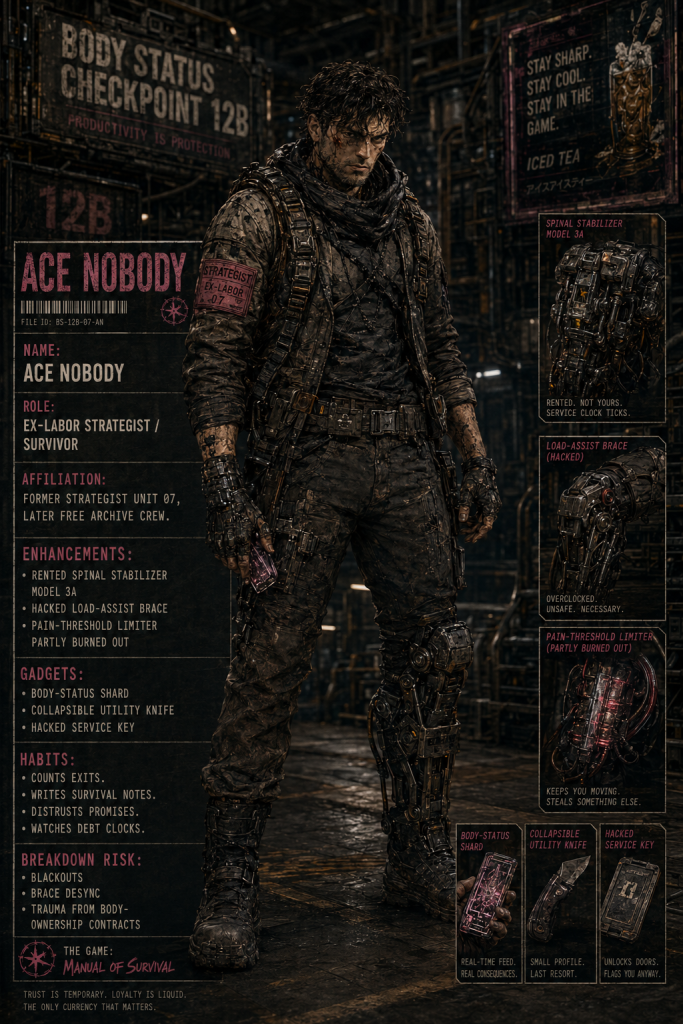
12.1 Ace Nobody
Role
Audience-entry character, former laborer, future author.
Starting Point
Ace begins as a physically capable worker who believes endurance is identity. They have survived by pushing through pain, taking extra shifts, carrying heavier loads, and laughing at people who complain.
Inciting Damage
A labor accident, body-tech failure, corporate betrayal, or classified injury changes their body status. Ace can no longer survive the old way.
Arc
Ace moves from muscle to mind.
They learn design.
They learn trade.
They learn language.
They learn how contracts work.
They learn how people are trapped.
They learn how to document systems.
They begin writing The Manual of Survival.
Core Question
Who are you when your strongest tool is no longer available?
Signature Line
“I thought the game was the work. Turns out the work was just the loading screen.”
12.2 Motor
Role
Mechanic-philosopher, mentor, systems reader.
Description
Motor is the person who sees the hidden structure behind everything. Machines, bodies, politics, contracts, and relationships are all motors to them.
They are funny, tired, brilliant, and sometimes impossible to understand until three episodes later.
Skills
- Body-tech repair
- Mechanical design
- System analysis
- Illegal diagnostics
- Pattern recognition
- Brutal honesty
Philosophy
“Don’t read what the system says it does. Watch what it makes people do.”
Signature Line
“Text lies. Motors confess.”
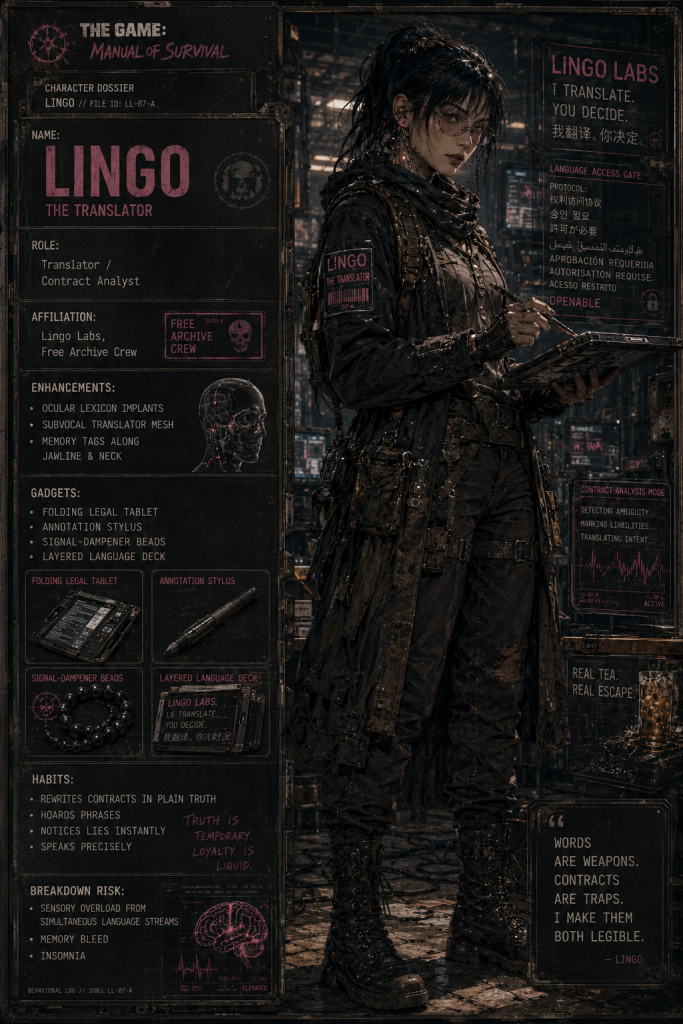
12.3 Lingo
Role
Translator, negotiator, ghostwriter, diplomatic smuggler.
Description
Lingo speaks many languages and trusts none of them.
They translate for professors, lawyers, ministers, smugglers, refugees, corporations, and people who do not want their real meaning understood.
Lingo knows that translation is not simply words. It is access, safety, interpretation, danger, and leverage.
Skills
- Translation
- Legal interpretation
- Diplomatic manipulation
- Academic rewriting
- Contract decoding
- Voice mimicry
- Cultural reading
Conflict
Lingo has helped powerful people say terrible things politely. They are trying to repay that moral debt.
Signature Line
“Every border is a sentence someone else wrote.”
12.4 Patch
Role
Body-tech assembler, illegal medic, upgrade artist.
Description
Patch fixes people with scrap, genius, bad coffee, and questionable ethics. They believe every body deserves support, but they also know every modification creates a new risk.
Patch is both comic relief and moral tension.
Skills
- Prosthetic repair
- Exosuit hacks
- Implant stabilization
- Field surgery
- Black-market sourcing
- Improvised engineering
Conflict
Patch keeps people alive inside a system that keeps breaking them.
Signature Line
“I can fix it. I did not say I can make it legal.”
12.5 Soft Hammer
Role
Former heavy labor champion, injured strategist, labor organizer.
Description
Soft Hammer used to be famous in the Labor Belts for impossible strength. They could move loads that machines refused. Their body became a legend, then a warning.
Now their body is unreliable. Their hands shake. Their back locks. Their enhancements misfire. Their old identity is gone.
Arc
Soft Hammer learns that the person who knows where labor breaks the body can teach others how to resist the machine.
Skills
- Strength
- Worker networks
- Tactical planning
- Labor memory
- Intimidation
- Moral authority
Signature Line
“They called me broken because I stopped being profitable.”
12.6 Buyer’s Remorse
Role
Ex-consumer influencer, branding manipulator, producer-in-training.
Description
Buyer’s Remorse used to sell upgrades, lifestyle systems, body mods, work hacks, survival kits, fake freedom, and premium identity packages.
Now they know the scam from the inside.
They understand why people buy their own chains if the packaging is beautiful enough.
Skills
- Branding
- Marketing psychology
- Social influence
- Product critique
- Scam detection
- Counter-propaganda
Arc
They move from selling desire to producing tools that actually help people.
Signature Line
“People don’t buy products. They buy permission to become someone else.”
12.7 The Author
Role
Mythic future identity, narrator, legacy figure.
Description
The Author may be Ace in the future. Or a role passed from survivor to survivor. Or a fake name used by the entire crew.
The Author is credited with writing The Manual of Survival, but nobody agrees who actually wrote it.
This ambiguity is important.
The manual belongs to everyone who survived enough to add a page.
Signature Line
“I did not write this to be believed. I wrote this so you could test it.”
13. Supporting Characters
Professor Glass
An academic who writes beautiful papers about ugly systems.
They speak softly, cite everything, and never take responsibility for consequences.
Minister Vale
A political figure who uses language to turn exploitation into policy.
They need translators, designers, and fixers — which makes them dangerous to Lingo and the crew.
Aunt Static
An old pirate broadcaster who interrupts official channels with survival advice, rumors, music, and forbidden chapters from the manual.
Little Warranty
A child courier with a fake body-support warranty tattooed on their arm.
They are funny, sharp, and represent the next generation already trapped in the system.
Doctor Receipt
A clinic operator who documents every injury like a financial transaction.
They may be villain, ally, or both depending on who pays.
The Cool Man
The in-world iced tea spokesman figure. In the direct dream version, this is Ice-T appearing in Lipton Iced Tea commercials. In a legally safer parody version, he becomes Ice Tee, spokesman for Liptin Ice Tea.
14. Villains and Opposing Forces
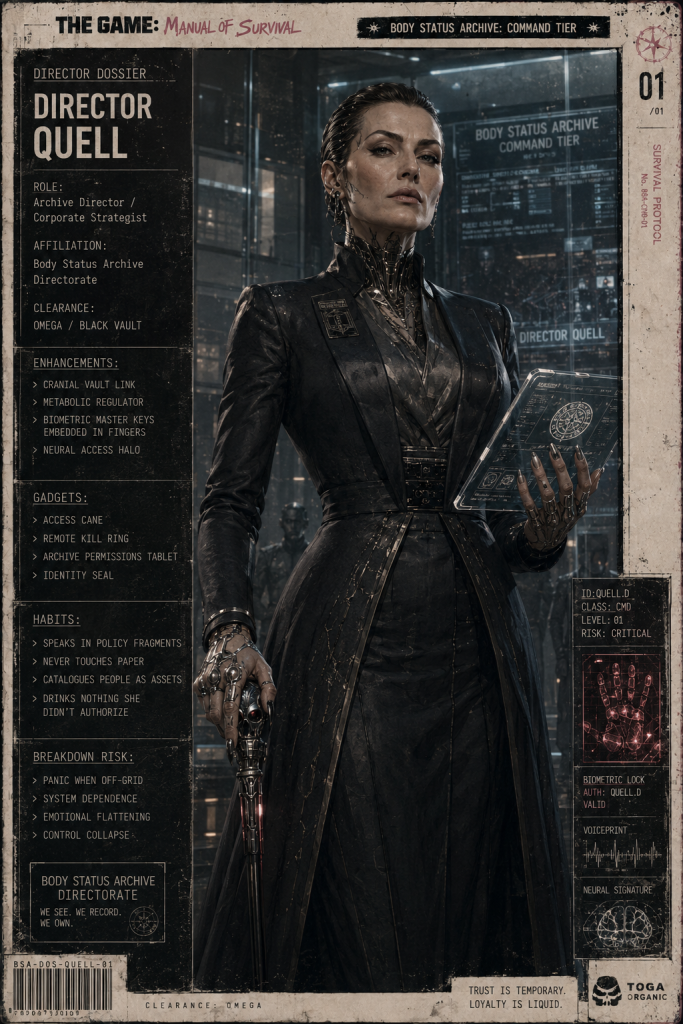
14.1 The Body Leasing Companies
Corporations that lease body enhancements to workers.
They present themselves as empowering.
They are actually dependency machines.
Slogans
“Your body, upgraded.”
“Work harder, safer, longer.”
“Protection you can afford, until you cannot.”
“Tomorrow’s labor, today’s subscription.”
14.2 The Labor Courts
Institutions that determine whether a body is legally injured, fraudulently injured, employable, enhanced, disabled, or commercially invalid.
They are terrifying because they are boring.
They destroy lives through forms, categories, hearings, and definitions.
14.3 The Refreshment Ministry
A surreal public-private advertising authority that manages morale campaigns.
It floods the world with hydration slogans, coolness propaganda, fake wellness messaging, and commercials that feel cheerful while the world burns.
It is the perfect home for the recurring iced tea gag.
14.4 The Professors of Practical Violence
Academics who create theories, frameworks, and legal language that justify brutal systems.
They never lift anything heavier than a glass of conference water, but their papers move armies, borders, labor laws, and corporate policy.
14.5 The Middlemen
A decentralized class of brokers who profit from confusion.
They sell access to access.
They translate the translation.
They certify the certificate.
They rent the thing you already paid for.
They make everything complicated enough that everyone needs them.
The crew often has to beat them by becoming better, stranger, more ethical middlemen.
15. The Manual of Survival
15.1 What It Is
The Manual of Survival is the central myth-object of the franchise.
It begins as Ace’s personal notes after injury.
Then it becomes a crew document.
Then it becomes a printed zine.
Then it becomes a banned book.
Then it becomes a black-market training tool.
Then it becomes propaganda.
Then it becomes religion to people who misunderstand it.
Then the crew must fight to protect its real meaning.
The manual is not a list of answers. It is a method of reading systems.
15.2 Key Principle
Understand the motor, not the text.
The text is what the system says.
The motor is what the system does.
15.3 Sample Chapters
Chapter 1: You Only Have This Body Once
Pain is information. Do not let the system teach you to ignore the only alarm you own.
Chapter 2: When Strength Ends, Strategy Begins
Losing one ability is not the end. It is the beginning of a different map.
Chapter 3: Translation Is Smuggling
Every language crossing moves power. Know what you carry.
Chapter 4: Design Is Not Decoration
Layout is instruction. Typography is authority. Color is command. Interfaces are politics.
Chapter 5: The Consumer/Producer Trap
A consumer buys survival. A producer builds leverage.
Chapter 6: Intelligence Is Not Wisdom
Smart people solve puzzles. Wise people ask who built the puzzle and why.
Chapter 7: The Middle Is a Battlefield
Between buyer and seller, worker and boss, body and contract, language and law — that is where the real game happens.
Chapter 8: The Game Was Always On
Nobody starts neutral. You enter the world already inside rules.
16. Recurring Commercial Motif
Ice-T for Lipton Iced Tea / Parody Variant
A recurring background gag runs through the entire franchise: iced tea commercials playing in the middle of collapse.
Direct Dream-Collab Version
Ice-T appears in Lipton Iced Tea commercials throughout the world, always calm, always cool, always deadpan.
He appears on:
- Broken vending machines
- Desert billboards
- Labor court waiting-room screens
- Body clinic monitors
- Bus shelters
- Hologram ads
- Pirate broadcasts
- Hydration kiosks
- Old magazines
- Product stickers
- Glitched public-service announcements
Legal-Safe Parody Version
If rights are not cleared, the in-world version becomes:
Ice Tee for Liptin Ice Tea
A fictional tough-guy spokesman in a suspiciously familiar campaign.
Function
The joke is that civilization is collapsing, people are being classified by body value, workers are breaking under contract labor, and yet the advertising never stops.
The commercial voice says:
Stay cool. Stay sharp. Stay in the game.
The world is brutal.
The beverage is chilled.
The brand is immortal.
Sample Commercial
Visual:
A desert labor camp. Workers in exo-braces drag steel across cracked earth. The sun is violent. A vending machine flickers.
The screen glitches.
A calm spokesman appears.
ICE-T / ICE TEE:
“World’s hot. Bosses are cold. Your spine is rented. Your contract is fake.”
He raises an iced tea.
ICE-T / ICE TEE:
“But you? You stay cool.”
Voice-over:
“Lipton Iced Tea. The game was always on.”
Or parody:
Voice-over:
“Liptin Ice Tea. Legally refreshing.”
A bottle drops from the machine.
Then a second item drops.
A legal summons.
Recurring Slogans
Stay cool. Stay sharp. Stay in the game.
When the heat is systemic, drink tactical.
Cold enough to forget your labor classification.
Hydration for the permanently exploited.
The game was always on. Good thing it’s iced.
17. Visual Style
17.1 Core Look
The visual identity should feel like:
A punk comic.
A survival manual.
A legal document.
A product catalog.
A desert billboard.
A body-tech repair diagram.
A black-market zine.
A fake commercial campaign.
A damaged instruction booklet.
A luxury brand after the apocalypse got hold of it.
17.2 Color Palette
Primary:
- Black
- White
- Dust gray
- Bone paper
- Rust
- Warning pink
- Sun-faded yellow
- Iced-tea amber
- Medical blue
- Corporate cream
Accent:
- Bright pink for warnings, UI highlights, stickers, and franchise marks
- Yellow/amber for refreshment-commercial elements
- Red used sparingly for injury, danger, and debt status
17.3 Typography
Typography should combine:
- Heavy condensed headlines
- Handwritten notes
- Industrial labels
- Legal document type
- Sticker-style title graphics
- Diagram captions
- Glitched corporate fonts
- Comic speech lettering
The page should always feel like someone has used it, corrected it, argued with it, stamped it, spilled something on it, and smuggled it across a border.
17.4 Graphic Motifs
- Body-status diagrams
- Exosuit schematics
- Warning labels
- Fake legal forms
- Stamps
- Barcodes
- Product stickers
- Hydration ads
- Desert billboards
- Translation notes
- Marginalia
- Torn manual pages
- Contract fragments
- Pink correction marks
- Black ink splashes
- White cut-out character portraits
18. Narrative Engine
Every story in THE GAME should include at least four of the following:
- A body problem
- A money problem
- A language problem
- A design problem
- A trade problem
- A moral problem
- A commercial interruption
- A manual lesson
- A system revealed
- A role transformation
The franchise works best when practical survival and philosophical insight happen in the same story.
Example:
The crew needs a spinal coolant cartridge.
To get it, they must translate an academic contract.
The contract hides a labor-rights violation.
Buyer’s Remorse redesigns the document so workers can understand it.
Patch modifies a vending machine to print copies.
Soft Hammer organizes the workers.
A fake iced tea ad plays in the background.
Ace writes a manual chapter:
“A readable document is a weapon.”
19. Animated Series Bible
Format
Adult animated action-comedy/drama.
Episode length: 22–30 minutes.
Season length: 8–10 episodes.
Visual style: punk comic animation, mixed media, fake commercials, manual inserts, graphic overlays.
Season 1: You’ve Got Game?
Season Premise
Ace Nobody suffers a body-status collapse after a labor disaster and is forced into the underground economy. They meet Motor, Patch, Lingo, Soft Hammer, and Buyer’s Remorse. Together they uncover that the accident was not an accident, but part of a body-leasing scheme.
Season Arc
Ace moves from laborer to systems reader.
Episode 1: Loading Screen
Ace is injured during a classified labor job. Their body file is downgraded. Their enhancement contract remains active. They owe money for a body that no longer works.
Episode 2: Coolant
Patch helps Ace stabilize a failing support system. The crew steals coolant from a corporate vending network while an iced tea commercial plays.
Episode 3: Terms and Conditions
Lingo discovers that Ace signed away injury rights through a mistranslated labor contract.
Episode 4: Soft Hammer Falls Twice
Soft Hammer returns to the Labor Belt where they were once famous and confronts the company that profited from their collapse.
Episode 5: Buyer’s Remorse
The crew needs a public-facing identity. Buyer’s Remorse helps them create one, but must confront their past as a seller of false freedom.
Episode 6: The Professor’s Sentence
A professor’s research paper becomes the legal foundation for a new body classification policy. Lingo is hired to translate it and secretly sabotages it.
Episode 7: Manual Draft
Ace begins writing survival notes. The crew argues whether documenting their methods will help people or get them killed.
Episode 8: The Game Was Always On
The crew exposes the body-leasing scheme, but the system absorbs the scandal. Ace realizes winning one fight is not enough. The manual must become a network.
Season 2: Information Dealer
Season Premise
The crew becomes a known underground information source. Their manual circulates illegally. Workers, smugglers, academics, ministers, and criminals all want access.
Arc
The crew learns that information creates power, but also danger.
Key Conflicts
- Fake versions of the manual appear.
- Labor courts start quoting the manual against workers.
- The Refreshment Ministry uses survival language in advertising.
- Lingo’s past work returns as evidence in a political trial.
- Ace becomes famous under a name they did not choose.
Season 3: The Translation Wars
Season Premise
Language becomes the battlefield. A treaty, a labor code, and a border policy all depend on translation. The crew must decide whether to expose, alter, or weaponize the text.
Arc
The crew realizes that words do not merely describe systems. They build them.
Season 4: Manual of Survival
Season Premise
The manual becomes a global object: book, myth, weapon, scam, school, cult, and counterfeit product.
Arc
The crew must reclaim the manual’s meaning without becoming authorities themselves.
Final Season Question
Can a survival method remain free once everyone wants to own it?
20. Graphic Novel Bible
Format
Ongoing graphic novel series with each volume built around a different survival transformation.
Visual structure:
- Main comic narrative
- Manual chapter inserts
- Fake advertisements
- Diagrams
- Contracts
- Translation notes
- Character field reports
- Product pages
- Legal notices
Volume 1: You’ve Got Game?
Ace’s injury, body classification, and entry into the underground crew.
Volume 2: Body Once
The enhancement economy is explored in full. Patch becomes central. The crew investigates body-leasing clinics.
Volume 3: Information Dealer
Ace learns to sell, protect, and verify information. The crew becomes a broker network.
Volume 4: Translation Is Smuggling
Lingo leads the story. Academic ports, ministers, legal language, and border contracts become the battlefield.
Volume 5: Design Is Not Decoration
Buyer’s Remorse and the design system take center stage. The crew fights a propaganda campaign by redesigning public understanding.
Volume 6: Soft Hammer
A labor uprising story centered on injured workers, body files, and the meaning of strength after collapse.
Volume 7: Manual of Survival
The manual becomes famous. Fake copies spread. The crew fights to preserve the motor, not the text.
Volume 8: The Game Was Always On
The final arc reveals that the game was never a single system. It was a pattern repeated across labor, language, design, law, commerce, and identity.
21. Video Game Bible
Genre
Narrative survival RPG / strategy adventure / systems-based roleplaying game.
Core Player Fantasy
You are not trying to become the strongest person in the world.
You are trying to survive long enough to understand the system, adapt your role, build a network, and leave behind knowledge that helps others.
Core Mechanic
The player’s body changes over time.
Physical power is useful, but not permanent.
Injury, fatigue, debt, enhancement dependency, legal classification, and mental strain all affect play.
The player must adapt.
Character Stats
Body
Strength, endurance, injury tolerance, recovery.
Wit
Improvisation, jokes, fast lies, pressure choices.
Intelligence
Research, technical analysis, planning.
Wisdom
Pattern recognition, restraint, long-term consequences.
Language
Translation, negotiation, cultural reading, legal interpretation.
Design
Persuasion, interface manipulation, document clarity, propaganda resistance.
Trade
Brokering, pricing, logistics, supply chains.
Network
Trust, contacts, favors, reputation.
Legacy
What others learn from your actions.
Body Status System
The player has a body file that can change.
Possible statuses:
- Fit
- Strained
- Overclocked
- Injured
- Stabilized
- Leased
- Flagged
- Disabled
- Modified
- Illegal
- Ghosted
- Unclassified
A lower body status is not a game-over. It changes available strategies.
A player with reduced physical ability may unlock stronger language, design, trade, and network options.
Role Shift System
The game encourages transformation.
You may begin as a Carrier, but become a Dealer.
You may begin as a Runner, but become a Translator.
You may begin as a Designer, but become an Author.
You may become a hybrid role.
The best builds are not pure builds. They are adaptive builds.
Mission Types
- Labor survival
- Body repair
- Contract decoding
- Translation negotiation
- Smuggling routes
- Design interventions
- Propaganda disruption
- Trade brokerage
- Academic infiltration
- Court hearings
- Manual distribution
- Worker organizing
- Commercial hacking
- Reputation battles
Ending Philosophy
The best ending is not domination.
The best ending is creating a survival network that no single corporation, court, ministry, or professor can own.
The final score is not wealth.
It is legacy.
22. Tabletop RPG Bible
Format
A tabletop roleplaying game based on survival, adaptation, and system-reading.
Core Dice Philosophy
Characters succeed not by having the highest strength but by combining abilities.
A body roll can move a door.
A language roll can move a guard.
A design roll can move a crowd.
A wisdom roll can avoid the trap entirely.
Player Archetypes
- Carrier
- Assembler
- Runner
- Dealer
- Designer
- Translator
- Producer
- Ghost
- Author
Key Rule
Every character begins with an advantage and a future cost.
Your strongest ability can become unstable.
This makes character development part of the survival philosophy.
Campaign Structure
Campaigns revolve around:
- A body crisis
- A debt chain
- A trade route
- A document
- A corrupt institution
- A survival manual chapter
- A community at risk
- A system that must be understood before it can be changed
23. Web / Digital Franchise Layer
In-World Website
The franchise website should feel like a smuggled survival interface.
Sections:
- Read the Manual
- Body Status Test
- Character Files
- Trade Map
- Commercial Archive
- Labor Court Simulator
- Translation Desk
- Design Is Not Decoration
- Submit a Survival Note
- The Game Was Always On
Interactive Features
Body Status Generator
Users answer questions and receive a fictional body classification with survival advice.
Manual Page Generator
Users create their own survival manual page.
Fake Contract Decoder
Users paste fictional contract language and the site translates the “text” into the “motor.”
Commercial Archive
A gallery of fake ads from the Refreshment Ministry.
Role Finder
Are you Carrier, Designer, Translator, Dealer, Ghost, or Author?
Survival Map
An interactive map of zones, routes, black markets, academic ports, and refreshment stations.
24. Social Media Strategy
Platform Voice
The franchise speaks like an underground survival broadcast.
Short, sharp, funny, useful, slightly threatening.
Examples:
Your pain is data. Do not let your boss delete it.
A contract is just a trap with grammar.
Design is not decoration. It is behavior in costume.
Translation is smuggling with subtitles.
You are not lazy. Your body is billing the system.
The game was always on. Learn the controls.
Content Types
- Manual excerpts
- Fake ads
- Body status cards
- Character quotes
- Survival diagrams
- Short animated commercial interruptions
- “Understand the motor” explainers
- Punk design posters
- In-world legal notices
- Translation jokes
- Labor court absurdities
- Iced tea background gags
25. Merchandise
Strong Merchandise Categories
- Manual of Survival zine
- Field notebooks
- Sticker packs
- Body-status patches
- Labor Court rejection stamps
- “Understand the Motor” posters
- “You Only Have This Body Once” shirts
- Fake iced tea commercial posters
- Character patches
- Trade corridor maps
- Exosuit diagram prints
- “Text Lies. Motors Confess.” hoodie
- “The Game Was Always On” cap
- “Design Is Not Decoration” print series
26. Brand Collaboration Potential
Dream Collaboration
Ice-T x Lipton Iced Tea x THE GAME
A deadpan commercial campaign built around the absurdity of staying cool in a brutal world.
Potential campaign line:
“The game was always on. Good thing it’s iced.”
Important Rights Note
Using Ice-T and Lipton directly requires formal rights, approval, licensing, and brand participation.
Until that exists, the franchise can use parody-safe fictional equivalents:
Ice Tee
Liptin Ice Tea
The Refreshment Ministry
This keeps the joke alive while avoiding dependency on third-party clearance.
27. Sample Dialogue
Ace and Motor
Ace:
“My back is gone. My license is frozen. My arm brace thinks I’m dead. What am I supposed to do now?”
Motor:
“Same thing everyone does when the machine spits them out.”
Ace:
“What?”
Motor:
“Learn where the mouth is.”
Lingo
Lingo:
“The minister did not say forced relocation. He said spatial correction.”
Soft Hammer:
“That sounds better?”
Lingo:
“That is why they pay translators.”
Patch
Patch:
“I fixed your knee.”
Ace:
“Why does it play radio?”
Patch:
“That is not radio. That is a border patrol frequency. You are welcome.”
Buyer’s Remorse
Buyer’s Remorse:
“They sold you pain relief as productivity. Then they sold your productivity as proof you were never in pain.”
Soft Hammer
Soft Hammer:
“I used to think strength was carrying the load. Now I know strength is asking who stacked it.”
28. Sample Opening Scene
Dust rolls over a labor corridor at sunrise.
A line of workers stands beneath a giant sign:
BODY STATUS CHECKPOINT 12B
PRODUCTIVITY IS PROTECTION
Ace Nobody flexes a rented exo-brace. It clicks against their spine. A warning light blinks, then disappears.
A nearby screen glitches awake.
A commercial plays.
ICE-T / ICE TEE:
“Heat index critical. Labor rights optional. Hydration mandatory.”
He lifts an iced tea bottle.
ICE-T / ICE TEE:
“Stay cool.”
The workers do not laugh.
A siren sounds.
The shift begins.
Ace steps forward.
The brace whispers:
Subscription expires in 03:00:00.
Cut to title:
THE GAME
You’ve Got Game?
29. Franchise Rules
Rule 1
The body matters.
Never make injury meaningless. Never use disability as simple decoration. Every body change must alter the character’s relationship to the world.
Rule 2
The joke must reveal the system.
Comedy should not just be random. It should expose absurdity.
Rule 3
Design is always story.
Posters, manuals, contracts, ads, subtitles, signs, interfaces, and labels are not background. They are worldbuilding.
Rule 4
No clean heroes.
The crew survives by compromise, trade, lies, theft, design, negotiation, and repair. They are not pure. They are learning.
Rule 5
No pure villains without a system.
Even the worst characters should reveal a structure bigger than themselves.
Rule 6
Every episode teaches a survival concept.
Not as school. As story.
Rule 7
The manual is never finished.
Every medium can add a page.
30. Franchise Architecture
Core Canon
- Animated series
- Graphic novels
- Manual of Survival book
- Video game
- In-world website
Expansion Canon
- Tabletop RPG
- Short films
- Fake commercials
- Posters and design drops
- Audio broadcasts from Aunt Static
- Character zines
- Trade corridor maps
- Translation case files
- Labor court documents
- Interactive survival tools
31. First-Year Launch Plan
Phase 1: Identity and Proof of World
Deliverables:
- Franchise logo
- Character lineup
- One-page pitch
- Visual style sheet
- Manual of Survival sample pages
- Fake iced tea commercial poster
- Website landing page
- Social media quote cards
Goal: make the world immediately understandable in one image and one paragraph.
Phase 2: Narrative Proof
Deliverables:
- 8-page comic short
- 3-minute animated teaser script
- Character dossiers
- Season 1 outline
- Game concept deck
- Manual chapter prototype
Goal: prove that the concept works as story.
Phase 3: Transmedia Expansion
Deliverables:
- Interactive website
- Body Status Generator
- Commercial Archive
- Printable zine
- Pitch deck for animation/game partners
- Art book sample
- Social media campaign
Goal: make the franchise feel alive before full production.
32. Pitch Deck Structure
A professional pitch deck should include:
- Cover
- Logline
- World overview
- Core themes
- Visual identity
- Main characters
- The body classification system
- The Manual of Survival
- The iced tea commercial motif
- Season 1 arc
- Graphic novel arc
- Game concept
- Audience
- Franchise expansion
- Rights/licensing note
- Closing statement
33. Audience
Primary audience:
- Fans of punk sci-fi
- Adult animation audiences
- Graphic novel readers
- Indie game players
- Design culture audiences
- Cyberpunk/post-apocalyptic fans
- Satirical worldbuilding fans
- People interested in labor, disability, technology, and survival systems
Secondary audience:
- Students and educators in design, media, labor studies, game design, communication, and cultural theory
- Zine and independent publishing communities
- Transmedia storytelling audiences
34. Why It Works
THE GAME has a strong franchise engine because every element generates story:
The body generates stakes.
The economy generates conflict.
The manual generates mythology.
The crew generates emotion.
The commercials generate satire.
The design system generates identity.
The game logic generates interactivity.
The philosophy generates depth.
It is not only a story world.
It is a system for producing stories.
35. Final Franchise Statement
THE GAME: You’ve Got Game? is a full media-span franchise about surviving a world that turns bodies into contracts, language into weapons, design into control, and labor into a trap.
Its heroes are not chosen ones.
They are damaged workers, translators, designers, fixers, smugglers, and authors who learn that survival is not about being untouched.
Survival is adaptation.
Survival is reading the system.
Survival is knowing when to lift, when to speak, when to trade, when to design, when to disappear, and when to write the manual for whoever comes next.
The world is hot.
The bosses are cold.
The ads are still playing.
The body only comes once.
The manual is unfinished.
And the game?
The game was always on.
THE GAME: Media Outlet Versions


Franchise Expansion Set
Below are six clearly different versions of THE GAME, each with its own format identity, audience function, tone, structure, and commercial purpose.
1. Main Movie Version
THE GAME: You’ve Got Game?


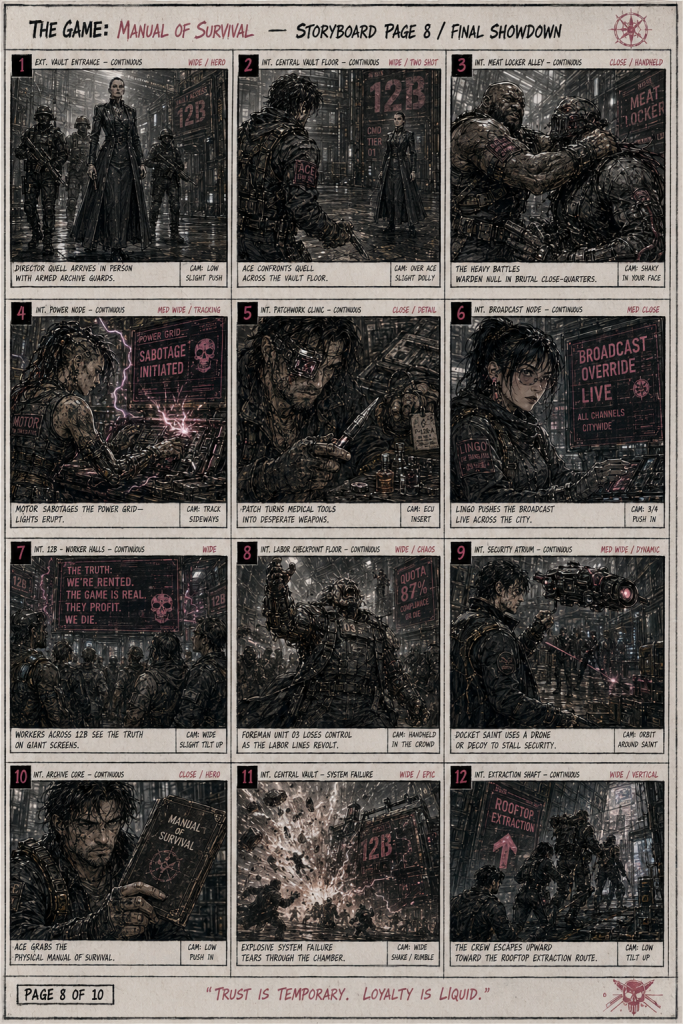


Format
Feature film, 110–125 minutes.
Genre
Punk sci-fi action satire / survival road movie / body-tech dystopia.
Core Function
The movie is the big public entry point. It introduces the world, the main crew, the body-classification system, the iced tea commercial gag, and the first version of The Manual of Survival.
Logline
After a brutal labor accident destroys his body classification, Ace Nobody joins a crew of misfit fixers, translators, designers, and broken workers to expose the body-leasing corporation that profits from turning human survival into subscription debt.
Story Engine
The movie works as a fast, explosive origin story.
Ace starts as a physical laborer who believes strength is enough. After a body-tech failure, Ace becomes legally downgraded, physically limited, and economically trapped. The company responsible refuses liability because the injury was hidden inside the fine print of an enhancement contract.
Ace meets Motor, Patch, Lingo, Soft Hammer, and Buyer’s Remorse. Together they discover that thousands of workers are being pushed into controlled injury cycles: leased body upgrades, dangerous shifts, forced repairs, debt extensions, and labor-court reclassification.
The crew’s mission becomes simple:
Steal the evidence.
Translate the contract.
Redesign the message.
Broadcast the truth.
Get out alive.
Tone
Big, loud, funny, dusty, physical, emotional.
Think of it as the version with the biggest explosions, fastest pacing, clearest character arcs, and most accessible audience hook.
Central Theme
When your body can no longer play the role assigned to you, you must learn a new game.
Key Set Pieces
- Labor Belt opening disaster
- Body Status Checkpoint escape
- Patch’s illegal clinic built inside an old vending warehouse
- Labor Court hearing turned public riot
- Desert chase through iced tea billboard fields
- Academic Port infiltration
- Final broadcast from a hijacked Refreshment Ministry tower
Ending
The crew exposes the body-leasing scandal, but the system survives by calling it an “isolated compliance failure.” Ace realizes that one victory is not enough. The final scene shows Ace writing the first line of The Manual of Survival.
Movie Tagline
You’ve got game? Survive the rules.
2. Television Series Version




THE GAME: The Game Was Always On
Format
Live-action or stylized premium television series.
8–10 episodes per season.
45–55 minutes per episode.
Genre
Serialized punk sci-fi drama / black comedy / labor conspiracy / survival ensemble.
Core Function
The television version is the deep-world version. It expands the politics, institutions, side characters, crew relationships, body classifications, trade routes, academic corruption, labor courts, and the long evolution of the manual.
Logline
In a future where bodies are legally ranked by productivity, a crew of damaged workers, translators, designers, and underground fixers builds a survival network while fighting the corporations, courts, and ministries that profit from human breakdown.
Series Structure
Each season focuses on a different layer of the game.
Season 1: Body Status
Ace loses physical status and joins the crew. The body-leasing system is exposed.
Season 2: Information Dealer
The crew becomes an underground information network. The manual begins circulating.
Season 3: Translation Wars
Academic papers, legal language, and political treaties become the new battlefield.
Season 4: Design Is Not Decoration
Buyer’s Remorse leads a counter-propaganda campaign against the Refreshment Ministry.
Season 5: Manual of Survival
The manual becomes famous, stolen, banned, copied, and weaponized.
Tone
More character-driven than the movie. More political. More room for satire, slow-burn tension, philosophical dialogue, and side stories.
Episode Formula
Each episode contains:
A body problem.
A system problem.
A language or design problem.
A commercial interruption.
A survival lesson.
A character transformation.
Television Strength
The series can show that the game is not one villain. It is a network of institutions: employers, courts, ministries, professors, brands, brokers, and desperate people making compromised choices.
Signature Device
Every episode opens with a fake lesson from The Manual of Survival, then proves, complicates, or destroys that lesson by the end.
TV Tagline
The rules were written before you were born. Learn to rewrite them.
3. Comic Trade Paperback Version


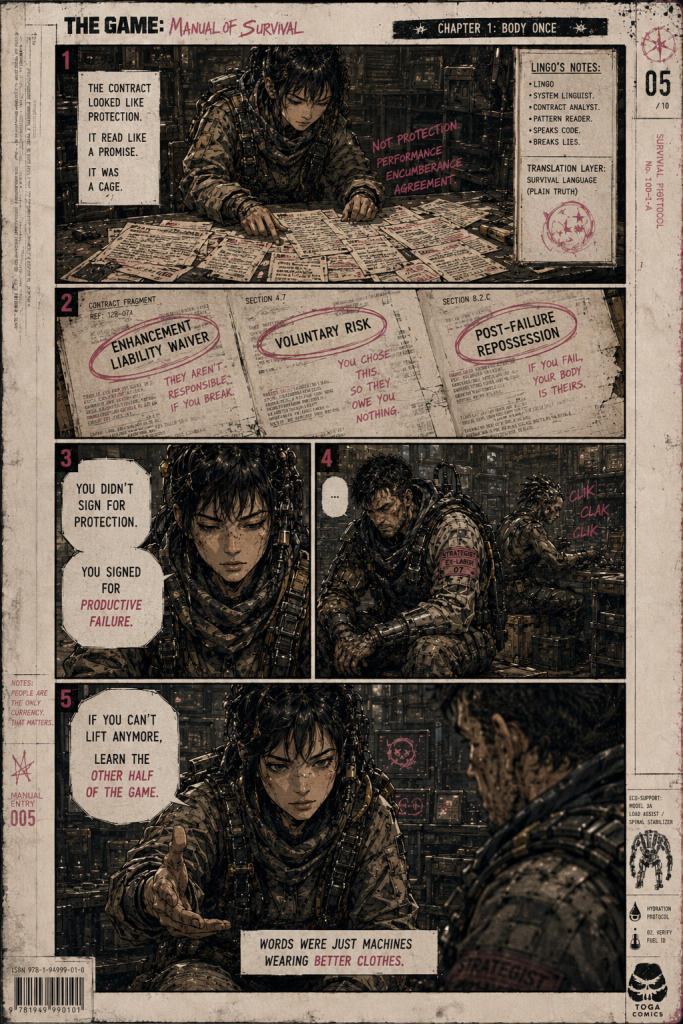


THE GAME: Manual of Survival — Volume One
Format
Graphic novel / comic trade paperback.
120–180 pages per volume.
Genre
Punk comic noir / sci-fi survival manual / visual satire.
Core Function
The comic trade paperback is the most visually experimental version. It combines story pages, fake ads, manual excerpts, body diagrams, contracts, classified files, translation notes, and propaganda posters.
Logline
After being downgraded from worker to liability, Ace Nobody enters the underground world of body-tech fixers and information dealers, where every scar is evidence and every document is a weapon.
Structure
The trade paperback is divided into chapters that feel like survival manual sections.
Chapter 1: Body Once
Ace’s injury and body-status downgrade.
Chapter 2: Subscription Spine
Patch explains the body-leasing economy.
Chapter 3: Text Lies
Lingo decodes Ace’s labor contract.
Chapter 4: Design Is a Weapon
Buyer’s Remorse redesigns the contract into a public poster workers can actually understand.
Chapter 5: Soft Hammer
The crew meets the broken labor legend.
Chapter 6: The Motor
Motor teaches Ace how to see systems.
Chapter 7: Stay Cool
The iced tea commercial motif becomes a recurring visual joke.
Chapter 8: Manual Draft
Ace writes the first public survival page.
Visual Identity
Black-and-white punk ink with bright pink warning marks, amber iced-tea commercial inserts, legal document textures, industrial diagrams, handwritten notes, and sticker-like character typography.
Special Pages
- Fake Lipton/Liptin iced tea ads
- Body classification charts
- Worker injury forms
- Exosuit diagrams
- “Understand the Motor” spreads
- Labor Court rejection notices
- Translation comparison pages
- Character field notes
Comic Strength
The comic can make every page a designed object. The reader does not just read the story; they handle the world as if it were a smuggled file.
Trade Paperback Tagline
A comic. A manual. A warning label.
4. Animation / Anime Version
THE GAME: Body Once
Format
Animated series or anime-style limited series.
12 episodes, 24 minutes each.
Genre
Stylized action anime / punk sci-fi / body-tech drama / absurdist comedy.
Core Function
The animation/anime version is the most kinetic and stylized. It pushes the body-tech action, character poses, exaggerated expressions, commercial interruptions, surreal landscapes, and emotional transformation.
Logline
In a world where body upgrades decide your social rank, a damaged laborer and a crew of illegal survival artists fight, translate, design, repair, and broadcast their way through a system that wants every human body converted into debt.
Tone
Sharper, faster, more visually extreme.
The anime version can heighten:
- Exosuit battles
- Body-status transformations
- Glitched advertisements
- Symbolic dream sequences
- Manual pages becoming animated diagrams
- Desert chase scenes
- Emotional inner monologues
- Hyper-stylized commercial breaks
Episode Arc
The anime version uses a strong season quest:
The crew must deliver a forbidden manual file across multiple zones before the Labor Courts and Refreshment Ministry erase it.
Episode Titles
- Subscription Spine
- Body Once
- The Girl Who Translated a Border
- Patch Job Messiah
- Soft Hammer Does Not Lift
- Iced Tea at the End of the World
- The Professor’s Violence
- Design Is Not Decoration
- Dealer Language
- Ghost Route
- Text Lies
- The Game Was Always On
Animation Signature
Every time a character understands a system, the visual world briefly transforms into diagrams: contracts become machinery, bodies become maps, advertisements become command structures, and language becomes architecture.
Anime Strength
The anime version can make philosophy visual. It can show thought as action.
Animation Tagline
Your body is the battlefield. Your mind is the map.
5. Soundtrack Version
THE GAME: Original Survival Soundtrack
Format
Album, score, mixtape, and in-world broadcast object.
Genre
Industrial hip-hop, punk electronics, desert dub, dirty bass, spoken word, glitch funk, outlaw radio, cinematic synth, commercial jingles.
Core Function
The soundtrack is not just music from the franchise. It is an in-world artifact. It sounds like pirate radio from the Labor Belts mixed with fake commercials, survival instructions, character voice notes, and propaganda interruptions.
Album Concept
The soundtrack is presented as a leaked broadcast from Aunt Static’s underground radio station.
Between tracks, listeners hear:
- Manual excerpts
- Body status alerts
- Fake iced tea ads
- Labor Court announcements
- Translation fragments
- Worker chants
- Patch’s repair instructions
- Motor’s philosophy
- Ace’s diary notes
Tracklist
- The Game Was Always On
Opening theme. Heavy bass, desert sirens, distorted choir. - Body Once
Slow industrial anthem about physical limitation and survival. - Subscription Spine
Mechanical percussion, exosuit hydraulics, debt-machine rhythm. - Stay Cool, Stay Sharp
Fake iced tea commercial jingle turned into a sinister dance track. - Text Lies. Motors Confess.
Motor’s theme. Minimal, mechanical, philosophical. - Translation Is Smuggling
Lingo’s theme. Multilingual vocal fragments, border-radio textures. - Soft Hammer
Heavy, emotional worker anthem. - Design Is Not Decoration
Sharp punk-electronic track with printer sounds, protest chants, and cut-up ad slogans. - Buyer’s Remorse
Sleek, cynical, commercial-pop track that slowly breaks apart. - Patch Job Messiah
Chaotic garage beat made from tools, sparks, medical scanners, and laughter. - Labor Court Lullaby
Cold bureaucratic synth, almost beautiful, deeply threatening. - Manual of Survival
Spoken word over dusty strings and low bass. - Liptin Ice Tea, Legally Refreshing
Parody commercial track. - Ghost Route
Desert dub escape theme. - You’ve Got Game?
End credits anthem.
Sound Identity
The soundtrack should feel like music built from:
Metal doors.
Vending machines.
Courtroom printers.
Exosuit hydraulics.
Ice cubes in plastic cups.
Desert wind.
Broken radios.
Worker chants.
Basslines that sound like engines.
Soundtrack Tagline
Music for workers, ghosts, dealers, designers, and damaged bodies still moving.
6. Novel Version
THE GAME: The Manual of Survival
Format
Novel, 320–420 pages.
Genre
Literary punk sci-fi / survival road novel / speculative labor satire.
Core Function
The novel is the most internal, philosophical, and emotionally detailed version. It gives access to Ace’s thoughts, the history of the world, the psychology of injury, the language of power, and the creation of the manual.
Logline
After a workplace body-tech failure strips him of his labor status, Ace Nobody joins an underground crew of misfits and begins writing a survival manual that turns his private injury into a public weapon.
Narrative Voice
First person or close third person with inserted manual fragments.
The novel should feel like a mix of confession, field report, road story, survival guide, and political joke told by someone who learned the hard way.
Structure
Part One: The Body
Ace’s labor life, injury, downgrade, shame, pain, and first encounter with the underground.
Part Two: The Crew
Ace meets Motor, Patch, Lingo, Soft Hammer, and Buyer’s Remorse. Each teaches a different survival language.
Part Three: The Text
Contracts, translations, academic papers, body files, and legal systems are revealed as machinery.
Part Four: The Motor
Ace understands that every institution has a hidden engine.
Part Five: The Manual
The crew publishes the first version of the manual. It spreads faster than they expected.
Novel Strength
The novel can explore what the body feels like after the system breaks it. It can show pain, shame, adaptation, intelligence, humor, and authorship from the inside.
Sample Opening Line
I thought the game started when I lost my body status, but that was just the first time the system bothered to tell me the score.
Novel Tagline
One body. One book. One chance to understand the machine.
Franchise Version Overview
Version
Title
Main Purpose
1. Movie
THE GAME: You’ve Got Game?
Big public origin story
2. TV Series
THE GAME: The Game Was Always On
Deep serialized worldbuilding
3. Comic Trade Paperback
THE GAME: Manual of Survival — Volume One
Visual/manual-style canon object
4. Animation/Anime
THE GAME: Body Once
High-energy stylized action version
5. Soundtrack
THE GAME: Original Survival Soundtrack
In-world pirate broadcast and music identity
6. Novel
THE GAME: The Manual of Survival
Internal, literary, philosophical version
Unified Franchise Spine
All six versions share the same core truth:
The body only comes once. The system will try to price it, rent it, break it, classify it, and sell it back to you. But the game is not only physical. The game is language, design, trade, wit, intelligence, wisdom, and legacy.
And the final lesson remains:
0 comments