

Franchise Concept Bible Outline
Working Title
“What Was That?”
Alternative Titles
Every Bump in the Night
Go Have a Look
The Terrier Wife Chronicles
Suburbia After Midnight
There’s Something in the Garden
Logline
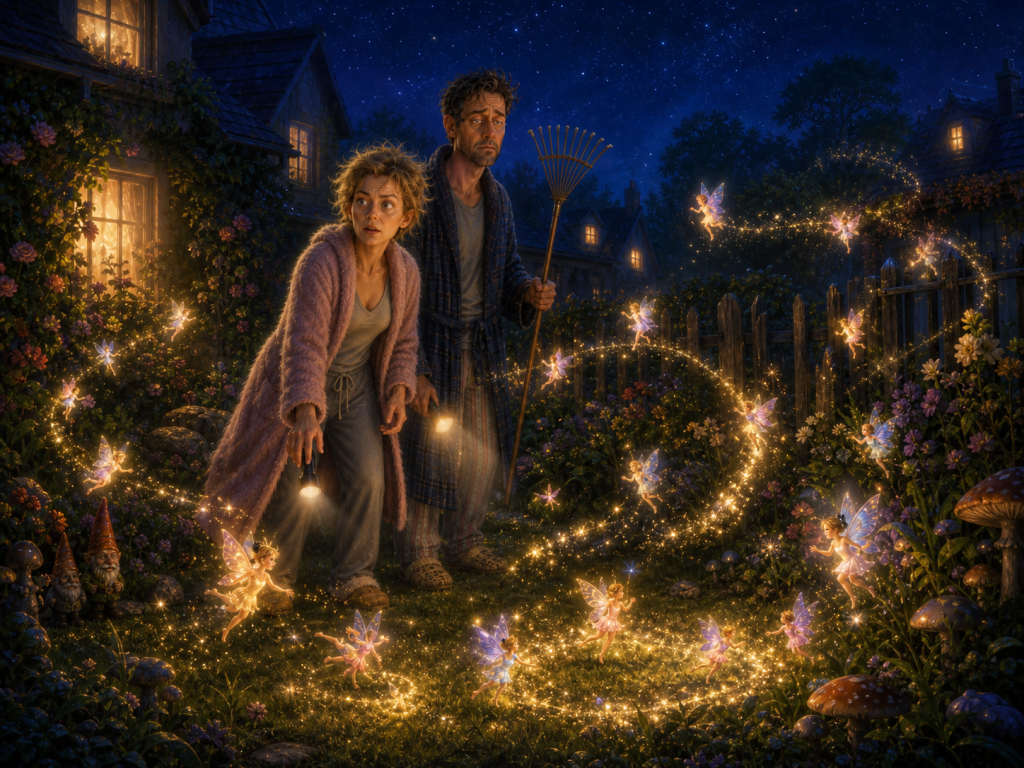
In a quiet suburban neighborhood where nothing should ever happen, a tired husband and his hyper-alert, wound-up wife are dragged into increasingly absurd midnight adventures every time she hears a noise and demands: “What was that? Go have a look.”
One night it is a raccoon. The next night it is aliens. Then gangsters. Then fairies. Then a haunted lawn gnome union. Then a dragon living inside the recycling bin.
Core Premise
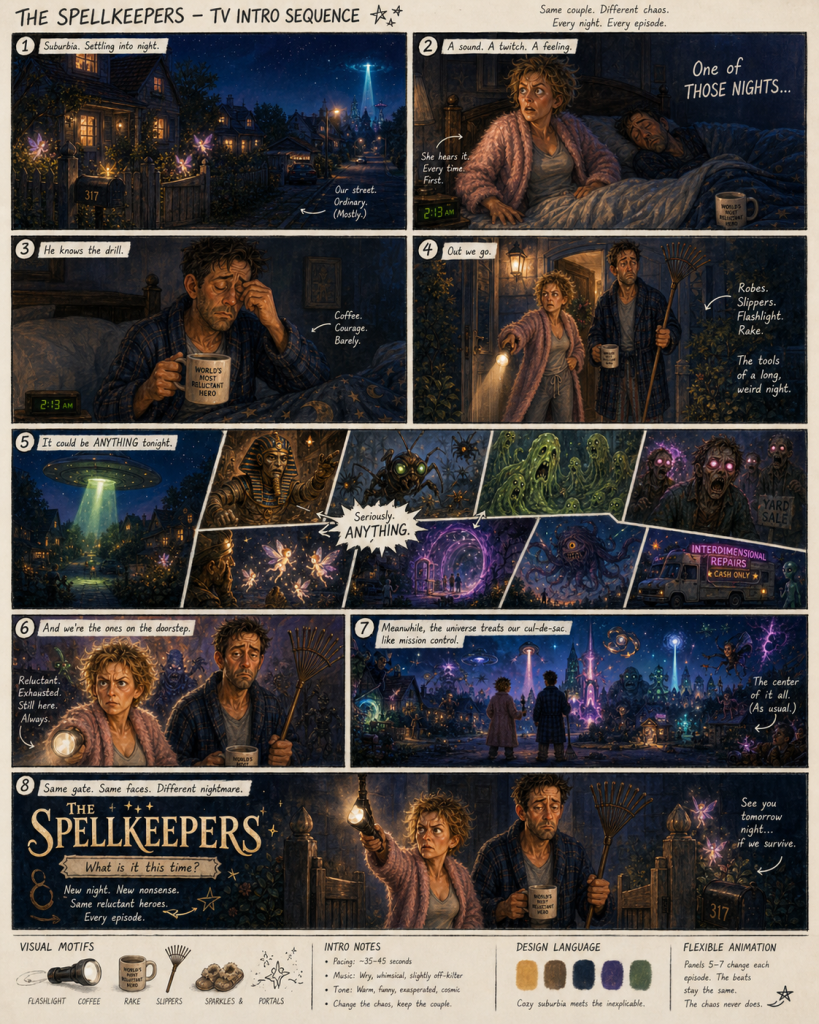
The series follows an ordinary couple living in a painfully normal suburban street. By day, everything is domestic: groceries, dishes, bins, curtains, nosy neighbors, mortgage anxiety, garden tools, badly parked cars.
By night, the house becomes a portal magnet for impossible events.
The wife has the nervous energy of a wound-up terrier. Every flicker of light, every bump, every branch tap, every distant siren triggers her alarm system.
Her husband, exhausted but loyal, becomes the designated investigator.
The repeated ritual:
“What was that?”
“Probably nothing.”
“No. No. I heard something.”
“It’s the pipes.”
“Go have a look.”
“I’m not going outside.”
“GO HAVE A LOOK.”
And then he opens the back door and finds himself staring at something insane.
Tone
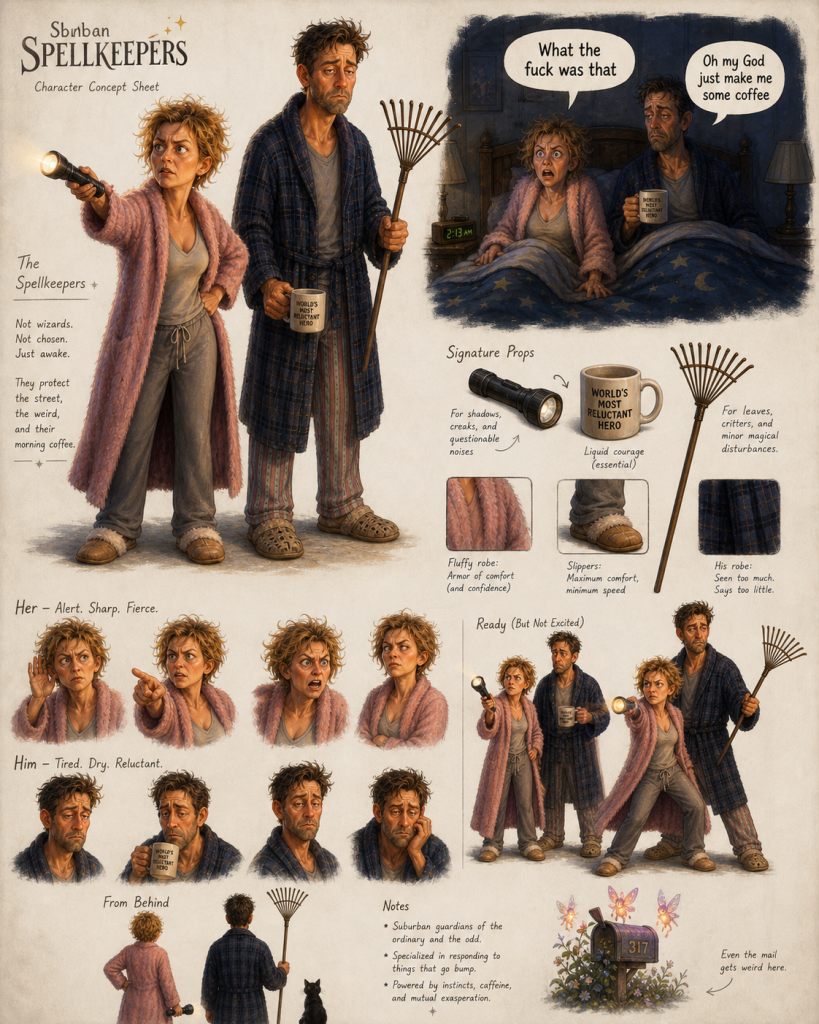
Suburban anxiety meets fantasy role-playing absurdity.
The tone should combine:
- Domestic comedy
- Magical realism
- Fantasy adventure
- Nighttime paranoia
- Relationship satire
- Creature-of-the-week chaos
- Cozy but dangerous worldbuilding
- “This should not be happening in a cul-de-sac” energy
The comedy comes from the contrast between tiny domestic problems and epic fantasy events.
Example:
The husband is trying to remember whether he put the bins out, while an alien queen is asking him to represent Earth in an intergalactic custody hearing.
Genre
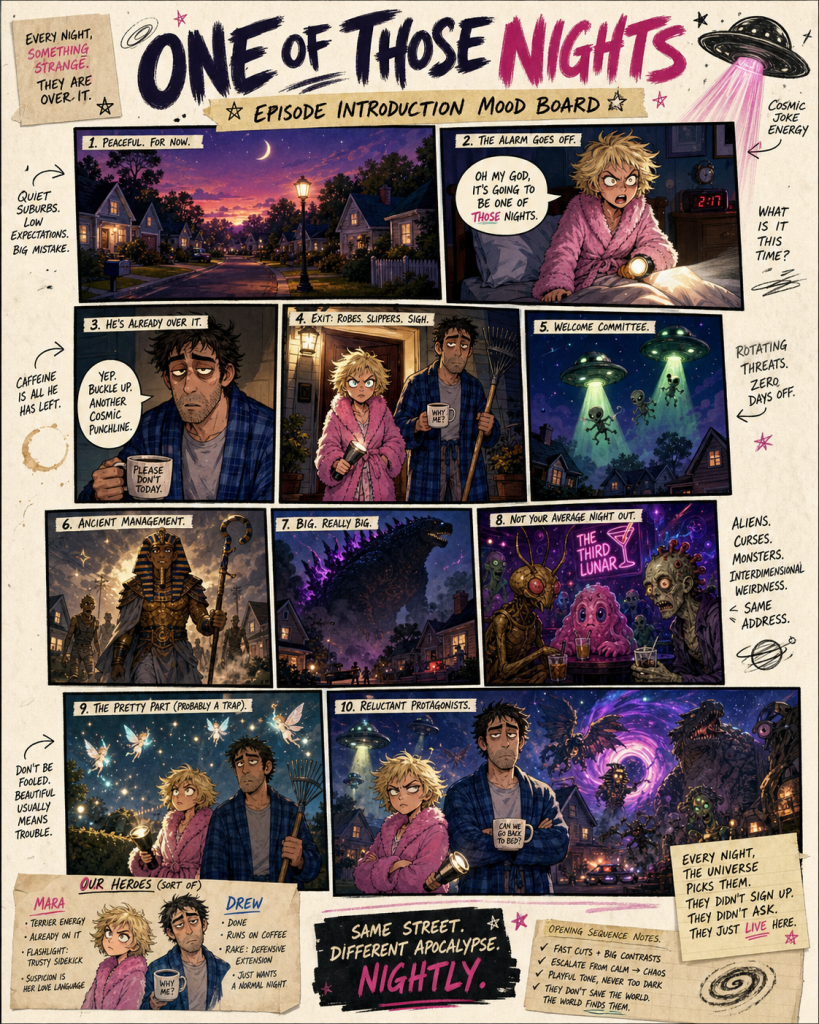
Animated fantasy sitcom / adventure comedy / suburban magical realism
Possible formats:
Animated series
22-minute episodes, with each episode beginning from a strange noise.
Children’s/YA graphic novel series
More whimsical, less adult danger, focused on magical neighborhood mysteries.
Adult animated comedy
More biting relationship humor, darker suburban satire, stranger threats.
Tabletop RPG / board game adaptation
Players investigate weird night events in a fantasy suburb.
Target Audience
Primary: older kids, teens, adults who enjoy surreal fantasy comedy.
Secondary: parents who recognize the domestic anxiety and “go check that noise” relationship dynamic.
This could work as a family-friendly concept with slightly spooky adventure, or as a sharper adult animated comedy depending on final tone.
Main Characters
The Husband
Working Name: Milo / Alf / Ben / Dave
The reluctant hero.
He is tired, practical, under-slept, and deeply suspicious of adventure. He does not want a quest. He wants a cup of tea and for everyone to stop hearing things.
Traits:
- Avoids conflict until forced into it
- Surprisingly good at surviving impossible situations
- Uses everyday logic in magical crises
- Carries slippers, flashlight, phone, and sometimes a garden rake
- Slowly becomes a local legend without wanting to
- His greatest power is deadpan common sense
Character joke:
He treats supernatural disasters like annoying household chores.
“There’s a goblin army in the shed.”
“Fine. But if they touch my extension cord, I’m calling someone.”
The Wife
Working Name: Tessa / Bibi / Nora / Pip
The wound-up terrier wife.
She is sharp, alert, restless, funny, loving, and always convinced something is happening. The tragedy is: she is usually right.
Traits:
- Hears everything
- Has explosive suspicion
- Notices patterns before anyone else
- Protects the house like a tiny guard dog
- Speaks in rapid-fire panic commands
- Often sends husband outside, then follows five seconds later
- Becomes more heroic as the story develops
Important: she should not just be “annoying.” She is the early-warning system. Her anxiety is also her superpower.
Catchphrases:
“What was that?”
“Did you hear that?”
“Go have a look.”
“No, not like that. Properly look.”
“Why is the hedge glowing?”
“I told you. I TOLD you.”
The Neighborhood
The neighborhood is basically a sleeping dragon disguised as suburbia.
Key Locations
The House
Ordinary on the outside, increasingly strange inside. Cupboards lead to pocket dimensions. The attic whispers. The basement has seasonal moods.
The Garden
The main portal zone. Mushrooms, fairy rings, buried relics, alien landing marks, mysterious holes, glowing weeds.
The Shed
The husband’s least favorite place. Contains tools, old paint, and possibly a retired warlock.
The Street
Looks normal by day. At night, it stretches, bends, loops, and sometimes leads to other kingdoms.
The Neighbor’s House
Suspiciously perfect. Lawn too neat. Curtains always twitching. They may be vampires, spies, retired elves, or just Dutch.
The Local Park
By daylight: playground and dog walkers.
By night: neutral meeting ground for creatures, spirits, raccoon smugglers, and moonlit fairy courts.
Visual World
A cozy suburban fantasy world with soft painted textures, warm windows, deep blue night skies, expressive characters, crooked fences, glowing mushrooms, and slightly oversized domestic objects.
The ordinary should feel tactile and recognizable: tiled kitchens, slippers, mugs, garden hoses, wheelie bins, cheap porch lights.
The fantasy should feel ancient, luminous, and ridiculous: floating fish, tiny knights, moth-wing fairies, alien beams, haunted topiary, raccoons wearing stolen jewelry.
Visual contrast:
Day: beige, green lawns, laundry, groceries, mundane routine.
Night: blue shadows, neon portals, glowing eyes, floating pollen, impossible silhouettes behind the hedge.
Franchise Engine
Every story begins with a noise, light, smell, shadow, object, or movement.
Episode structure:
- Quiet suburban evening
- Wife hears/sees something
- Husband dismisses it
- Wife escalates: “Go have a look”
- Husband investigates
- The impossible is real
- The couple is pulled into an absurd adventure
- Domestic logic solves a fantasy problem
- They return home exhausted
- Final tiny noise implies tomorrow will be worse
Recurring Adventure Types
Alien Abduction Night
A strange flicker in the garden turns out to be alien teenagers joyriding in a stolen saucer. The husband gets abducted in his bathrobe and must negotiate the return of his lawn furniture from a galactic pawn market.
Gangster Drive-By
A black car rolls through the cul-de-sac and sprays magical bullets at the hedge. It turns out to be a turf war between goblin mobsters and fairy debt collectors over stolen moon-sugar.
Light Fairy Dance
Tiny glowing fairies appear above the bins, dancing beautifully. The wife is enchanted. The husband suspects they are casing the house. Both are correct.
The Shed Knight
A miniature knight has been living behind the lawnmower for six years, guarding a cursed screwdriver.
The Hedge Is Breathing
The hedge becomes a sleeping forest creature that has been trimmed into submission for decades and now wants revenge.
The Bin Portal
The recycling bin opens into a kingdom where all lost socks, broken chargers, and old batteries go to become gods.
The Skunk Prophet
A skunk appears every full moon and predicts disaster through smell patterns.
The Cul-de-Sac Ritual
All the neighbors gather at 3:00 AM wearing robes. They claim it is the neighborhood watch.
The Cat Knows
The household cat has been leading a double life as a diplomatic envoy between the human world and the attic spirits.
Core Themes
Marriage as Adventure
The couple bickers, panics, blames each other, and still survives together. The love is in the irritation.
Anxiety as Perception
The wife’s jumpiness is not weakness. She notices what everyone else ignores.
Ordinary Life Is Already Weird
Suburbia is not boring. It is full of rituals, hidden conflicts, strange neighbors, buried histories, and monsters disguised as chores.
Reluctant Heroism
The husband becomes brave not because he wants glory, but because someone has to check the noise.
The Home as a Magical Boundary
The house is their fortress. Every adventure tests what “home” means.
Relationship Dynamic
The heart of the franchise is the couple’s rhythm.
She is alert.
He is tired.
She is right.
He is annoyed.
They both panic.
They both improvise.
They both survive.
Their arguments should be funny but affectionate.
Example dialogue:
Wife: Did you hear that?
Husband: I heard you hearing that.
Wife: It came from the garden.
Husband: Everything comes from the garden. That’s where outside is.
Wife: Go have a look.
Husband: Last time I had a look, I joined a frog monarchy.
Wife: Take the rake.
Season One Arc
Season Theme
The couple slowly discovers their suburb was built on top of an ancient crossing point between worlds.
Every weird event is not random. The neighborhood is waking up.
Episode Arc
At first, each night seems unrelated: aliens, fairies, gangsters, ghosts, goblins. But clues build:
- Symbols appear under wallpaper
- The garden mushrooms form maps
- The streetlights blink in patterns
- The same black cat appears in every crisis
- The neighbors know more than they admit
- The wife’s hearing may be connected to the crossing point
- The husband may have accidentally signed an ancient contract by accepting a parcel
Season Finale
The entire cul-de-sac lifts out of reality and becomes a floating island between worlds. The couple must host an emergency neighborhood meeting while dragons, aliens, fairies, gangsters, and garden spirits argue over ownership rights.
The wife finally says:
“See? I told you something was wrong.”
Episode Ideas
Episode 1: “What Was That?”
A noise behind the bins leads to a tiny alien crash site. The alien insists the husband is now legally its mechanic.
Episode 2: “The Flicker”
The porch light flickers in Morse code. Something inside the bulb is trying to warn them.
Episode 3: “Go Have a Look”
The husband refuses to investigate, so the wife goes instead and is crowned queen of the moth fairies.
Episode 4: “The Drive-By”
A gangster car shoots at the garden gnome. The gnome shoots back.
Episode 5: “The Shed Has Rules”
The shed refuses entry unless the husband answers three riddles about power tools.
Episode 6: “Neighborhood Watch”
The local neighborhood app becomes possessed and starts reporting crimes from the future.
Episode 7: “The Light Dance”
Fairies dance in the garden, but every dance step rearranges reality inside the house.
Episode 8: “Abducted”
The wife is abducted by aliens because her hearing makes her valuable as a cosmic radar system.
Episode 9: “The Thing in the Wall”
A scratching sound turns out to be a tiny civilization living inside the insulation.
Episode 10: “Bin Night”
The bins must be placed in the correct ritual order or the street is swallowed by a trash dimension.
Episode 11: “The Terrier Signal”
The wife’s nervous energy activates an ancient defense spell buried under the patio.
Episode 12: “Cul-de-Sac at the End of the World”
The street detaches from Earth and drifts into the fantasy borderlands.
Creature & Faction Bible
The Fairies
Beautiful, glowing, petty, bureaucratic. They dance, steal names, file complaints, and weaponize glitter.
The Alien Visitors
Not majestic invaders. More like irresponsible tourists, teenagers, insurance agents, and cosmic surveyors.
The Goblin Gangsters
Drive tiny black cars, wear sharp suits, deal in cursed garden ornaments and stolen luck.
The Lawn Spirits
Ancient beings trapped beneath trimmed grass. They hate sprinklers.
The Gnomes
Not cute. Organized. Unionized. Possibly militant.
The Raccoon Syndicate
Trash thieves with aristocratic manners.
The Night Birds
Owls, crows, and magpies that act as messengers, spies, and judges.
The Neighbors
Every neighbor has a secret. Some are supernatural. Some are just weird, which may be worse.
Franchise Format Possibilities
Animated Series
Best main format. Strong recurring joke engine and expandable world.
Picture Book Series
For a softer children’s version:
“What Was That in the Garden?”
Each book reveals a different magical visitor.
Graphic Novels
Allows larger worldbuilding, maps, factions, and visual gags.
Tabletop RPG
Players are suburban residents investigating strange noises, protecting the street, and managing household chores during supernatural events.
Video Game
A cozy investigation adventure game. Explore house, garden, street, shed, attic, and dream portals. The wife hears clues; the husband investigates. Players solve absurd domestic-fantasy puzzles.
Game Concept
Title
Go Have a Look
Gameplay Loop
- Hear a noise
- Choose equipment: flashlight, rake, slippers, biscuits, phone, umbrella
- Investigate location
- Identify threat
- Negotiate, flee, repair, trick, or accidentally worsen situation
- Return home before sunrise
- Upgrade house defenses and relationship trust
Mechanics
- Wife acts as radar system
- Husband performs investigation
- Noise map shows suspicious zones
- Domestic inventory solves fantasy problems
- Choices affect neighbors and factions
- The garden evolves over time
Merchandising Potential
- “What Was That?” mugs
- “Go Have a Look” slippers
- Flashlight/rake hero kit
- Garden gnome figures
- Glowing fairy night lights
- Suburban fantasy map posters
- Plush alien in bathrobe
- Talking wife button: “Did you hear that?”
- Board game: Cul-de-Sac of Doom
Brand Taglines
Every quiet street has a secret.
Every noise is a quest.
Marriage. Mortgage. Monsters.
He checks the garden. The universe checks back.
Suburbia is louder after midnight.
She heard it first. He regretted it later.
Core Pitch
“What Was That?” is a suburban fantasy comedy about marriage, anxiety, and the terrifying possibility that the strange noise outside really is something.
It turns the most ordinary domestic sentence — “Go have a look” — into the launchpad for endless adventures. One night it is aliens. One night it is fairy politics. One night it is goblin gangsters. But underneath the absurdity is a warm emotional core: two people trying to protect their home, their peace, and each other in a world that refuses to stay normal.
0 comments