That little three-by-three grid, one through nine, with zero sitting underneath like the bass note at the bottom of the machine. Ten circles. Ten pressure points. Ten little portals pretending to be numbers.
But anonymize the labels and suddenly it is no longer a keypad.
It is a drum machine.
A beat patch.
A rhythm grid.
A tiny MPC for your bank card.
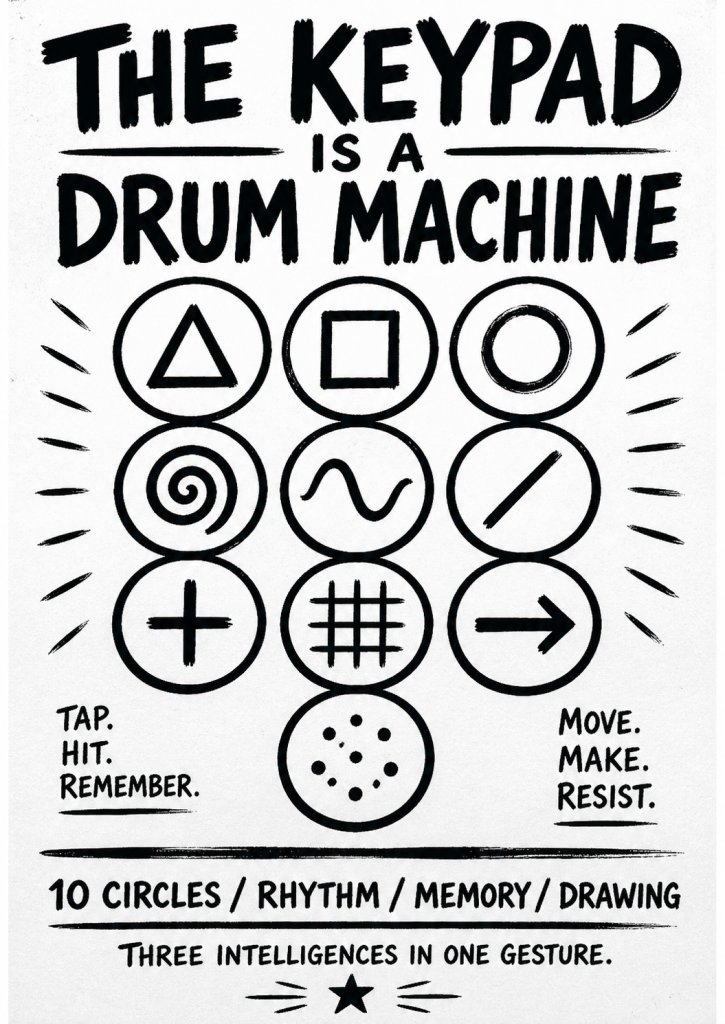
You do not only remember your PIN as numbers. You can remember it as a rhythm: tap, pause, tap-tap, drop. You can remember it as a movement: up, down, diagonal, corner, center. And you can remember it as a drawing: because every four-digit code becomes a line, a gesture, a tiny invisible illustration traced across the pad.
So entering a PIN is not just “typing numbers.”
It is three intelligences at once:
Numerical intelligence — remembering the code as digits.
Musical intelligence — remembering the code as a beat.
Visual-spatial intelligence — remembering the code as a shape, a route, a little drawing your finger performs.
The ATM asks for a secret.
Your body answers with choreography.
Your memory does not sit in one place. It spreads across rhythm, pattern, muscle, number, and image. A code becomes a song. A song becomes a map. A map becomes a gesture. And the gesture opens the machine.
That is the strange little genius of the keypad:
a security system disguised as a drum pad,
a drawing tool disguised as a calculator,
a memory palace disguised as ten plastic buttons.
0 comments