
FATBLADE EV
Franchise Bible
Micro-electric motorcycles between cruiser muscle, sportbike precision, and desert range survival
1. Core franchise statement
FATBLADE EV is a micro-electric motorcycle franchise built around one brutal idea:
Small electric footprint. Big road presence.
It takes the visual weight and authority of a Harley-Davidson Fat Boy, the aerodynamic control and technical sharpness of a Honda CBR, and the desert survival logic of KTM adventure/rally machines, then compresses all of that into a new class of accessible electric motorcycles priced between €10,000 and €15,000.
This is not a luxury EV motorcycle for collectors.
This is not a scooter.
This is not a green lifestyle toy.
It is a street weapon, commuter machine, desert scout, fashion object, and micro-EV platform.
The franchise exists at the intersection of:
Motorcycle culture
EV mobility
Tuning culture
Streetwear
Adventure travel
Urban rebellion
Affordable future tech
2. Franchise title
Main brand name
FATBLADE EV
Full concept name
FATBLADE EV: Micro Electric Power Motorcycles
Internal slogan
Cruiser soul. Sportbike teeth. Desert lungs.
Public slogans
Ride heavy. Move light.
The micro-EV with motorcycle blood.
Silent torque. Loud presence.
Built for asphalt, dust, neon, and survival.
Not a scooter. Not a superbike. A new animal.
3. The core product idea
FATBLADE is a shared-platform electric motorcycle family.
The same central chassis, motor architecture, electronics, and battery platform are used across three core models:
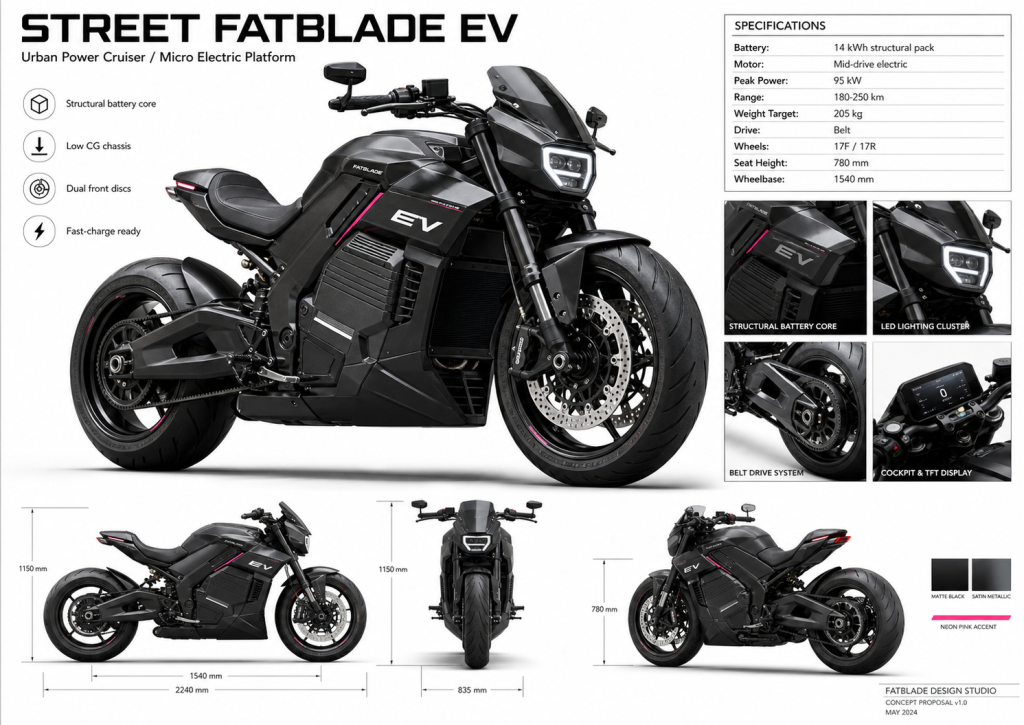
- Fatblade Street — urban power cruiser
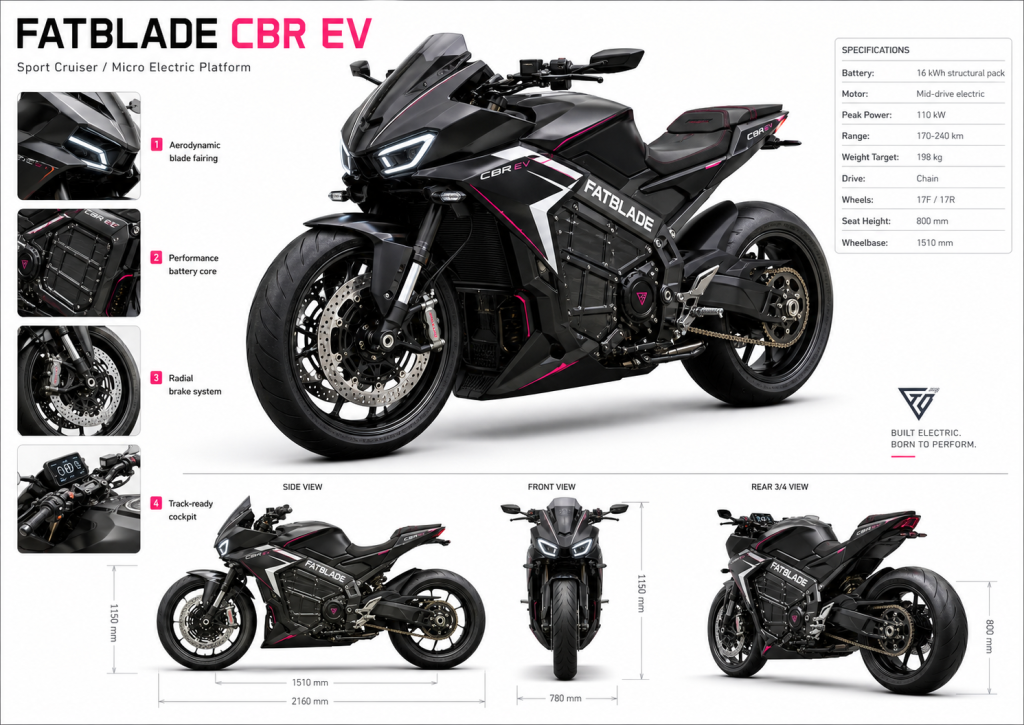
- Fatblade CBR — sport cruiser
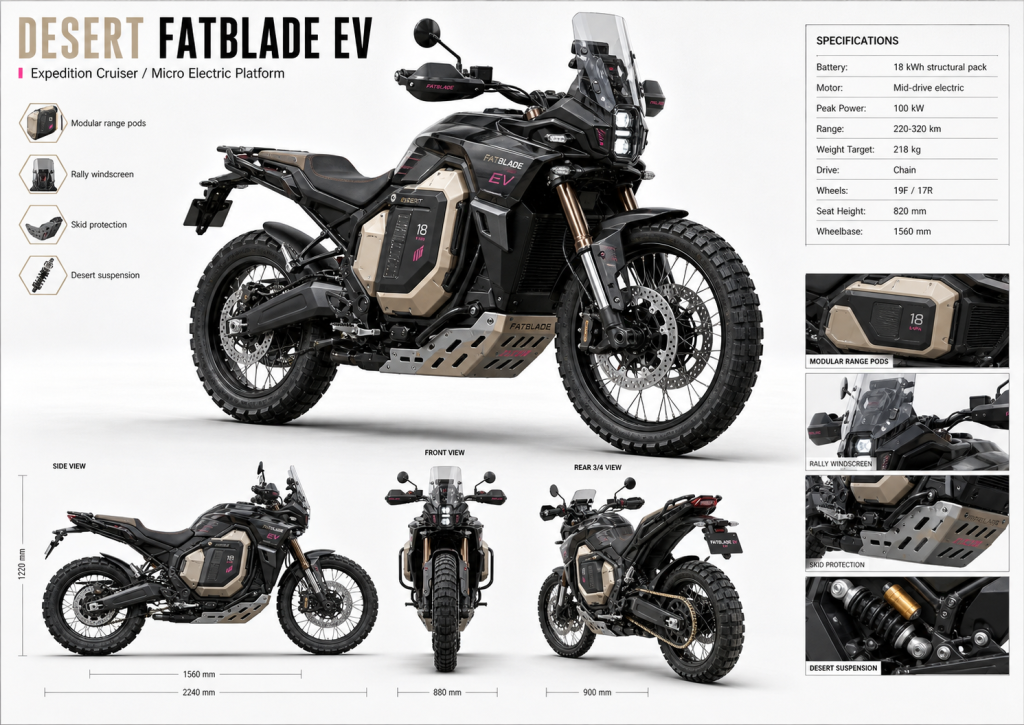
- Fatblade Desert — adventure explorer
Each model is priced inside the €10k–€15k bracket, making the franchise feel like a serious retail brand, not a fantasy hyperbike project.
Core price ladder
Model
Position
Retail target
Fatblade Street
Urban power cruiser
€10,499
Fatblade CBR
Sport cruiser
€12,499
Fatblade Desert
Adventure explorer
€14,999
The whole franchise depends on one commercial truth:
Make the bike feel like €25,000, but build it like a smart €10k–€15k micro-EV platform.
4. Franchise category
New vehicle category
Micro Electric Power Motorcycle
Not e-bike.
Not e-moped.
Not scooter.
Not full-size electric superbike.
A Micro Electric Power Motorcycle is:
- Compact enough for cities
- Strong enough for highways
- Stylish enough for tuning culture
- Modular enough for adventure
- Affordable enough for mass culture
- Aggressive enough to carry a franchise identity
The word “micro” does not mean weak.
It means:
right-sized
battery-efficient
modular
urban-ready
less wasteful
platform-based
The bikes are meant to look muscular, but their technical philosophy is lean.
5. Franchise DNA
The three bloodlines
1. Cruiser blood
From cruiser culture, FATBLADE takes:
- Low stance
- Large visual mass
- Thick tires
- Torque-first riding
- Comfortable authority
- Strong silhouette
- Rider-as-character energy
The rider should feel like they are not “on” the bike but inside the machine’s attitude.
2. Sportbike blood
From sportbike culture, FATBLADE takes:
- Sharp nose
- Aerodynamic side blades
- High braking confidence
- Strong cornering geometry
- Aggressive cockpit
- Digital display
- Performance credibility
The bike must never feel lazy.
It should be cruiser-looking, but not cruiser-sloppy.
3. Desert blood
From desert/adventure motorcycles, FATBLADE takes:
- Long-range thinking
- Suspension travel
- Skid protection
- Serviceable parts
- Modular storage
- Dust protection
- Survival accessories
- Off-road visual credibility
The desert model especially should feel like a bike that can survive after the city ends.
6. Product family
Model 1: FATBLADE STREET
Position
Urban power cruiser.
Price
€10,499
Personality
The Street is the entry icon. It is the cleanest, most urban, most fashion-friendly FATBLADE.
It is designed for:
- Commuters
- Night riders
- City cruisers
- Tuning culture
- First serious EV motorcycle buyers
- Riders who want presence without superbike pricing
Design character
Low, wide, black, clean, compact.
It should look like a miniature cyber-Fatboy with CBR tension in the front.
Technical sheet
Feature
Target
Motor
Mid-drive permanent magnet
Peak power
70–90 kW
Torque
240–280 Nm system target
Battery
12–14 kWh
Range
170–230 km mixed
Charging
Type 2 / fast-charge compatible where possible
Drive
Belt
Wheels
17F / 17R
Seat height
760–790 mm
Weight
185–205 kg
Top speed
150–170 km/h
0–100 km/h
4.0 seconds target
Riding modes
Eco / City / Sport / Custom
Core features
- LED square headlight
- Low center of gravity
- Wide rear tire
- Minimal windscreen
- Belt drive
- Phone app
- Keyless ride
- Regenerative braking
- Reverse assist
- Walk mode
- Optional neon accent kits
Colorways
- Matte Black
- Arctic White
- Neon Pink
- Chrome Shadow
- White Tiger Edition
- Rubber Black Edition
Brand role
The Street is the volume seller.
It must be affordable, iconic, easy to recognize, and easy to customize.
Model 2: FATBLADE CBR
Position
Sport cruiser.
Price
€12,499
Personality
The CBR version is the sharper, faster, more aerodynamic brother. It keeps the cruiser body mass but introduces a sportbike nose, improved suspension, sharper steering, and more performance-oriented rider ergonomics.
It is designed for:
- Fast commuters
- Sportbike riders who want EV torque
- Younger riders entering performance culture
- Highway users
- Brand ambassadors
- Content creators
- Track-day-adjacent street riders
Design character
More blade, less bulk.
Where the Street is black muscle, the CBR is aerodynamic violence.
Technical sheet
Feature
Target
Motor
Mid-drive permanent magnet
Peak power
90–100 kW
Torque
280–320 Nm system target
Battery
14–16.5 kWh
Range
200–260 km mixed
Charging
Faster DC-compatible target
Drive
Belt or reinforced chain
Wheels
17F / 17R
Seat height
790–810 mm
Weight
195–210 kg
Top speed
180–200 km/h
0–100 km/h
3.2–3.8 seconds target
Riding modes
Eco / Rain / Road / Sport / Track / Custom
Core features
- CBR-inspired sport fairing
- Aggressive front lighting
- Semi-active suspension option
- Cornering ABS and traction control
- Stronger dual front brakes
- Aero side blades
- Sport cockpit
- Quick-shift-style throttle mapping
- Adjustable regen
- Tire pressure monitoring
Colorways
- Stealth Grey
- Pearl White
- Neon Pink
- Carbon Black
- Asphalt Orange
- Blackpink Track Edition
Brand role
The CBR is the poster bike.
It attracts attention, makes the franchise look serious, and gives the brand speed credibility.
Model 3: FATBLADE DESERT
Position
Adventure explorer.
Price
€14,999
Personality
The Desert is the most expensive and most world-building-friendly model. It turns the micro-EV platform into a survival bike.
It is the model that gives FATBLADE myth.
It is designed for:
- Adventure riders
- Rural riders
- Camping culture
- Desert routes
- Forest roads
- Long-range commuters
- Overlanding enthusiasts
- Military/survival aesthetic fans
- Touring riders who do not want a giant motorcycle
Design character
A cyber rally cruiser.
Thicker suspension. Taller stance. Rally screen. Skid plate. Battery side pods. Hard luggage. Dust armor.
It should look like the motorcycle equivalent of a black desert insect.
Technical sheet
Feature
Target
Motor
Mid-drive permanent magnet
Peak power
80–95 kW
Torque
300–340 Nm system target
Battery
16–18 kWh base
Optional pods
2 × 3–4 kWh
Range
190–260 km base / 300–400 km extended
Drive
Chain
Wheels
19F / 17R
Seat height
810–840 mm
Weight
210–225 kg base / 235–245 kg with pods
Top speed
150–165 km/h
0–100 km/h
3.8–4.4 seconds target
Riding modes
Eco / Explorer / Offroad / Rally / Custom
Core features
- Long-travel suspension
- 19-inch front wheel
- Dual-sport tires
- Skid plate
- Crash bars
- Modular side battery pods
- Handguards
- Rally screen
- GPS/SOS module option
- Solar trickle accessory
- Low-speed crawl mode
- Limp-home energy reserve mode
- Dust-sealed electronics
Colorways
- Sandstorm Beige
- Graphite Black
- Hazard Orange
- Arctic White
- Military Grey
- Desert Pink
Brand role
The Desert is the myth machine.
It expands the brand from product to lifestyle: maps, routes, camping gear, film content, survival kits, desert events, and long-range EV culture.
7. Technical platform philosophy
Shared platform
The franchise should be developed around one modular architecture.
Shared across all models
- Main frame
- Battery core
- Motor family
- Controller architecture
- Display unit
- App ecosystem
- Charging interface
- Lighting electronics
- Brake architecture
- Core software
- Rear subframe mounting points
Model-specific parts
- Fairings
- Suspension travel
- Wheels
- Tires
- Seat shape
- Handlebar geometry
- Luggage systems
- Battery pod compatibility
- Windscreen
- Skid protection
- Brake tuning
- Riding mode calibration
This keeps retail pricing believable.
The trick is to create three emotional products from one industrial platform.
8. Battery doctrine
The problem
Electric motorcycle range is difficult because motorcycles have limited battery space and poor aerodynamic efficiency at high speed.
So FATBLADE should not pretend to solve physics with marketing.
Instead, the brand should be honest:
Range is a system. Not just a number.
The solution
FATBLADE range comes from five systems:
- Right-sized battery
- Aerodynamic bodywork
- Regenerative braking
- Smart riding modes
- Optional modular energy pods
Battery architecture
Base pack
A structural battery block mounted low and central.
This battery is visually treated as the “engine” of the motorcycle.
Pod batteries
Optional side modules inspired by desert rally fuel tanks.
These pods should be:
- Removable
- Lockable
- Crash-protected
- Serviceable
- Software-recognized
- Balanced left/right
- Usable as emergency auxiliary range
Energy modes
Eco
Maximum range, soft acceleration, high regen.
City
Responsive but efficient.
Sport
Maximum torque response, reduced regen drag.
Rain
Soft throttle, high traction control.
Explorer
Range-conscious adventure mode.
Offroad
ABS and traction behavior adapted for loose surfaces.
Rally
High power, loose-surface slip allowance, controlled regen.
Limp Home
Emergency low-speed reserve mode.
9. Rider experience
Emotional target
The rider should feel:
- Strong
- Protected
- Fast
- Modern
- Slightly illegal
- Visibly different
- Part of a new category
The bike should make no engine noise, but it should not feel polite.
Its silence should feel dangerous.
Sound identity
Since EVs are quiet, FATBLADE needs a controlled sound language.
Not fake engine noise.
Instead:
- Low electronic startup pulse
- Subtle turbine-like acceleration tone
- Safety pedestrian sound below city speed
- Optional sound profiles
- Turn signal ticks with mechanical quality
- Boot-up sound like a machine waking up
The sound should be minimal, not childish.
Display experience
The dashboard should be simple and severe.
Main display modes:
- Speed
- Range
- Battery percentage
- Riding mode
- Regen level
- Motor temperature
- Navigation
- Charging status
- Pod battery status
- Tire pressure
- Service warnings
Graphic style:
- Black background
- White typography
- Neon pink highlights
- Orange warning states
- Minimal icons
- High contrast
- Large readable UI
10. Visual identity
Core visual language
FATBLADE is:
black metal
white light
neon pink signal
sand/desert survival
rubber texture
industrial concrete
blade geometry
fat-tire mass
Logo direction
The logo should be heavy, condensed, and angular.
It should feel like:
- Motorcycle badge
- Racing decal
- Streetwear wordmark
- EV tech brand
- Military stencil
Typography
Primary type style
Condensed bold uppercase.
Used for:
- Logo
- Model names
- Posters
- Tank/battery graphics
- Apparel
Secondary type style
Clean technical sans-serif.
Used for:
- Technical sheets
- UI
- Website
- Manuals
- Spec tables
Accent typography
Handwritten marker/graffiti style for limited editions, apparel, event posters, and underground culture drops.
Color system
Core palette
Color
Role
Matte Black
Main brand body
Arctic White
Contrast and racing panels
Neon Pink
Signal/accent identity
Graphite Grey
Technical surfaces
Sand Beige
Desert model identity
Hazard Orange
Adventure warning/accent
Chrome/Satin Metal
Premium mechanical detail
Signature graphic elements
- Fat diagonal blade stripe
- Neon pink micro-line
- White EV block lettering
- Black battery monolith
- Desert pod graphic
- Square LED face
- Tire-track pattern
- Topographic desert lines
- Circuit-board map pattern
- Warning-label decals
11. Industrial design rules
Rule 1: The battery is the engine
Never hide the battery completely.
The central battery block must be a visual icon.
Rule 2: Fat silhouette, sharp details
The overall bike may be broad and heavy-looking, but the details must be sharp.
Rule 3: No cute EV language
Avoid soft eco-friendly design.
No bubbly shapes.
No friendly scooter cues.
No “green leaf” symbolism.
Rule 4: The headlight is the face
The square LED headlight is the signature.
It should feel like a robot animal staring forward.
Rule 5: Modular parts must look intentional
Side pods, luggage, screens, crash bars, and skid plates must look native to the bike, not aftermarket.
Rule 6: Pink is a weapon, not decoration
Neon pink should be used as signal energy:
- Lines
- Brake accents
- UI highlights
- Apparel details
- Limited-edition decals
Never overuse it.
12. Apparel franchise
FATBLADE is not just a motorcycle product.
It should have a full fashion/tuning ecosystem.
Apparel categories
1. Tracksuits
The tracksuit is the hero garment.
Initial examples:
- White Tiger Tracksuit
- Neon Pink Zebra Tracksuit
- Rubber Black Tracksuit
- Desert Dust Tracksuit
- Chrome Shadow Tracksuit
- Hazard Orange Rally Tracksuit
2. Riding jackets
Armored but fashion-first.
Styles:
- Cruiser bomber
- Sport shell jacket
- Desert utility jacket
- Rubberized rain jacket
- Reflective night jacket
3. Gloves
- Short urban gloves
- Sport gloves
- Desert gloves
- Pink-accent night gloves
4. Helmets
Helmet line should include:
- Matte black full-face
- White tiger shell
- Neon pink zebra shell
- Desert rally helmet
- Chrome visor edition
5. Bags
- Charging cable sling bag
- Battery-pod-inspired backpack
- Helmet duffel
- Desert roll bag
- Magnetic tank/battery bag
- Side-pod utility cases
6. Footwear
- Riding sneakers
- Armored boots
- Desert boots
- Rubber rain boots
- Neon sole editions
13. Customization system
Customization is central to the franchise.
Factory customization
Customers can choose:
- Main body color
- Accent stripe
- Seat finish
- Wheel finish
- Headlight ring color
- Decal pack
- Display theme
- Sound profile
- App skin
Dealer customization
Dealers can install:
- Luggage racks
- Battery pods
- Windscreens
- Crash bars
- Tire packages
- Heated grips
- Extra lighting
- Seat upgrades
- Charging accessories
Community customization
The brand should support:
- Vinyl wraps
- Limited graphic kits
- Apparel-matching bike skins
- User-submitted design contests
- Seasonal color drops
- Artist editions
Signature customization packs
BLACKPINK Pack
Matte black base, neon pink lines, white EV lettering.
WHITE TIGER Pack
White base, black tiger striping, pink micro-accent.
NEON ZEBRA Pack
Pink/black zebra pattern, night-ride visibility theme.
DESERT GHOST Pack
Sand beige, white panels, orange hazard markings.
RUBBER Pack
All-black satin/rubberized texture, minimal decals.
CHROME NIGHT Pack
Satin metal, black frame, dark visor details.
14. Media universe
FATBLADE should be franchiseable as content.
Core media tone
The world of FATBLADE is not clean sci-fi.
It is:
- Urban
- Industrial
- Dusty
- Nocturnal
- Concrete-heavy
- Neon-lit
- Road-worn
- Stylish
- Slightly dystopian
- But still accessible
Brand world
A near-future Europe where cities are overcrowded, fuel culture is fading, and people need smaller, smarter, more expressive machines.
The FATBLADE riders are not superheroes.
They are:
- Couriers
- Designers
- mechanics
- tuners
- night workers
- desert travelers
- streetwear kids
- ex-sportbike riders
- urban survivalists
- EV rebels
Possible documentary series
Ride Heavy, Move Light
A branded series following riders who use micro-EV motorcycles in real life:
- City commuting
- Desert tests
- Charging challenges
- Custom builds
- Fashion drops
- Tuning meets
- Long-range rides
- Night photography
Possible fictional series
FATBLADE: Silent Roads
A grounded action/drama world about electric motorcycle couriers, desert routes, underground EV races, and the culture around modified micro-EV machines.
Not superhero.
Not cyberpunk cliché.
More like road-culture realism with sharp design.
15. Community and events
Event formats
1. FATBLADE Night Runs
Urban night rides through major cities.
Focus:
- LED visuals
- black/pink styling
- photography
- safe group riding
- music
- streetwear
2. Desert Range Trials
Adventure rides testing range, terrain, and modular battery pods.
3. Micro-EV Tuning Meets
Events for e-motorcycles, e-mopeds, e-bikes, and custom EVs.
FATBLADE becomes the premium middle category.
4. Silent Rally
A long-distance EV ride event where the challenge is not noise or speed, but navigation, efficiency, and endurance.
5. Apparel Drop Nights
Bike reveal + fashion show + limited merchandise.
6. Dealer Build-Offs
Dealers customize Fatblade bikes and compete for best build.
16. Digital ecosystem
FATBLADE app
The app is not optional branding. It is part of the motorcycle experience.
App features
- Battery status
- Charging status
- Range estimate
- Route planner
- Charging station integration
- Riding mode customization
- Anti-theft tracking
- Service reminders
- Firmware updates
- Ride logs
- Community events
- Apparel drops
- Customization marketplace
Rider profile
Each rider has a digital garage:
- Bike model
- Colorway
- Accessories
- Range stats
- Ride history
- Badges
- Community photos
- Custom skin previews
Digital economy
The franchise can sell:
- Display themes
- Sound profiles
- Navigation skins
- Limited graphics
- Apparel-linked UI packs
- Event passes
- Route packs
- Service subscriptions
17. Retail and dealership experience
Store concept
The FATBLADE retail environment should feel like:
motorcycle showroom × streetwear store × tuning garage × EV lab
Not a sterile car dealership.
Materials
- Concrete
- Black steel
- LED strips
- Rubber flooring
- White spec boards
- Pink accent lighting
- Tool walls
- Apparel racks
- Charging demo stations
Customer zones
- Bike display zone
- Customization wall
- Apparel wall
- Charging education zone
- Test-ride booking desk
- Service/upgrade counter
- Owner community board
Sales logic
The customer should not just buy a bike.
They should choose:
- Model
- Colorway
- Range package
- Apparel pack
- Helmet pack
- Charging pack
- App profile
- First event invitation
18. Launch strategy
Phase 1: Concept reveal
Release three hero models:
- Street
- CBR
- Desert
Show them as a complete family immediately.
Do not reveal only one model.
The franchise depends on the triangle.
Phase 2: Apparel-first hype
Before full production, launch:
- White Tiger Tracksuit
- Neon Pink Zebra Tracksuit
- Rubber Black Tracksuit
- Helmets
- Gloves
- Posters
- Digital wallpapers
This lets the brand build culture before vehicle delivery.
Phase 3: Prototype road content
Film:
- City night ride
- Highway sport test
- Desert range test
- Charging sequence
- Custom garage build
- Apparel shoot
Phase 4: Reservation campaign
Offer:
- €100 refundable reservation
- Founder’s Edition badge
- Limited color priority
- Apparel discount
- First event access
Phase 5: First production models
Launch the Street first.
Then CBR.
Then Desert.
Reason:
The Street is the easiest to manufacture and sell at volume.
The CBR builds performance credibility.
The Desert creates myth and higher-margin accessories.
19. Model roadmap
Year 1
- Fatblade Street
- Apparel drop 01
- Helmet line
- App beta
- Night Run events
Year 2
- Fatblade CBR
- Performance accessories
- Sport apparel line
- Dealer customization packs
- First owner festival
Year 3
- Fatblade Desert
- Modular battery pods
- Luggage systems
- Desert Range Trials
- Documentary series
Year 4
- Fatblade Mini
- Fatblade Delivery Fleet
- Fatblade Police/Patrol concept
- Fatblade Cargo Pod
- Expanded European dealer network
Year 5
- Second-generation platform
- Solid-state or next-gen pack readiness
- Larger battery option
- Global licensing
- Game/media tie-ins
- Full franchise apparel ecosystem
20. Future product extensions
FATBLADE MINI
Lower-cost urban version.
Target price: €6,999–€8,999
More like a city micro-moto.
FATBLADE CARGO
Delivery and courier version.
Features:
- Rear cargo rack
- Swappable utility boxes
- Fleet app
- Lower power
- High durability
FATBLADE PATROL
Security, police, campus, or industrial version.
Features:
- Silent patrol mode
- Extra lights
- GPS
- Utility storage
- Rugged tires
FATBLADE RALLY
Higher-end desert competition concept.
Could exceed the €15k target as a halo model.
FATBLADE ARTIST SERIES
Limited-edition bikes designed by artists, fashion labels, tattoo artists, or tuning shops.
21. Customer archetypes
1. The Urban Rider
Needs a stylish daily vehicle.
Wants:
- Low running cost
- Easy charging
- Strong image
- No fuel
- Compact parking
- City speed
Best model: Fatblade Street
2. The Ex-Sportbike Rider
Wants speed but not the old petrol ritual.
Wants:
- Torque
- Brakes
- Handling
- Sport look
- Fast acceleration
- Tech credibility
Best model: Fatblade CBR
3. The Desert Romantic
Wants escape.
Wants:
- Range
- Luggage
- dust protection
- Camping gear
- Adventure look
- Self-reliance
Best model: Fatblade Desert
4. The Tuning/Fashion Rider
Wants identity first.
Wants:
- Limited colors
- Apparel matching
- Visible customization
- Community
- Photos
- Events
Best model: any, depending on style.
5. The Practical EV Buyer
Wants affordable transport.
Wants:
- Low maintenance
- Range honesty
- Charging clarity
- Warranty
- App support
- Real price
Best model: Fatblade Street
22. Competitive positioning
FATBLADE should avoid competing directly with high-end electric motorcycles.
Instead, it should position itself between:
- premium electric scooters
- entry electric motorcycles
- midrange petrol motorcycles
- urban mobility products
- fashion/tuning culture
- light adventure bikes
The key market position:
More emotional than a scooter.
More affordable than a premium electric motorcycle.
More usable than a full sportbike.
More stylish than a commuter bike.
More modular than a cruiser.
23. Manufacturing logic
To hit €10k–€15k retail, the franchise must be disciplined.
Keep expensive variation low
Use one platform.
Change visible parts, not core engineering.
Control battery cost
Battery sizes must be large enough to be credible, but not absurd.
Ideal strategy:
- Street: smaller pack
- CBR: medium pack
- Desert: medium-large pack + optional pods
Use modular body panels
The frame and battery stay the same.
The personality comes from:
- panels
- fairings
- graphics
- tires
- suspension
- software
- accessories
Avoid overengineering the base bike
Do not put every expensive feature on every model.
Examples:
- Semi-active suspension only on CBR premium trim
- Battery pods only on Desert
- Advanced GPS/SOS as option
- Premium brakes as upgrade
- Carbon parts as accessory
24. Trim structure
Base
Affordable entry version.
Includes:
- Standard battery
- Standard display
- Basic app
- ABS
- Core riding modes
- Standard paint
Plus
Most popular trim.
Adds:
- Better display
- More app features
- Premium seat
- Accent graphics
- Better lighting
- Faster onboard charging
Pro
Top trim.
Adds:
- Better suspension
- Advanced traction control
- Premium brakes
- Custom display themes
- Better tires
- Special colorways
Founder’s Edition
Launch-only limited version.
Includes:
- Numbered badge
- Special colorway
- Apparel pack
- helmet discount
- Event invitation
- App founder skin
25. Safety and trust
The franchise should not oversell danger.
It can look aggressive, but it must communicate safety seriously.
Safety features
- ABS
- Traction control
- Regenerative braking calibration
- Bright LED lighting
- Reverse assist
- Walk mode
- Battery protection
- Crash sensor
- App lock
- GPS tracking
- Tire pressure monitoring
- Emergency reserve mode
- Service alerts
Brand promise
Wild-looking. Sensible underneath.
That is crucial.
26. Brand voice
Tone
FATBLADE speaks like:
- A motorcycle builder
- A tuning shop
- A streetwear label
- A technical spec sheet
- A desert survival guide
It should not sound like a corporate EV company.
Words to use
- torque
- blade
- range
- dust
- street
- silent
- heavy
- light
- battery core
- night run
- pod
- scout
- blacktop
- charge
- armor
- modular
- low
- wide
- sharp
Words to avoid
- eco-friendly cliché
- green revolution
- cute
- smart mobility lifestyle
- urban solution
- premium sustainability journey
- clean future for everyone
Voice examples
Bad:
“Experience sustainable mobility for the city of tomorrow.”
Good:
“Silent torque for dirty streets.”
Bad:
“A convenient electric scooter alternative.”
Good:
“Not a scooter. A micro-electric power motorcycle.”
Bad:
“Designed for eco-conscious consumers.”
Good:
“Built for riders who want less fuel, not less attitude.”
27. Website structure
Homepage
Sections:
- Hero video: three bikes riding through city/desert/industrial roads
- Headline: Ride Heavy. Move Light.
- Three model cards
- Price ladder
- Battery/range explainer
- Apparel drop
- Customization preview
- App ecosystem
- Reservation CTA
- Events/community
Model pages
Each model page should include:
- Hero render
- Price
- Range
- Technical sheet
- Colorways
- 360 view
- Accessories
- Riding modes
- Comparison chart
- Reservation CTA
Apparel page
Should feel like a streetwear drop, not a merch shop.
Community page
Includes:
- Night Runs
- Desert Trials
- Owner builds
- Route maps
- Event photos
Build configurator
Essential for the franchise.
Users should configure:
- model
- trim
- color
- accent
- seat
- wheels
- tires
- luggage
- battery pods
- apparel bundle
28. Social media strategy
Platforms
Primary visual channel.
Content:
- renders
- streetwear
- detail shots
- night rides
- model comparisons
- user builds
TikTok
Short motion content.
Content:
- walkarounds
- acceleration clips
- charging myths
- outfit + bike pairings
- before/after custom wraps
YouTube
Longer brand-building.
Content:
- prototype documentaries
- range tests
- model deep dives
- design process
- owner stories
Discord / community
For early adopters, tuners, beta testers, and event coordination.
Content pillars
- Bike design
- Technical sheets
- Fashion drops
- Riding footage
- Custom builds
- Range truth
- Charging education
- Community events
- Behind the scenes
- Concept art
29. Launch campaign
Campaign title
NOT A SCOOTER
Campaign message
People misunderstand small electric vehicles.
They think “micro” means weak.
FATBLADE proves micro can be brutal.
Campaign visuals
- Fatblade Street under concrete overpass
- Fatblade CBR in tunnel lights
- Fatblade Desert in dust
- Riders in white tiger and neon zebra tracksuits
- Close-ups of battery core
- LED headlight staring forward
- Charging cable treated like weapon gear
Campaign copy
Not a scooter.
Not a compromise.
Not another polite EV.
FATBLADE is a micro-electric power motorcycle built for riders who want range, torque, and presence without full-size waste.
30. Franchise manifesto
We do not believe electric has to be soft.
We do not believe small has to be weak.
We do not believe motorcycles need to be trapped between old petrol nostalgia and sterile future mobility.
We believe in machines with presence.
We believe in right-sized power.
We believe in silent torque.
We believe a city bike can look like a threat.
We believe a desert bike can charge from a wall.
We believe fashion belongs in the garage.
We believe the battery is the new engine.
We believe the rider is not a consumer but a character.
We believe the future should be affordable enough to ride.
FATBLADE EV.
Ride heavy. Move light.
31. Final franchise summary
FATBLADE EV is a complete franchise because it has all the required layers:
Product: three clear motorcycles
Price: realistic €10k–€15k ladder
Identity: black, white, neon pink, desert orange
Culture: tuning, fashion, urban rides, adventure routes
Technology: shared micro-EV platform
Media: documentary, fictional world, social content
Apparel: tracksuits, helmets, bags, gloves, jackets
Community: night runs, desert trials, owner builds
Expansion: mini, cargo, patrol, rally, artist editions
The strongest version of the franchise is not “an electric motorcycle brand.”
It is:
A micro-EV motorcycle culture brand.
A brand where the bike, the clothes, the app, the road, the rider, the garage, and the event all belong to the same visual world.
Franchise Bible
Micro-electric motorcycles between cruiser muscle, sportbike precision, and desert range survival
1. Core franchise statement
FATBLADE EV is a micro-electric motorcycle franchise built around one brutal idea:
Small electric footprint. Big road presence.
It takes the visual weight and authority of a Harley-Davidson Fat Boy, the aerodynamic control and technical sharpness of a Honda CBR, and the desert survival logic of KTM adventure/rally machines, then compresses all of that into a new class of accessible electric motorcycles priced between €10,000 and €15,000.
This is not a luxury EV motorcycle for collectors.
This is not a scooter.
This is not a green lifestyle toy.
It is a street weapon, commuter machine, desert scout, fashion object, and micro-EV platform.
The franchise exists at the intersection of:
Motorcycle culture
EV mobility
Tuning culture
Streetwear
Adventure travel
Urban rebellion
Affordable future tech
2. Franchise title
Main brand name
FATBLADE EV
Full concept name
FATBLADE EV: Micro Electric Power Motorcycles
Internal slogan
Cruiser soul. Sportbike teeth. Desert lungs.
Public slogans
Ride heavy. Move light.
The micro-EV with motorcycle blood.
Silent torque. Loud presence.
Built for asphalt, dust, neon, and survival.
Not a scooter. Not a superbike. A new animal.
3. The core product idea
FATBLADE is a shared-platform electric motorcycle family.
The same central chassis, motor architecture, electronics, and battery platform are used across three core models:
- Fatblade Street — urban power cruiser
- Fatblade CBR — sport cruiser
- Fatblade Desert — adventure explorer
Each model is priced inside the €10k–€15k bracket, making the franchise feel like a serious retail brand, not a fantasy hyperbike project.
Core price ladder
Model
Position
Retail target
Fatblade Street
Urban power cruiser
€10,499
Fatblade CBR
Sport cruiser
€12,499
Fatblade Desert
Adventure explorer
€14,999
The whole franchise depends on one commercial truth:
Make the bike feel like €25,000, but build it like a smart €10k–€15k micro-EV platform.
4. Franchise category
New vehicle category
Micro Electric Power Motorcycle
Not e-bike.
Not e-moped.
Not scooter.
Not full-size electric superbike.
A Micro Electric Power Motorcycle is:
- Compact enough for cities
- Strong enough for highways
- Stylish enough for tuning culture
- Modular enough for adventure
- Affordable enough for mass culture
- Aggressive enough to carry a franchise identity
The word “micro” does not mean weak.
It means:
right-sized
battery-efficient
modular
urban-ready
less wasteful
platform-based
The bikes are meant to look muscular, but their technical philosophy is lean.
5. Franchise DNA
The three bloodlines
1. Cruiser blood
From cruiser culture, FATBLADE takes:
- Low stance
- Large visual mass
- Thick tires
- Torque-first riding
- Comfortable authority
- Strong silhouette
- Rider-as-character energy
The rider should feel like they are not “on” the bike but inside the machine’s attitude.
2. Sportbike blood
From sportbike culture, FATBLADE takes:
- Sharp nose
- Aerodynamic side blades
- High braking confidence
- Strong cornering geometry
- Aggressive cockpit
- Digital display
- Performance credibility
The bike must never feel lazy.
It should be cruiser-looking, but not cruiser-sloppy.
3. Desert blood
From desert/adventure motorcycles, FATBLADE takes:
- Long-range thinking
- Suspension travel
- Skid protection
- Serviceable parts
- Modular storage
- Dust protection
- Survival accessories
- Off-road visual credibility
The desert model especially should feel like a bike that can survive after the city ends.
6. Product family
Model 1: FATBLADE STREET
Position
Urban power cruiser.
Price
€10,499
Personality
The Street is the entry icon. It is the cleanest, most urban, most fashion-friendly FATBLADE.
It is designed for:
- Commuters
- Night riders
- City cruisers
- Tuning culture
- First serious EV motorcycle buyers
- Riders who want presence without superbike pricing
Design character
Low, wide, black, clean, compact.
It should look like a miniature cyber-Fatboy with CBR tension in the front.
Technical sheet
Feature
Target
Motor
Mid-drive permanent magnet
Peak power
70–90 kW
Torque
240–280 Nm system target
Battery
12–14 kWh
Range
170–230 km mixed
Charging
Type 2 / fast-charge compatible where possible
Drive
Belt
Wheels
17F / 17R
Seat height
760–790 mm
Weight
185–205 kg
Top speed
150–170 km/h
0–100 km/h
4.0 seconds target
Riding modes
Eco / City / Sport / Custom
Core features
- LED square headlight
- Low center of gravity
- Wide rear tire
- Minimal windscreen
- Belt drive
- Phone app
- Keyless ride
- Regenerative braking
- Reverse assist
- Walk mode
- Optional neon accent kits
Colorways
- Matte Black
- Arctic White
- Neon Pink
- Chrome Shadow
- White Tiger Edition
- Rubber Black Edition
Brand role
The Street is the volume seller.
It must be affordable, iconic, easy to recognize, and easy to customize.
Model 2: FATBLADE CBR
Position
Sport cruiser.
Price
€12,499
Personality
The CBR version is the sharper, faster, more aerodynamic brother. It keeps the cruiser body mass but introduces a sportbike nose, improved suspension, sharper steering, and more performance-oriented rider ergonomics.
It is designed for:
- Fast commuters
- Sportbike riders who want EV torque
- Younger riders entering performance culture
- Highway users
- Brand ambassadors
- Content creators
- Track-day-adjacent street riders
Design character
More blade, less bulk.
Where the Street is black muscle, the CBR is aerodynamic violence.
Technical sheet
Feature
Target
Motor
Mid-drive permanent magnet
Peak power
90–100 kW
Torque
280–320 Nm system target
Battery
14–16.5 kWh
Range
200–260 km mixed
Charging
Faster DC-compatible target
Drive
Belt or reinforced chain
Wheels
17F / 17R
Seat height
790–810 mm
Weight
195–210 kg
Top speed
180–200 km/h
0–100 km/h
3.2–3.8 seconds target
Riding modes
Eco / Rain / Road / Sport / Track / Custom
Core features
- CBR-inspired sport fairing
- Aggressive front lighting
- Semi-active suspension option
- Cornering ABS and traction control
- Stronger dual front brakes
- Aero side blades
- Sport cockpit
- Quick-shift-style throttle mapping
- Adjustable regen
- Tire pressure monitoring
Colorways
- Stealth Grey
- Pearl White
- Neon Pink
- Carbon Black
- Asphalt Orange
- Blackpink Track Edition
Brand role
The CBR is the poster bike.
It attracts attention, makes the franchise look serious, and gives the brand speed credibility.
Model 3: FATBLADE DESERT
Position
Adventure explorer.
Price
€14,999
Personality
The Desert is the most expensive and most world-building-friendly model. It turns the micro-EV platform into a survival bike.
It is the model that gives FATBLADE myth.
It is designed for:
- Adventure riders
- Rural riders
- Camping culture
- Desert routes
- Forest roads
- Long-range commuters
- Overlanding enthusiasts
- Military/survival aesthetic fans
- Touring riders who do not want a giant motorcycle
Design character
A cyber rally cruiser.
Thicker suspension. Taller stance. Rally screen. Skid plate. Battery side pods. Hard luggage. Dust armor.
It should look like the motorcycle equivalent of a black desert insect.
Technical sheet
Feature
Target
Motor
Mid-drive permanent magnet
Peak power
80–95 kW
Torque
300–340 Nm system target
Battery
16–18 kWh base
Optional pods
2 × 3–4 kWh
Range
190–260 km base / 300–400 km extended
Drive
Chain
Wheels
19F / 17R
Seat height
810–840 mm
Weight
210–225 kg base / 235–245 kg with pods
Top speed
150–165 km/h
0–100 km/h
3.8–4.4 seconds target
Riding modes
Eco / Explorer / Offroad / Rally / Custom
Core features
- Long-travel suspension
- 19-inch front wheel
- Dual-sport tires
- Skid plate
- Crash bars
- Modular side battery pods
- Handguards
- Rally screen
- GPS/SOS module option
- Solar trickle accessory
- Low-speed crawl mode
- Limp-home energy reserve mode
- Dust-sealed electronics
Colorways
- Sandstorm Beige
- Graphite Black
- Hazard Orange
- Arctic White
- Military Grey
- Desert Pink
Brand role
The Desert is the myth machine.
It expands the brand from product to lifestyle: maps, routes, camping gear, film content, survival kits, desert events, and long-range EV culture.
7. Technical platform philosophy
Shared platform
The franchise should be developed around one modular architecture.
Shared across all models
- Main frame
- Battery core
- Motor family
- Controller architecture
- Display unit
- App ecosystem
- Charging interface
- Lighting electronics
- Brake architecture
- Core software
- Rear subframe mounting points
Model-specific parts
- Fairings
- Suspension travel
- Wheels
- Tires
- Seat shape
- Handlebar geometry
- Luggage systems
- Battery pod compatibility
- Windscreen
- Skid protection
- Brake tuning
- Riding mode calibration
This keeps retail pricing believable.
The trick is to create three emotional products from one industrial platform.
8. Battery doctrine
The problem
Electric motorcycle range is difficult because motorcycles have limited battery space and poor aerodynamic efficiency at high speed.
So FATBLADE should not pretend to solve physics with marketing.
Instead, the brand should be honest:
Range is a system. Not just a number.
The solution
FATBLADE range comes from five systems:
- Right-sized battery
- Aerodynamic bodywork
- Regenerative braking
- Smart riding modes
- Optional modular energy pods
Battery architecture
Base pack
A structural battery block mounted low and central.
This battery is visually treated as the “engine” of the motorcycle.
Pod batteries
Optional side modules inspired by desert rally fuel tanks.
These pods should be:
- Removable
- Lockable
- Crash-protected
- Serviceable
- Software-recognized
- Balanced left/right
- Usable as emergency auxiliary range
Energy modes
Eco
Maximum range, soft acceleration, high regen.
City
Responsive but efficient.
Sport
Maximum torque response, reduced regen drag.
Rain
Soft throttle, high traction control.
Explorer
Range-conscious adventure mode.
Offroad
ABS and traction behavior adapted for loose surfaces.
Rally
High power, loose-surface slip allowance, controlled regen.
Limp Home
Emergency low-speed reserve mode.
9. Rider experience
Emotional target
The rider should feel:
- Strong
- Protected
- Fast
- Modern
- Slightly illegal
- Visibly different
- Part of a new category
The bike should make no engine noise, but it should not feel polite.
Its silence should feel dangerous.
Sound identity
Since EVs are quiet, FATBLADE needs a controlled sound language.
Not fake engine noise.
Instead:
- Low electronic startup pulse
- Subtle turbine-like acceleration tone
- Safety pedestrian sound below city speed
- Optional sound profiles
- Turn signal ticks with mechanical quality
- Boot-up sound like a machine waking up
The sound should be minimal, not childish.
Display experience
The dashboard should be simple and severe.
Main display modes:
- Speed
- Range
- Battery percentage
- Riding mode
- Regen level
- Motor temperature
- Navigation
- Charging status
- Pod battery status
- Tire pressure
- Service warnings
Graphic style:
- Black background
- White typography
- Neon pink highlights
- Orange warning states
- Minimal icons
- High contrast
- Large readable UI
10. Visual identity
Core visual language
FATBLADE is:
black metal
white light
neon pink signal
sand/desert survival
rubber texture
industrial concrete
blade geometry
fat-tire mass
Logo direction
The logo should be heavy, condensed, and angular.
It should feel like:
- Motorcycle badge
- Racing decal
- Streetwear wordmark
- EV tech brand
- Military stencil
Typography
Primary type style
Condensed bold uppercase.
Used for:
- Logo
- Model names
- Posters
- Tank/battery graphics
- Apparel
Secondary type style
Clean technical sans-serif.
Used for:
- Technical sheets
- UI
- Website
- Manuals
- Spec tables
Accent typography
Handwritten marker/graffiti style for limited editions, apparel, event posters, and underground culture drops.
Color system
Core palette
Color
Role
Matte Black
Main brand body
Arctic White
Contrast and racing panels
Neon Pink
Signal/accent identity
Graphite Grey
Technical surfaces
Sand Beige
Desert model identity
Hazard Orange
Adventure warning/accent
Chrome/Satin Metal
Premium mechanical detail
Signature graphic elements
- Fat diagonal blade stripe
- Neon pink micro-line
- White EV block lettering
- Black battery monolith
- Desert pod graphic
- Square LED face
- Tire-track pattern
- Topographic desert lines
- Circuit-board map pattern
- Warning-label decals
11. Industrial design rules
Rule 1: The battery is the engine
Never hide the battery completely.
The central battery block must be a visual icon.
Rule 2: Fat silhouette, sharp details
The overall bike may be broad and heavy-looking, but the details must be sharp.
Rule 3: No cute EV language
Avoid soft eco-friendly design.
No bubbly shapes.
No friendly scooter cues.
No “green leaf” symbolism.
Rule 4: The headlight is the face
The square LED headlight is the signature.
It should feel like a robot animal staring forward.
Rule 5: Modular parts must look intentional
Side pods, luggage, screens, crash bars, and skid plates must look native to the bike, not aftermarket.
Rule 6: Pink is a weapon, not decoration
Neon pink should be used as signal energy:
- Lines
- Brake accents
- UI highlights
- Apparel details
- Limited-edition decals
Never overuse it.
12. Apparel franchise
FATBLADE is not just a motorcycle product.
It should have a full fashion/tuning ecosystem.
Apparel categories
1. Tracksuits
The tracksuit is the hero garment.
Initial examples:
- White Tiger Tracksuit
- Neon Pink Zebra Tracksuit
- Rubber Black Tracksuit
- Desert Dust Tracksuit
- Chrome Shadow Tracksuit
- Hazard Orange Rally Tracksuit
2. Riding jackets
Armored but fashion-first.
Styles:
- Cruiser bomber
- Sport shell jacket
- Desert utility jacket
- Rubberized rain jacket
- Reflective night jacket
3. Gloves
- Short urban gloves
- Sport gloves
- Desert gloves
- Pink-accent night gloves
4. Helmets
Helmet line should include:
- Matte black full-face
- White tiger shell
- Neon pink zebra shell
- Desert rally helmet
- Chrome visor edition
5. Bags
- Charging cable sling bag
- Battery-pod-inspired backpack
- Helmet duffel
- Desert roll bag
- Magnetic tank/battery bag
- Side-pod utility cases
6. Footwear
- Riding sneakers
- Armored boots
- Desert boots
- Rubber rain boots
- Neon sole editions
13. Customization system
Customization is central to the franchise.
Factory customization
Customers can choose:
- Main body color
- Accent stripe
- Seat finish
- Wheel finish
- Headlight ring color
- Decal pack
- Display theme
- Sound profile
- App skin
Dealer customization
Dealers can install:
- Luggage racks
- Battery pods
- Windscreens
- Crash bars
- Tire packages
- Heated grips
- Extra lighting
- Seat upgrades
- Charging accessories
Community customization
The brand should support:
- Vinyl wraps
- Limited graphic kits
- Apparel-matching bike skins
- User-submitted design contests
- Seasonal color drops
- Artist editions
Signature customization packs
BLACKPINK Pack
Matte black base, neon pink lines, white EV lettering.
WHITE TIGER Pack
White base, black tiger striping, pink micro-accent.
NEON ZEBRA Pack
Pink/black zebra pattern, night-ride visibility theme.
DESERT GHOST Pack
Sand beige, white panels, orange hazard markings.
RUBBER Pack
All-black satin/rubberized texture, minimal decals.
CHROME NIGHT Pack
Satin metal, black frame, dark visor details.
14. Media universe
FATBLADE should be franchiseable as content.
Core media tone
The world of FATBLADE is not clean sci-fi.
It is:
- Urban
- Industrial
- Dusty
- Nocturnal
- Concrete-heavy
- Neon-lit
- Road-worn
- Stylish
- Slightly dystopian
- But still accessible
Brand world
A near-future Europe where cities are overcrowded, fuel culture is fading, and people need smaller, smarter, more expressive machines.
The FATBLADE riders are not superheroes.
They are:
- Couriers
- Designers
- mechanics
- tuners
- night workers
- desert travelers
- streetwear kids
- ex-sportbike riders
- urban survivalists
- EV rebels
Possible documentary series
Ride Heavy, Move Light
A branded series following riders who use micro-EV motorcycles in real life:
- City commuting
- Desert tests
- Charging challenges
- Custom builds
- Fashion drops
- Tuning meets
- Long-range rides
- Night photography
Possible fictional series
FATBLADE: Silent Roads
A grounded action/drama world about electric motorcycle couriers, desert routes, underground EV races, and the culture around modified micro-EV machines.
Not superhero.
Not cyberpunk cliché.
More like road-culture realism with sharp design.
15. Community and events
Event formats
1. FATBLADE Night Runs
Urban night rides through major cities.
Focus:
- LED visuals
- black/pink styling
- photography
- safe group riding
- music
- streetwear
2. Desert Range Trials
Adventure rides testing range, terrain, and modular battery pods.
3. Micro-EV Tuning Meets
Events for e-motorcycles, e-mopeds, e-bikes, and custom EVs.
FATBLADE becomes the premium middle category.
4. Silent Rally
A long-distance EV ride event where the challenge is not noise or speed, but navigation, efficiency, and endurance.
5. Apparel Drop Nights
Bike reveal + fashion show + limited merchandise.
6. Dealer Build-Offs
Dealers customize Fatblade bikes and compete for best build.
16. Digital ecosystem
FATBLADE app
The app is not optional branding. It is part of the motorcycle experience.
App features
- Battery status
- Charging status
- Range estimate
- Route planner
- Charging station integration
- Riding mode customization
- Anti-theft tracking
- Service reminders
- Firmware updates
- Ride logs
- Community events
- Apparel drops
- Customization marketplace
Rider profile
Each rider has a digital garage:
- Bike model
- Colorway
- Accessories
- Range stats
- Ride history
- Badges
- Community photos
- Custom skin previews
Digital economy
The franchise can sell:
- Display themes
- Sound profiles
- Navigation skins
- Limited graphics
- Apparel-linked UI packs
- Event passes
- Route packs
- Service subscriptions
17. Retail and dealership experience
Store concept
The FATBLADE retail environment should feel like:
motorcycle showroom × streetwear store × tuning garage × EV lab
Not a sterile car dealership.
Materials
- Concrete
- Black steel
- LED strips
- Rubber flooring
- White spec boards
- Pink accent lighting
- Tool walls
- Apparel racks
- Charging demo stations
Customer zones
- Bike display zone
- Customization wall
- Apparel wall
- Charging education zone
- Test-ride booking desk
- Service/upgrade counter
- Owner community board
Sales logic
The customer should not just buy a bike.
They should choose:
- Model
- Colorway
- Range package
- Apparel pack
- Helmet pack
- Charging pack
- App profile
- First event invitation
18. Launch strategy
Phase 1: Concept reveal
Release three hero models:
- Street
- CBR
- Desert
Show them as a complete family immediately.
Do not reveal only one model.
The franchise depends on the triangle.
Phase 2: Apparel-first hype
Before full production, launch:
- White Tiger Tracksuit
- Neon Pink Zebra Tracksuit
- Rubber Black Tracksuit
- Helmets
- Gloves
- Posters
- Digital wallpapers
This lets the brand build culture before vehicle delivery.
Phase 3: Prototype road content
Film:
- City night ride
- Highway sport test
- Desert range test
- Charging sequence
- Custom garage build
- Apparel shoot
Phase 4: Reservation campaign
Offer:
- €100 refundable reservation
- Founder’s Edition badge
- Limited color priority
- Apparel discount
- First event access
Phase 5: First production models
Launch the Street first.
Then CBR.
Then Desert.
Reason:
The Street is the easiest to manufacture and sell at volume.
The CBR builds performance credibility.
The Desert creates myth and higher-margin accessories.
19. Model roadmap
Year 1
- Fatblade Street
- Apparel drop 01
- Helmet line
- App beta
- Night Run events
Year 2
- Fatblade CBR
- Performance accessories
- Sport apparel line
- Dealer customization packs
- First owner festival
Year 3
- Fatblade Desert
- Modular battery pods
- Luggage systems
- Desert Range Trials
- Documentary series
Year 4
- Fatblade Mini
- Fatblade Delivery Fleet
- Fatblade Police/Patrol concept
- Fatblade Cargo Pod
- Expanded European dealer network
Year 5
- Second-generation platform
- Solid-state or next-gen pack readiness
- Larger battery option
- Global licensing
- Game/media tie-ins
- Full franchise apparel ecosystem
20. Future product extensions
FATBLADE MINI
Lower-cost urban version.
Target price: €6,999–€8,999
More like a city micro-moto.
FATBLADE CARGO
Delivery and courier version.
Features:
- Rear cargo rack
- Swappable utility boxes
- Fleet app
- Lower power
- High durability
FATBLADE PATROL
Security, police, campus, or industrial version.
Features:
- Silent patrol mode
- Extra lights
- GPS
- Utility storage
- Rugged tires
FATBLADE RALLY
Higher-end desert competition concept.
Could exceed the €15k target as a halo model.
FATBLADE ARTIST SERIES
Limited-edition bikes designed by artists, fashion labels, tattoo artists, or tuning shops.
21. Customer archetypes
1. The Urban Rider
Needs a stylish daily vehicle.
Wants:
- Low running cost
- Easy charging
- Strong image
- No fuel
- Compact parking
- City speed
Best model: Fatblade Street
2. The Ex-Sportbike Rider
Wants speed but not the old petrol ritual.
Wants:
- Torque
- Brakes
- Handling
- Sport look
- Fast acceleration
- Tech credibility
Best model: Fatblade CBR
3. The Desert Romantic
Wants escape.
Wants:
- Range
- Luggage
- dust protection
- Camping gear
- Adventure look
- Self-reliance
Best model: Fatblade Desert
4. The Tuning/Fashion Rider
Wants identity first.
Wants:
- Limited colors
- Apparel matching
- Visible customization
- Community
- Photos
- Events
Best model: any, depending on style.
5. The Practical EV Buyer
Wants affordable transport.
Wants:
- Low maintenance
- Range honesty
- Charging clarity
- Warranty
- App support
- Real price
Best model: Fatblade Street
22. Competitive positioning
FATBLADE should avoid competing directly with high-end electric motorcycles.
Instead, it should position itself between:
- premium electric scooters
- entry electric motorcycles
- midrange petrol motorcycles
- urban mobility products
- fashion/tuning culture
- light adventure bikes
The key market position:
More emotional than a scooter.
More affordable than a premium electric motorcycle.
More usable than a full sportbike.
More stylish than a commuter bike.
More modular than a cruiser.
23. Manufacturing logic
To hit €10k–€15k retail, the franchise must be disciplined.
Keep expensive variation low
Use one platform.
Change visible parts, not core engineering.
Control battery cost
Battery sizes must be large enough to be credible, but not absurd.
Ideal strategy:
- Street: smaller pack
- CBR: medium pack
- Desert: medium-large pack + optional pods
Use modular body panels
The frame and battery stay the same.
The personality comes from:
- panels
- fairings
- graphics
- tires
- suspension
- software
- accessories
Avoid overengineering the base bike
Do not put every expensive feature on every model.
Examples:
- Semi-active suspension only on CBR premium trim
- Battery pods only on Desert
- Advanced GPS/SOS as option
- Premium brakes as upgrade
- Carbon parts as accessory
24. Trim structure
Base
Affordable entry version.
Includes:
- Standard battery
- Standard display
- Basic app
- ABS
- Core riding modes
- Standard paint
Plus
Most popular trim.
Adds:
- Better display
- More app features
- Premium seat
- Accent graphics
- Better lighting
- Faster onboard charging
Pro
Top trim.
Adds:
- Better suspension
- Advanced traction control
- Premium brakes
- Custom display themes
- Better tires
- Special colorways
Founder’s Edition
Launch-only limited version.
Includes:
- Numbered badge
- Special colorway
- Apparel pack
- helmet discount
- Event invitation
- App founder skin
25. Safety and trust
The franchise should not oversell danger.
It can look aggressive, but it must communicate safety seriously.
Safety features
- ABS
- Traction control
- Regenerative braking calibration
- Bright LED lighting
- Reverse assist
- Walk mode
- Battery protection
- Crash sensor
- App lock
- GPS tracking
- Tire pressure monitoring
- Emergency reserve mode
- Service alerts
Brand promise
Wild-looking. Sensible underneath.
That is crucial.
26. Brand voice
Tone
FATBLADE speaks like:
- A motorcycle builder
- A tuning shop
- A streetwear label
- A technical spec sheet
- A desert survival guide
It should not sound like a corporate EV company.
Words to use
- torque
- blade
- range
- dust
- street
- silent
- heavy
- light
- battery core
- night run
- pod
- scout
- blacktop
- charge
- armor
- modular
- low
- wide
- sharp
Words to avoid
- eco-friendly cliché
- green revolution
- cute
- smart mobility lifestyle
- urban solution
- premium sustainability journey
- clean future for everyone
Voice examples
Bad:
“Experience sustainable mobility for the city of tomorrow.”
Good:
“Silent torque for dirty streets.”
Bad:
“A convenient electric scooter alternative.”
Good:
“Not a scooter. A micro-electric power motorcycle.”
Bad:
“Designed for eco-conscious consumers.”
Good:
“Built for riders who want less fuel, not less attitude.”
27. Website structure
Homepage
Sections:
- Hero video: three bikes riding through city/desert/industrial roads
- Headline: Ride Heavy. Move Light.
- Three model cards
- Price ladder
- Battery/range explainer
- Apparel drop
- Customization preview
- App ecosystem
- Reservation CTA
- Events/community
Model pages
Each model page should include:
- Hero render
- Price
- Range
- Technical sheet
- Colorways
- 360 view
- Accessories
- Riding modes
- Comparison chart
- Reservation CTA
Apparel page
Should feel like a streetwear drop, not a merch shop.
Community page
Includes:
- Night Runs
- Desert Trials
- Owner builds
- Route maps
- Event photos
Build configurator
Essential for the franchise.
Users should configure:
- model
- trim
- color
- accent
- seat
- wheels
- tires
- luggage
- battery pods
- apparel bundle
28. Social media strategy
Platforms
Primary visual channel.
Content:
- renders
- streetwear
- detail shots
- night rides
- model comparisons
- user builds
TikTok
Short motion content.
Content:
- walkarounds
- acceleration clips
- charging myths
- outfit + bike pairings
- before/after custom wraps
YouTube
Longer brand-building.
Content:
- prototype documentaries
- range tests
- model deep dives
- design process
- owner stories
Discord / community
For early adopters, tuners, beta testers, and event coordination.
Content pillars
- Bike design
- Technical sheets
- Fashion drops
- Riding footage
- Custom builds
- Range truth
- Charging education
- Community events
- Behind the scenes
- Concept art
29. Launch campaign
Campaign title
NOT A SCOOTER
Campaign message
People misunderstand small electric vehicles.
They think “micro” means weak.
FATBLADE proves micro can be brutal.
Campaign visuals
- Fatblade Street under concrete overpass
- Fatblade CBR in tunnel lights
- Fatblade Desert in dust
- Riders in white tiger and neon zebra tracksuits
- Close-ups of battery core
- LED headlight staring forward
- Charging cable treated like weapon gear
Campaign copy
Not a scooter.
Not a compromise.
Not another polite EV.
FATBLADE is a micro-electric power motorcycle built for riders who want range, torque, and presence without full-size waste.
30. Franchise manifesto
We do not believe electric has to be soft.
We do not believe small has to be weak.
We do not believe motorcycles need to be trapped between old petrol nostalgia and sterile future mobility.
We believe in machines with presence.
We believe in right-sized power.
We believe in silent torque.
We believe a city bike can look like a threat.
We believe a desert bike can charge from a wall.
We believe fashion belongs in the garage.
We believe the battery is the new engine.
We believe the rider is not a consumer but a character.
We believe the future should be affordable enough to ride.
FATBLADE EV.
Ride heavy. Move light.
31. Final franchise summary
FATBLADE EV is a complete franchise because it has all the required layers:
Product: three clear motorcycles
Price: realistic €10k–€15k ladder
Identity: black, white, neon pink, desert orange
Culture: tuning, fashion, urban rides, adventure routes
Technology: shared micro-EV platform
Media: documentary, fictional world, social content
Apparel: tracksuits, helmets, bags, gloves, jackets
Community: night runs, desert trials, owner builds
Expansion: mini, cargo, patrol, rally, artist editions
The strongest version of the franchise is not “an electric motorcycle brand.”
It is:
A micro-EV motorcycle culture brand.
A brand where the bike, the clothes, the app, the road, the rider, the garage, and the event all belong to the same visual world.
0 comments